Government still in difficulty with refugees and its Rwanda policy
October 2023
Immigration remains a key issue for both the government and the opposition and the focus is on the large number of Channel crossings from France. The prime minister has pledged to end the crossings, however they continue to come in large numbers. The government spent considerable time trying to find countries willing to take migrants and eventually found Rwanda to which £145m was paid to set up the necessary reception facilities. The planned first flight ended when the European Court found against the deportations because under article 3 of the European Convention of Human Rights, there is an absolute ban on the use of torture and other serious mistreatment of which there is considerable evidence that it takes place in that country.
In a Country Report by the US Department of State in 2022, there is an extremely long list of problems with human rights in Rwanda. They include: unlawful or arbitrary killings; torture or cruel, inhuman, degrading treatment by the government; harsh and life threatening prison conditions and arbitrary detentions. Their activities also extend overseas and in particular in the Democratic Republic of the Congo which include killings, kidnapping and violence. The report also lists a range of activities against the media and journalists. There are similar reports from Human Rights Watch and Amnesty. Altogether it paints a picture of a country which is a stranger to human rights and where violence and repression are a way of life.
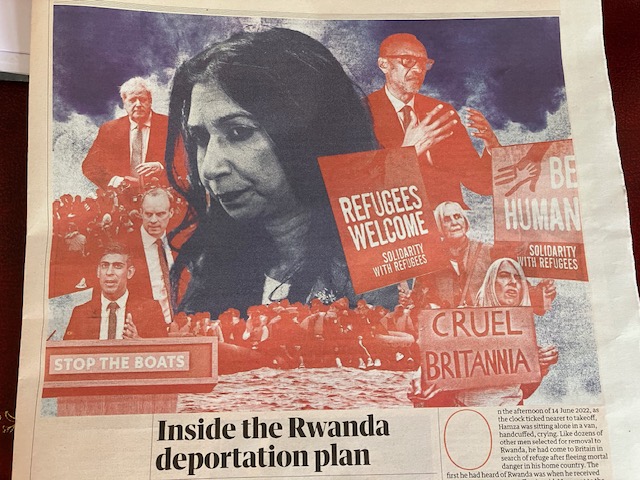
Daniel Trilling in his ‘long read’ in today’s Guardian newspaper (5 October) Inside the Rwanda deportation plan: there were so many warnings it would fail. How did it get this far? traces the whole story of where the idea came from and how it got stuck after the European Court ended it at least temporarily. The proposal was meant to act as a deterrent to further Channel crossings. This was never likely to have been the case since people willing to risk their lives in a rubber dingy having paid considerable sums to a smuggler are sufficiently desperate not to heed any such threat even if they were aware of it.
He reveals that the Foreign Office said ‘no’ to Rwanda largely because of the sort of reasons listed above. They were aware of the UN putting pressure on Rwanda to stop its troops engaging in mass killings and rape in DRC. Officials from the Foreign Office were preparing Country Policy and Information Notes CPIN, which were unfinished at the time the decision was taken.
The government was embarrassed when an undercover report secretly filmed Johnson Busingye, the high commissioner for Rwanda saying disobliging things about the UK government such as it was “immoral for the British to claim to be a compassionate country”. Asked about the shooting of twelve refugees he replied “so what”.
The Supreme Court is due to rule at the end of the year and it is likely that the prime minister Rishi Sunack will ignore the European Court if it rules in the government’s favour.
It is hard to fathom the reasoning behind the government’s position on this policy. It was designed to be a deterrent but it was advised by its own officials that this was unlikely to be effective. The numbers of immigrants who would be sent is a matter of a few thousand which, in the face of the many thousands crossing the Channel and the tens of thousands languishing in immigration centres and hotels, will be a tiny proportion. They must have been aware of the copious evidence that the country was entirely unsuitable as a place to send vulnerable people. They must also have known that Israel abandoned the very same policy and the Danish government had put its policy on hold.
At the Conservative conference this week, the prime minister cancelled the next leg of the HS2 rail project claiming that ‘the facts had changed’ and this prompted a change in policy. Yet in the case of Rwanda, the facts haven’t exactly changed but have been visible all the while. It is though the policy – described as ‘shameful’ by Amnesty International’ chief executive – has become totemic existing in a space beyond reason and facts, a kind of belief system which defies rational thinking. Partly it is because the prime minister has made stopping the boats a key policy aim and Rwanda is central to that, a policy which cannot be cancelled for fear of looking weak. If flights take place at the end of the year it will cause considerable suffering to those sent there.


 Amnesty in Salisbury & South Wiltshire