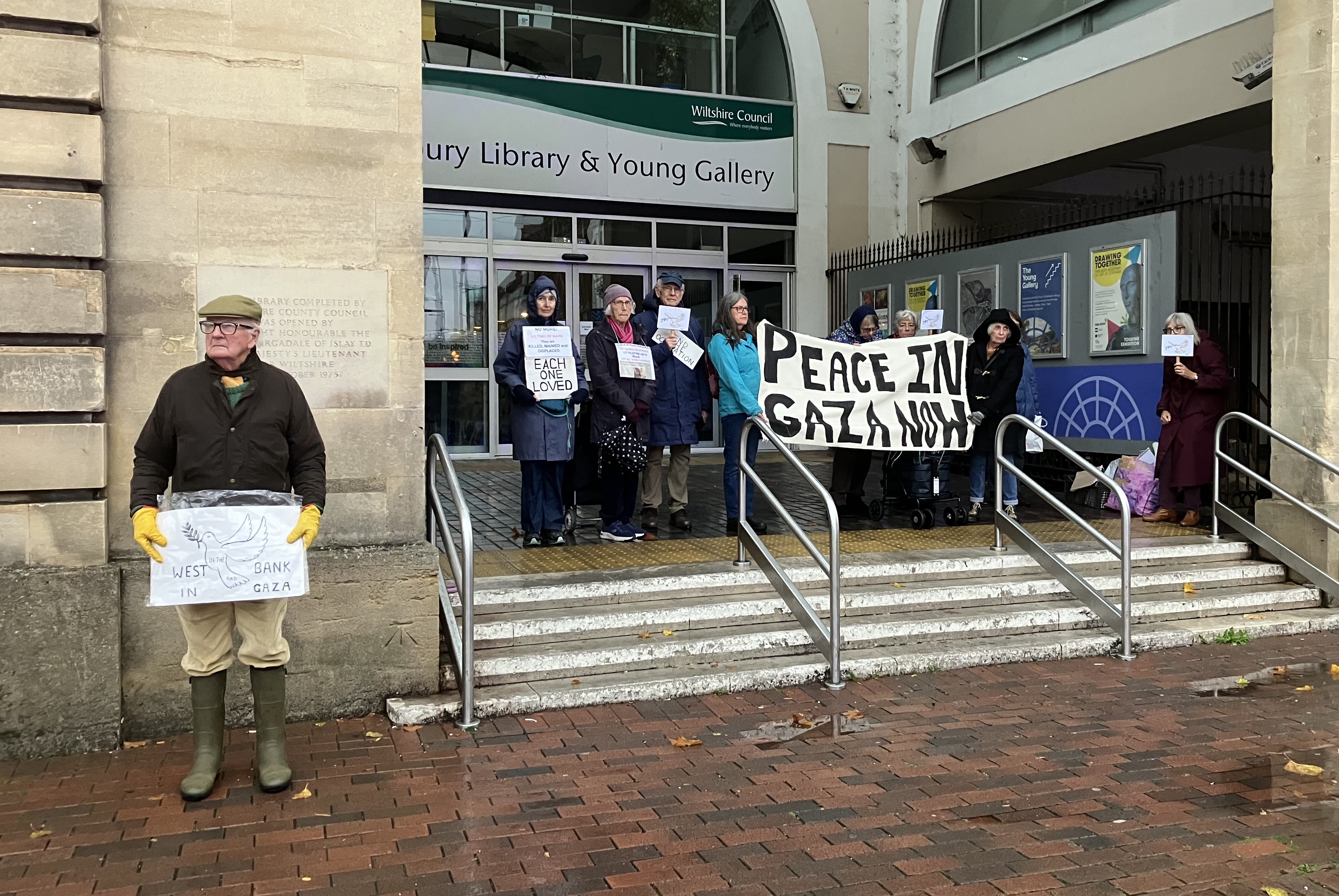
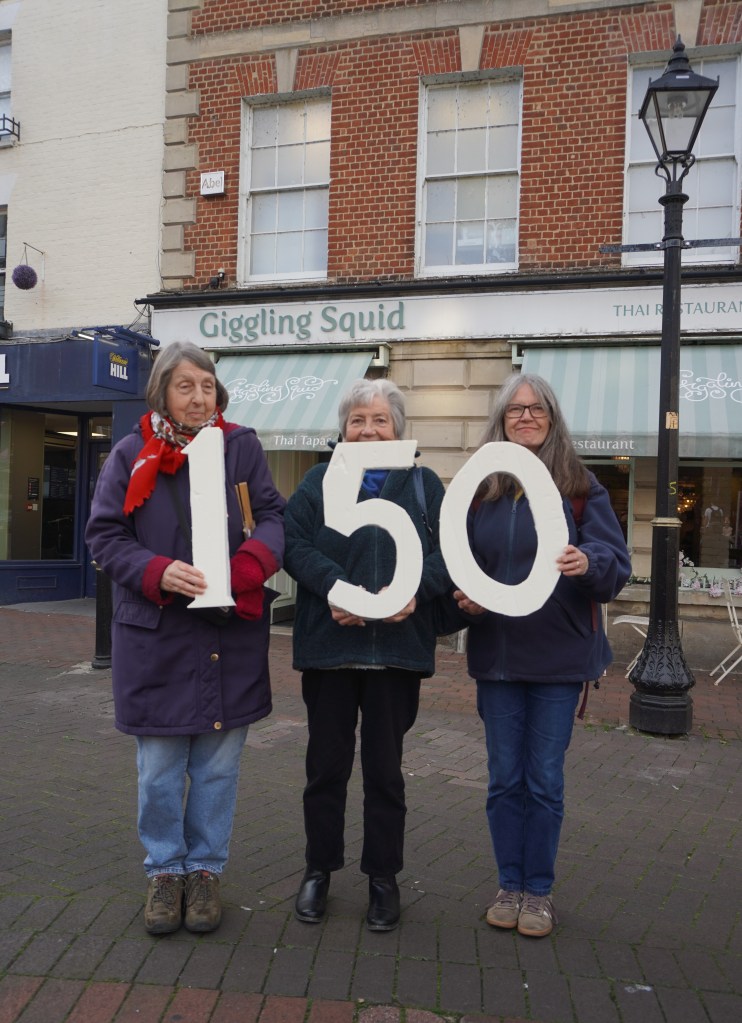
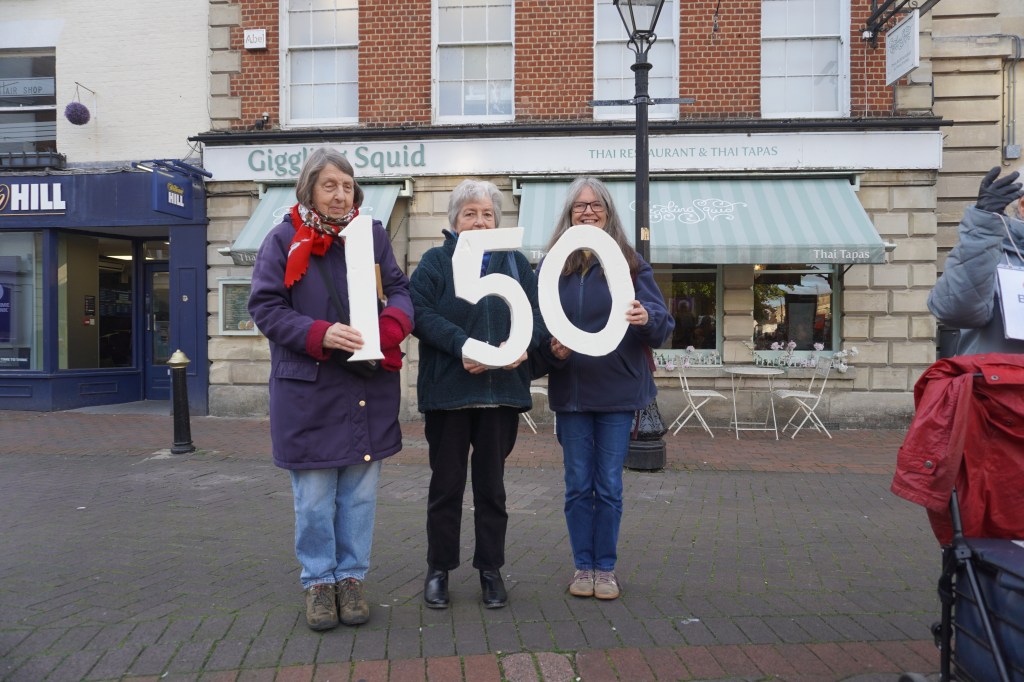
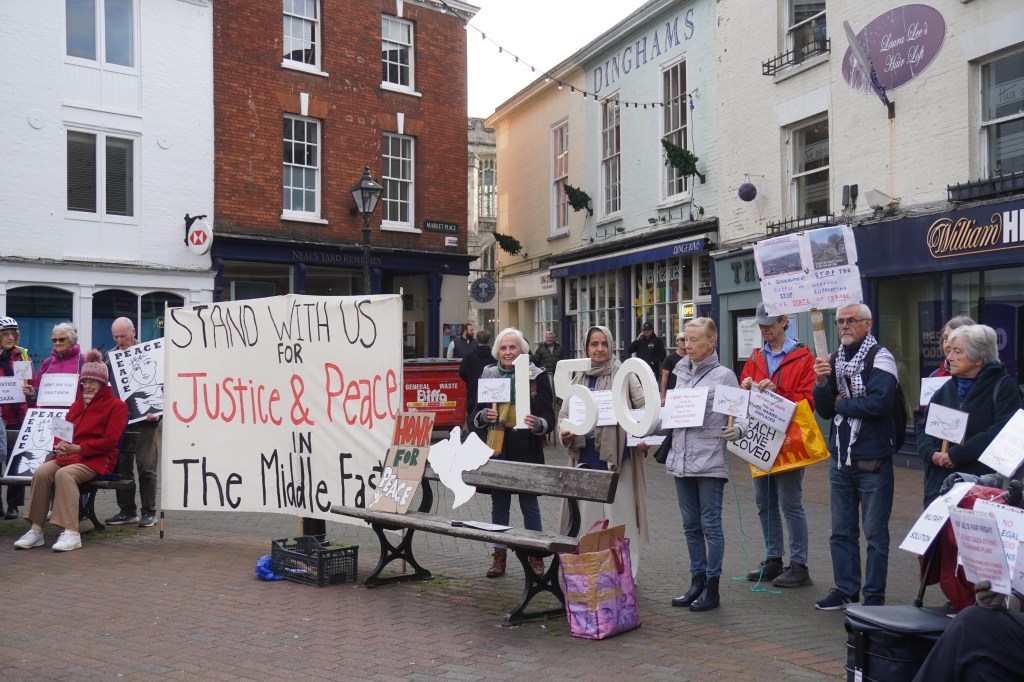
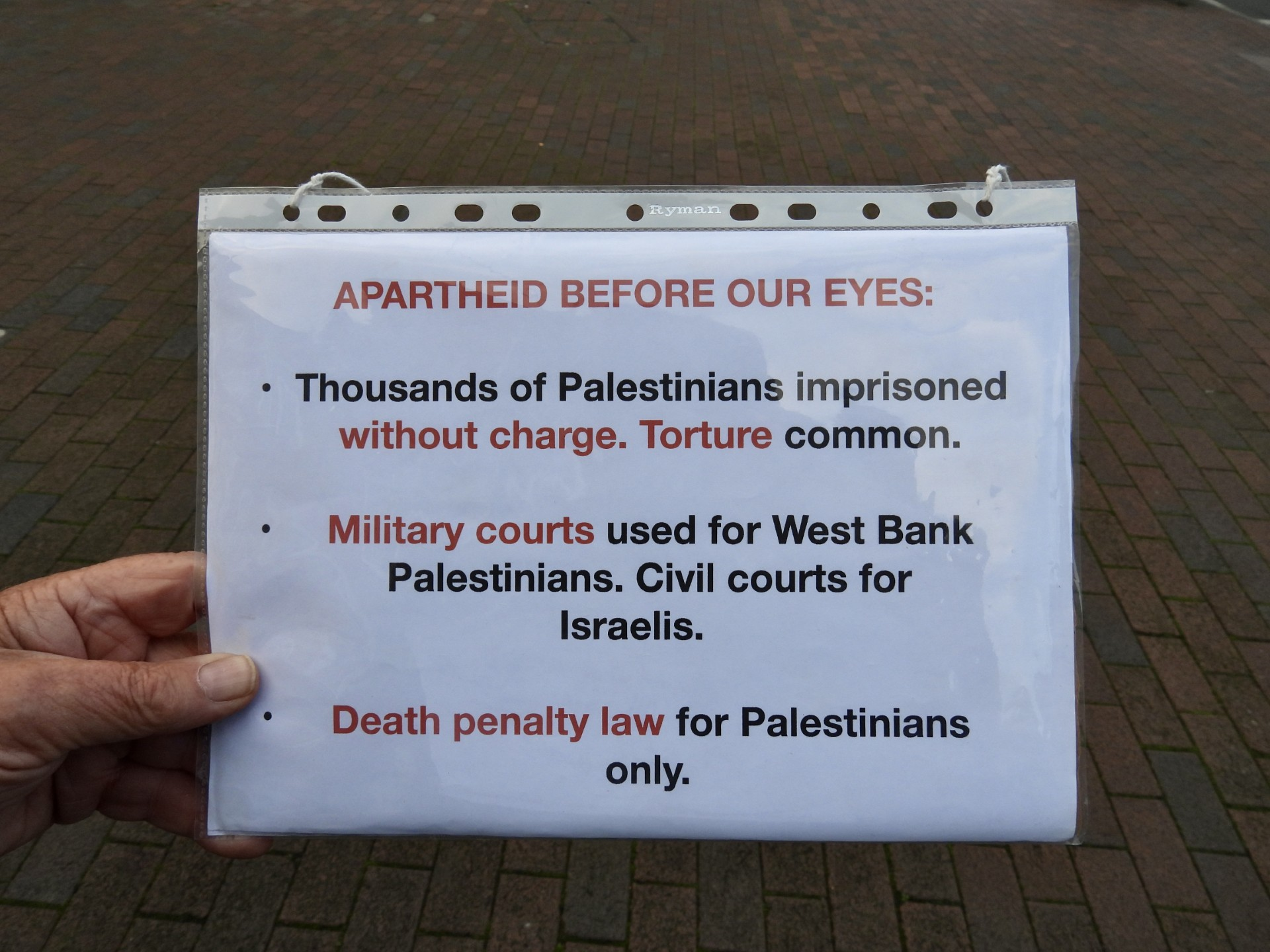
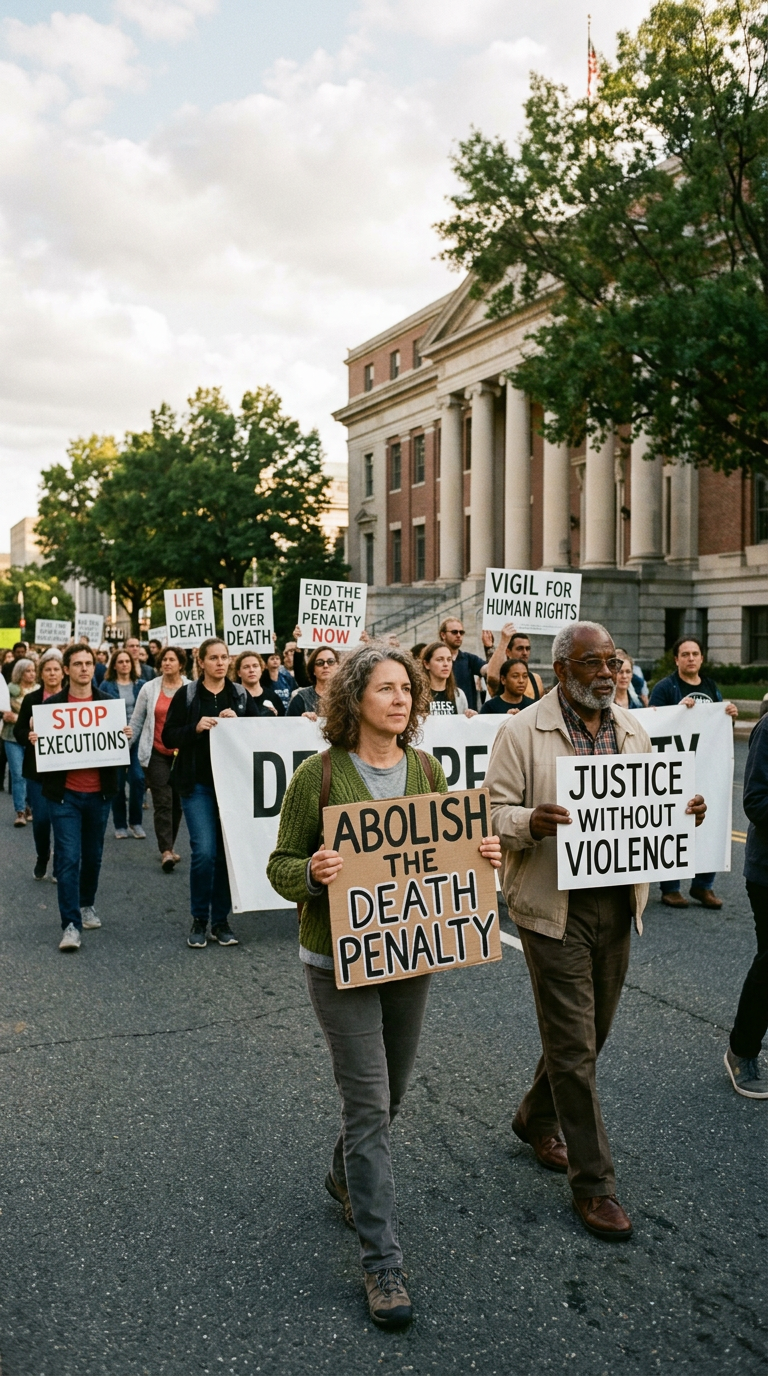
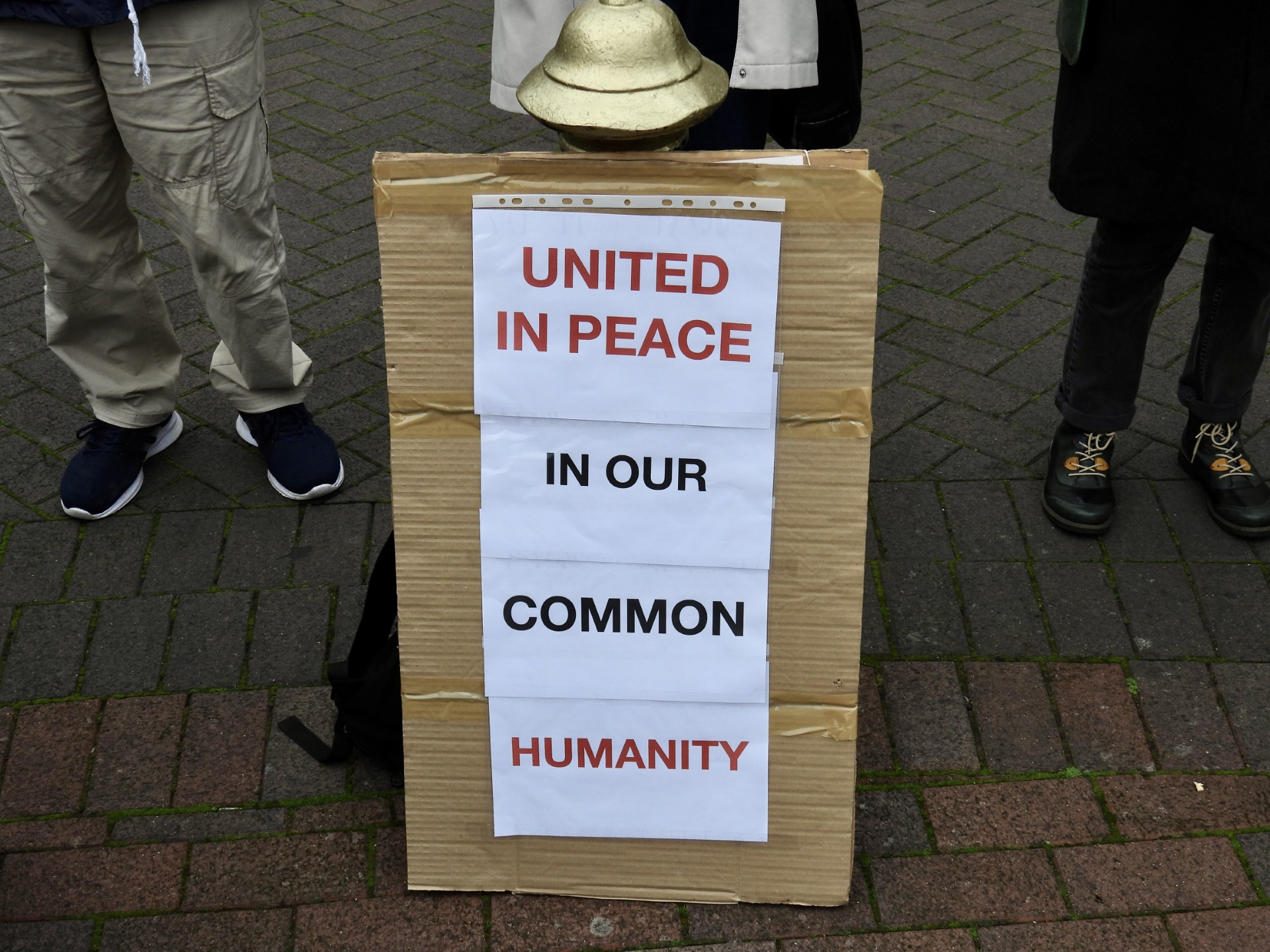
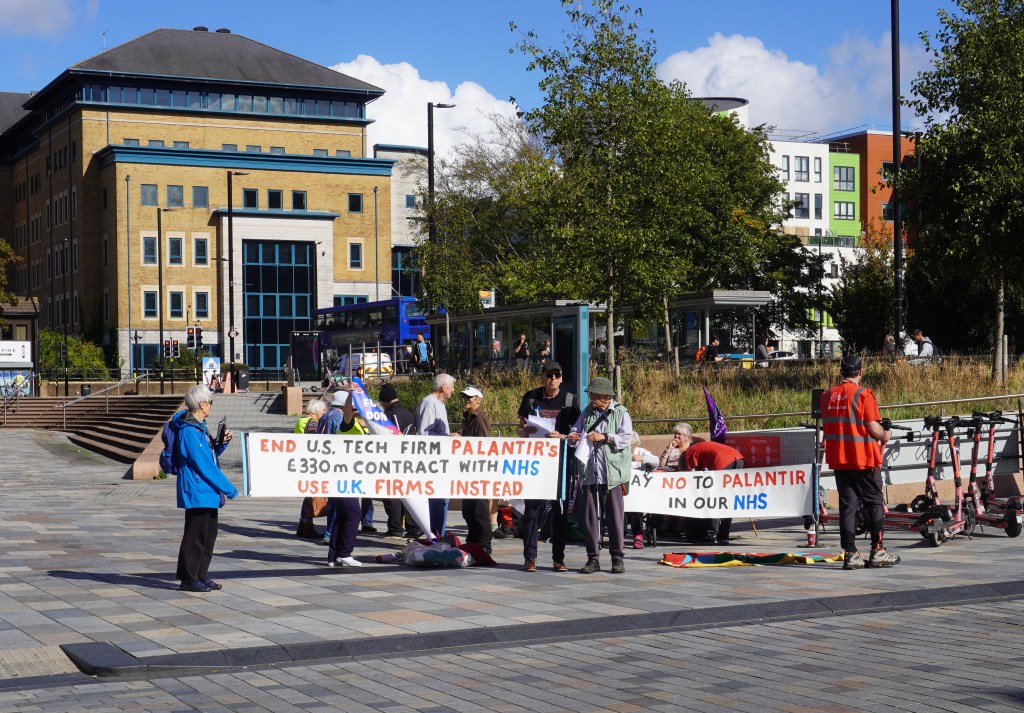
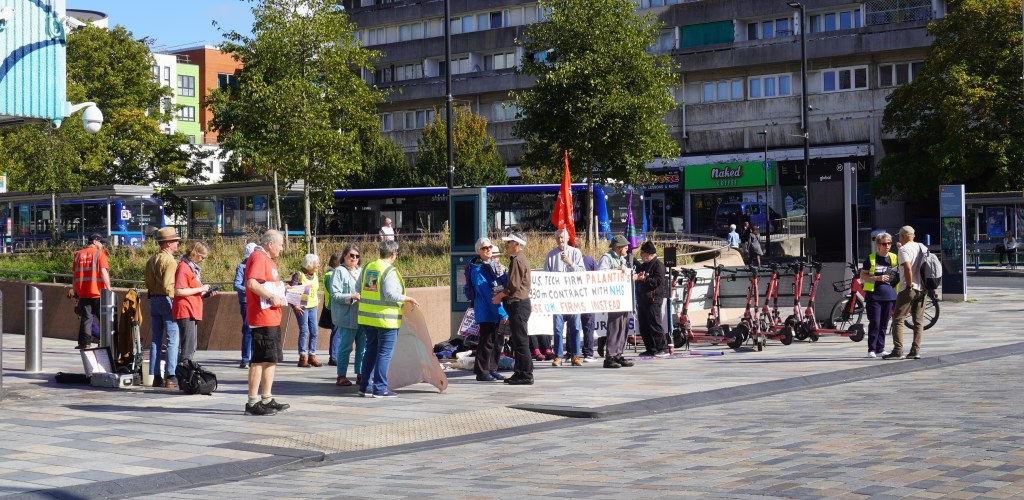
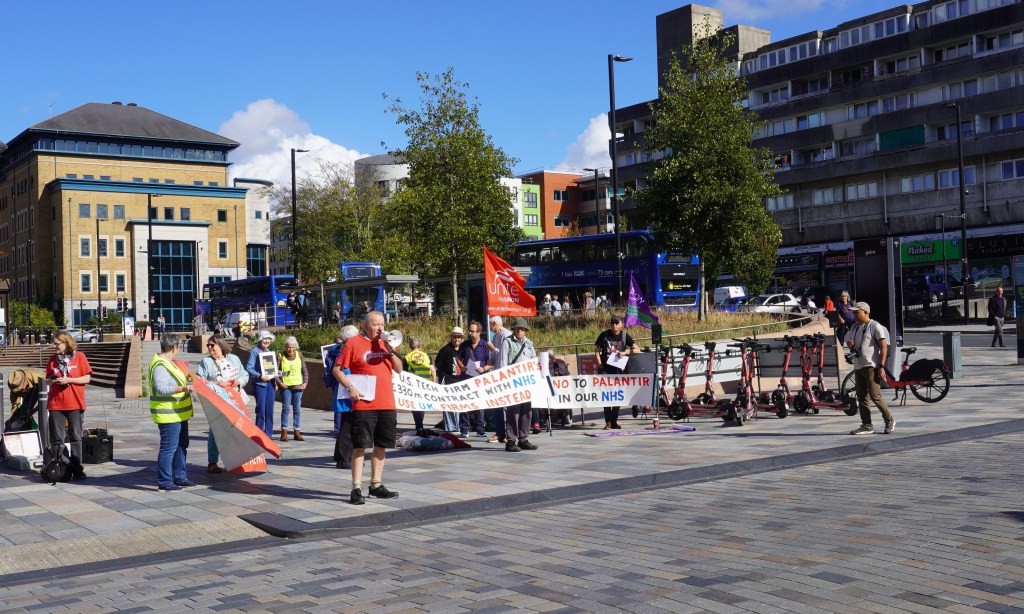
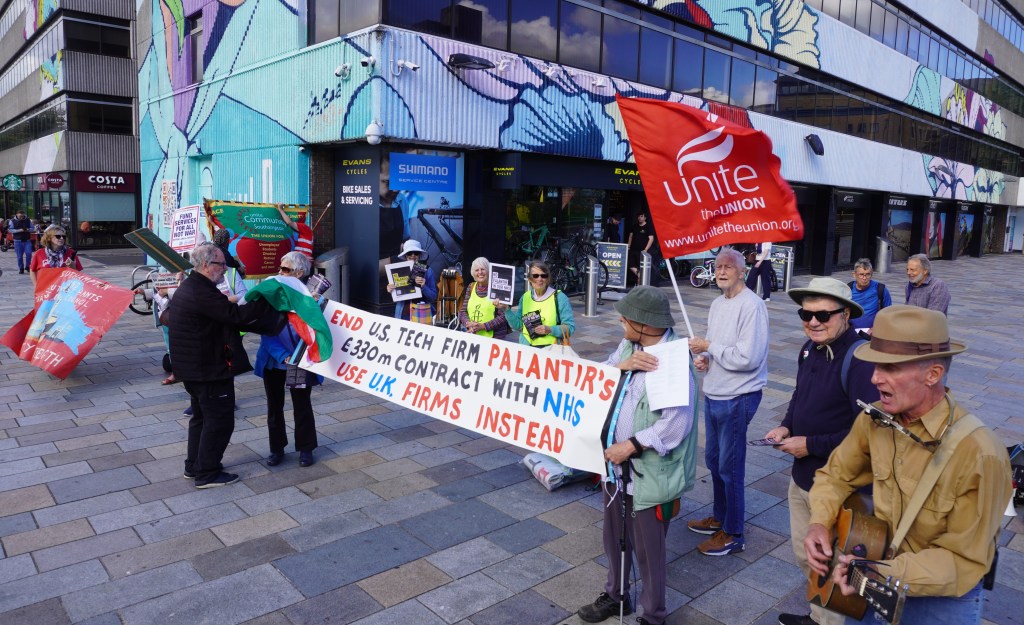
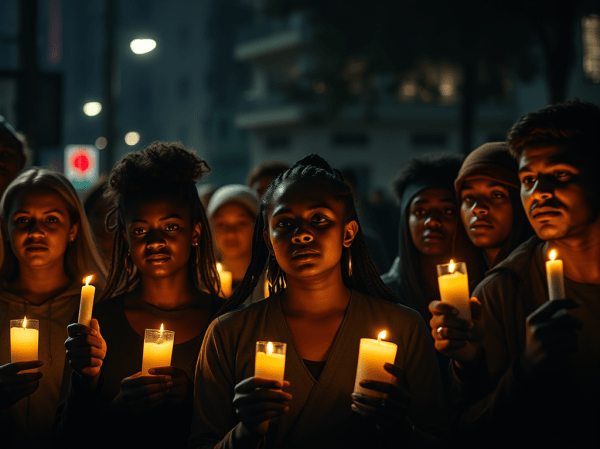
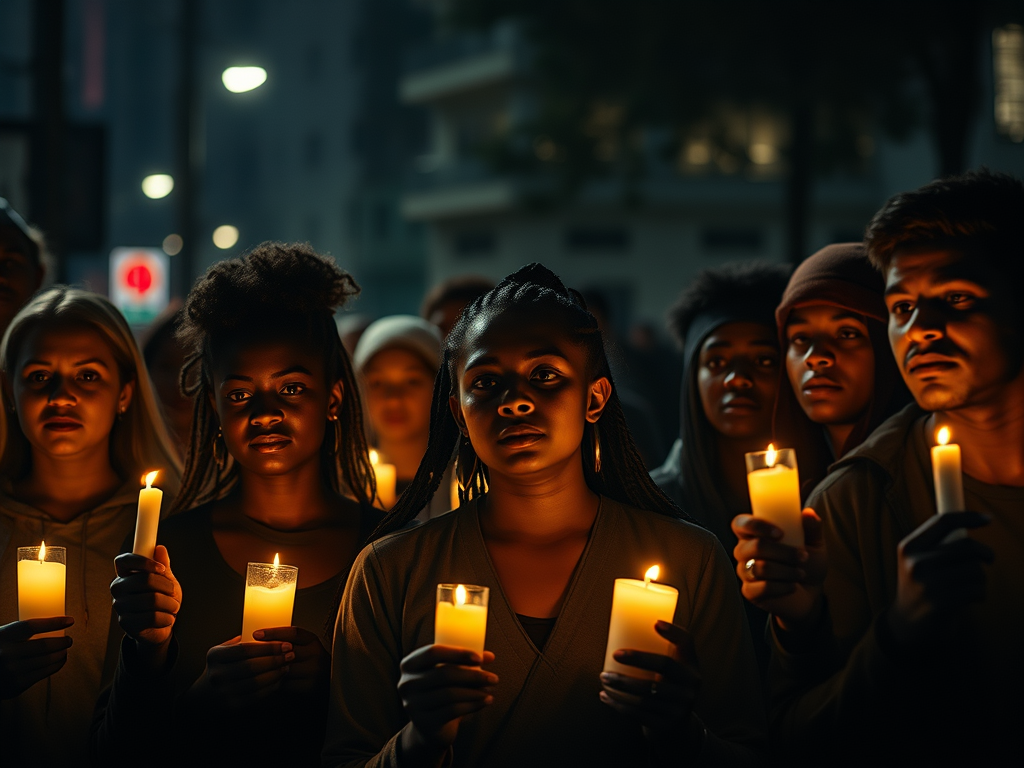
After the strong turnout for vigil 150, the storm meant few braved last evening’s vigil as we sheltered on the steps of the Library. We are pleased to note that the previous week’s vigil attracted some coverage in the Salisbury Journal both on line and in the print version.
On Friday 23rd, Channel 4 News had an extended package on the violence in the West Bank which has been growing in intensity and frequency [registration may be required]. It showed dead goats killed by settler gangs and the camera crew and reporter were themselves attacked. It is the time of the olive harvest and settlers are attacking pickers and the trees themselves. IDF soldiers do little to prevent these attacks. There is footage of Palestinian houses being demolished. Data for the number of attacks is provided by the Israeli human rights organisation Yesh Din which gives copious information about how little is done to bring perpetrators to justice.
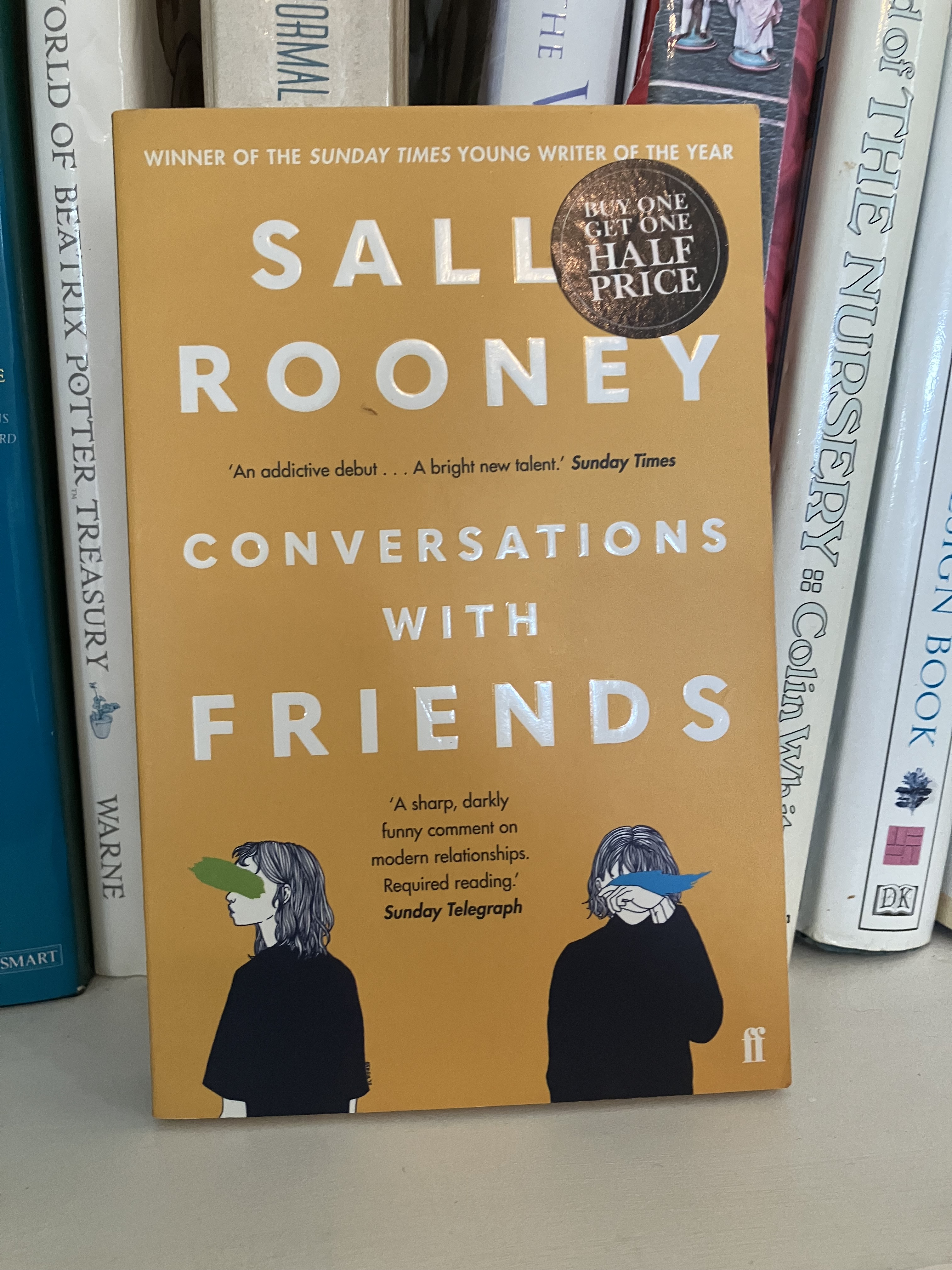
The UK’s support for violence in the Middle East with the supply of weapons is well-aired on these pages. They are also keen to stifle support for Palestine Action and over 3,000 have now been arrested for so doing. The author Sally Rooney has been caught up in the dispute and her books can no longer be sold in the UK as this risks arrest. Palestine Action say:
“The ban on Palestine Action was only introduced to serve the interests of the Israel lobby and the Israeli arms industry at the expense of the fundamental freedoms of British citizens.
“Andy Burnham’s Government has the power to overturn this authoritarian ban, but they are choosing instead to defend it in the Supreme Court” [accessed 25 October].
Sarah Helm
A writer and journalist Sarah Helm has also been caught up in what is almost an hysterical response by a range of right wing and Israeli supporting news organisations. Sarah is the wife of Jonathan Powell who is the government’s national security adviser. She responded on X to a clip of broadcaster Adam Boulton criticising fellow writer Sally Rooney over her support for the pro-Palestinian movement. She wrote “God help us authors who support Palestine and Palestine Action. Sounds like Adam [Boulton] would have all our books swept off the shelves in a jiffy.”
The post has drawn attention because Palestine Action was proscribed as a terrorist organisation in the UK in July 2025, making membership and certain forms of support for the group criminal offences under the Terrorism Act 2000. The effect of this decision is increasingly being seen as an attack on free speech. An appeal will be heard in the Supreme Court soon.
The police have decided to take no action as her words do not pass the required threshold. The Campaign Against Antisemitism has been especially vocal against Ms Helm. The organisation was founded by Gideon Falter.
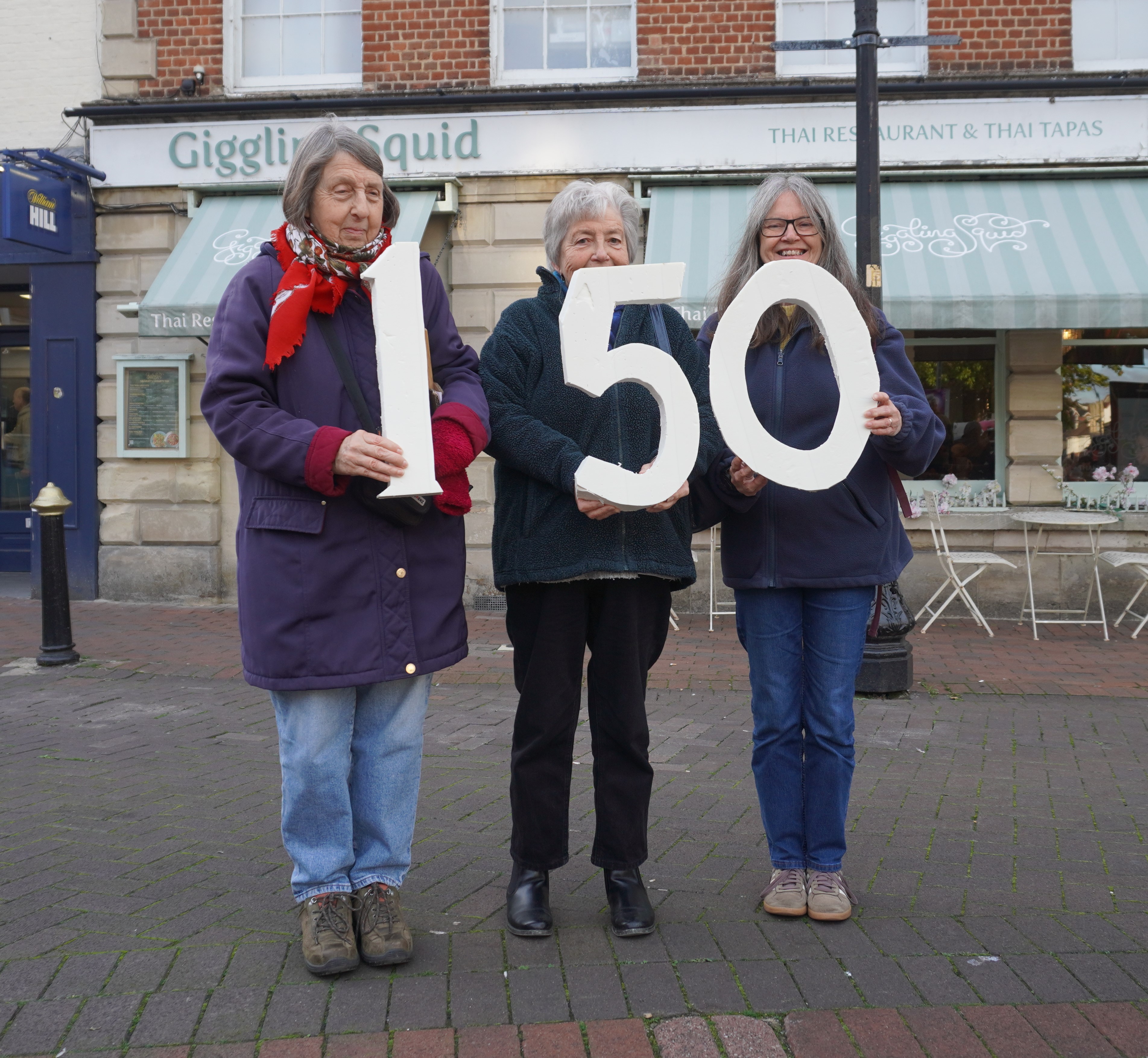
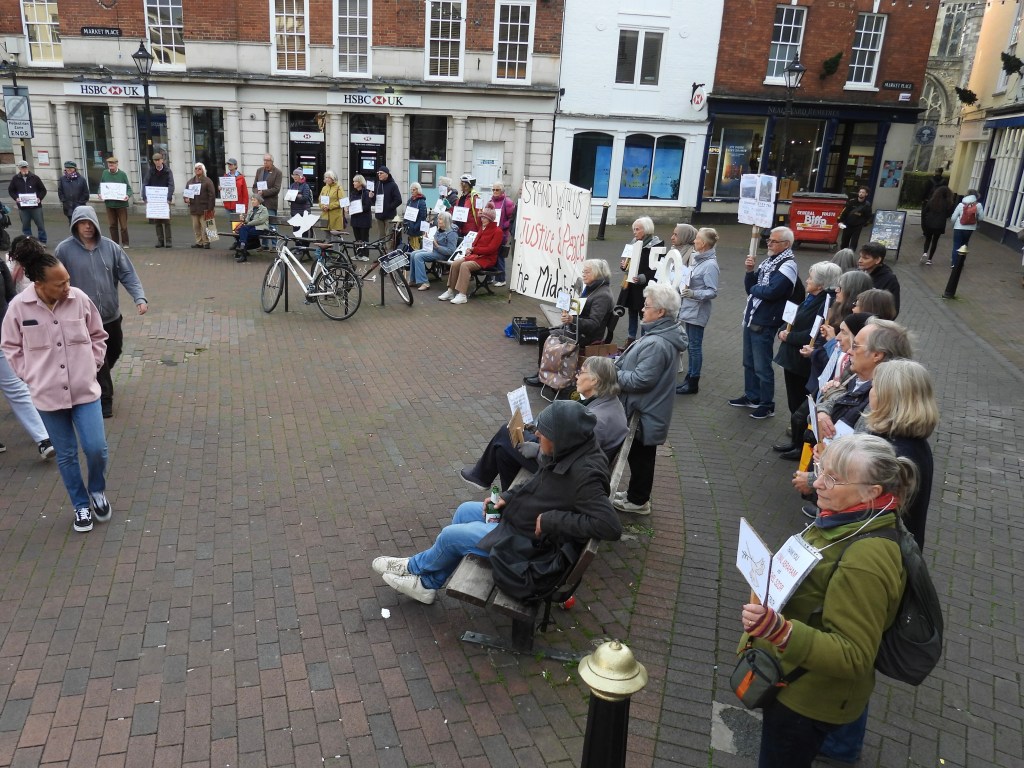
It almost doesn’t seem possible that a group of people in Salisbury have turned out each Saturday for 150 weeks to stand, sometimes in the cold and rain, to support the principle of peace and justice in the Middle East. Yesterday (17th) there were 40 of us and it should be emphasised that although there are stalwart members who come more of less every week, there are others who come a few times and there are passers-by who join in a well. Not seen at any of the 150 vigils over three years is the local MP Mr John Glen. He is a supporter of Conservative Friends of Israel.
Israel continues to dominate the news last week. First the film NAZA which has achieved considerable international recognition and success being viewed by millions around the world. It has generated a fierce response from Israel and the IDF who accuse the soldiers who were interviewed as ‘smearing’ Israel and ‘causing harm to Israel’s diplomatic and security interests’. They both deny its integrity yet say it is a threat.
Sally Rooney the Irish novelist, has had to remove all her books from sale in the UK because she risks falling foul of the terrorist laws because of her support for Palestine Action. Any royalties from those sales risk being classed as ‘proceeds of terrorism’ and she risks a prison sentence. This is a direct attack on free speech and comment. Curiously, various organisations which promote violent action are not proscribed by the government such is their obsession with supporting Israel and the arms deals. Iran’s Revolutionary Guard, thought to be behind some recent incidents such as Fairford for example, is not proscribed.
The third event of last week was the attack by settlers on a group of diplomats from France, Belgium and Poland visiting the West Bank. They had also attacked Palestinians trying to harvest their olives beating one man badly. They also attacked a Washington Post photographer Heidi Levine.
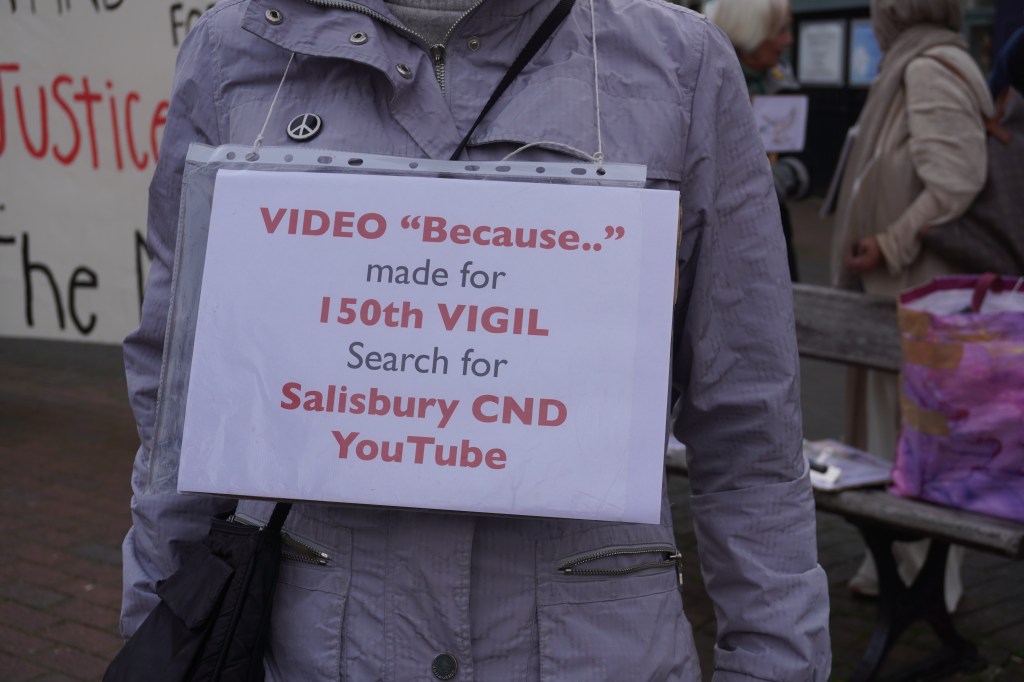
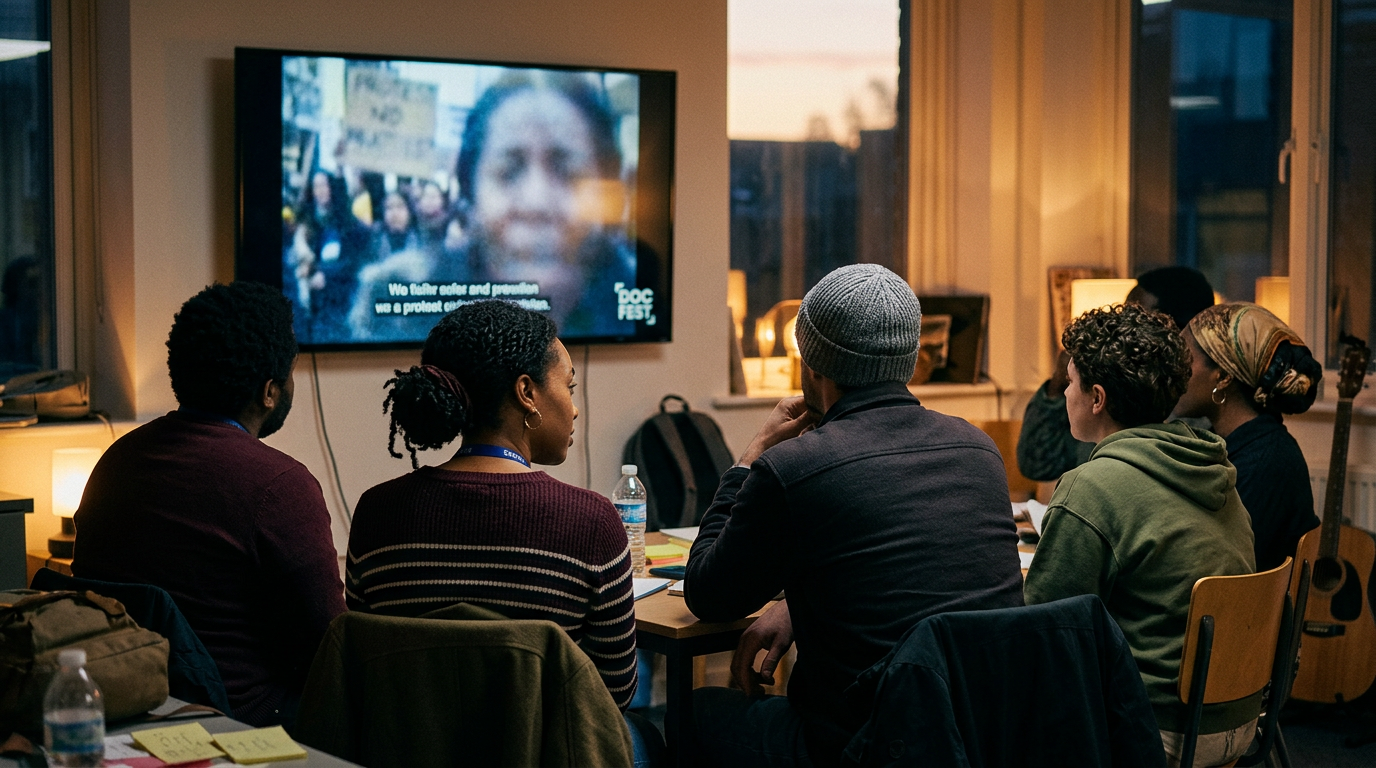
Our film Because … was published last week and we are pleased to report a good level of interest so far.
Main photo: Salisbury Amnesty, other photos courtesy of Peter Gloyns
The film NAZA was shown in cinemas around the country yesterday and following the showing there was an interview with the makers and others involved. NAZA is the word used by the IDF to assess collateral deaths in pursuit of one Hamas operative. It is short for Nezek agavi in Hebrew meaning collateral damage. The film – a documentary – is unusual in many respects. It is shot almost completely at night in Tel Aviv on the roof of an apartment block. There are 24 interviews with IDF personnel of various ranks whose identities are concealed. There were no interviews with journalists or politicians, simply the IDF people. The interviews were not interspersed with Gaza footage which came at the end showing the distress of one man in particular whose wife and children were buried after a strike. They were interspersed with views of Israelis living ordinary lives in the flats opposite, a kind of counterpoint to the narratives we were listening to.
The interviewees explained the reasoning behind the word and what it means in practice. The Israelis have almost complete control of the mobile phone network and are able to track and listen in to conversations of Hamas people and others in the strip. Having identified a target the question then is how to kill them, where they are now or wait until they are home. At home, the problem then becomes the level of collateral deaths of family members, including children, and everyone else living in the block. Estimates are made and the NAZA might in fact be around 200 or more. The block is then bombed killing everyone living in it.
It is clear that the level of civilian, non combatant deaths is known before a strike. We are not therefore talking about a one-off incidence of accidental mishap which will happen in any war, but a deliberate policy where the likely level of killing is known beforehand.
Various bodies, including the UN, Amnesty International, B’Tselem and Physicians for Human Rights – the latter two of which are Israeli based – have said Israel is committing genocide against Palestinians in Gaza. The film won the Special Jury Prize at the Venice Film Festival and there was a 25 minute standing ovation. It was produced by the Guardian.
‘Human shield’ and other claims
It is also clear that frequent claims by Netanyahu and others that every effort is made to limit civilian casualties is utterly untrue. Further, the claims that Hamas ‘use human shields’ is untrue. We saw clips of both statements being made by Netanyahu. These claims are clearly and unequivocally refuted by the testimonies made in the documentary. They have however been endlessly repeated in British media outlets such that it has left a lasting impression of heartless and ruthless Hamas terrorists lining up Palestinians for slaughter. The death toll of 73,000 is therefore the fault of Hamas.
NAZA became a kind of euphemism: they [IDF soldiers] would say ‘NAZA 200’ as a means of saying two hundred would be killed to kill one Hamas person. A chilling detail was the ability of the Israelis to listen to mobile phone conversations and if they picked up a child saying ‘Daddy’s home’ (or similar) it would be a trigger for a strike.
The soldiers
The soldiers had obviously become troubled by the wanton killing and being participants in what were clearly war crimes. They joined up after the terrible events of October 7th but became disillusioned. This led to them taking the risk of speaking to the film makers. They were troubled at the scale of killing and how depersonalised and dehumanising it was. Buttons were pressed and an entire block of flats, full of people, would be flattened by a massive bomb.
Considerable efforts were made to check the narratives and the soldier’s accounts. Around another hundred sources were spoken to in an effort to check facts.
Israeli response
The response has been fierce and according to one of the producers Jonathan Glazer, ‘more venal than expected’. IDF has produced a ten page rebuttal basically denying every aspect of the film.
They have also produced their own film which mimics the actual one [we were unable to locate this on YouTube. We may add it in a later amendment]. They have called for the two film makers to have their Israeli citizenship annulled. Their parents have faced death threats in Israel.
While claiming the film is, to quote the Times of Israel ‘Distorted, misleading and disingenuous‘, the government has accused them of exposing state secrets. They report a major effort is underway to locate the speakers.
Comments
This is a powerful documentary exposing the mechanism of Israel’s military activities in Gaza. There is no doubt that war crimes have been committed on a massive scale. No attempt was made by the documentary makers to draw wider conclusions beyond the testimony of the 24 interviewees, which gives it its power.
The film is, and will be, shown around the world and this will be of concern to the Israeli government. The usual and knee-jerk attack line of anti-Semitism and anti-Israel is harder to demonstrate when everyone interviewed and the film makers themselves are all Jewish.
It throws a spotlight on the support offered by the US and the UK governments to Israel. Both have been willing participants in their support – overt and covert – to them in effect becoming participants in a killing machine. We continue to supply arms and to allow the Israeli defence firm Elbit Systems to operate in the UK. It also throws a spotlight on the 150 or so members of parliament who are members of one of the Friends of Israel groups the most heavily funded lobby group in Westminster. Are they happy with their continuing support? The Salisbury MP Mr John Glen is a ‘proud member’ of the Conservative version of this organisation. All are shamed.
It is to be hoped it will have a lasting impact certainly in the West.
The 149th vigil held on Saturday. Big row about the Green party motion on Zionism
October 2026
A tense week on the Israel front with a major row erupting at the Green party conference arising from a motion to defining Zionism as “a political ideology which called for the creation – and, now it exists, the continuity – of an ethnonationalist Jewish State in historic Palestine to the exclusion and/or domination of the non-Jewish population.” It has put the party leader Zac Polanski in a difficult position partly because he was absent for the vote itself.
The death toll continues in Gaza with 74,243 deaths and 1,460 killed since the ‘cease fire’. There are 175,243 wounded many of whom are children who have suffered severe physical injuries and who have lost family members. Some have experienced mental trauma which will last a lifetime. It is ironic listening to the earnest debates and interviews about the Green party motion, to note that there is no equivalent earnest debate about this death toll. It has just become so much background noise.
We held our 149th vigil on Saturday with around 25 present. Next Saturday 17th, will be the 150th such vigil. We had no notion they would continue this long. The local MP, Mr John Glen has never appeared at a single vigil nor mentioned their existence in his weekly column courtesy of the Salisbury Journal. He is a member of the Conservative Friends of Israel lobbying organisation.
The film NAZA is being shown in the Odeon in Salisbury on Thursday 15th. This is the award winning film made secretly in Israel at night. The resulting documentary, “NAZA,” takes a look at the technology used by Israel in Gaza to identify military targets. Anonymous sources in the film said the technology also has been used to kill Palestinian civilians. A trailer can be seen here.
We are pleased to attach the minutes of the last meeting thanks to group member Lesley for preparing them and thanks to group members for their contributions. Rather longer than ordinary minutes, they contain reports on the death penalty, the situation with refugees and immigrants, statistics and a report on the state of rights in the UK a sad addition to what we report on.
Because … is now published. Next week will be the 150th vigil
October 2026
We are pleased to announce the publication of our video Because ... in which some participants of the vigils we have held every Saturday since the horrific events of October 7th and the aftermath, give their reasons for attending. This coming Saturday 17th, will be our 150th such vigil. We hope you will watch it and perhaps share it.
Three years since the October 7th massacre. What have we learned?
The first casualty of war is truth is a well worn saying and in the case of the war in Gaza it can be modified to say truth has been a continuing casualty. In this post we want to discuss the things we have learned about this conflict which has inflicted such terrible harm.
The recent history stems from the dreadful massacre which occurred on October 7th three years ago. 1,200 were murdered by Hamas attackers and 251 were taken hostage. It sent shock waves around Israel and around the world. It kicked off a series of violent events including the deaths of over 74,000 Palestinians in Gaza.
But what has been learned or achieved from this violence?
1 The first truth is that it has not brought Israel the peace and tranquillity it has for so long sought. The Zionist quest for a homeland has left them surrounded by neighbours who are at least wary of the state or are solid in their hostility. It has chosen the path of becoming a military superpower as far as the region is concerned. Its answer to so many questions and issues is violence. Violence in the West Bank is increasing and is largely unchecked.
That they are able to pursue this path of violence has largely been down to the support, military and diplomatic, which has been given to it by Western powers in particular the US. The UK has supported them but at a lower level. Despite the wholly disproportionate violence meted out on the population of Gaza, this support has continued. It seems impervious to public protest and disquiet.
2 Which leads directly to the second point which is the distorted way news of the conflict has been treated by the British media. The BBC has come in for serious criticism from the Centre for Media Monitoring and also the journalist Peter Oborne who came to Salisbury to speak about his book Complicit. In their defence it can pointed out that independent journalists have been banned from Gaza and large numbers of journalists who are there have been murdered by IDF snipers. Despite that, the corporation has given unequal weight to its reporting. At the head of this piece we quote the number of hostages taken by Hamas. There were frequent bulletins by broadcasters about their plight, moves to secure their release, interviews with those who were released and with Israeli politicians expressing horror at their captivity.
There was almost no mention of Palestinian hostages by contrast. The BBC and other media referred to them as ‘prisoners’. There were no interviews, bulletins or commentary for them. The horrific treatment they endured in an underground prison where torture was routine, was hardly mentioned. It was almost as though there were two worlds: one where Israeli’s suffering as hostages and whose plight was regularly detailed and another where Palestinian hostages almost became invisible. Any mention of ‘genocide’ will result in an immediate rebuttal by presenters. What the purpose of RAF overflights was likewise almost never mentioned.
This, and other omissions means we cannot rely on balanced reporting from our domestic media particularly with a conflict so politically weighted as this.
3 The shortcomings of our media are exceeded by the shortcomings of the political system. Many have noted the extensive membership of the various Friends of Israel groups in Parliament with around 150 MPs signed up. It really does raise a serious question about impartiality. Harking back to the previous point, it almost always the case that political interviewees are never asked about their membership. It has proved remarkedly easy for the Israeli government to suborn our politicians.
More serious is the continuing sales of arms to Israel only belatedly and partially curtailed by David Lammy MP. (there are doubts even about that. Israel import records showed no change). Along with sales to other despotic or authoritarian regimes, it seems as though arms sales take precedence over any consideration of the death and destruction they cause. Government claims that export controls are ‘robust’ are close to insulting the intelligence of the public.
Lesson: the political class is compromised and is not acting in the best interest of the country.
4 Knowledge of the origins of the conflict are not widely known or understood. There are many who believe October 7th was the start. Many believe the firing of rockets by Hamas is a cause. Few are aware of the 1948/49 Nakba (catastrophe) in which around 700,000 or more Arabs and Palestinians died. Few are aware of the Apartheid system in Israel (denied by them). Few are aware of the Balfour agreement and how that came about. Not understanding the history and the role of the West, and in particular Britain, in creating the situation leading to the current state means we are doomed to carry perpetuating it.
The lesson here, often the fact in all wars and conflicts, is that history is important. Failing to understand the background and why we are where we are, means many are ill-informed. When they are politicians or political commentators, the results can be significant.
Overall conclusions
What are the overall conclusions? A powerful combination of a lack of historical perspective, combined with a desire to sell arms to almost all-comers, a parliament too easily suborned by a powerful and well-funded lobbying operation, and a media too frightened by the relentless claims of anti-Semitism or being anti-Israel, have led to a misinformed public and an epic disaster for the people of Gaza. 74,000 dead. More thousands lie buried in the rubble. Tens of thousands traumatise physically or mentally by the violence. This combination of cowardice and misinformation has played a key part in this disaster. It will come to haunt Israel in years to come.
There are signs of change. Ed Miliband’s statement a few weeks ago is welcome. The threatened closure of the Jerusalem consulate now to be a ‘mission’ demonstrates that criticism of violence in the West Bank is striking home. The mass walkout of the UN when Netanyahu rose to speak is a sign of Israel’s increasing pariah status. However, this change may well have come more quickly had the failings described here not taken place.
If politicians had resigned their membership of Friends of Israel, if the media including the BBC had treated both sides equally, had reported on things like apartheid, if both had not allowed themselves to bullied by claims of ‘anti-Semitism’ etc., and if there was greater recognition of an historical perspective, public attitudes might have been different.
It has been a tragedy made worse by our behaviour.
Another and depressing conclusion is the lack – in that favourite phrase deployed after a disaster or scandal – of ‘lessons learned’. There do not seem to have been any nor any move for an enquiry. We should be thankful at least for an absence of humbug.
Perhaps the biggest lesson is that any idea of a ‘new world order’ is dead. Or rather an order based on rights and the rule of law. It has been replaced by an order where might is right and notions of rights are a fond memory.
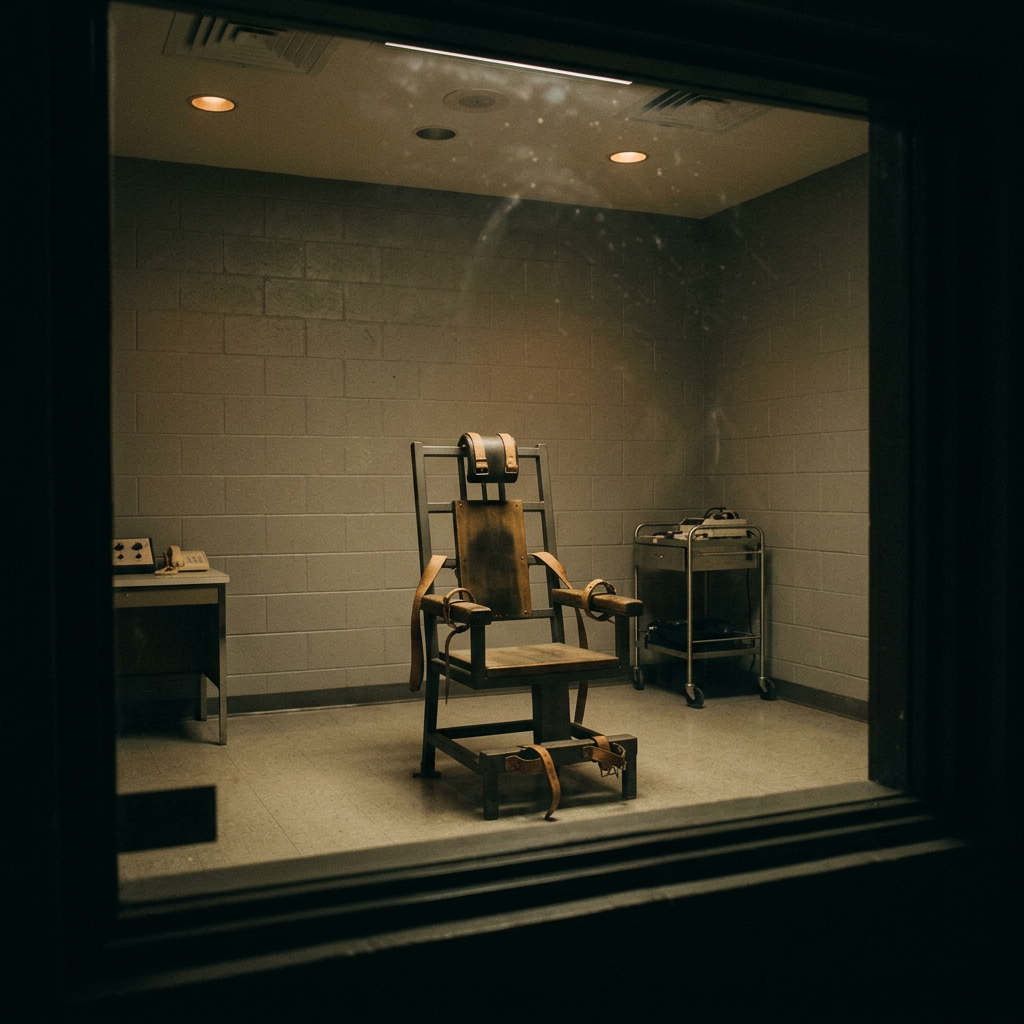
This is written in the UK where the death penalty is no longer practised. It might therefore be wondered why we should continue to campaign for its abolition elsewhere in the world. It is partly because we believe the penalty to be a barbaric one and that applies across the world. We campaign for justice and human rights everywhere not just in our own backyard. We believe the penalty should be abolished in all circumstances and for all crimes.
There are currently 25,508 people on death rows somewhere in the world according to the World Coalition Against the Death Penalty. 2,707 are known to be executed the highest number since 1981. Large numbers are executed in China but the numbers are a state secret. Thousands are executed in a ‘conveyor belt’ of killing there with mobile vans travelling the country to speed up the process. There is a bewildering number of crimes – over 40 – which attract the death sentence.
The top countries carrying out the executions are China, Iran, Saudi Arabia, Yemen and the US. That a notionally civilized country should be in such company is telling.
Christa Pike
The death penalty has made it onto the news in the past few days with the failed execution of Christa Pike in Tennessee. She was twice injected with lethal drugs but survived and has now partially recovered. There has been shock expressed around the world. Members of the Salisbury Group have written to the Governor to ask that her sentence be commuted.
Part of the problem is the difficulty in obtaining reliable drugs since firms and countries are unwilling to supply them. To overcome that problem, the firing squad is being introduced. Which leads to the truly bizarre, shameful and shocking proposal by Pete Hegseth to allow the live streaming of an execution. This is of Nidal Hasan who killed 13 in Texas. It is in a belief it will act as a deterrent.
Deterrence
The continued belief in the penalty is based on its supposed deterrent effect. However, a report released in April by the National Research Council of the National Academies based on a review of more than three decades of research, concluded that studies claiming a deterrent effect on murder rates by a use of the death penalty are fundamentally flawed. The report concluded: “The committee concludes that research to date on the effect of capital punishment on homicide is not informative about whether capital punishment decreases, increases, or has no effect on homicide rates”.
Many of the countries are using it not just to put series criminals to death, but as a form of coercion and intimidation.
Some reasons why it should be abolished
It is degrading and inhumane. What is often forgotten is the effects it has on others including prison staff who have to carry out the task
it is not a deterrent as we have argued
the justice system is imperfect and often flawed. The poor quality of legal representation for the poorest in society often means there is injustice. Mistakes cannot afterwards be put right
it is being used in some countries as a means of coercion and to intimidate those the state disapproves of
It disproportionately affects the poorest and marginalised in society.
Action you can take
Following the shockingly botched attempts to execute Christa Pike on 1st October, please write a letter dated 10th October to Bill Lee, Governor of Tennessee, calling for the commutation of Ms Pike’s death sentence as a first step, followed by the commutation of the sentences of all those on death row and the establishment of an indefinite moratorium on executions.
Contact details: Bill Lee
Governor of Tennessee
State Capitol
600 Dr Martin Luther King Jr Blvd
Nashville
TN 37243
USA.
Governor Lee’s email address is bill.lee@tn.gov but a letter would be preferable as he is more likely to see it.
You might want, as well as expressing your deep concern about what has happened, to recognise as positives the review he has ordered into the protocol and procedures, and the fact that he has paused executions at least until the end of the year – that of Gary Sutton will not now go ahead on 3rd December.
A scarcely believable wish by Pete Hegseth to live stream an execution by firing squad
UPDATE: the execution will no longer be live streamed President Trump announced on 15th. This has followed a sustained and worldwide condemnation of Pete Hegseth’s proposal. 16 October.
The Defense Secretary, Pete Hegseth, wants to live stream the execution by firing squad of Nidal Hasan who murdered 13 at a medical processing facility in Texas in November 2009. President Trump is reported to have agreed to it. America is already alone among civilised nations in continuing to use the penalty and providing a livestream of the event adds a level of barbarism to it. There is no other nation in the world which live streams such an event.
Public executions take place in Saudi Arabia and the state is seen to be medieval. That the Defense Secretary wishes America to join it seems scarcely believable.
The last public execution took place in the UK in 1868 in Newgate prison. The last in America was much later in 1936 in Kentucky that is only 90 years ago. France surprisingly, was later still and took place in 1939 but caused such outrage it was abolished.
Hegseth claims it is to explain to people there are serious consequences for crimes such as this. Many Americans will be revolted by this spectacle. For a supposedly civilised nation to countenance this is almost unbelievable.
The penalty itself is not a deterrent. There is no significant difference in murder rates between States who still use it and those who don’t. Mistakes cannot be rectified and there have been many acquittals of those convicted of serious crimes which turn out to be mistaken. Offering a livestream adds a layer of barbarity to the process.
Doubts were expressed today (9th) whether it will in fact go ahead.
CORRECTION: We believe Saudi Arabia no longer carries out executions in public. 11 October.
The Joint Committee on Human Rights has called for a new AI Bill to address the scale and seriousness of threats posed to human rights by artificial intelligence systems. Local MP, Sir Desmond Swayne is on the Committee. It points out that existing UK laws that could apply to AI do so primarily at the point of deployment, leaving the responsibility on its users rather than its designers. Regulators lack the power to test and evaluate AI systems before they are released, or to prevent their release if they are considered to pose unacceptable risks. Model developers engage with the AI Security Institute on a voluntary basis and it has no statutory power.
In a fast moving world with technology moving at breakneck speed, the current legal framework that applies to AI is fragmented and difficult to navigate. It relies on harm-specific and sector-specific legislation leaving gaps in protection which fails to address preventable human rights risks.
The right of an individual to seek effective remedy against decisions made against them is endangered by the use of AI. Insufficient transparency concerning how AI systems are used in decision making and a lack of effective mechanisms to challenge those decisions threatens the rights of people in the UK, particularly those of already minoritised communities, including Black and Minority Ethnic people. The right to privacy is also under serious threat.
To address the global nature of AI harms it argues governments need to collaborate to identify risks and promote consistent standards and that the UK should continue to play a leading role in international AI summits and seek to be party to international declarations and agreements on AI safety. (Source – Joint Committee [accessed 7 October])
Government approach to protest
Much concern has been expressed about successive government’s introducing legislation to try and limit protests. Climate campaigns and activities by Palestinian support organisations have come in for increasing controls and abundant arrests. Egged on by the right media with its talk of ‘zealots’ and ‘fanatics’, successive home secretaries have awarded the police more and more powers to clamp down on them. We have fundamental rights of assembly and of free speech which underpin protests.
Recent home secretaries have all been women who would not have been able to be MPs, let alone a home secretary, had it not been for the concerted and violent actions of the suffragettes. Many of the improvements to life we somewhat take for granted are the result of campaigns or protest movements.
The Parliamentary Joint Committee on Human Rights under Lord David Alton is launching an enquiry to look at the Government’s approach to protest: “We want to understand if the expansion of police powers relating to protest has been proportionate or if they will have a chilling effect on the right to protest. We will also examine if the new laws are effective in protecting wider society from the potential negative consequences of disruptive protest.”
Online privacy
The Investigatory Powers Tribunal is today considering how to take forward two legal challenges concerning the Government’s reported attempt to weaken end-to-end encryption for Apple users. One challenge has been brought by Apple. The other has been brought by Liberty, Privacy International and two individuals. End-to-end encryption is an essential security tool. It protects our bank details, health information, private conversations and photos, ensuring that only the sender and recipient can access the data being shared.
Surveillance
Between February and July this year, the British Transport Police ran a six-month live facial recognition trial across some of London’s busiest transport hubs – without making a single arrest.
The aim of the scheme was to catch offenders and people breaching court orders. More than half a million faces were scanned. The trial cost more than £320,000 and took up almost 100 hours of police time. This resulted in one alert which turned out to be incorrect. Despite this, the British Transport Police announced last month that it will be extending the trial for another four months and expanding it into London Underground stations.
Facial recognition is an essential tool used by repressive regimes such as China to control their citizens.
These two technologies, combined with a series of home secretaries keen to limit freedoms and giving police more and more powers, are a serious threat to our rights. We need to be aware of this.
Political concerns still a factor in attitudes to immigration and refugees
October 2026
Worldwide, while the number of refugees continues to grow by contrast, the amount of support continues to fall. The UNHCR have a new report Protection Eroded: the Human Cost of Underfunding, which notes how governments are cutting back on their provisions for refugee aid. Between 2024 and 2025, the total amount of aid fell from $5.2 billion to $3.9 billion, and by July of this year only 32% of the allocated funds had been received. Some British political parties are, of course, eager to cut the aid budget even more.
The US government has attacked the UNHCR for its emphasis on protection, inclusion, durable solutions and legal pathways, on the grounds that it facilitates mass migration. In reality 65% of refugees are in states near to their origins, 70% in Lower and Middle Income countries. An article in the Swiss-based New Humanitarian notes that European and North American countries want refugees to stay nearer their bases, but cutbacks have made the problem worse – by making it someone else’s problem, they encourage more movement. They summarise “Refugee protection is not the opposite of border control… calling [legal routes] ‘open borders’ is like accusing a court of acquitting everyone simply because it gives each defendant a hearing.”
Shabana Mahmood
Closer to home, speaking to The Rest is Politics podcast, Home Secretary Shabana Mahmood said “sexual abusers would exploit most asylum seekers as long as traffickers continued to decide who came to the UK”. She said: “We’re not in control of this border. The sifting of the people that end up in the north of France and are about to get on a dinghy is done by criminal gangs who are also, by the way, people traffickers… You can almost guarantee that every woman that’s in the north of France has probably been raped along the journey. Some of the men too, they’ve certainly been abused and threatened. That is not the model that should decide whether somebody gets to come to the UK, make this their place of sanctuary and ultimately become one of us.”
In passing, the recent claim by a whistleblower that only 1 in a 100 claims for asylum are genuine appears to have had little purchase, and has not become a serious contention.
The “one-in-one-out” scheme for boat people between the UK and France has not been renewed; the government considered the numbers involved to be unable to be increased for practical reasons. It has been very costly.
The Home Secretary has established a legal resettlement route for women and girls from Afghanistan and Pakistan with medical needs, but this will only apply to hundreds rather than thousands of refugees. From this month, charities and local community groups can apply to be sponsors or hosts to arrivals, as from next Autumn, according to Mahmood’s speech to the Labour Party conference. The Refugee Council considers the numbers allowed in to be far too small.
For those already here, the new legislation will impose new limits. With the extended time frame for right to remain, it is calculated that in 20 years, the cost has increased from £155 to £3,226. For those receiving temporary support before a decision is made a £10,000 “refugee tax” will effectively be imposed once they are accepted. The UK has the most expensive immigration fees in Europe. It has been suggested that the extended qualifying period may be reduced, as discussions are ongoing.
A group calling itself the Coalition for Asylum Rights and Justice has opposed the planned Independent Immigration Appeals Authority as not independent, less qualified, unfair in not expediting appeals and not improving decision-making. This is still under discussion in the Bill in committee.
At a time of much disturbance centred around asylum seekers accommodation, the Chief Constable of Essex stated that the level of crime in the towns around the Wethersfield holding centre is less than 3 years ago when the site opened.
Amnesty holds a webinar to discuss aspects of the death penalty
October 2026
Amnesty International does not agree with the use of the death penalty in any circumstances. Even if the individual or individuals have committed horrific crimes, the use of the penalty merely perpetuates violence by the state. There is no evidence that it acts as a deterrent. A major problem is that mistakes cannot be rectified if the individual has been executed. It is costly and in states like the US it costs millions if not billions of dollars keeping people on death row while the appeals process grinds on.
Intimidation
The webinar looked at another aspect which has probably been overlooked, namely its use as a means of intimidation. In countries like China, Saudi and Iran in particular, the penalty – or the threat of its use – is a form of intimidating people into silence. It often goes in parallel with the use of torture, it was said, to obtain the confession needed for executions to take place.
Iran in particular has seen considerable unrest much predating the February war launched on them by the US and Israel. 36 have been executed and a further 78 remain under sentence of death. It is a ‘tool for intensifying fears’. Some of the accusations against those arrested include the ‘waging war against God’ and the absurd ‘corruption on earth’.
In Saudi the numbers are massive with nearly 100 executed by June this year. It was noted there was not a proper court system which are sometimes run by intelligence officers. Torture is normalised. Intimidation is made worse by executions held in public.
Uganda was mentioned with the possibility of executions for homosexuals.
Amnesty is planning a campaign as the 10th is World Day Against the Death Penalty.
We are pleased to attach the latest death penalty report for mid September to mid October thanks to group member Lesley for the work in compiling it. This month the failed execution of Christa Pike in Tennessee has led to international outrage. After two failed attempts to execute her she was found still to be alive and was rushed to hospital where it is reported she is still alive.
The governor of Florida continues with his drive to execute people making it the record state in the US.
We are pleased to report the release of Jagtar Singh-Johal on bail after being held in prison for 9 years.
As ever we must note that we have no reports from China which is believed to execute more of its citizens than the rest of the world combined but where details are a state secret.
Latest vigil – No 148 – well attended. Green party passes a vote on Zionism
October 2026
Over 30 attended the 148th vigil on what turned out to be a damp evening.
The major news this week was the decision by the Green party at their annual conference to declare Zionism an ‘ethnonationalist project’ which has drawn predictable criticism from Israel. The Israeli foreign ministry said in a post on X on Sunday that the motion “constitutes a clear antisemitic text according to the IHRA (International Holocaust Remembrance Alliance) definition, as it denies the Jewish people’s right to self-determination”.
The chief rabbi, Ephraim Mirvis, described the motion as “poisonous antisemitism” and a “threat to British Jews and to Britain”. However, as we have pointed out previously, not all Jewish people in the UK agree with the rabbi.
It was also reported last week that there has been a rise in Jewish people in the UK feeling ’emotionally attached to Israel’. This follows a longitudinal survey carried out by the Institute for Jewish Policy Research of 2,500 individuals. It has risen 13 points since the start of the Gaza war. There is also a rise in those identifying themselves as Zionist.
Our attention has been drawn to the following two items concerning how children are treated in Israeli prisons. One by Save the Children and the other a video by Al Jazeera. There is a WARNING that the latter contains distressing material.
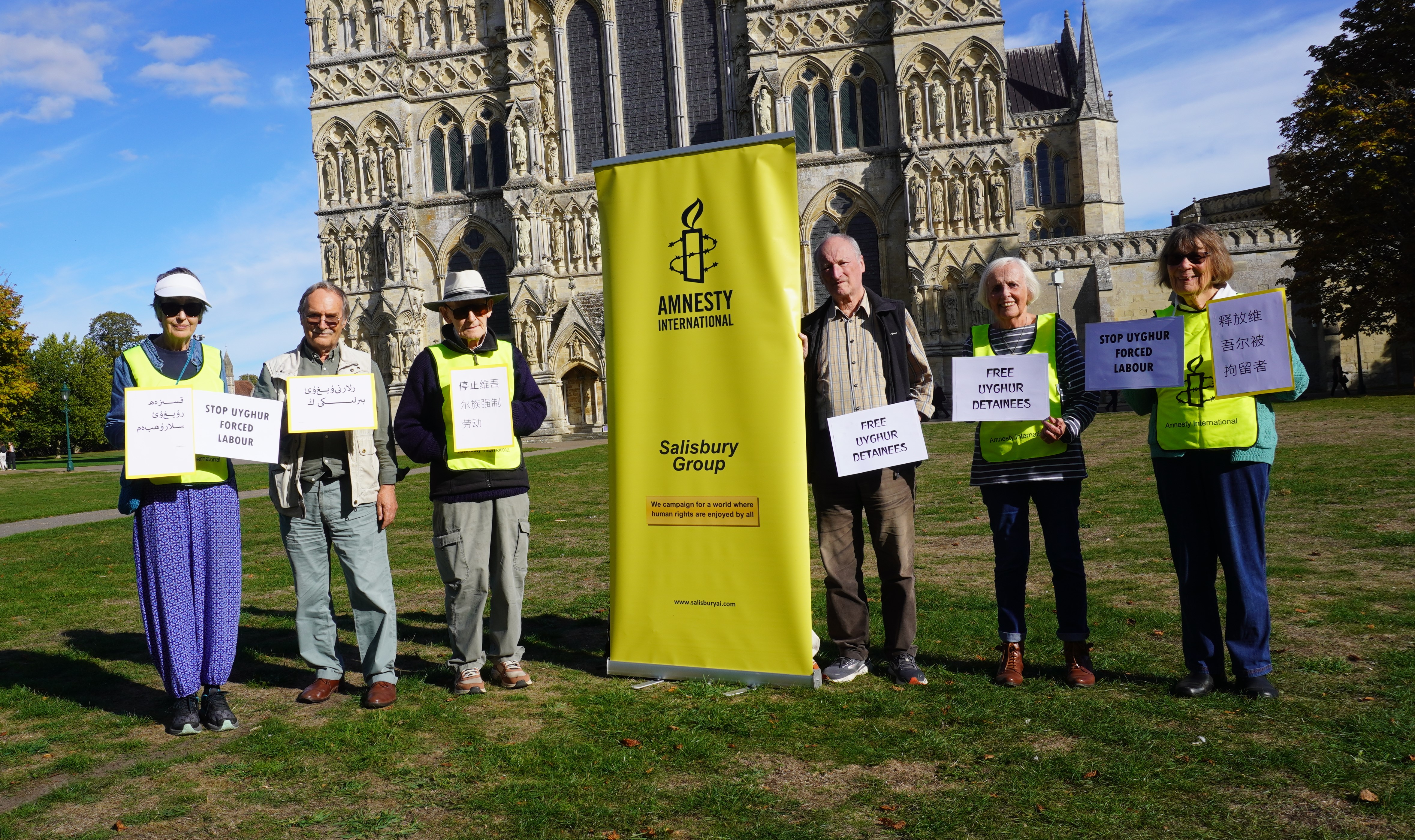
Throughout August the Salisbury group took part in the national campaign to highlight the plight of the Uyghur population in Xinjiang province in China. We reported on the extreme measures used by the Chinese to repress the culture, language and religion of this population and the imprisonment of around a million as part of a process of ‘re-education’. We also noted the vast programme of forced labour particularly of cotton much of it finding its way its way into high street clothing with seemingly little concern by our retailers.
The group held a brief photo opportunity today to highlight the Uyghurs and to keep them in the public eye.
A recent report by Global Rights Compliance suggests we may have been a bit ‘narrow’ in focusing on cotton as the latest 5 year plan for the region in which it is explained:
“The Plan’s overriding priority is to position China at the “forefront of global science and technology”, by eliminating critical technological dependencies and ensuring that its development trajectory cannot be disrupted by external pressure or supply chain coercion.
“This self-reliance shift ultimately relies on material foundations. The success of these goals depends on securing reliable access to raw materials at scale. The Xinjiang Uyghur Autonomous Region (Xinjiang) is central: the region holds the majority of China’s beryllium reserves, a material with no substitute in semiconductor manufacturing, and provides the cheap coal-based energy that makes energy-intensive mineral processing”.
This suggests the process of repression will continue because this dominance relies not just on the material itself but its processing. This will also need forced labour to achieve.
There are signs that politicians are beginning to worry about the ‘China threat’ which is on several levels. Our concern is with the rights of a people who are not Han Chinese, who are routinely persecuted and the fruits of their persecution finds its way into products we buy in the West.
Members of the Salisbury group take part in national demonstration about this firm
October 2026
The public are slowly becoming aware of the firm Palantir and how it is increasingly being used by British institutions. Profound worries are expressed on a number of counts about the use of this firm. They include the security of the information obtained, the degree of control by government over the firm’s actions, the engagement by Palantir in the violent actions of IDF in Gaza and ICE in the US, the deeply unpleasant remarks made by Peter Thiel the owner of the organisation, and how naïve government ministers seem to place contracts of dubious merit and without proper tenders.
Members of the Salisbury group joined others in Southampton on 1st October to protest against the continuing involvement in the NHS in particular. NHS staff are particularly concerned not least because of Peter Thiel’s remarks about their organisation saying […] “the NHS makes people sick“.
Security of the information
The firm has an increasing number of contracts with the police, the MoD and the NHS. Vast quantities of information are garnered and it is claimed that major savings are made to waiting times and operational efficiency. Only they aren’t and the claims are wildly exaggerated. Our concern however is the security of the information and where the data is held. The firm claims that the data is secure but following a struggle, details of the contract were released and the elements dealing with data storage were redacted. We do not know in other words.
Government control
This is an American company and thus outside the control of our government for much of its activity. Since successive governments seem to be in awe of American tech giants the question is, how much control does our government have? Is it able to inspect the storage architecture? Can it know to what use the information is being put by the firm? The UK government has a long, long history of tech disasters and experience shows that those in the Civil Service dealing with these matters have little knowledge.
Palantir’s ‘morals‘
The firm has been more than happy to engage in some unsavoury activities. It provided the IDF with the means to coordinate all its information to enable strikes on alleged Hamas terrorists in Gaza. Although many might argue that Israel was entitled to strike against terrorist threats, the NAZA policy meant entire blocks of flats were bombed to kill one possible terrorist. They are deployed by ICE in its campaign of rounding up illegal immigrants and others.
Peter Thiel
One of the proprietors of Palantir, he is on record having made some unpleasant remarks. He is a supporter in Carl Schmitt who was active between the wars and was seen as a Nazi supporter and a leading light in the party. He is sceptical about democracy. He is of course entitled to his views and several commentators have found it difficult to quite bottom out what they are. However, he is disdainful of government controls. His combination of beliefs make one wonder how safe our information is in his hands.
Government contracts
Technology has such power these days that contracts with companies like Palantir should be subject to rigorous scrutiny and control. The original contract was placed during the Covid pandemic for £1 by Boris Johnson when he was prime minister. The new prime minister Andy Burnham is keen to promote his ‘pro business’ government which raises the question how closely will the activities of this firm be monitored.
The government is desperate to see an improvement in the performance of the NHS and a reduction in the waiting lists. Will they overlook problems of security and rights in its haste to enjoy the supposed benefits offered by this firm? It is reported that Labour may be thinking of ending the NHS part of the contract which they have to do in December.
Middle East Eye reports that a motion, put forward at the party’s conference in Liverpool by the Labour-affiliated Socialist Health Association and at least three constituency parties, urged the government to cancel the £330m ($437m) contract to process NHS data with the controversial tech giant. It said Palantir was “facing numerous allegations of involvement in serious breaches of human rights, including due to it developing technology for Israel’s military to use in its unlawful occupation of Palestinian land and genocide in Gaza”.
The motion said: “The Labour government has a responsibility to uphold public trust in politics, including in the awarding of public contracts, particularly where there are allegations of involvement in grave violations of international law.” The motion was blocked however.
Terrifying failure to execute Christa Pike in Tennessee
October 2026
It seems as far as Tennessee is concerned, actually executing someone is more difficult than might be supposed. Christa Pike was on the gurney and the supposedly lethal drugs were injected twice. Forty minutes later, she was heard snoring from behind a screen and was taken to hospital.
There seems no doubt that Christa committed the murder of a fellow 19 year old 30 years ago in 1995. She was sentenced to death at the time. As is common in America, the appeals process can take decades and last right up to the last moment. The latest appeal concerns how she was treated as a child with evidence of rape and sexual abuse.
There followed a tussle between the Tennessee Supreme Court and the US Supreme Court with the latter agreeing the execution could go ahead. Three justices dissented.
USA is the only country in the Americas still to retain the penalty and these events add a further twist to the campaign to end the penalty it including Tennesseans for Alternative to the Death Penalty. Amnesty is opposed to the penalty in all circumstances.
We may amend this post in the light of further developments. The failed execution has led to a storm of protest in the US.
Sources: Daily Mail, Daily Mirror, BBC, Guardian. We were unable to access the Tennessean.
Storm Austen reduces numbers at latest vigil October 2026 After the strong turnout for vigil 150, the storm meant few braved last evening’s vigil as we sheltered on the steps of the Library. We are pleased to note that the previous week’s vigil attracted some coverage in the Salisbury Journal both on line and in…
This milestone vigil well attended October 2026 It almost doesn’t seem possible that a group of people in Salisbury have turned out each Saturday for 150 weeks to stand, sometimes in the cold and rain, to support the principle of peace and justice in the Middle East. Yesterday (17th) there were 40 of us and…
October 2026 Today, 17th October, is the 150th vigil in Salisbury. If you are able to come that would be wonderful. You may wonder why you haven’t heard of this and we are disappointed to report that the Salisbury Journal declined to publish the press notice. We cannot know why. 5 o’clock outside the Library…
Palestine Solidarity Campaign have made the claim that ‘public anger over Israel’s treatment of Palestinians and Britain’s response was increasingly being expressed‘. The claim was made by Aimee Shalan who will become director in November.
She said Palestine becoming an electoral issue both domestically and nationally. She pointed to Ed Miliband’s recent statement and the change in policy towards the West Bank in particular. The West Bank appeared in the news in recent days because of the latest incident of severe violence involving over 100 militant settlers who overwhelmed security forces in an attack on the village of Jalud.
Several senior politicians, including the president Isaac Herzog, have condemned the violence but there is an element of shutting the stable door after the horse has bolted. Settler violence has been overtly and covertly supported by politicians and the security forces have up to now, stood by while Palestinians were attacked and their properties destroyed. It is a bit late to complain now when the scale of violence and ethnic cleansing has become so extreme.
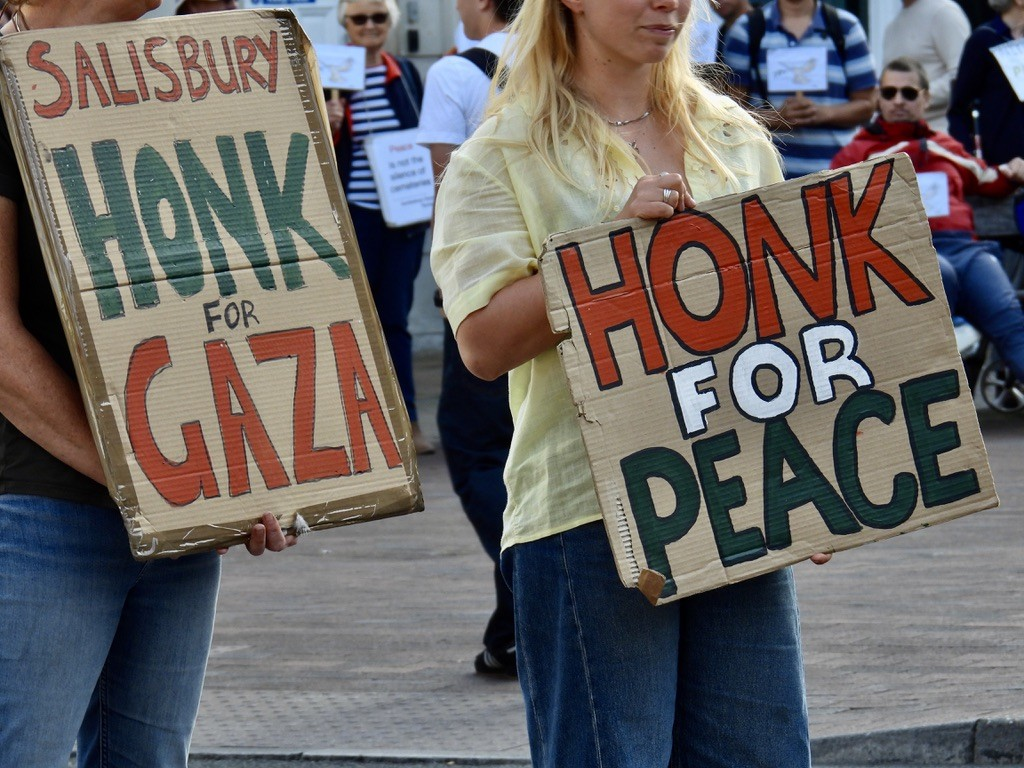
The 147th vigil was held on Saturday with nearly 40 in attendance. There was a good response to the invitation to ‘honk for peace’. The Salisbury MP, Mr John Glen. has not appeared and there was no mention of the vigil again in his weekly column courtesy of the Salisbury Journal. He is a member of the Conservative Friends of Israel group.
Film update – Because …
Our film Because ... is progressing well and will be finished ready for the 150th vigil. Most interviews have been completed.
NAZA was shown in cinemas around the country October 2026 The film NAZA was shown in cinemas around the country yesterday and following the showing there was an interview with the makers and others involved. NAZA is the word used by the IDF to assess collateral deaths in pursuit of one Hamas operative. It is…
The 149th vigil held on Saturday. Big row about the Green party motion on Zionism October 2026 A tense week on the Israel front with a major row erupting at the Green party conference arising from a motion to defining Zionism as “a political ideology which called for the creation – and, now it exists,…
October meeting minutes October 2026 We are pleased to attach the minutes of the last meeting thanks to group member Lesley for preparing them and thanks to group members for their contributions. Rather longer than ordinary minutes, they contain reports on the death penalty, the situation with refugees and immigrants, statistics and a report on…
We include a text today largely written by Floridians for Alternatives to the Death Penalty, concerning the execution of Curtis Beasley on 29th of September. Florida is on something of an execution spree partly because the Governor, Ron DeSantis, believes in its effectiveness as a deterrent. There is no evidence for this.
Tonight, the People of the State of Florida executed Curtis Wilkie Beasley, Sr. for the 1995 murder of Carolyn Monfort. In this gubernatorial administration alone, that makes him the 44th execution, the 13th veteran, the 14th senior citizen, and the 27th person condemned to die despite a non-unanimous jury vote for death.
Carolyn Monfort was murdered in her own home by someone she knew and had welcomed there. She had a family, a life, and people who expected to see her again. Her life deserves our recognition in its own right, even as we oppose the way Florida chose to bring her story to its conclusion.
Some executions command the attention of our state and even the whole US. Others happen quietly, while most people go about their Tuesday evening. Florida’s unprecedented and remarkable pace of executions over the past two years makes that possible. Before we have finished saying one person’s name, another death warrant is signed. The names blur and the numbers rise, and those who aren’t closely following along are none the wiser. This is part of the administration’s plan to overwhelm and desensitize. To let everyday Floridians forget that all of this killing is happening in their names.
The Case
Curtis’ case drew comparatively little of the attention that others have drawn. But the facts deserve to be heard nonetheless. Curtis‘ case is a prime example of the arbitrariness of Florida’s death penalty. Over the past month, his lawyers have fought to bring this disparity to light. The courts continue to turn a blind eye.
Curtis was sentenced by a non-unanimous jury, a practice found almost exclusively in Florida. Florida requires a jury vote of 8 to 4 to sentence someone to death, while Alabama requires a supermajority of 10 of 12 votes. Every other death penalty state has rejected this practice.
The right to a jury trial is firmly rooted in the nation’s fabric. So is the history of denying some jurors a meaningful voice. Non-unanimous jury rules took hold in the Jim Crow era as a way to let Black people sit on juries while allowing other jurors to disregard their votes. In a 2020 landmark case called Ramos v. Louisiana, the U.S. Supreme Court confronted that history and held that a jury must be unanimous to convict someone of a serious crime.
This term, the Supreme Court will consider another part of that promise: whether the right to a jury trial requires twelve jurors, rather than the six Florida uses in most criminal cases. Florida asks a full jury of twelve to decide a capital case, but permits a death sentence even when one, two, three, or four of them believe life without parole is the appropriate sentence. The questions before the Court are different, yet they reach the same concern: whether the state can call people to serve on a jury and then diminish the force of their voices. That is exactly what happened to the two jurors who believed that Curtis Beasley should live.
Before drugs and alcohol carved a destructive path through his life and led to the violence that landed him on death row, Curtis lived a life that many of us would recognize. He played Little League baseball and went to Bible camp. He won the Perfect Attendance award in 4th grade. He had an after-school job at a T.V. repair shop, started a garage band with his friends, and listened to country music. He was president of his senior class. He volunteered to serve our country in the Army, and did so honorably, during a time of intense anti-military sentiment. He was a father, a son, and a brother. He was more than the 44th, 13th, 14th, or 27th – more than a statistic in this steady stream of violence.
We will keep telling these stories, including the ones that receive less attention as Florida continues to carry out executions at a pace unrivaled by any time period in the State’s recorded history. Tonight we remember Carolyn Monfort and the life taken from her. We remember Curtis Beasley as a whole person, too. Neither should disappear into the count.
Pip: If you’ve ever wondered why British arms keep flowing to conflict zones despite mountains of evidence of civilian harm, welland2 has spent considerable effort mapping the answer — and it turns out “political cowardice, greed, and some perverse thinking” covers a lot of ground.
Mara: This episode follows that investigation closely — the machinery behind UK arms exports, the seven structural reasons those exports continue, and what it means for Gaza, Yemen, and British credibility on the world stage. Let’s start with how those exports get justified, and why they keep surviving scrutiny.
From Gaza to Yemen: Why UK Arms Sales Keep Flowing
Pip: The central question here is not whether harm is happening — the evidence on civilian deaths, destroyed hospitals, and ethnic cleansing is described as copious — but why successive governments, across both main parties, have worked so hard to keep the arms flowing anyway.
Mara: The post lays out the official reasoning and then dismantles it. On the pattern of civilian harm, it quotes directly: “a few incidents do not a pattern make, and the motives of those doing the killing cannot be known.”
Pip: That framing — we can’t know why they’re bombing the hospital — is doing a lot of work for a lot of arms licenses. The post calls the overall picture, plainly, lying.
Mara: Seven structural reasons are offered. Economics comes first: around 300,000 people are employed in the sector, many in marginal constituencies. But York University studies are cited showing the net economic value is nowhere near the headline figures once corporate welfare is factored in.
Pip: So the jobs argument is itself propped up by subsidies. The revolving door compounds it — 604 individuals moved from ministry or military roles into arms firms between January 2017 and June 2022, with CAAT describing it as “open office” corruption.
Mara: The post also identifies the F-35 issue as a sovereignty problem in plain sight. British-made components go into weapons used over Gaza and Lebanon, but the claim is they can’t be tracked — which the post calls an insult, given that goods are routinely tracked electronically. The real reason, it argues, is unwillingness to confront Washington.
Pip: Sovereignty reclaimed from Brussels, surrendered quietly to the Pentagon.
Mara: Fear of the antisemitism label is named as another factor — described as having percolated into media coverage, with the BBC reporting cited for double standards on language around hostages and prisoners. And roughly 150 MPs hold membership in Friends of Israel groups, raising direct questions about impartiality on arms votes.
Mara: The conclusion is direct: “It is a cover for political cowardice, greed and some perverse thinking around supporting Israel and the arms industry generally.” Yemen is named alongside Gaza — years of bombing, a massive death toll, and nothing resolved.
Pip: And the same pattern — unqualified support for Saudi strikes on civilian targets — repeated without apparent reflection.
Mara: The post ends by arguing that arming a regime conducting ethnic cleansing only postpones a reckoning, and that Britain’s role should be supporting dialogue and a viable Palestinian state — a commitment the UK has now formally made. The gap between that commitment and current arms policy is the political failure the piece is naming.
Pip: The stakes don’t get much higher than “destroys any hope born of the post-war Universal Declaration.” That’s where we land.
Mara: The through-line across all of this is the distance between stated values and actual policy — and the structural forces that keep that distance in place.
Pip: Next time, presumably, we find out whether any of those structures have shifted. The evidence so far suggests they are slow movers.
In the previous post we discussed the recent report Dead Letter published by the Campaign Against the Arms Trade, the webinar held by them, and the Channel 4 Despatches programme, which all described in some detail the contortions carried out by successive governments to justify the selling of arms to murderous regimes. Also discussed was the involvement in the legal system in some of the bizarre reasoning employed to fight off claims by human rights groups such as Al Haq and others that what they were doing was contrary to international human rights law.
The shear extent of what can only be described as lying is staggering. Despite copious evidence of death of civilians and the destruction basic infrastructure such as schools, hospitals and mosques, the bombing of water treatment plants and a deliberate policy of ethnic cleansing, successive governments have clung on to arguments such as a lack of evidence, a few incidents do not a pattern make, and the motives of those doing the killing cannot be known. Anything in fact to justify the continuation of arms sales.
Why?
Which prompts the question why? Why are politicians of both main parties so desperately keen to maintain these fictions? Why have they watered down regulations of what can or cannot be sold? Why do they persist in the argument that we have one of the more robust export regimes in the world when patently it is not?
In this essay we want to suggest some reasons. Necessarily, it cannot always be evidenced as efforts are made to conceal anything which might compromise the government or ministers. It is largely speculative therefore. We suggest there are seven major reasons why we have the system we have.
Economic and the need for jobs
The arms industry employs large numbers of people many of whom are in marginal constituencies [it was always argued thus but in view of recent political upheavals, what is or is not a marginal is now somewhat questionable]. There are around 300,000 people employed. Further, it is one of the few sectors in the economy which has seen significant growth. Adopting some kind of moral policy and concerning itself with the rights of those at the receiving end of weaponry, would have a serious effect on these numbers.
Post war effects
After the war, Japan and Germany were unable to develop their arms firms which provided an opportunity for the UK to shine. Whereas those two countries modernised and produced a range of products which steadily ended many UK firms’ ability to compete (cars and electronic goods for example), arms were not among them. Considerable support was provided by the UK government to the industry. However, claims of job creation and economic value are considerably weakened when the degree and scale of ‘corporate welfare’ is taken into account. York University has produced a number of studies showing the net value is nowhere near the headline claims by politicians.
Nevertheless, it is an area where British firms do have a presence on the world stage, despite its questionable economic value.
Close links to the US
It is interesting to reflect on the enormous fuss made at the time of Brexit where ‘take back control’ and ‘regain our sovereignty’ were two of the key messages. Yet we have lost these to the Americans. Witness the F-35 arguments where it is claimed the 15% made in the UK cannot be tracked. They are a key weapon in the destruction of Gaza, bombing of Lebanon and the attack on Iran. The tracking claim is to insult the British people who know full well that goods nowadays are tracked electronically. The reason is not being able to stand up to the Americans and the likely threat to future partnership deals. If our sovereignty was ever lost it has been to the US not Brussels. It is even claimed that the moment the items are manufactured, ownership passes immediately to the US so we cannot embargo their sale to Israel.
Anti-Semitic and anti-Israel claims
Any or all criticism of Israel and its actions are deemed anti-Semitic. These claims seem to have struck fear into the heart of the British political establishment. They were a powerful force in the removal of Jeremy Corbyn. Sir Keir Starmer worked hard to ‘rip out anti-Semitism by its roots’ as he put it. The nature of the anti-Semitism under Corbyn is difficult to bottom out. A lengthy BBC report delves into it in some detail and some of the evidence seem tenuous to say the least. It does appear that the party was slow to take disciplinary action where there were incidents but Corbyn’s stance against anti-Semitism seemed clear. Inevitably, as in any organisation, there are going to be individuals who are anti-Semitic.
What is important is the perception but it does seem clear that the policy of claiming that any or all criticisms of Israel has taken root. It has been effective and has percolated into the BBC and other parts of the media. We reported on the Centre for Media Monitoring’s report into BBC reporting in an earlier post. They describe the double standards, muffling of Palestinian voices and language issues amounting to severe bias. For example, they frequently reported that Hamas seized ‘hostages’ whereas Israelis took ‘prisoners’. Both were hostages and both were kept incommunicado and badly treated. The word ‘prisoner’ suggested some kind of judicial process had taken place. Evidence of an Apartheid state has almost never been mentioned by BBC commentators despite the copious evidence produced by Amnesty, Human Rights Watch and Israeli human rights groups.
Slowly, things seem to be changing however and the recent statement and actions by Ed Miliband the Foreign Secretary are a welcome if belated sign. Israel is losing the moral high ground and is fast becoming an international pariah. Witness the huge walkout of delegates at the UN when Benjamin Netanyahu rose to speak.
MPs easily manipulated
That around 150 members of parliament are members of their party’s Friends of Israel groups is shocking. In a previous post we discuss how easy Israel seems to find engaging impressionable and naïve newbie MPs to their point of view with cleverly crafted visits to Israel and other financial support.
Any question of curbing sales of arms has to overcome this quiet army of closet supporters of the regime. The question has to be asked: how can an MP properly act dispassionately in deciding what is in Britain’s and Palestinian’s or even Israel’s best interested if they are members of what is believed to be the best funded parliamentary lobby group? Both Sir Keir Starmer and David Lammy were staunch members and so is Andy Burnham the new prime minister.
Further, when one or other of these MPs are interviewed, their membership is only rarely mentioned by interviewers.
The Revolving Door
This is the deeply corrupting matter of senior military staff, senior civil servants and ex-ministers, heading off to take up lucrative directorships or consultancies with arms companies. Both Transparency International and CAAT have criticised this. CAAT terms it ‘open office’ corruption.
The numbers are quite staggering. No less than 604 individuals moved from ministry or military roles into arms firms between January 2017 to June 2022. Quite apart from the undue influence taking place, it has led to poor scrutiny, delivery failure and massive budget overruns. The suspicion is that with a promise of a lucrative post retirement appointment, awkward or challenging questions are not asked. Proper scrutiny is not carried out. Neither are questions asked about moral or humanitarian issues arising from the use of the weapons. The now abolished ACOBA controls were widely condemned as toothless.
Racism
Underpinning much of the attitudes and biased media reporting is racism. Arabs and Palestinians are regarded as untrustworthy and uncivilised (algebra?). This appears in claims of Britain being overrun by Moslems and London becoming ‘Londonistan’ subject to Sharia Law: Islamophobia in other words.
Whereas anti-Semitism receives a great deal of coverage (rightly) and necessary police action, anti-Palestinian attitudes do not get the same attention. British politicians like the local MP, Danny Kruger, can quite casually claim that ‘all the deaths in Gaza are the fault of Hamas‘. It is difficult to believe this blanket statement of blame would be applied to an attack on another racial group. There, cries of ‘indiscriminate’ would be heard. The different treatment of Palestinian deaths in comparison with Israeli has been a feature of criticisms of media coverage.
Security
A frequent reason which crops up is security. This argument seems to hinge around the role Israel plays as a source of information about the Middle East. Israel has a fearsome reputation in the field of intelligence and western powers including the UK are keen to avail themselves of it.
Conclusions
To many, the continuing and obdurate policy of successive British governments has been baffling. In the face of mounting evidence, the continued support for arms sales seems insupportable and unconscionable. In this essay, we attempted an explanation based on a variety of factors we have discussed. Essentially they are about money, jobs dependant on the sales, corruption and a willingness of the political elite to follow the Israeli line. Fear of the anti-Semitism tag is also a factor.
It hasn’t just been Israel: a similar pathology has been witnessed in the Yemen conflict. There, unqualified support for the Saudi bombing of multiple civilian targets was seen. Arms are still being supplied to UAE despite strong evidence that they are passed on to the RSF in Sudan.
The public approaches this from having witnessed terrible scenes on the news despite the banning of independent news media into Gaza and the steady murder or assassination of journalists by the IDF. (More have been killed than in any other comparable conflict). Many feel deeply that this isn’t right and the UK should have no part of it.
These views find few favours in Westminster for the reasons we have suggested. Their answer is to erect ever more contorted arguments in support of an indefensible position. This is more than speculative as the Despatches programme revealed. They showed that great efforts were made by the Foreign Office to conceal details and not to leave a paper record. It is a cover for political cowardice, greed and some perverse thinking around supporting Israel and the arms industry generally.
The ultimate tragedy is that it won’t. Supporting a thuggish regime to carry on a programme of violence and ethnic cleansing creating along the way an entire new generation of young people bent on revenge, merely postpones the ultimate reckoning. Israel is a superpower in the region and giving them more and more weapons is merely to pour petrol on a fire. Years of bombing Yemen and a massive death toll has solved nothing.
British involvement in this activity destroys any hope born of the post war Universal Declaration with its claims of ‘never again’. Our role should be to support moderation, dialogue and actively to support the creation of a viable Palestinian state (which the UK is now committed to). Our political class is profoundly letting the nation down. It represents a massive political failure for a range of unworthy reasons.
Refugees and asylum seekers still consuming political capital
September 2026
With the return of Parliament this month, the Immigration and Asylum Bill is back in action. The Bill has passed its second reading and is now in committee stage. The most contentious parts are the refusal of family reunions, the extended time frame for residence, and the modern slavery definitions. An August meeting of the Regulatory Policy Committee of the House considered the Home Office’s impact assessment to be “not fit for purpose”, and Article 8 on modern slavery to be “inadequate”.
Boat crossings
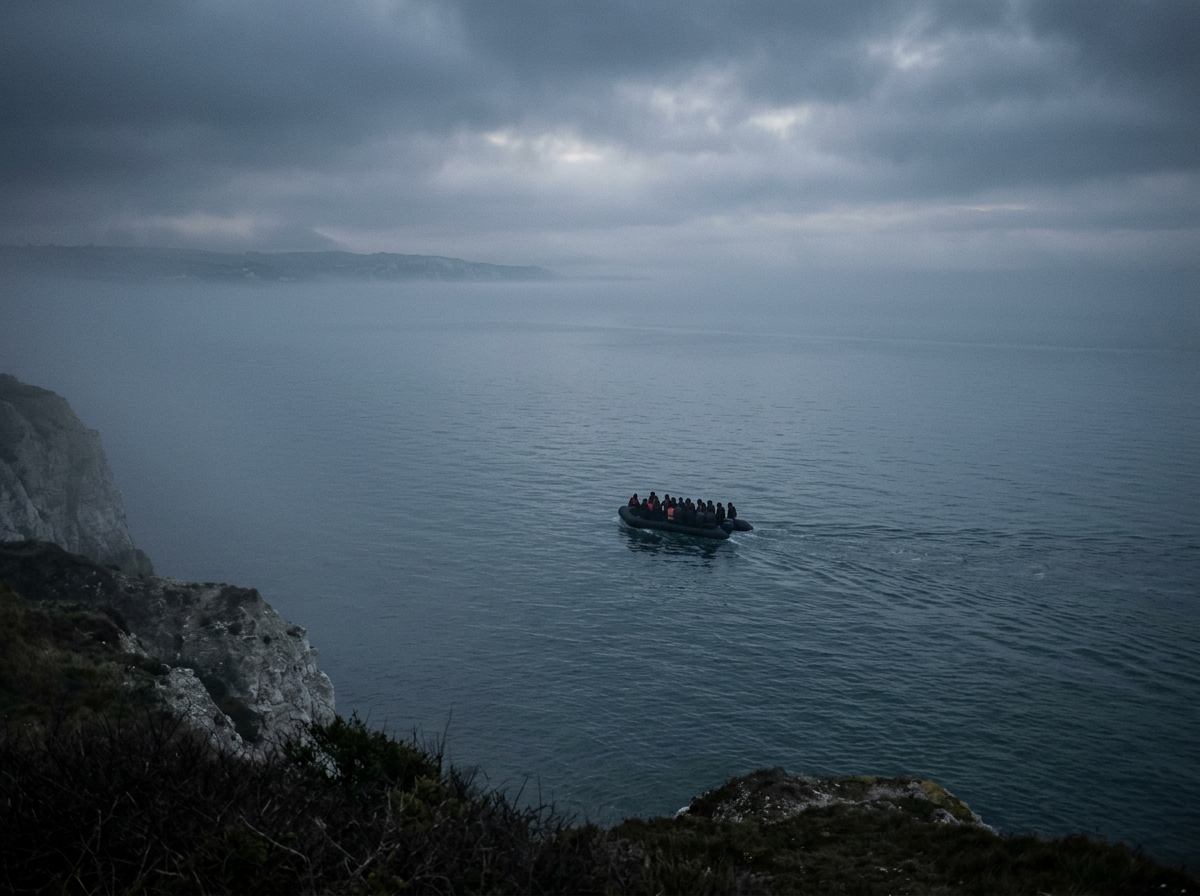
On the small boats front, numbers remain down (102 vessels between June and August, the lowest since 2019, but they are now much bigger boats, taking up to 230 people. Whereas in 2018, 7 was the average load, it is now 65). In 2026, 17,000 migrants have crossed the Channel so far. The backlog of pending cases continues to fall, down to 40,000, the lowest since June 2019, but the grant rate is falling as well, down to 38% acceptances (it had been up to 77%).
With the resultant increase in appeals, the 24-week target for hearing appeals may be hard to achieve. Concern has been widely expressed that the new Independent Immigration Appeals Authority will be free to use non-qualified legal staff to adjudicate the appeals.
40,000 migrants were returned in the year to June, three quarters of them were “voluntary”, mainly to Albania, Brazil, India and Poland. The fine weather over the summer did not materially affect the numbers of crossings, which remain lower than recent years. Other factors include more collaborative action with the French authorities, and seizure of 1100 boats, according to the National Crime Agency.
Migrants and asylum seekers who are already here continue to be the focus of interest. By the end of June only 16,021 claimants were in hotels, but the 69,000 were in other temporary accommodation.
Beyond the statistics, public attitudes in the UK may not be reflected in the mainstream media. A recent YouGov poll indicated that 75% of the public would distinguish between migrants and refugees and 59% thought that too much attention was paid to how migrants came rather than why. Nevertheless, another poll revealed that 40% believed that more small boats were arriving this year than last, and only 22% (correctly) believing there were fewer.
Immigrants and crime
The OECD has observed that there has been little evidence of change in crime figures despite the amount of immigration. In the UK, convictions among non-UK citizens come out at about 12%, the same level as for the adult UK population. Higher levels of lawbreaking were observed among Afghans (sexual offences) and Albanians (drugs) but not substantially. The Government’s advisory guide for asylum seekers on British culture has not had any significant effect thus far. A feature of recent unrest at Portsmouth and Dover has been claims of high crime rates by immigrants.
Across Europe a similar trend is noticeable. Despite the furore in Ceuta, numbers in the first quarter were down by 46% on 2025, but there were more deaths than previously. Member countries of the EU nevertheless continue to be much engaged on the issue. The European Parliament in June approved an overhaul of migration policy, expressly to speed up deportations. EU interior ministers from 22 countries agreed to take “any necessary measures to safeguard public order and address risks arising from secondary movements” (by which they mean migrants moving on from their first country of arrival). The Schengen Agreement has already been suspended in certain places (notably in the spat between liberal Spain and hard-line Italy).
The other big issue for the EU is the search for “hubs” outside the Union for removal of rejected migrants. Five EU countries have agreed to sign deals. Rwanda and Uganda are said to be compliant, but the question remains as to who has the responsibility for such deportees. The European Court of Human Rights is expected to adjudicate against the governments; the Council of Europe has already observed that the changes in policy pose “considerable human rights risks.”
Climate
Finally, with ongoing climate change and a possible exceptional El Niño, there has been much discussion of “climate mobility”. The UN Refugee Convention has nothing on the topic, and there is no legal category of “climate refugee”, but the International Court of Justice has given advisory opinion recognising the issue.
Pip: A local Amnesty group in Salisbury posts about Uyghur rights — and suddenly cities across China are reading. That is either heartening or a sign that someone in Beijing is taking notes.
Mara: This episode covers Salisbury Amnesty’s recent posts on the Uyghur campaign, from the surprising reach of their online presence to the forced labour hidden inside your high street wardrobe. Let’s start with the campaign itself and what those viewing figures actually revealed.
Uyghur Campaign Reaches Across the Firewall
Pip: The Salisbury group ran a daily posting campaign on Uyghur rights — and the audience that showed up was not quite the one anyone expected.
Mara: The campaign newsletter reported figures that stopped people mid-scroll. Here is what it said: “Around 70% were from China and Hong Kong SAR, a figure we have never seen before. Usually, views from China seldom reach double figures.”
Pip: So a small Wiltshire group is somehow punching through one of the most sophisticated censorship systems on earth. That is the real story here — not the post count, but who is reading.
Mara: The breakdown gets more specific. Fifty-six cities across China are represented in the data, with 31 views from Beijing and 15 from Shanghai. The newsletter notes that “views from nine cities in China even exceeded the views of people from Salisbury.”
Pip: Which suggests ordinary people actively routing around the Great Firewall to find this material — not just state monitors checking in.
Mara: Facebook told a different story. The same posts drew only around twenty views each there, with almost no engagement from the eighteen-to-twenty-four age group. The campaign also secured a letter in the Salisbury Journal, which the newsletter describes as a paper that does not usually publish material on topics outside the local area.
Pip: Harder to get into than Beijing, apparently.
Mara: The Uyghur Crisis Response Team acknowledged the group’s posts on Bluesky, which rounds out a campaign the newsletter calls “altogether a satisfactory response.” And the month was not yet over when those figures were filed. That reach into China sets up the harder question — what exactly are people in Xinjiang living under?
Forced Labour in the Clothes on Your Back
Pip: The post titled “Slavery was abolished in 1807 — Not in Xinjiang” opens with a blunt premise: the system did not end, it just became harder to see on a label.
Mara: The post draws on Sheffield Hallam University research, which states that “previous research has provided significant evidence indicating that these programmes are indeed tantamount to forced labour, human trafficking, and modern slavery and that this system of repression is particularly deployed in the cotton and textile industries.”
Pip: Xinjiang produces around eighty percent of China’s cotton — which is roughly twenty percent of global supply. The brands that pledged to cut ties in 2020 did not necessarily solve anything.
Mara: That is the mechanism the post calls “cotton laundering.” Once raw cotton becomes yarn or fabric and passes through a third country like Bangladesh or Vietnam, its origin becomes nearly impossible to trace. Even the “Better Cotton” label offers no guarantee — the post notes it “can be mixed or blended with what they call conventional cotton very early on in the supply chain.”
Pip: So the ethical label is doing the laundering for them. Efficient.
Mara: The post names M&S specifically, via an RTÉ investigation, as a retailer featured in footage about vague labelling practices. The campaign asks readers to write directly to retailers — a sample letter is included — asking what safeguards they have in place to verify their cotton’s origin.
Mara: The post closes with a line worth sitting with: “The products of this obnoxious and cruel system are sitting on the clothing racks of our major high street retailers and hence in your wardrobes. Truly we are all involved.”
Pip: And that is the thread connecting both posts — the question of who is paying attention, and whether attention is enough.
Pip: A record month of hits from inside China, and forced labour woven into everyday retail. The local and the global keep colliding.
Mara: They do. Next time, we will see where that thread leads.
Lots of interest in this month’s minutes and newsletter
July 2026
We are pleased to attach our July minutes and newsletter with thanks to several group members for their contributions. There are pieces on the refugee situation which continues to resonate in the British political scene but often with little attention to the facts. Few would know from the media and politicians that the number of boat crossings have declined for example.
As we have pointed out in a previous post, we now report on British human rights following successive government’s introduction of ever more restrictive laws on assembly and protest.
There is a summary of the death penalty noting that the Restore party wants to see the penalty brought back in the UK. This coincided with the conditional pardon offered to Ruth Ellis, the last woman to be executed in Britain.
There is a report on social media statistics noting that views to this site are at significantly higher level than last year but that most come from outside the UK. High numbers from China are a surprise but very welcome.
There is no meeting in August and the next time we meet is on September 10th.
A new feature on the site which will appear from time to time, is podcasts. The first is below. Note they are produced by AI but from texts written and researched by us not using any AI. It is an amalgamation of more than one text post. Feedback is welcome. We hope you enjoy listening! If you are not used to these, click on the heading and you will see a sound bar with the text displayed below it.
Pip: Amnesty Salisbury keeps showing up — in the rain, at the park, in the footnotes of trade agreements nobody else is reading.
Mara: That's the thread running through welland2's recent posts: rights under pressure, from ECHR reforms to death row to a sustainability fair in a local park. Let's start with where the pressure is heaviest — the slow dismantling of civil liberties.
Rights eroding in plain sight
Pip: The headline concern here is a pattern, not a single event — each new policy framed as a border measure or a public-order fix, but adding up to something larger when you step back.
Mara: The post "Steady Erosion of Rights Continues" puts it directly: "It is not even true to say 'by stealth' as it is done in plain sight."
Pip: That's the part that should unsettle people. The argument isn't that rights are being quietly stolen — it's that they're being removed openly, and we've stopped noticing.
Mara: The context is the ECHR declaration giving European governments more power to deport migrants, even where there's a risk of mistreatment on return. Yvette Cooper called it permission for countries to "take action on illegal immigration." Amnesty International's response was that it risks creating a "hierarchy of people" — those protected under Article 3 against torture, and those who are not.
Pip: And the post notes that the UK sells arms to countries that practice torture while turning away people fleeing it. That tension doesn't get much airtime.
Mara: The post also flags the Police, Crime, Sentencing and Courts Act 2022 and the Public Order Act 2023 as part of the same drift — limits on protest, expanding police powers, and now pressure on jury trials. Local MPs John Glen and Danny Kruger are recorded by They Work for You as voting against equality and human rights legislation.
Mara: Then there's the vigil — post number 128, held in the rain, documented in "A Damp Vigil." Around twenty people attended. Omer Bartov's book is quoted there, asking how Israel, founded the same year as the genocide convention, now conducts what he calls a genocidal undertaking with near-total impunity.
Pip: And the minutes and newsletter post pulls these threads together — immigration, the death penalty, the state of rights in the UK — for anyone who wants the fuller picture.
Mara: The Oklahoma piece is the counterweight. Richard Glossip, after twenty-seven years on death row and three last meals, walked out of jail after a judge ordered his release ahead of retrial. The prosecution had withheld evidence about its key witness's mental health. As the post puts it: had he been executed on any of those three occasions, it could not be undone.
Pip: The good news from Oklahoma is real. It's just that it took nearly three decades to arrive. On to the trade deal that skipped the values entirely.
A trade deal without the values
Pip: The Gulf States agreement is being sold as a win for British business — but the post "Government Signs Trade Deal" asks what got left out of the small print.
Mara: Sir Keir told his biographer "There is no version of my life that does not largely revolve around me being a human rights lawyer." The post's response is pointed: being a lawyer is not the same as having principles and acting on them.
Pip: The TUC called it a "values free agreement." The UAE's record — the kafala system tying workers to single employers, mass trials, solitary confinement, allegations of arming Sudan's RSF — none of it made it into the text.
Mara: Which sets up exactly what the Salisbury group was raising at the park.
Sustainability is also about the clothes you wear
Pip: "People in the Park" is the annual Salisbury Transition City event — seventy-five exhibitors, sustainability focus — and the local Amnesty group brought a different angle to it.
Mara: The post describes the group highlighting Amnesty International's report "Stitched Up," which details abuses in the global jeans industry: "health hazards, physical and sexual abuse of the mainly female workforce, wage theft and the denial of union and collective bargaining rights."
Pip: The response was muted. The post's honest read is that people associate sustainability with the environment, not with the supply chain behind a pair of jeans.
Mara: Around a quarter of the cotton comes from Xinjiang, where forced labour is documented and the region is closed to outside observers. The post's conclusion: retailers can claim humanitarian credentials on their websites while the exploitation continues.
Pip: Rights in the courtroom, rights at the border, rights in the fabric of your jeans — it's the same argument in different registers.
Mara: And the vigil keeps going. Next episode, we'll see what else is accumulating.
We have published 192 posts so far this year on a wide variety of subjects concerned with human rights. A key feature of the year has been the continuation of our vigils. We have held over 109 since the current conflict started and although there is some kind of cessation of hostilities, peaceful reconciliation between Israel and the Palestinians seems a far away dream. Some food aid is getting in but Israel has seized almost all the cultivable land leaving those in Gaza hemmed into an even smaller part of their territory. We have commented on the poor reporting of events there and the unsatisfactory nature of so many interviews.
Arms sales
A feature of this conflict and other conflicts around the world is the role of the arms trade. It appears that this trade seems to determine British policy: truly the tail wagging the dog. The government frequently trots out that it has a ‘robust policy’ whilst granting licences – and in particular open licenses – to almost all who come. The effects on people at the receiving end of these weapons sales does not seem to worry the Foreign Office or government ministers. Recent government’s policies have focused on growth and if growth means selling arms to Israel and to the UAE so be it. There is considerable evidence that the latter are supplying the RSF in Sudan who are alleged to commit many atrocities.
At the height of the Yemen war we highlighted the role of British arms firms and their weapons sales to the Saudis. RAF personnel were involved just short of being labelled ‘mercenaries’.
Sport
Sport has featured in several of our posts and the ever increasing use by states with abysmal human rights records to use sport to burnish their images. Virtually all sports are involved, but especially football, boxing, motor sport, golf, tennis and cycling. The driver is money. China and the Gulf states are among those with almost unlimited resources to pour into sporting events with seemingly no difficulty in attracting sportsmen and women to compete in their countries with no moral qualms. They also invest in our football clubs again with no concerns about how tainted the money is.
It has become so part of the furniture now that it engenders little comment. Whereas some years ago a nation which executes significant numbers of its citizens – often after confessions extracted under torture – which imprisons or ‘disappears’ human rights defenders and journalists and treats its women as second class citizens denying them many rights, would raise eyebrows when seeking to sponsor or host a sporting event. Not today.
Refugees
And it is not just sport where issues of human rights have seemed to take a back seat. People entering this country by various means have generated a massive amount of political controversy here in the UK. It is probably true to say that immigration in one form or another is one of the dominant political forces at work. It is deciding elections. A number of politicians are using the ‘crisis’ to their political advantage (they hope). Egged on by sections of our media, they have created the impression that there is a crisis particularly around the numbers arriving in small boats across the Channel. Any concern for those in the boats and why they are risking their lives to get here does not seem to feature. The impression is sometimes created that if we could deport the migrants (however defined) our problems would be over. The connection between our arms sales and the instability of the countries they have fled from does not seem to enter their thinking.
The contribution by immigrants (again however defined) is scarcely recognised. That large sections of our economy (horticulture and the food industry for example), the health service, hospitality and transport, would cease to function without them seldom seems to enter the consciousness of our senior politicians. We have commented on the strange fact that many of our senior politicians, including Rishi Sunak, Suella Braverman, Priti Patel, Shabana Mahmood, Kwasi Kwarteng and Danny Kruger are all descended from recent immigrants but are among the most aggressive about deporting those coming after them. We can offer no explanation.
Rights at home
Which brings us to another theme concerning the government and its own attachment to UK human rights. It was once hoped that the arrival of Sir Keir Starmer – an ex human rights lawyer and past Director of Public Prosecutions – would see an improvement in the human rights climate. Sadly, it has not come to pass. Laws against protests introduced by the Conservatives to clamp down on protestors, have not been modified or repealed and have even been added to. A more humane policy towards immigrants and refugees has not happened. Arrests have continued and as this is being written, those arrested on pro-Palestine marches are close to death on hunger strike. His continuing support for Israel has been shaming. He has issued critical comments but they have not been backed up by action, cutting arms supplies for example. No believable explanation for the hundreds of RAF flights over Gaza has been forthcoming. His most disgraceful comment that ‘Israel was right to withhold power and water from Gaza’ was widely condemned.
This year we have introduced a new regular feature reviewing the human right situation in the UK itself. This is probably something we would never have contemplated doing say, twenty years ago but a combination of poor leadership, aggressive home secretaries and many MPs with little interest in protecting human rights, has led to this move. Both Danny Kruger (MP for East Wiltshire) and John Glen (MP for Salisbury) are listed on They Work For You as generally voting against human rights is another factor. Mr Glen, who is listed as a member of the well-funded lobby group Conservative Friends of Israel has never once visited the Saturday peace vigil nor mentioned it in his weekly column in the Salisbury Journal.
Ukraine, Sudan, China, Palestine …
The world situation does not seem to get any better. The situation in Ukraine is critical and not just for the Ukrainians. We have one member of the Security Council, Russia gratuitously attacking an independent nation while another member, the US seems indifferent to their plight. The warm greeting by President Trump of President Putin on the tarmac in Alaska must be one of the more grizzly images of the past year. European nations have become almost powerless, in part because of their collective failure to invest in defence (defense) but also because they have become kind of vassal states to the US.
We must not forget that human rights in Russia are poor. There is no opposition and a leader who was a threat to Putin, Navalny, was probably murdered in Siberia. Others have been arrested or murdered along with many journalists. Children have been abducted from Ukraine. Ukrainian prisoners have been tortured.
We could devote a whole page to China. A million Uyghurs are persecuted and are forced to work while their culture is systematically destroyed by the Communist Party. Some call it genocide. Tibet has had a similar treatment and its culture largely eliminated. They are believed to execute more of its citizens than all the rest of the world combined. Freedom has been snuffed out in Hong Kong. Chinese nationals are intimidated overseas.
The future
The future is unpromising. The ‘New World Order’ created after the war is well and truly dead. Powerful interests act at will. Despotic leaders act in their own interests not in the interests of ordinary people. Europe is too feeble to act. It looks as though things will continue as they are. There is no hint that the current conflicts will end equitably but based on the whims of a handful of profoundly flawed men.
A large number of MPs of all parties are members of the Friends of Israel group and many also receive money from them. How can they be expected to act honestly, with integrity and in the best interests of the country (to be clear, the UK whose residents voted them in not a foreign state) if they are members of a powerful and well funded lobby group? Arms companies continue to sell their wares with few controls so desperate is the government for growth. The BBC has been cowed into silence on important topics.
In June of last year, the Institute for Government, recognising the serious loss of trust in the government, published its 7 steps to restore trust. One was the publication of an independent ministerial code. Another was to ensure lobbying was built on a clear coherent and transparent system. It has not happened. There is no rigorous or proper system of controlling the ‘revolving door’ which is a passport for corruption by ministers, ex-civil servants and military people retiring into lucrative appointments with arms companies.
Hope
The weekly vigils and the many hundreds of protests around the country for an end to the killing and genocide in Gaza is a heartening sign. It shows a significant number of people who care about what is happening, care that is not reflected by the government nor by chunks of the media. Despite their numbers, reporting is thin with a media all too keen gleefully to report flag waving disturbances outside hotels or army camps. If hope is to be found it lies with ordinary people who simply say ‘this isn’t right, this is not what I believe in’. Rutger Bregman in his Reith Lectures (2025) argues just this: that small committed groups can make a difference. However, whether they can achieve this at the international level is debatable. We can cite climate which will be having harmful effects on more and more of the world’s population and where progress if anything is going backwards.
We shall continue to campaign and we always welcome new members to the team.
Best wishes for the New Year to our small band of readers!
Today marks the 25th Anniversary of the Human Rights Act
October 2025
Twenty five years ago this act was signed and ended the need to go to Strasbourg to get justice. It fundamentally changed the law by giving fundamental rights to citizens. It is currently under threat and it, and the European Convention which predates it, are disliked by many of the political and media class. In the next post we shall discuss this in more detail.
And we want to celebrate it with a photo. We were formed not too long after Amnesty International itself was created and we are, sadly, the last group left in Wiltshire.
We shall be assembling at 2:30 near the Guildhall in the market square tomorrow, October 3rd for a group photo. It should only take 30 minutes or so and we are inviting all members and supporters who can make it, to come and join in.
In some ways it is sad that we still need to exist. The hope after the Second World War and the signing of the Universal Declaration of Human Rights in 1948 was high. People believed human rights would become the norm in societies around the world. It hasn’t turned out that way. Atrocities still continue in Africa, the Uyghurs are still persecuted in China, war rages in Ukraine, bombing continues in Gaza and human rights violations continue around the world in Syria, Iran, Burma and Saudi Arabia.
One of our continuing campaigns is the ending of the death penalty around the world (see our reports on this site). You will also see from our site and elsewhere that the UK is a major supplier of arms to states which are engaged in abusing their citizens. This has been a vexed issue at present concerning arms to Israel. It is an irony of the post war world that the UN Security Council is comprised of the world’s major arms suppliers. So there is still a need for human rights work.
The Salisbury group was established in 1974 and has been going strong for 50 years. It took us a bit by surprise today when we realised this so we haven’t thought of any celebrations yet. But as the last active group in Wiltshire we can allow ourselves a bit of pride that we are still here and still trying to promote the human rights cause in the county.
It probably seems a little different today from 50 years ago. Human rights then were regarded as a good thing and support was largely unquestioning. The war was a living memory for many and a desire never to see a repeat of the death and destruction of the war and the horrors of the Holocaust was deeply felt.
A long time has passed however and today, we see successive Conservative governments seeking to end or curtail the Human Rights Act. Laws have been passed making protest more difficult and the police have been given more powers to arrest those protesting.
Much of the media keeps up a steady campaign denigrating human rights and suggesting they are a means for terrorists and serious criminals to escape justice because their ‘rights’ have been infringed. We are made less safe they claim because of the act rather than the precise opposite. The benefits the act has brought are seldom mentioned. The success of the Hillsborough families in overturning the various coroner and court decisions and the false narrative put out by the police was a major example.
Some sections of the media do not like the act since it provides some protection from press intrusion and this has led them to carry on a relentless campaign often supported by exaggerated stories.
In the past few years the issue of immigration has come to the fore and immigrants crossing the Channel by boat has become a political hot potato. The government is seeking to send some immigrants to Rwanda in an attempt to discourage smugglers from sending them over from France. There has always been hostility to immigrants as each wave has come over, the Jews from Russia for example at the beginning of the last century.
But the notion that we would become more sympathetic and welcoming has not worked out. The question therefore is how embedded are human rights norms and beliefs in our society? The occasional desire for a return of the death penalty, hostility to refugees as just mentioned and evidence of the UK government’s involvement in torture, clampdowns on protest suggest that human rights and human dignity is only shakily rooted in our society.
So although the group is 50 this year, our work is not done!
If you live in the South Wilshire area, we would welcome you joining us. Follow this site for details of what we are doing.
Today, 17th October, is the 150th vigil in Salisbury. If you are able to come that would be wonderful. You may wonder why you haven’t heard of this and we are disappointed to report that the Salisbury Journal declined to publish the press notice. We cannot know why. 5 o’clock outside the Library for half and hour.