Latest vigil – No 148 – well attended. Green party passes a vote on Zionism
October 2026
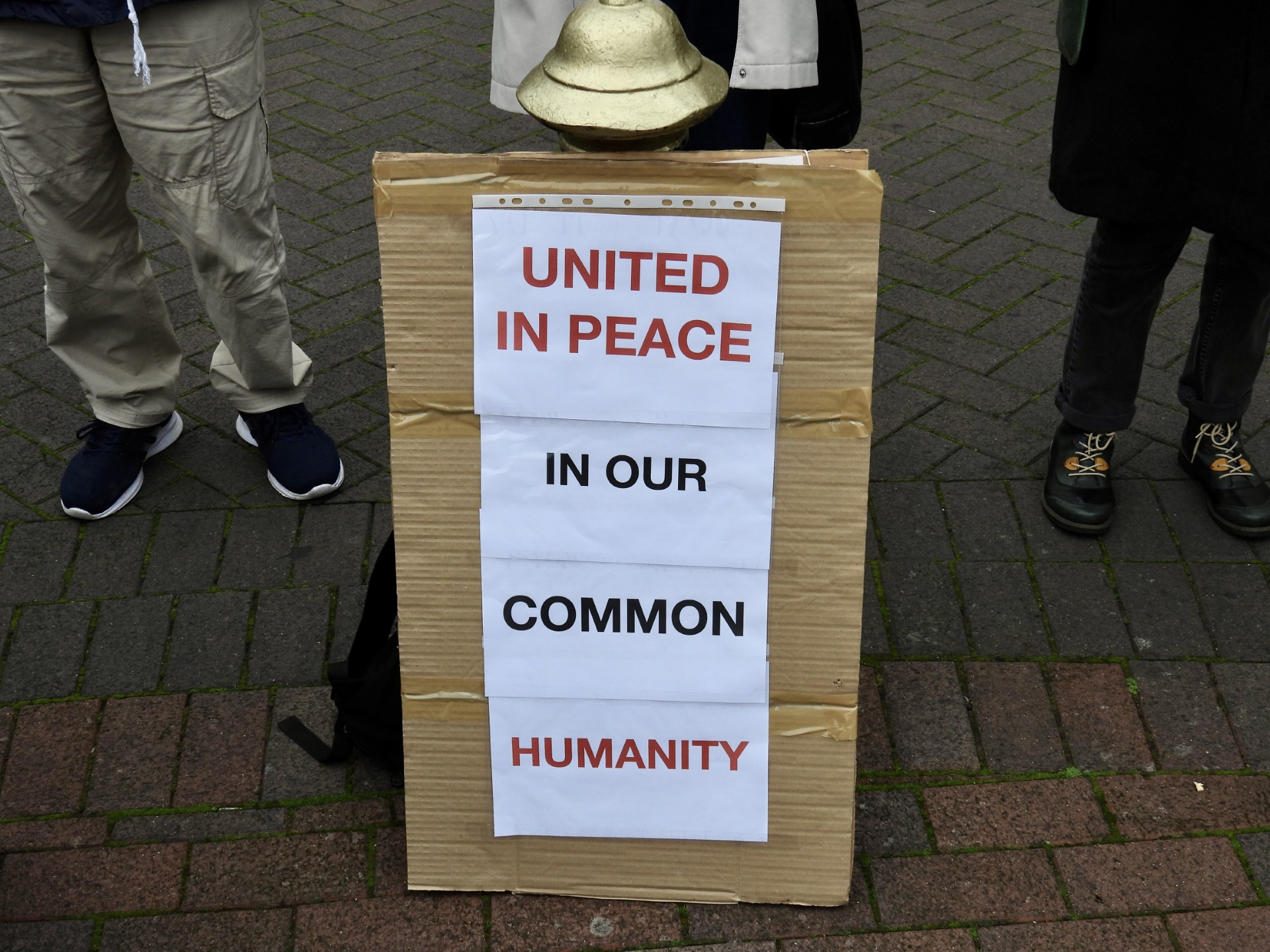
Over 30 attended the 148th vigil on what turned out to be a damp evening.
The major news this week was the decision by the Green party at their annual conference to declare Zionism an ‘ethnonationalist project’ which has drawn predictable criticism from Israel. The Israeli foreign ministry said in a post on X on Sunday that the motion “constitutes a clear antisemitic text according to the IHRA (International Holocaust Remembrance Alliance) definition, as it denies the Jewish people’s right to self-determination”.
The chief rabbi, Ephraim Mirvis, described the motion as “poisonous antisemitism” and a “threat to British Jews and to Britain”. However, as we have pointed out previously, not all Jewish people in the UK agree with the rabbi.
It was also reported last week that there has been a rise in Jewish people in the UK feeling ’emotionally attached to Israel’. This follows a longitudinal survey carried out by the Institute for Jewish Policy Research of 2,500 individuals. It has risen 13 points since the start of the Gaza war. There is also a rise in those identifying themselves as Zionist.
Our attention has been drawn to the following two items concerning how children are treated in Israeli prisons. One by Save the Children and the other a video by Al Jazeera. There is a WARNING that the latter contains distressing material.
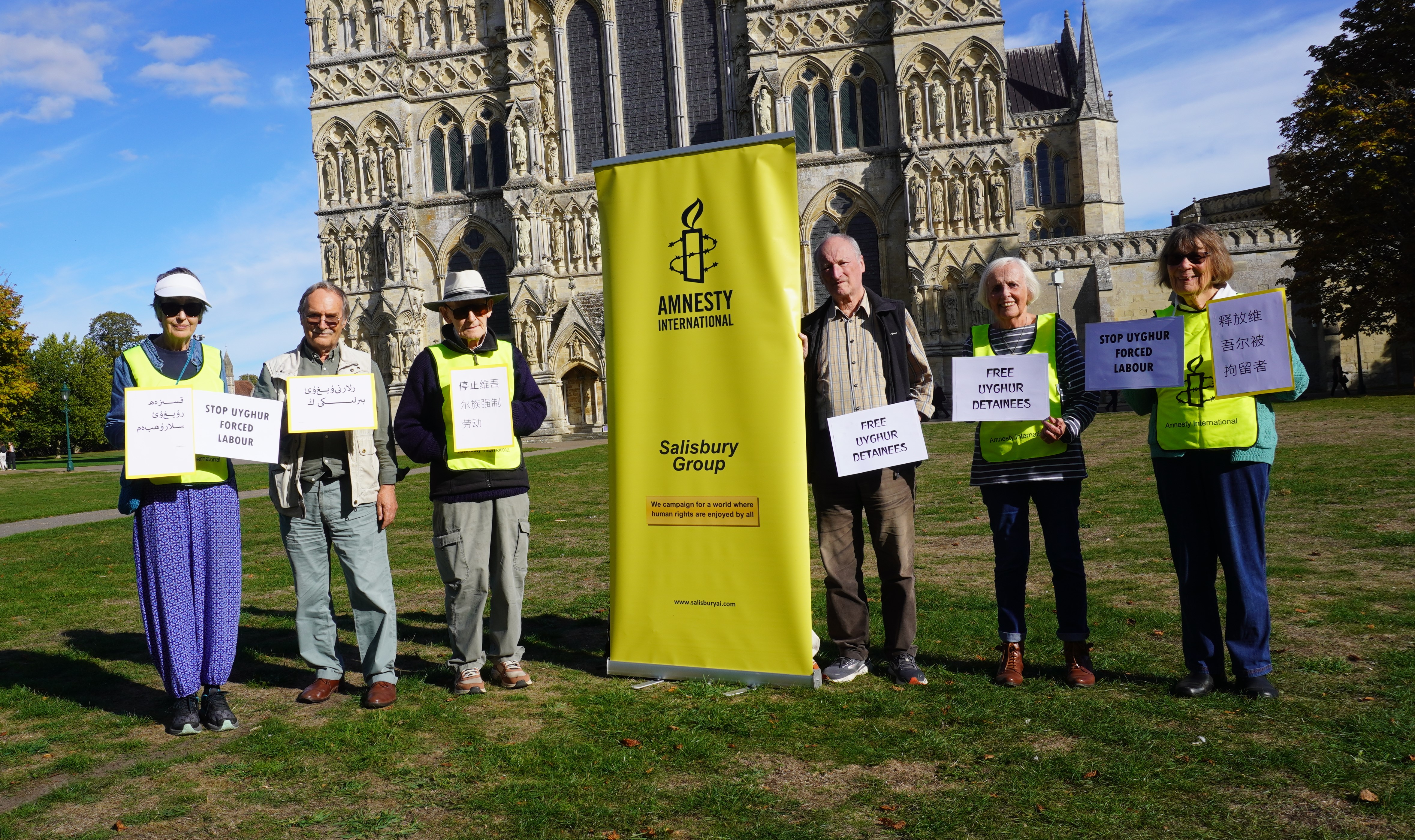
Throughout August the Salisbury group took part in the national campaign to highlight the plight of the Uyghur population in Xinjiang province in China. We reported on the extreme measures used by the Chinese to repress the culture, language and religion of this population and the imprisonment of around a million as part of a process of ‘re-education’. We also noted the vast programme of forced labour particularly of cotton much of it finding its way its way into high street clothing with seemingly little concern by our retailers.
The group held a brief photo opportunity today to highlight the Uyghurs and to keep them in the public eye.
A recent report by Global Rights Compliance suggests we may have been a bit ‘narrow’ in focusing on cotton as the latest 5 year plan for the region in which it is explained:
“The Plan’s overriding priority is to position China at the “forefront of global science and technology”, by eliminating critical technological dependencies and ensuring that its development trajectory cannot be disrupted by external pressure or supply chain coercion.
“This self-reliance shift ultimately relies on material foundations. The success of these goals depends on securing reliable access to raw materials at scale. The Xinjiang Uyghur Autonomous Region (Xinjiang) is central: the region holds the majority of China’s beryllium reserves, a material with no substitute in semiconductor manufacturing, and provides the cheap coal-based energy that makes energy-intensive mineral processing”.
This suggests the process of repression will continue because this dominance relies not just on the material itself but its processing. This will also need forced labour to achieve.
There are signs that politicians are beginning to worry about the ‘China threat’ which is on several levels. Our concern is with the rights of a people who are not Han Chinese, who are routinely persecuted and the fruits of their persecution finds its way into products we buy in the West.
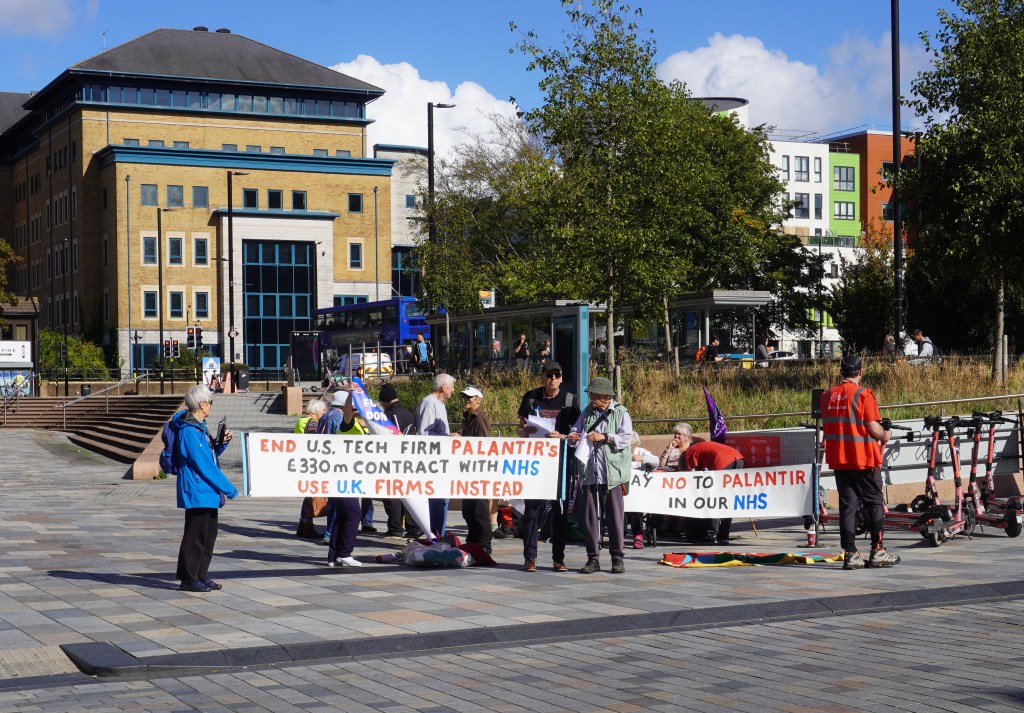
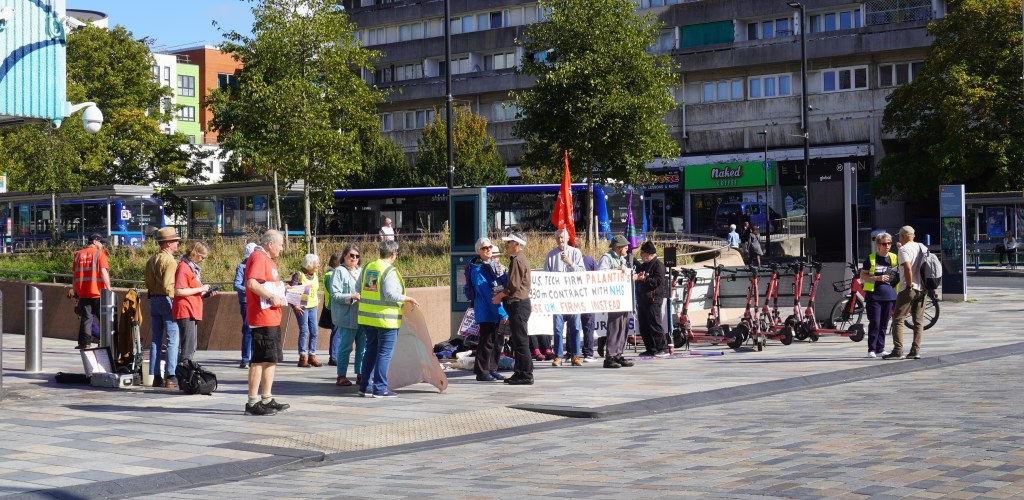
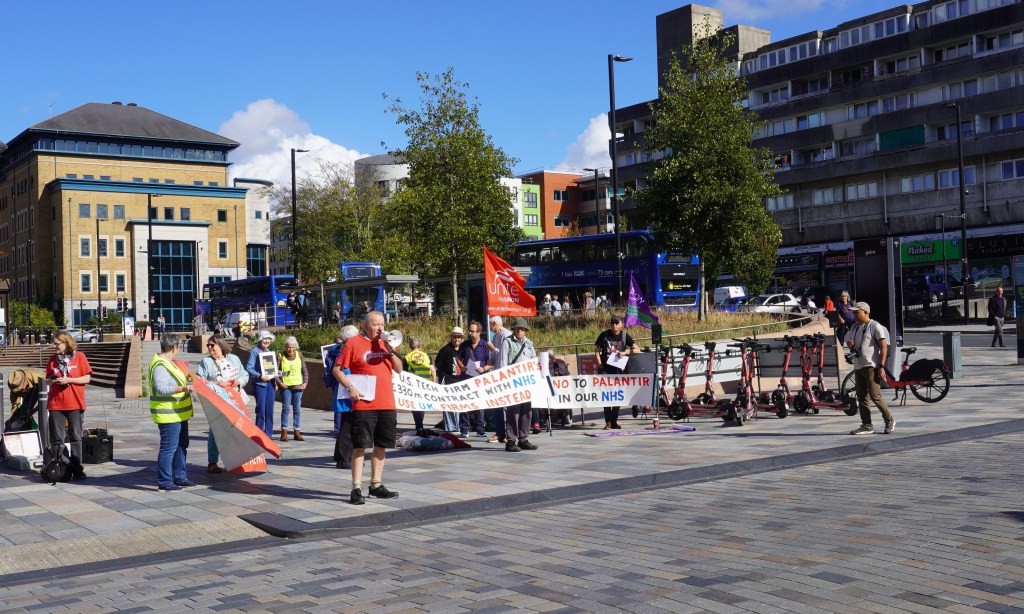
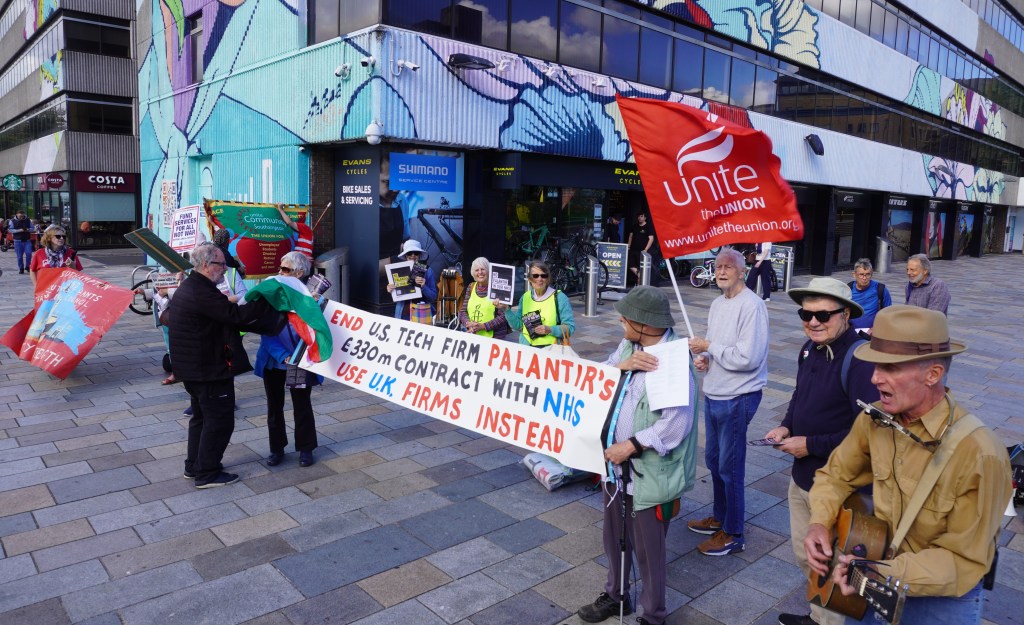
Members of the Salisbury group take part in national demonstration about this firm
October 2026
The public are slowly becoming aware of the firm Palantir and how it is increasingly being used by British institutions. Profound worries are expressed on a number of counts about the use of this firm. They include the security of the information obtained, the degree of control by government over the firm’s actions, the engagement by Palantir in the violent actions of IDF in Gaza and ICE in the US, the deeply unpleasant remarks made by Peter Thiel the owner of the organisation, and how naïve government ministers seem to place contracts of dubious merit and without proper tenders.
Members of the Salisbury group joined others in Southampton on 1st October to protest against the continuing involvement in the NHS in particular. NHS staff are particularly concerned not least because of Peter Thiel’s remarks about their organisation saying […] “the NHS makes people sick“.
Security of the information
The firm has an increasing number of contracts with the police, the MoD and the NHS. Vast quantities of information are garnered and it is claimed that major savings are made to waiting times and operational efficiency. Only they aren’t and the claims are wildly exaggerated. Our concern however is the security of the information and where the data is held. The firm claims that the data is secure but following a struggle, details of the contract were released and the elements dealing with data storage were redacted. We do not know in other words.
Government control
This is an American company and thus outside the control of our government for much of its activity. Since successive governments seem to be in awe of American tech giants the question is, how much control does our government have? Is it able to inspect the storage architecture? Can it know to what use the information is being put by the firm? The UK government has a long, long history of tech disasters and experience shows that those in the Civil Service dealing with these matters have little knowledge.
Palantir’s ‘morals‘
The firm has been more than happy to engage in some unsavoury activities. It provided the IDF with the means to coordinate all its information to enable strikes on alleged Hamas terrorists in Gaza. Although many might argue that Israel was entitled to strike against terrorist threats, the NAZA policy meant entire blocks of flats were bombed to kill one possible terrorist. They are deployed by ICE in its campaign of rounding up illegal immigrants and others.
Peter Thiel
One of the proprietors of Palantir, he is on record having made some unpleasant remarks. He is a supporter in Carl Schmitt who was active between the wars and was seen as a Nazi supporter and a leading light in the party. He is sceptical about democracy. He is of course entitled to his views and several commentators have found it difficult to quite bottom out what they are. However, he is disdainful of government controls. His combination of beliefs make one wonder how safe our information is in his hands.
Government contracts
Technology has such power these days that contracts with companies like Palantir should be subject to rigorous scrutiny and control. The original contract was placed during the Covid pandemic for £1 by Boris Johnson when he was prime minister. The new prime minister Andy Burnham is keen to promote his ‘pro business’ government which raises the question how closely will the activities of this firm be monitored.
The government is desperate to see an improvement in the performance of the NHS and a reduction in the waiting lists. Will they overlook problems of security and rights in its haste to enjoy the supposed benefits offered by this firm? It is reported that Labour may be thinking of ending the NHS part of the contract which they have to do in December.
Middle East Eye reports that a motion, put forward at the party’s conference in Liverpool by the Labour-affiliated Socialist Health Association and at least three constituency parties, urged the government to cancel the £330m ($437m) contract to process NHS data with the controversial tech giant. It said Palantir was “facing numerous allegations of involvement in serious breaches of human rights, including due to it developing technology for Israel’s military to use in its unlawful occupation of Palestinian land and genocide in Gaza”.
The motion said: “The Labour government has a responsibility to uphold public trust in politics, including in the awarding of public contracts, particularly where there are allegations of involvement in grave violations of international law.” The motion was blocked however.
Terrifying failure to execute Christa Pike in Tennessee
October 2026
It seems as far as Tennessee is concerned, actually executing someone is more difficult than might be supposed. Christa Pike was on the gurney and the supposedly lethal drugs were injected twice. Forty minutes later, she was heard snoring from behind a screen and was taken to hospital.
There seems no doubt that Christa committed the murder of a fellow 19 year old 30 years ago in 1995. She was sentenced to death at the time. As is common in America, the appeals process can take decades and last right up to the last moment. The latest appeal concerns how she was treated as a child with evidence of rape and sexual abuse.
There followed a tussle between the Tennessee Supreme Court and the US Supreme Court with the latter agreeing the execution could go ahead. Three justices dissented.
USA is the only country in the Americas still to retain the penalty and these events add a further twist to the campaign to end the penalty it including Tennesseans for Alternative to the Death Penalty. Amnesty is opposed to the penalty in all circumstances.
We may amend this post in the light of further developments. The failed execution has led to a storm of protest in the US.
Sources: Daily Mail, Daily Mirror, BBC, Guardian. We were unable to access the Tennessean.
The 149th vigil held on Saturday. Big row about the Green party motion on Zionism October 2026 A tense week on the Israel front with a major row erupting at the Green party conference arising from a motion to defining Zionism as “a political ideology which called for the creation – and, now it exists,…
October meeting minutes October 2026 We are pleased to attach the minutes of the last meeting thanks to group member Lesley for preparing them and thanks to group members for their contributions. Rather longer than ordinary minutes, they contain reports on the death penalty, the situation with refugees and immigrants, statistics and a report on…
Because … is now published. Next week will be the 150th vigil October 2026 We are pleased to announce the publication of our video Because … in which some participants of the vigils we have held every Saturday since the horrific events of October 7th and the aftermath, give their reasons for attending. This coming…
Palestine Solidarity Campaign have made the claim that ‘public anger over Israel’s treatment of Palestinians and Britain’s response was increasingly being expressed‘. The claim was made by Aimee Shalan who will become director in November.
She said Palestine becoming an electoral issue both domestically and nationally. She pointed to Ed Miliband’s recent statement and the change in policy towards the West Bank in particular. The West Bank appeared in the news in recent days because of the latest incident of severe violence involving over 100 militant settlers who overwhelmed security forces in an attack on the village of Jalud.
Several senior politicians, including the president Isaac Herzog, have condemned the violence but there is an element of shutting the stable door after the horse has bolted. Settler violence has been overtly and covertly supported by politicians and the security forces have up to now, stood by while Palestinians were attacked and their properties destroyed. It is a bit late to complain now when the scale of violence and ethnic cleansing has become so extreme.
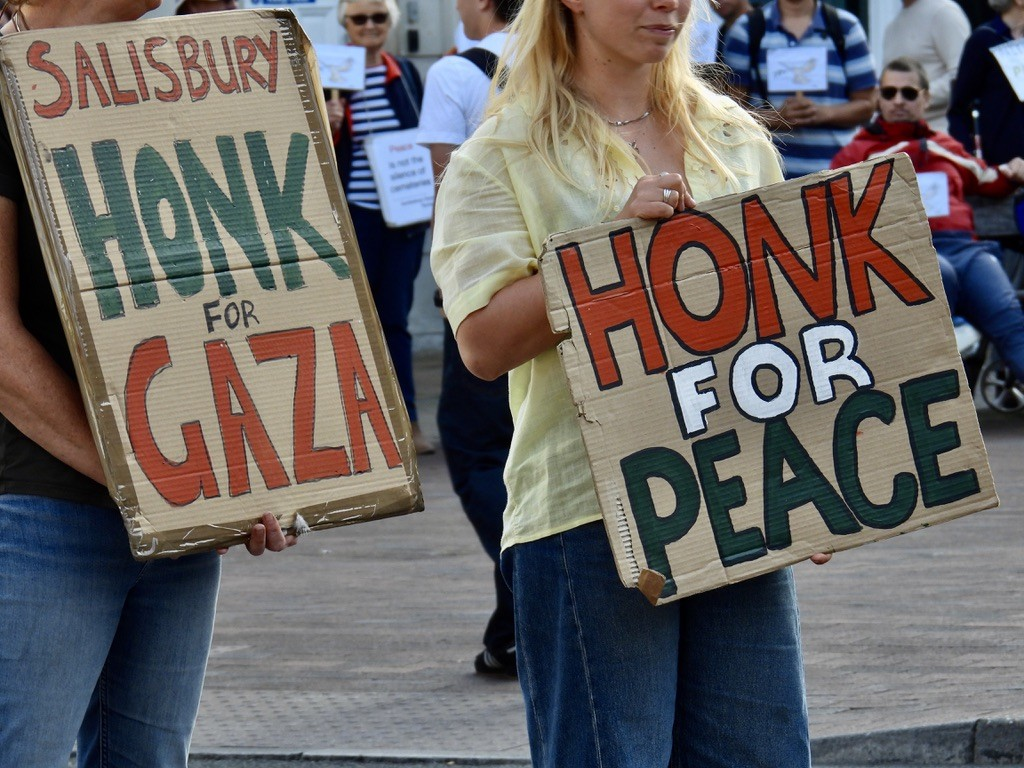
The 147th vigil was held on Saturday with nearly 40 in attendance. There was a good response to the invitation to ‘honk for peace’. The Salisbury MP, Mr John Glen. has not appeared and there was no mention of the vigil again in his weekly column courtesy of the Salisbury Journal. He is a member of the Conservative Friends of Israel group.
Film update – Because …
Our film Because ... is progressing well and will be finished ready for the 150th vigil. Most interviews have been completed.
Three years since the October 7th massacre. What have we learned? The first casualty of war is truth is a well worn saying and in the case of the war in Gaza it can be modified to say truth has been a continuing casualty. In this post we want to discuss the things we have…
A scarcely believable wish by Pete Hegseth to live stream an execution by firing squad The Defense Secretary, Pete Hegseth, wants to live stream the execution by firing squad of Nidal Hasan who murdered 13 at a medical processing facility in Texas in November 2009. President Trump is reported to have agreed to it. America…
We include a text today largely written by Floridians for Alternatives to the Death Penalty, concerning the execution of Curtis Beasley on 29th of September. Florida is on something of an execution spree partly because the Governor, Ron DeSantis, believes in its effectiveness as a deterrent. There is no evidence for this.
Tonight, the People of the State of Florida executed Curtis Wilkie Beasley, Sr. for the 1995 murder of Carolyn Monfort. In this gubernatorial administration alone, that makes him the 44th execution, the 13th veteran, the 14th senior citizen, and the 27th person condemned to die despite a non-unanimous jury vote for death.
Carolyn Monfort was murdered in her own home by someone she knew and had welcomed there. She had a family, a life, and people who expected to see her again. Her life deserves our recognition in its own right, even as we oppose the way Florida chose to bring her story to its conclusion.
Some executions command the attention of our state and even the whole US. Others happen quietly, while most people go about their Tuesday evening. Florida’s unprecedented and remarkable pace of executions over the past two years makes that possible. Before we have finished saying one person’s name, another death warrant is signed. The names blur and the numbers rise, and those who aren’t closely following along are none the wiser. This is part of the administration’s plan to overwhelm and desensitize. To let everyday Floridians forget that all of this killing is happening in their names.
The Case
Curtis’ case drew comparatively little of the attention that others have drawn. But the facts deserve to be heard nonetheless. Curtis‘ case is a prime example of the arbitrariness of Florida’s death penalty. Over the past month, his lawyers have fought to bring this disparity to light. The courts continue to turn a blind eye.
Curtis was sentenced by a non-unanimous jury, a practice found almost exclusively in Florida. Florida requires a jury vote of 8 to 4 to sentence someone to death, while Alabama requires a supermajority of 10 of 12 votes. Every other death penalty state has rejected this practice.
The right to a jury trial is firmly rooted in the nation’s fabric. So is the history of denying some jurors a meaningful voice. Non-unanimous jury rules took hold in the Jim Crow era as a way to let Black people sit on juries while allowing other jurors to disregard their votes. In a 2020 landmark case called Ramos v. Louisiana, the U.S. Supreme Court confronted that history and held that a jury must be unanimous to convict someone of a serious crime.
This term, the Supreme Court will consider another part of that promise: whether the right to a jury trial requires twelve jurors, rather than the six Florida uses in most criminal cases. Florida asks a full jury of twelve to decide a capital case, but permits a death sentence even when one, two, three, or four of them believe life without parole is the appropriate sentence. The questions before the Court are different, yet they reach the same concern: whether the state can call people to serve on a jury and then diminish the force of their voices. That is exactly what happened to the two jurors who believed that Curtis Beasley should live.
Before drugs and alcohol carved a destructive path through his life and led to the violence that landed him on death row, Curtis lived a life that many of us would recognize. He played Little League baseball and went to Bible camp. He won the Perfect Attendance award in 4th grade. He had an after-school job at a T.V. repair shop, started a garage band with his friends, and listened to country music. He was president of his senior class. He volunteered to serve our country in the Army, and did so honorably, during a time of intense anti-military sentiment. He was a father, a son, and a brother. He was more than the 44th, 13th, 14th, or 27th – more than a statistic in this steady stream of violence.
We will keep telling these stories, including the ones that receive less attention as Florida continues to carry out executions at a pace unrivaled by any time period in the State’s recorded history. Tonight we remember Carolyn Monfort and the life taken from her. We remember Curtis Beasley as a whole person, too. Neither should disappear into the count.
Pip: If you’ve ever wondered why British arms keep flowing to conflict zones despite mountains of evidence of civilian harm, welland2 has spent considerable effort mapping the answer — and it turns out “political cowardice, greed, and some perverse thinking” covers a lot of ground.
Mara: This episode follows that investigation closely — the machinery behind UK arms exports, the seven structural reasons those exports continue, and what it means for Gaza, Yemen, and British credibility on the world stage. Let’s start with how those exports get justified, and why they keep surviving scrutiny.
From Gaza to Yemen: Why UK Arms Sales Keep Flowing
Pip: The central question here is not whether harm is happening — the evidence on civilian deaths, destroyed hospitals, and ethnic cleansing is described as copious — but why successive governments, across both main parties, have worked so hard to keep the arms flowing anyway.
Mara: The post lays out the official reasoning and then dismantles it. On the pattern of civilian harm, it quotes directly: “a few incidents do not a pattern make, and the motives of those doing the killing cannot be known.”
Pip: That framing — we can’t know why they’re bombing the hospital — is doing a lot of work for a lot of arms licenses. The post calls the overall picture, plainly, lying.
Mara: Seven structural reasons are offered. Economics comes first: around 300,000 people are employed in the sector, many in marginal constituencies. But York University studies are cited showing the net economic value is nowhere near the headline figures once corporate welfare is factored in.
Pip: So the jobs argument is itself propped up by subsidies. The revolving door compounds it — 604 individuals moved from ministry or military roles into arms firms between January 2017 and June 2022, with CAAT describing it as “open office” corruption.
Mara: The post also identifies the F-35 issue as a sovereignty problem in plain sight. British-made components go into weapons used over Gaza and Lebanon, but the claim is they can’t be tracked — which the post calls an insult, given that goods are routinely tracked electronically. The real reason, it argues, is unwillingness to confront Washington.
Pip: Sovereignty reclaimed from Brussels, surrendered quietly to the Pentagon.
Mara: Fear of the antisemitism label is named as another factor — described as having percolated into media coverage, with the BBC reporting cited for double standards on language around hostages and prisoners. And roughly 150 MPs hold membership in Friends of Israel groups, raising direct questions about impartiality on arms votes.
Mara: The conclusion is direct: “It is a cover for political cowardice, greed and some perverse thinking around supporting Israel and the arms industry generally.” Yemen is named alongside Gaza — years of bombing, a massive death toll, and nothing resolved.
Pip: And the same pattern — unqualified support for Saudi strikes on civilian targets — repeated without apparent reflection.
Mara: The post ends by arguing that arming a regime conducting ethnic cleansing only postpones a reckoning, and that Britain’s role should be supporting dialogue and a viable Palestinian state — a commitment the UK has now formally made. The gap between that commitment and current arms policy is the political failure the piece is naming.
Pip: The stakes don’t get much higher than “destroys any hope born of the post-war Universal Declaration.” That’s where we land.
Mara: The through-line across all of this is the distance between stated values and actual policy — and the structural forces that keep that distance in place.
Pip: Next time, presumably, we find out whether any of those structures have shifted. The evidence so far suggests they are slow movers.
In the previous post we discussed the recent report Dead Letter published by the Campaign Against the Arms Trade, the webinar held by them, and the Channel 4 Despatches programme, which all described in some detail the contortions carried out by successive governments to justify the selling of arms to murderous regimes. Also discussed was the involvement in the legal system in some of the bizarre reasoning employed to fight off claims by human rights groups such as Al Haq and others that what they were doing was contrary to international human rights law.
The shear extent of what can only be described as lying is staggering. Despite copious evidence of death of civilians and the destruction basic infrastructure such as schools, hospitals and mosques, the bombing of water treatment plants and a deliberate policy of ethnic cleansing, successive governments have clung on to arguments such as a lack of evidence, a few incidents do not a pattern make, and the motives of those doing the killing cannot be known. Anything in fact to justify the continuation of arms sales.
Why?
Which prompts the question why? Why are politicians of both main parties so desperately keen to maintain these fictions? Why have they watered down regulations of what can or cannot be sold? Why do they persist in the argument that we have one of the more robust export regimes in the world when patently it is not?
In this essay we want to suggest some reasons. Necessarily, it cannot always be evidenced as efforts are made to conceal anything which might compromise the government or ministers. It is largely speculative therefore. We suggest there are seven major reasons why we have the system we have.
Economic and the need for jobs
The arms industry employs large numbers of people many of whom are in marginal constituencies [it was always argued thus but in view of recent political upheavals, what is or is not a marginal is now somewhat questionable]. There are around 300,000 people employed. Further, it is one of the few sectors in the economy which has seen significant growth. Adopting some kind of moral policy and concerning itself with the rights of those at the receiving end of weaponry, would have a serious effect on these numbers.
Post war effects
After the war, Japan and Germany were unable to develop their arms firms which provided an opportunity for the UK to shine. Whereas those two countries modernised and produced a range of products which steadily ended many UK firms’ ability to compete (cars and electronic goods for example), arms were not among them. Considerable support was provided by the UK government to the industry. However, claims of job creation and economic value are considerably weakened when the degree and scale of ‘corporate welfare’ is taken into account. York University has produced a number of studies showing the net value is nowhere near the headline claims by politicians.
Nevertheless, it is an area where British firms do have a presence on the world stage, despite its questionable economic value.
Close links to the US
It is interesting to reflect on the enormous fuss made at the time of Brexit where ‘take back control’ and ‘regain our sovereignty’ were two of the key messages. Yet we have lost these to the Americans. Witness the F-35 arguments where it is claimed the 15% made in the UK cannot be tracked. They are a key weapon in the destruction of Gaza, bombing of Lebanon and the attack on Iran. The tracking claim is to insult the British people who know full well that goods nowadays are tracked electronically. The reason is not being able to stand up to the Americans and the likely threat to future partnership deals. If our sovereignty was ever lost it has been to the US not Brussels. It is even claimed that the moment the items are manufactured, ownership passes immediately to the US so we cannot embargo their sale to Israel.
Anti-Semitic and anti-Israel claims
Any or all criticism of Israel and its actions are deemed anti-Semitic. These claims seem to have struck fear into the heart of the British political establishment. They were a powerful force in the removal of Jeremy Corbyn. Sir Keir Starmer worked hard to ‘rip out anti-Semitism by its roots’ as he put it. The nature of the anti-Semitism under Corbyn is difficult to bottom out. A lengthy BBC report delves into it in some detail and some of the evidence seem tenuous to say the least. It does appear that the party was slow to take disciplinary action where there were incidents but Corbyn’s stance against anti-Semitism seemed clear. Inevitably, as in any organisation, there are going to be individuals who are anti-Semitic.
What is important is the perception but it does seem clear that the policy of claiming that any or all criticisms of Israel has taken root. It has been effective and has percolated into the BBC and other parts of the media. We reported on the Centre for Media Monitoring’s report into BBC reporting in an earlier post. They describe the double standards, muffling of Palestinian voices and language issues amounting to severe bias. For example, they frequently reported that Hamas seized ‘hostages’ whereas Israelis took ‘prisoners’. Both were hostages and both were kept incommunicado and badly treated. The word ‘prisoner’ suggested some kind of judicial process had taken place. Evidence of an Apartheid state has almost never been mentioned by BBC commentators despite the copious evidence produced by Amnesty, Human Rights Watch and Israeli human rights groups.
Slowly, things seem to be changing however and the recent statement and actions by Ed Miliband the Foreign Secretary are a welcome if belated sign. Israel is losing the moral high ground and is fast becoming an international pariah. Witness the huge walkout of delegates at the UN when Benjamin Netanyahu rose to speak.
MPs easily manipulated
That around 150 members of parliament are members of their party’s Friends of Israel groups is shocking. In a previous post we discuss how easy Israel seems to find engaging impressionable and naïve newbie MPs to their point of view with cleverly crafted visits to Israel and other financial support.
Any question of curbing sales of arms has to overcome this quiet army of closet supporters of the regime. The question has to be asked: how can an MP properly act dispassionately in deciding what is in Britain’s and Palestinian’s or even Israel’s best interested if they are members of what is believed to be the best funded parliamentary lobby group? Both Sir Keir Starmer and David Lammy were staunch members and so is Andy Burnham the new prime minister.
Further, when one or other of these MPs are interviewed, their membership is only rarely mentioned by interviewers.
The Revolving Door
This is the deeply corrupting matter of senior military staff, senior civil servants and ex-ministers, heading off to take up lucrative directorships or consultancies with arms companies. Both Transparency International and CAAT have criticised this. CAAT terms it ‘open office’ corruption.
The numbers are quite staggering. No less than 604 individuals moved from ministry or military roles into arms firms between January 2017 to June 2022. Quite apart from the undue influence taking place, it has led to poor scrutiny, delivery failure and massive budget overruns. The suspicion is that with a promise of a lucrative post retirement appointment, awkward or challenging questions are not asked. Proper scrutiny is not carried out. Neither are questions asked about moral or humanitarian issues arising from the use of the weapons. The now abolished ACOBA controls were widely condemned as toothless.
Racism
Underpinning much of the attitudes and biased media reporting is racism. Arabs and Palestinians are regarded as untrustworthy and uncivilised (algebra?). This appears in claims of Britain being overrun by Moslems and London becoming ‘Londonistan’ subject to Sharia Law: Islamophobia in other words.
Whereas anti-Semitism receives a great deal of coverage (rightly) and necessary police action, anti-Palestinian attitudes do not get the same attention. British politicians like the local MP, Danny Kruger, can quite casually claim that ‘all the deaths in Gaza are the fault of Hamas‘. It is difficult to believe this blanket statement of blame would be applied to an attack on another racial group. There, cries of ‘indiscriminate’ would be heard. The different treatment of Palestinian deaths in comparison with Israeli has been a feature of criticisms of media coverage.
Security
A frequent reason which crops up is security. This argument seems to hinge around the role Israel plays as a source of information about the Middle East. Israel has a fearsome reputation in the field of intelligence and western powers including the UK are keen to avail themselves of it.
Conclusions
To many, the continuing and obdurate policy of successive British governments has been baffling. In the face of mounting evidence, the continued support for arms sales seems insupportable and unconscionable. In this essay, we attempted an explanation based on a variety of factors we have discussed. Essentially they are about money, jobs dependant on the sales, corruption and a willingness of the political elite to follow the Israeli line. Fear of the anti-Semitism tag is also a factor.
It hasn’t just been Israel: a similar pathology has been witnessed in the Yemen conflict. There, unqualified support for the Saudi bombing of multiple civilian targets was seen. Arms are still being supplied to UAE despite strong evidence that they are passed on to the RSF in Sudan.
The public approaches this from having witnessed terrible scenes on the news despite the banning of independent news media into Gaza and the steady murder or assassination of journalists by the IDF. (More have been killed than in any other comparable conflict). Many feel deeply that this isn’t right and the UK should have no part of it.
These views find few favours in Westminster for the reasons we have suggested. Their answer is to erect ever more contorted arguments in support of an indefensible position. This is more than speculative as the Despatches programme revealed. They showed that great efforts were made by the Foreign Office to conceal details and not to leave a paper record. It is a cover for political cowardice, greed and some perverse thinking around supporting Israel and the arms industry generally.
The ultimate tragedy is that it won’t. Supporting a thuggish regime to carry on a programme of violence and ethnic cleansing creating along the way an entire new generation of young people bent on revenge, merely postpones the ultimate reckoning. Israel is a superpower in the region and giving them more and more weapons is merely to pour petrol on a fire. Years of bombing Yemen and a massive death toll has solved nothing.
British involvement in this activity destroys any hope born of the post war Universal Declaration with its claims of ‘never again’. Our role should be to support moderation, dialogue and actively to support the creation of a viable Palestinian state (which the UK is now committed to). Our political class is profoundly letting the nation down. It represents a massive political failure for a range of unworthy reasons.
CAAT report describes how governments have continued supplying arms despite evidence of war crimes
September 2026
The Campaign Against the Arms Trade have just published a report called Dead Letter in which it details successive government’s determination to continue to supply arms despite mounting evidence of mass killing and war crimes. Reading the report it is difficult to believe we have governments with any semblance of integrity or humanity.
CAAT and other human rights agencies including Amnesty, have made various attempts to challenge the government but the legal process has been sadly and woefully insufficient to force them to change their ways. We have documented over several years the UK’s involvement in Yemen and more recently, Gaza and described the horrific death tolls which have taken place in both theatres.
Yemen
Up to the end of 2021, around 377,000 died in Yemen. The Saudis attacked population areas including hospitals, mosques, public gatherings, and food, water, energy and transport infra-structure. Few of these had a military objective. Despite copious evidence from a range of human rights organisations, the UN and observers on the ground the government claimed ‘it had not found evidence of International Human Rights non compliance‘. It relied solely on the evidence produced by the Saudis’ own Joint Incident Assessment Team which unsurprisingly, found nothing wrong. All other evidence was ignored.
Further, they argued that a small number of incidents did not represent a pattern despite the huge number of raids and the resulting death toll. British companies and the RAF were directly involved in the destruction.
Gaza
A similar pattern of behaviour was evident in Gaza. Here, despite the massive destruction of property in the territory, the policy of NAZA which involves bombing an entire apartment block in order to kill one suspected Hamas operative, the government steadfastly continued to supply arms to Israel. Their arguments here were specious beyond belief. Despite knowing of the destruction and killing of tens of thousands of Palestinians, they claimed they did not have sufficient information as to why the IDF and therefore could not conclude that it was a breach of IHL. This despite copious statements by senior Israeli politicians making it plain they were seeking the destruction of Palestinians.
Webinar
CAAT organised a webinar on 24th September which speakers from Mwatana and Shadow World Investigations discussed the report and its implications. An additional aspect is the ‘revolving door’ where senior military personnel, civil servants from the MoD and some politicians, take up lucrative directorships or consultancies when they retire. This thoroughly unsatisfactory and corrupt system goes a long way to explaining the almost desperate desire of governments to do almost anything to continue selling arms despite the terrible consequences of doing so.
It has had an effect on our politics in the UK. So desperate are the government that our democracy is being subverted. Protestors are arrested and the freedom of association is being curbed. Just reflect that our government is busy selling arms which cause terrible destruction and do not seem to achieve any tangible benefits for anyone at all (belligerents included) yet it is protestors who are arrested and accused of terrorism. Even the judicial process is corrupted by altering charges after sentence had been passed.
Special contempt was reserved for Sir Keir Starmer and his dreadful statement on the cutting off of food, water and power to Gaza. The Channel 4 Despatches programme aired on 24th, discusses the same issues focusing mostly on Gaza. It has obtained a mass of internal Foreign Office documentation showing that the government well knew what was happening but chose to look the other way. David Cameron comes off particularly badly.
Political process
The report is a must read and sets out in detail the extent to which our politics have been corrupted by the arms trade. The problem is that both main parties are involved so that there is no proper scrutiny. Recent events and statements by Ed Miliband are encouraging as far as they go but such are the tentacles of corruption whether real change will take place remains to be seen.
However, one is left with the question: why do our politicians twist themselves into such contortions to defend the indefensible?