Podcast Episode: Humanism And Middle East Debate


Pip: If you’ve ever wondered how a government squares “we stand for democracy and the rule of law” with “also, here are some more weapons” — welland2 has been to a festival that asked exactly that question.

Mara: This episode covers talks from the Festival of Humanism: UK foreign policy in the Gulf, and a debate between an Israeli and a Palestinian that was so in demand it had to be repeated in a bigger hall. Let’s start with what those festival talks said about conflict, hypocrisy, and who gets a seat at the table.

Festival Talks On Conflict

Pip: The through-line across both festival sessions is a single uncomfortable question: when Western governments talk about human rights and the rule of law, are they describing a principle or a brand?

Mara: Dr David Wearing’s talk at the Festival of Humanism set that up directly. The post captures his framing of Britain’s governing class this way: he made “the distinction between ‘we’ meaning them and ‘we’ meaning the population at large.”

Pip: That distinction does a lot of work. It means the arms sales, the training of security forces, the quiet financial entanglement with Gulf monarchies — none of that was put to a public vote. It happened in the gap between those two “we”s.

Mara: Wearing traced the history back to oil — Britain establishing protectorates around the Arabian peninsula primarily to secure supply — and argued the logic never really changed. The post notes he pointed out that “we would find it difficult to support our arms industry without the sales to the Gulf states.” The economic interdependence runs deeper than arms: legal services, accountancy, sovereign wealth funding the UK deficit.

Pip: The self-deception angle is what lands hardest. He describes RAF personnel actively involved in supporting Saudi forces during Yemen, while a senior army figure talked about the “rules based international order maintaining peace and prosperity.” That’s not a gap between rhetoric and reality — that’s a chasm.

Mara: The post calls it “an almost baffling lack of awareness.” And Wearing connects it explicitly to a colonial mindset — one that made it easy to view the region as backward, which in turn made it easier to look past the death penalty, the imprisonment of journalists and activists, the denial of women’s rights.

Pip: His book AngloArabia is flagged for anyone who wants the full argument in print.

Mara: The second session — the Israeli-Palestinian debate — and drew such a crowd it had to be repeated the following day in a larger hall. A British-Israeli software engineer and a British-Palestinian paediatrician spoke together, and the post deliberately doesn’t attribute individual points to individual speakers. The point being that some of the positions would surprise you about who held them.

Pip: One of those positions: “the conflict was about land — religion was very much a secondary factor.” Another: “armed resistance has made life more difficult for those it seeks to support.” Neither of those is a fringe view from outside — they came from inside the room, from people with direct stakes.

Mara: The post closes on a note that connects back to Wearing’s argument: outside interference — the Gulf dynamics, the arms flows — is “a factor in the perpetuation of violence.” The two sessions sat together, and they did.

Pip: And if the governing class won’t have the conversation, apparently a humanist festival in Bournemouth will.

Mara: The same logic — who gets heard, who gets excluded — runs straight into the questions the group is raising closer to home.


Pip: Two festival sessions, one through-line: the distance between what governments say they stand for and what the money actually does.

Mara: And the argument that ordinary voters are largely excluded from that gap. Worth watching what the group surfaces next.

An Israeli and a Palestinian debate


Debate between the two at the Festival of Humanism over the weekend

June 2026

So popular was this debate that many couldn’t get in so it was repeated the following day in a bigger hall. The two speakers were Yaniv Aknin who is a British-Israeli software engineer currently working in London. He was born and raised in Israel but left in 2013. Jasr Kawkby is a British-Palestinian paediatrician currently working in East London. He was raised as a Muslim in Palestine.

It would be usual in a write-up of this kind to discuss what A said then to discuss B, making clear thereby who said what. We will not do this in this instance and just discuss what was said by both. These are some of the points made:

  • It was pure chance where you were born and whether you were Moslem, Christian or Jew.
  • Language was important. To call what happened a ‘war of independence’ was quite wrong. It was a colonial war. To live in a land where the ‘natives’ were expelled and prevented from returning was morally wrong.
  • Armed resistance has made life more difficult for those it seeks to support. It has alienated foreign support.
  • Suffering has been inflicted on those with no responsibility for the plight of Jews [in history].
  • Israel must stop its barbaric actions [for example] denying food aid in Gaza and must respect the rights of Palestinian prisoners in Jewish gaols.
  • [In answer to a question] the conflict was about land: religion was very much a secondary factor. It was however a complicating factor.
  • Zionism was a wrong ideology.
  • Most destruction of human life was by Israeli forces [meaning the IDF from other comments he made].
  • Pressure should be applied to Israel until it complies with human rights. We must recognise the oppression of Palestinians.
  • The lack of unconditional support from the West seen as a betrayal or anti-Semitism.
  • Religion was a catalyst for violence: how can we spread non-religious ideas? [This was a Humanist conference].
  • We should not be selling arms to Israel.

You might believe some of the answers are obviously from one ‘side’ or the other. You may well be wrong. There were in fact some surprises. This is to illustrate that there are those from the region – whether Jew or Moslem – who see both sides and recognise some of the wrongs that are committed. Because so much air time is given to extremists, we can be led to believe that they are representative of the population as a whole. It demonstrates that perhaps there is some chance in the future for some kind of reconciliation. The interference by outside forces – discussed in our last post in relation to the Gulf – is a factor in the perpetuation of violence.

Images: Yaniv (top); Jasr (lower)


Recent posts:

Refugee event this Saturday


The group will be in the Market Square on Saturday as part of Refugee Week

June 2026

Immigration, refugees and asylum seekers are top of the political agenda and generate huge anger in many communities. Some is understandable with a firm called Serco buying up properties and converting them into HMOs* filling them with among others, immigrants.

The debate around this topic has fuelled more heat than light. As we have noted in our reports, the general impression is of an ever rising trend of immigration, mostly by boat, and all of them being housed in ‘luxury’ hotels. They are taking our jobs and are responsible for a great deal of crime it is claimed. Some politicians and their parties have responded to these ideas, with great success. A key element of the forthcoming Makerfield by-election will be the immigration issue.

QUIZ

So how true is all this stuff? How sure are you of your knowledge around this issue? You can find out on Saturday 20th starting at 9 am and finishing at noon in the Cheesemarket (outside HSBC). There we will be hosting a quiz.

This is important in the sense that massive amounts of misinformation and false beliefs are determining policy. The value that immigrants bring to the economy is largely overlooked. The reaction to the Channel crossings verges on the hysterical. There is not denying there are problems to do with immigration but the scale of them is much exaggerated. So come and find out!

*house in multiple occupation


Understanding the Hypocrisy in UK’s Gulf Policies


Brilliant speaker at the Festival of Humanism

June 2026

Dr David Wearing gave a brilliant speech to the Festival in Bournemouth on the role of the UK in the Gulf. He set his observations in an historical context and provided a cogent analysis of the way we, and other countries in the West, have supported the despotic regimes in Gulf. The recent trade deal was celebrated by the government with no apparent concern for the welfare and rights of its people.

He anchored his talk in the attitudes of Britain’s governing class making the distinction between ‘we’ meaning them and ‘we’ meaning the population at large. Some of the latter are not comfortable with how our governments have joyfully provided arms and succour to these regimes despite their appalling human rights record.

He pointed out the arrant hypocrisy of government ministers and others in the governing class, talking about ‘British power standing for free trade, the rule of law and democracy’, polar opposites of what is happening in the Gulf. We have consistently supported illiberal regimes and quoted a speech made by Tony Blair at the time of the Iraq war.

The 2011 Arab Spring saw uprisings in many North African and Arab states. They were gradually extinguished often by brutal means. He pointed out that the security forces were often trained by the West including the UK.

Oil

The history is basically about oil and its discovery in what was then Persia. Britain set up a series of protectorates around the Arabian peninsular with the primary objective of securing the safe supply of this valuable resource. As the rest of the world gradually moved towards more liberal regimes, the Gulf monarchies were supported first by the British and gradually by America as it became the power in the region.

One of his main points was how closely tied we are to these states. People are aware for example, of investment in football clubs like Newcastle and Manchester City. They are less aware of how much we need their money to fund our deficit. We are aware of the arms sales but less aware of the ‘soft’ exports of accountancy, legal and other services. The economies are closely tied with a high degree of inter-dependence.

He noted that we would find it difficult to support our arms industry without the sales to the Gulf states. Our low investment in defence (defense) is subject to political attention at the moment with the resignation of the Defence Secretary last week.

Self-deception

His main theme is the degree to which we tell ourselves stories. Britain was deeply implicated in the Yemen war with our people and the RAF closely involved in supporting Saudi forces in their bombing campaign. He spoke disparagingly about the head of the Army who talked about the ‘rules based international order maintaining peace and prosperity’. An almost baffling lack of awareness.

It was closely linked to a nineteenth century colonial mindset where we viewed the Middle East as populated by backward peoples in contrast with the civilised and advanced West. Rather forgets the contributions to optics, astronomy, medicine and mathematics from that region (the invention of algebra for example, and the words for the angles of a triangle are Arabic in origin). This thinking by the governing elite makes it easy to carry on supporting Israel with arms sales and ignoring the use of starvation as a weapon of war.

He touched briefly on the actual links between their monarchs are ours with visits by members of the Royal Family to the region and their visits here.

A fascinating talk which made explicit the ‘double think’ in our dealings with the region and where the ordinary voter is excluded from the debate. Money and arms sales dominate the thinking helped by a colonial mindset. Concern for the lives of political opponents, human rights activists and journalists, who are frequently arrested and held for years; the huge use of the death penalty, and the lack of rights of women does not seem to trouble our political leaders. Much play is made of Sir Keir Starmer’s (prime minster at the time of writing) background as a human rights lawyer, yet there is no sign of this, no sign at all, in his speeches on Gulf related matters.

His book AngloArabia – Why Gulf Wealth Matters to Britain (Polity Press) is available.


Recent posts:

Group minutes: June


Minutes and Newsletter for the June meeting

June 2026

The latest minutes are available thanks to group member Lesley for the work in preparing them. More than just minutes, they contain a lot of interesting material on the death penalty, the increasingly worrying state of rights in the UK, immigration matters and statistics concerning our website and other social media activity.

We shall be in the Cheese market this Saturday 20th June from 9 am with our refugee quiz. This is Refugee Week and the whole topic of refugees, immigration and asylum seekers raises more heat than light with considerable mis and disinformation. So if you are in the Salisbury area, pop along and see how you get on.


Latest posts:

Immigration a hot potato again


Immigration has shot to the top of the political agenda again with a vengence

June 2026

Riots in Belfast with houses lived in by immigrant families burned out, a massive police presence with water canons being used and civil disturbances in Southampton, have filled out screens in the past few days. A fierce debate in parliament and what some might term inflammatory statements by politicians have added to a sense that there is a crisis at the centre of which is immigration.

The violent knife attack by a Sudanese man who had entered Northern Ireland via the Republic, and before that France, has inflamed tensions with mobs directing their ire at all immigrants even those who have lived here for years and are a key part of the NHS for example. Posters in Southampton said things like ‘Enough is Enough’ and ‘Illegal migration is destroying our civilisation’. They claimed solidarity with those in Belfast. There were also counter protests (see image).

As with so many things to do with immigration, there is a great deal of misinformation fuelled by social media in particular although print media is not too far behind. Elon Musk has been widely criticised for his remarks on X and the promotion of comments by Tommy Robinson and Rupert Lowe (Restore Party).

Immigration: some of the facts

To get a global perspective on the trends in migration, a recent article in the Journal of Refugee Studies has found that most “forced migration”(its preferred term) in recent years has taken place in the Global South (76%), most of that being into neighbouring countries (in Africa and Asia primarily).  Turkey and Iran have been the biggest recipients.  At the same time, the UNHCR say that 10% of global refugees (some 11 million) have lost funding from the Commission in the last year.

In Europe, the Chisinau conference on dealing with the immigration issue ended without a decisive result.  Last year 7 Council of Europe countries declared that the ECHR had “gone too far” and “protects the wrong people.” The Secretary-General convened this meeting of European justice ministers, which issued a joint statement (not including France, Germany, Spain or Turkey, who take 60% of refugees to the continent), reaffirming their commitment to the ECHR, but allowing some movement in removing claimants and using offshore hubs.  The declaration is not legally binding, so local laws override it.  It is worth pointing out that only 0.7% of foreign offenders have won appeals against the UK at the Court (and a recent case at the UK Court of Appeal has shown how hard it is to use the infamous Article 3 argument).

Are the figures up or down?

Latest (2025) figures on irregular immigration to Europe showed Spain as the main host, followed by Italy and France (UK was 5th, but only 9th on a per head basis).  It is worth noting, though, that the number of arrivals on the European borders is down this year (by 40%), as it is in Britain.

In Britain, the latest British Future survey of public opinion noted that 49% of respondents believed that immigration is rising, when it is falling rapidly.  They also believed that asylum seekers make up 33% of immigrants (the actual figure is 9%). The latest figures on small boats (to late May) indicate that, at 8,565, they are down by 37% on 2025.  Pending asylum applications in Q1 were at 93,000, 12,000 down on last year.

Down, but you would not know it from the media or from politicians.

The House of Commons Public Accounts Committee has published a very critical report on the workings of the asylum system, which it says lacks direction and is given to short-term fixes.  Particular criticism was directed at the failings of the system of monitoring failed asylum seekers and the lack of a clear strategy for the move away from hotel accommodation for new claimants. One aspect of the failing system is that research has shown that, of persons held in immigration detention, only 27% had a lawyer and half were having to do their own legal representation.

The ongoing debate about indefinite leave to remain rumbles on.  Plans have been mooted to make the 5-year time requirement retrospective, which would affect 2 million people, including 300,000 children.  The Institute of Government has declared against such a scheme.  There is also an ongoing issue about classifying children as adults (with the Home Office attempting to use AI to help decide.)  The Helen Bamber Foundation claim that 755 children were classified as adults in the last year.  They have also a report out, interviewing some children on the stress of the proposed new restrictions.

The Migration Observatory report that the share of asylum seekers in hotel accommodation has halved since 2023 to 21%.  The North West has the highest incidence.  They also report the 3 in 10asylum seekers with active claims were not receiving any government support at the end of 2025.

The Rwanda deportation plan, now abandoned, cost the UK £270 million, to remove 4 people.  The Rwandan government’s claim for compensation was turned down this month by the International Court at The Hague.

Refugee Week

The Salisbury Group will have a presence in the Cheese Market in the City centre on Saturday 20th June from 09:00 till noon. Details in a later post.

AH


Recent posts:

Why not become a subscriber?

Latest death penalty report


Report for mid-May to mid-June

June 2026

We are pleased to attach our latest report on the death penalty around the world thanks to group member Lesley for the work in compiling it. Although there is mention of a case in China, that country does not appear despite executing more or its citizens than the rest of the world combined.

UK Human Rights Report: key issues in June 2026


Our monthly report on human rights in the UK

June 2026

UK Political Prisoners

Research by Queen Mary University of London and the protest group Defend our Juries says that custodial sentences for acts of direct action or civil disobedience were once rare. They are now being imposed with increasing length and frequency in the UK, creating ‘a new breed of political prisoners’ through the systemic incarceration of people acting to prevent climate breakdown and the annihilation of Gaza.

Rules on Transgender

The ECHR has offered clarification on  the application of the law on transgender status, confirming that since the legal definition of sex is based on sex at birth, single sex toilets must exclude transgender people for whom the provision of separate facilities is recommended.

Palantir Challenge

The Mayor of London Sadiq Khan has blocked the use of Palantir platforms for the Metropolitan Police Force.  Despite its record for assisting anti-immigration police in the US and aiding Israeli surveillance in Gaza, it is alleged that the police failed seriously to consider any other company for the contract.  The lack of process is seriously concerning, since Palantir has been allowed to gain a foothold in public services to the extent that it has now amassed more than 30 contracts with the UK state.  Critics also dispute its superior performance.

A cross party group of MPs have now challenged the Government on this.  Amnesty and other concerned organisations such as the Good Law Project are coordinating local protests against the use of Palantir in NHS Trusts. see our previous post on this firm and the danger it poses.

Equality Act: Public Sector Equality Duty

Discussion around the murder of Henry Nowak has centred around whether the Public Sector Equality Duty section of the Equality Act 2010 led the police in question to mistakenly prioritise a false allegation of racism over an actual stabbing attack, as Tory leader Kemi Badenoch argued.  However, critics say the case was a failure of police procedure rather than a pointer to review the section on institutional guidance on racism. The murder has generated a great deal of political heat.

The Public Sector Equality Duty states that public authorities should ‘advance equality of opportunity between people who share and people who do not share a relevant protected characteristic’.  Protected characteristics include age, disability, pregnancy, sex and sexual orientation.  Government guidance says the duty should ‘always be applied in a proportionate way’ depending on the circumstances of the case.

The duty was introduced in 2010 as part of the Equality Act which merged previous anti-discrimination laws such as the Equal Pay Act and the Disability Discrimination Act.

Since its introduction, organisations and individuals have been able to take public bodies to court for failing to abide by the duty, for example when councils withdrew library funding, set unequal fees for council funding to private care homes, or when the Home Office had not complied with the duty in relation to how its ‘hostile environment ‘ policies would impact members of the Windrush generation.

While Reform would abolish the entire act, the Conservatives criticise only the public sector section.  The Labour Government, however, is promising further anti-discriminatory legislation, a new equality and diversity strategy, with a primary focus on getting working class people joining and progressing in the Civil Service.


Recent posts:

Vigil number 130


Vigil No. 130 held in the wet. High level of support

June 2026

It was a damp and windy evening so we retreated to the steps of the Library for our vigil this week attended by around 25. Notable this time was the high level of support from passers by one even presenting us with a box of chocolates. Others gave us the thumbs up, took a photo on their phone or smiled in recognition of our efforts. It has been some weeks now since we have experienced a negative reaction.

It would be good to report progress with a ceasefire or some kind of improvement in the political climate. Of this there

is no sign. The situation in Gaza remains dire. The death toll (there are various estimates) is at over 73,107; of which 12,500 are women and there have been 173,000 injuries, some serious. A harrowing interview was aired on Channel 4 last week of a boy who was paralysed by shrapnel from the waist down from a tank shell. He is no longer able to play football with his friends. Harrowing footage was also aired on the BBC of an infant shot dead by Israeli soldiers in Hebron.

Wes Streeting, one of the possible contenders to become the new prime minister, has been forceful about the failure of the Labour party to call out what is happening in the region. He has been particularly critical of Sir Keir Starmer’s infamous interview on LBC in which he said Israel had the right to cut off water and power to Gaza. Attempts to deny this at the time were unconvincing.

The attacks on Lebanon are following a similar pattern with the demolition of villages and the destruction of entire blocks of flats in Tyre and elsewhere. The Times of Israel reports that over 3,000 have died in the current conflict. There is supposed to be a ‘ceasefire’. Hezbollah continue to fire rockets into Israel.

A difference with this conflict however is that there is coverage from outside media which contrasts with Gaza where they are banned. There is first hand footage and interviews with residents not possible in Gaza. This might make a difference as it enables images to be shown of the devastation which was not possible in Gaza.

A resolution to the conflict between Iran, the US and Israel is not yet in view.

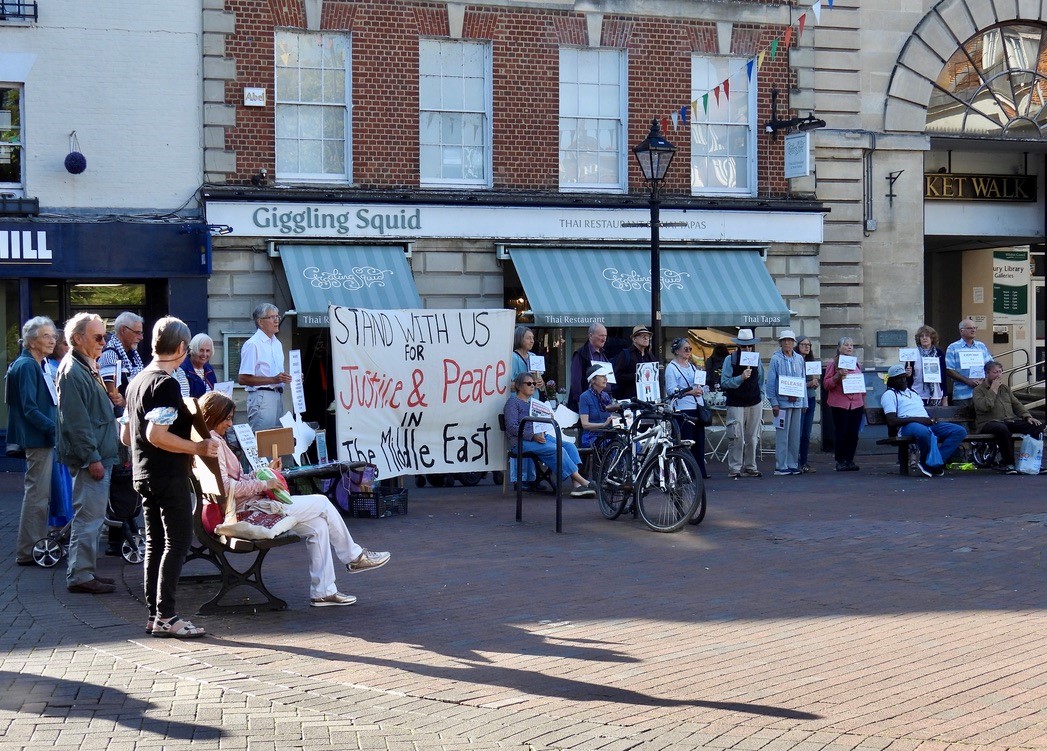
Picture taken at start of the vigil – more came during the vigil.

Once again we note the continued absence of the local MP Mr John Glen from the vigils together with any mention of them in his weekly Salisbury Journal column. He along with – shamefully – a large number of MPs from all of the main parties, is a member of one of the Friends of Israel groups, believed to be the largest and best funded of all the Parliamentary lobby organisations.


Previous posts:

Podcasts


New feature on this site

June 2026

A new feature on the site which will appear from time to time, is podcasts. The first is below. Note they are produced by AI but from texts written and researched by us not using any AI. It is an amalgamation of more than one text post. Feedback is welcome. We hope you enjoy listening! If you are not used to these, click on the heading and you will see a sound bar with the text displayed below it.


Recent posts:

Blog at WordPress.com.

Up ↑