Podcast Episode: Prisons, Punishment, And Survival


Pip: Nearly three decades behind bars, nine execution dates, three last meals — and the first thing Richard Glossip does on the outside is go to an Italian restaurant. There's something both devastating and deeply human about that.

Mara: welland2 has been covering the territory where criminal justice, human rights, and detention conditions intersect — and this episode moves through wrongful conviction and release, then into what imprisonment can look like at its most extreme.

Pip: Let's start with Richard Glossip and what it means to walk out after all of that.

Richard Glossip: Nine Dates, One Release

Pip: The Glossip case sits at the intersection of wrongful conviction, prosecutorial misconduct, and the death penalty — and his release in May 2026 raises the question of what justice even looks like after nearly thirty years on death row.

Mara: The interview with The Intercept captures the disorientation of that transition directly. Glossip says: "I tried never to let myself become institutionalized… But I mean it's hard. You go through all these horrible things and all these different dates … and last meals and everything. And then it doesn't look like this day will ever get here. But you always hope that it will."

Pip: That's someone who kept himself psychologically intact across nine execution dates — which is an almost incomprehensible act of endurance — and is now readjusting to sleeping without prison noise and eating pasta in a neighborhood restaurant.

Mara: The Supreme Court vacated his conviction in February 2025, finding prosecutors allowed a key witness to lie in court and withheld crucial information from the defense. Oklahoma County District Judge Natalie Mai ordered his release on a five-hundred-thousand-dollar bond, stating the court hopes "a new trial, free of error, will provide all interested parties, and the citizens of Oklahoma, the closure they deserve."

Pip: The Attorney General who previously confessed error in the prosecution has now said his office won't seek the death penalty in any retrial. That's a significant shift in posture from the state.

Mara: Glossip himself seems to be holding that carefully. He says: "Once you're out here and you see all the things that was taken away from you — and all the times they almost took everything away from me, my life and everything — you see all of it now… And it kind of still makes me angry at times because none of this should have ever happened."

Pip: Anger seems like the precise and correct response.

Mara: He also describes being recognized in public — a barber refused payment, telling him it was "an honor" to cut his hair. And he's reunited with his wife Lea, whom he first corresponded with and later married while incarcerated.

Pip: His closing note in the interview is striking — he says he's going to trust the process and "just enjoy life." After everything, that reads less like naivety and more like a deliberate choice.

Mara: The retrial date hasn't been set. The case that put him on death row — alleged involvement in a 1997 murder-for-hire — still has to be resolved. The release is real, but it isn't the end.

Pip: Which raises a harder question about what systems produce these situations in the first place — and what happens when those systems operate without any oversight at all.

CECOT: When the Prison Is the Punishment

Mara: The post on CECOT — El Salvador's Centro de Confinamiento del Terrorismo — documents what Channel 5 filmed when Richard Madeley was granted access: cells of a hundred men, steel racks three tiers high, lights on twenty-four hours a day, no reading materials, no contact with family or lawyers.

Pip: Madeley's own summary lands the dilemma squarely: "It's obvious that CECOT breaches human rights as we currently understand. It's a shocking, extreme corner of humanity, but El Salvadorians were writhing under the thumb of psychotic, psychopathic sadists. I wonder if sacrificing civil liberties for the common good is something others would ever be prepared to embrace."

Mara: The post doesn't resolve that question — it holds it open. San Salvador's murder rate was around sixteen a day before President Bukele's crackdown. That rate has dropped dramatically. The post notes the prison has a capacity for forty thousand, and that trials happen on screen with up to a hundred defendants at a time.

Pip: The question of what detention is actually for doesn't get easier the closer you look.


Mara: From Glossip rebuilding a life outside to the conditions inside CECOT — both stories are really asking what accountability and punishment are supposed to achieve.

Pip: And whether the systems designed to deliver justice are capable of honest answers to that. More from Salisbury and South Wiltshire next time.

Richard Glossip interview


Glossip is interviewed after his release from prison

June 2026

After fac­ing nine exe­cu­tion dates, and being giv­en three last meals, Richard Glossip was released on bail on May 14, 2026 and set foot out­side of prison walls for the first time in near­ly three decades. In an inter­view with The Intercept, Mr. Glossip dis­cuss­es adjust­ing phys­i­cal­ly and emo­tion­al­ly to his new life as he awaits a pos­si­ble retri­al for the 1997 crime that sent him to death row, despite his long­stand­ing claims of inno­cence. Oklahoma County District Judge Natalie Mai ordered his release on a $500,000 bond, stat­ing ​“The Court hopes that a new tri­al, free of error, will pro­vide all inter­est­ed par­ties, and the cit­i­zens of Oklahoma, the clo­sure they deserve.”

I tried nev­er to let myself become insti­tu­tion­al­ized… But I mean it’s hard. You go through all these hor­ri­ble things and all these dif­fer­ent dates … and last meals and every­thing. And then it doesn’t look like this day will ever get here. But you always hope that it will“.

Mr. Glossip said of the wide­spread atten­tion on his case, ​“It’s over­whelm­ing but it’s amaz­ing at the same time.” Since his release, he has been able to reunite with his wife Lea, with whom he first cor­re­spond­ed and lat­er mar­ried while in prison. In a con­ver­sa­tion with The Intercept, Mr. Glossip described ini­tial­ly hav­ing dif­fi­cul­ty sleep­ing with­out the con­stant noise of prison, eat­ing at a neigh­bor­hood Italian restau­rant with his wife, and going food shop­ping. He also dis­cussed feel­ing sup­port­ed by his com­mu­ni­ty in Oklahoma. He recount­ed sev­er­al sto­ries of being rec­og­nized, includ­ing by a bar­ber who refused pay­ment for his hair­cut, telling Mr. Glossip it was ​“an hon­or” to cut his hair.

Once you’re out here and you see all the things that was tak­en away from you — and all the times they almost took every­thing away from me, my life and every­thing — you see all of it now… And it kind of still makes me angry at times because none of this should have ever hap­pened. And this should have nev­er been tak­en from me in the first place”.

Mr. Glossip is now await­ing a pos­si­ble retri­al for his alleged involve­ment in the 1997 ​“mur­der-for-hire” of Barry Van Trees, his boss at an Oklahoma City Motel. Oklahoma Attorney General Gentner Drummond, who pre­vi­ous­ly con­fessed error in the pros­e­cu­tions that end­ed in Mr. Glossip’s death sen­tence, announced that his office will not seek the death penal­ty in his new tri­al. The Supreme Court vacat­ed Mr. Glossip’s con­vic­tion and death sen­tence in February 2025, find­ing that pros­e­cu­tors allowed a key wit­ness to lie in court and with­held cru­cial infor­ma­tion from the defense about the same wit­ness. AG Drummond, who sup­port­ed Mr. Glossip’s appeal to the United States Supreme Court, now says “…my office will make sure Mr. Glossip receives a fair tri­al based on hard facts, sol­id evi­dence and truthful testimony.” 

They’ll make the right deci­sions. I know they will. I wouldn’t be out here today if they wasn’t… So I’m just going to let them han­dle it. … I’m just gonna enjoy life.

This text is from the World Coalition Against the Death Penalty


Previous posts:

Why not become a subscriber?

A most terrible prison


Channel 5 is allowed into CECOT – a prison from hell

June 2026

Richard Madeley was allowed to film inside the most awful prison called CECOT – Centro de Confinamiento del Terrorismo – in San Salvador and the results were transmitted last week. Despite the restrictions placed on the programme makers, it showed a prison that might have come straight out of some dystopian horror film (movie). The prison is vast and to get about it, he had to travel on a shuttle bus. It has a capacity for 40,000.

Words cannot fully describe the state in which the men are held. Think battery farm for chickens and you get close. Men are effectively warehoused in cells of 100 which contain steel racks three tiers high on which they spend their days. They are not allowed any reading materials and there is no TV. The lights stay on 24 hours a day every day. They have no contact with relatives or lawyers. Trials such as they are, take place on screen with up to 100 defendants at a time. The men will never leave the prison. Further insight is by Human Rights Watch who reported on American nationals held there. They eat the same food each day.

Madeley makes it clear that the men are members of various gangs and have committed a vast number of murders. Some inmates are alleged to have murdered 30 people. San Salvador had a high murder rate with around 16 a day. The drastic measures taken by the president Nayib Bukele has seen this rate drop dramatically. This poses a profound question: that in a state where gangs operate and murder is at a very high level, can the drastic measures and the methods used in CECOT be justified?

Madeley admitted feeling ‘shaken’ by the experience and film of some of the terrible murders could not be shown on British TV. He continued: “It’s obvious that CECOT breaches human rights as we currently understand. It’s a shocking, extreme corner of humanity, but El Salvadorians were writhing under the thumb of psychotic, psychopathic sadists. I wonder if sacrificing civil liberties for the common good is something others would ever be prepared to embrace”. The approach by the President is popular among many in El Salvador who are free of the threat posed by the murderous gang members.

The prison has proved to be controversial in the US and a CBS film was pulled before transmission because allegedly, political pressure was applied. President Trump is reported to be keen on the prison and USA Today revealed a financial deal in which prisoners were sent there.

It is a dilemma. Human rights groups condemn the regime but it has delivered a measure of normality for Salvadorians. Richard Madeley poses this question at the end of his programme. Can such inhumane methods ever be justified?

Sources: The Sun, Cornwall Live, Guardian, Independent, USA Today, CBS


Pic: AFP

The tragedy only gets worse


The steady destruction of Lebanon continues while the world looks on

May 2026

The systematic destruction of large parts of southern Lebanon continues apace and on Wednesday, Israel ordered the evacuation of the city of Tyre a city of 200,000 inhabitants. Beirut has be hit by multiple missile and drone strikes which the IDF claim are targeted. It is interesting to note that news media are putting the word ‘targeted’ in inverted commas: progress of sorts.

It is a tragedy that shows no sign of an end. Death and destruction in Gaza with Netanyahu now saying they want to annex 70% of the territory from the 50% they control now. Nearly 73,000 have died there and many thousands more injured. The tragedy of the West Bank where settlers are attacking Arab and Palestinian homes, attacking people and destroying trees and crops. It is a tragedy in south Lebanon where more killing is taking place, white phosphorous is being used and entire villages erased from the map. The attack on Iran is a tragedy with much destruction and many deaths.

The West’s response has been feeble, the UK’s particularly so. Weapons are still being provided to Israel and RAF flights continue. The appalling treatment of the flotilla and those on board drew only a muted response from our government. Israel continues to act with impunity and seems if anything to be ratcheting up the violence. They have successfully put the US in an extremely difficult position. Trump is desperate to secure a deal with Iran which many believe Israel does not want. The lack of a concerted response by the UK and a willingness to follow in the wake of the US and President Trump is a tragedy all of itself.

Part of the UK’s pusillanimous response is because so many of the government’s MPs and many other MPs from other parties are members of the Friends of Israel groups, the best funded of lobby organisations in parliament. If you read the link to the Canary you will see the comment: ‘Finally, this raises serious questions about whose interests these officials actually work for. In turn, a serious long-felt concern is brought to the forefront: is the UK government occupied by Israel? This is precisely the question we asked of the Salisbury MP, Mr John Glen, who is a ‘proud member’ of the Conservative Friends of Israel. Who are you representing, many people in Salisbury who find the violence to be abhorrent and counter productive, or, the Israeli government? He said he would not dignify the question with an answer.

Another tragedy is that it will not, in the long run, improve Israel’s security. By simply bombing, destroying villages and parts of towns, incarcerating thousands of Palestinians in appalling conditions – it is merely creating resentments and hatreds for the future. This has to be the ultimate tragedy for the country. Of particular concern is that violence has become embedded into the psyche of the country – a kind of first response to problems is to send for the military and bomb somewhere. Perhaps John Steinbeck’s quote is apposite: ‘All war is a symptom of man failure as a thinking animal‘.

Vigil 130

Which is why the vigils in Salisbury continue but with no sight of the local MP. The public responses are now uniformly positive with thumbs up and a few stopping by. The rights of almost all those living in the region have been compromised.

Sources: Palestine News, Al Jazeera, (various)


Recent posts:

Thought of becoming a subscriber?

Execution spree continues in Florida


Man on death row for 34 years due to be executed

May 2026

The pace of executions in Florida continues and the latest is Dusty Ray Spencer who has been on death row since 1992. Gov. De Santis has signed the warrant and the due date is noon on June 25th. Florida accounts for 40% of all US executions last year according to Amnesty International. It is the tenth such warrant signed by the governor this year. The state set a record in 2025 with 19 executions.

Spencer was convicted of murdering his wife in a violent assault. This was witnessed by his son who tried unsuccessfully to intervene. The Jury voted 7-5 in favour of execution. There have been a number of appeals. Floridians for Alternatives to the Death Penalty state that if the case was heard today, he would be unlikely to receive the death penalty. In the light of all the executions FADP say that ‘We reject the idea that executions are inevitable. Nothing requires the state of Florida to respond to violence with more violence. Our leaders still have a choice’.

In preparing this piece we have explored a number of articles in the US and Florida media and there is little to explain how a marine who apparently had a good service record, became this violent individual. There are brief mentions of his mental state but little else.

If you visit the FADP site there is a petition. Amnesty is opposed to the death penalty in all circumstances. We publish a report each month on the use of the penalty around the world.

Sources: CBS News, FADP, Tampa Bay Times, Justia Law, ‘They Will Kill You’


Latest posts:

Vigil following a horrific week


Global outcry following appalling treatment of flotilla activists

May 2026

The world was shocked this week by the appalling scenes and the treatment of activists seized by Israeli forces on the high seas. A BBC video shows some of what went on. Around 430 activists were seized in the operation and were shown with their hands tied behind their backs and made to put their foreheads to the ground while the Israeli Security minister shouted abuse at them. It has caused international consternation particularly as Ben-Gvir is a close confidant of Netanyahu the prime minister who has said the behaviour was ‘not in line with Israel’s values and norms’. Various countries have summoned Israeli ambassadors.

Haaretz reports that 15 detainees were sexually assaulted. A German Foreign Ministry spokesman has demanded a full explanation. An Israeli prison service spokesman called the claims ‘false and entirely without factual basis’. The video testimonies of those who arrived back home seem to point to widespread abuse and violence against them.

Vigil

The 129th vigil in Salisbury took place this week in bright sunshine with around 30 in attendance. A number of passers-by took photos and indicated support either verbally or by gesture.

Why not subscribe?

Podcast Episode: Rights Trade And Sustainability


Pip: Amnesty Salisbury keeps showing up — in the rain, at the park, in the footnotes of trade agreements nobody else is reading.

Mara: That's the thread running through welland2's recent posts: rights under pressure, from ECHR reforms to death row to a sustainability fair in a local park. Let's start with where the pressure is heaviest — the slow dismantling of civil liberties.

Rights eroding in plain sight

Pip: The headline concern here is a pattern, not a single event — each new policy framed as a border measure or a public-order fix, but adding up to something larger when you step back.

Mara: The post "Steady Erosion of Rights Continues" puts it directly: "It is not even true to say 'by stealth' as it is done in plain sight."

Pip: That's the part that should unsettle people. The argument isn't that rights are being quietly stolen — it's that they're being removed openly, and we've stopped noticing.

Mara: The context is the ECHR declaration giving European governments more power to deport migrants, even where there's a risk of mistreatment on return. Yvette Cooper called it permission for countries to "take action on illegal immigration." Amnesty International's response was that it risks creating a "hierarchy of people" — those protected under Article 3 against torture, and those who are not.

Pip: And the post notes that the UK sells arms to countries that practice torture while turning away people fleeing it. That tension doesn't get much airtime.

Mara: The post also flags the Police, Crime, Sentencing and Courts Act 2022 and the Public Order Act 2023 as part of the same drift — limits on protest, expanding police powers, and now pressure on jury trials. Local MPs John Glen and Danny Kruger are recorded by They Work for You as voting against equality and human rights legislation.

Mara: Then there's the vigil — post number 128, held in the rain, documented in "A Damp Vigil." Around twenty people attended. Omer Bartov's book is quoted there, asking how Israel, founded the same year as the genocide convention, now conducts what he calls a genocidal undertaking with near-total impunity.

Pip: And the minutes and newsletter post pulls these threads together — immigration, the death penalty, the state of rights in the UK — for anyone who wants the fuller picture.

Mara: The Oklahoma piece is the counterweight. Richard Glossip, after twenty-seven years on death row and three last meals, walked out of jail after a judge ordered his release ahead of retrial. The prosecution had withheld evidence about its key witness's mental health. As the post puts it: had he been executed on any of those three occasions, it could not be undone.

Pip: The good news from Oklahoma is real. It's just that it took nearly three decades to arrive. On to the trade deal that skipped the values entirely.

A trade deal without the values

Pip: The Gulf States agreement is being sold as a win for British business — but the post "Government Signs Trade Deal" asks what got left out of the small print.

Mara: Sir Keir told his biographer "There is no version of my life that does not largely revolve around me being a human rights lawyer." The post's response is pointed: being a lawyer is not the same as having principles and acting on them.

Pip: The TUC called it a "values free agreement." The UAE's record — the kafala system tying workers to single employers, mass trials, solitary confinement, allegations of arming Sudan's RSF — none of it made it into the text.

Mara: Which sets up exactly what the Salisbury group was raising at the park.

Sustainability is also about the clothes you wear

Pip: "People in the Park" is the annual Salisbury Transition City event — seventy-five exhibitors, sustainability focus — and the local Amnesty group brought a different angle to it.

Mara: The post describes the group highlighting Amnesty International's report "Stitched Up," which details abuses in the global jeans industry: "health hazards, physical and sexual abuse of the mainly female workforce, wage theft and the denial of union and collective bargaining rights."

Pip: The response was muted. The post's honest read is that people associate sustainability with the environment, not with the supply chain behind a pair of jeans.

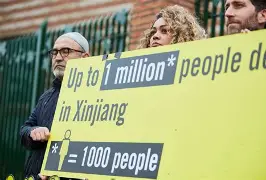
Mara: Around a quarter of the cotton comes from Xinjiang, where forced labour is documented and the region is closed to outside observers. The post's conclusion: retailers can claim humanitarian credentials on their websites while the exploitation continues.


Pip: Rights in the courtroom, rights at the border, rights in the fabric of your jeans — it's the same argument in different registers.

Mara: And the vigil keeps going. Next episode, we'll see what else is accumulating.

Government signs trade deal


Sir Keir says deal with Gulf States a ‘huge win’ for British business but …

May 2026

The government proudly announced a trade deal with the Gulf States this week which will increase trade with UK firms by many millions. The fly in the ointment however is the human and worker’s rights in those countries which are dire. Take UAE as an example. The country commits a wide range of abuses against its citizens. There is little freedom of expression with a number of individuals given long sentences following mass trials which are transparently unfair.

Women have few rights and experience inequality in education, employment and legal rights. The kefala system is widely employed which ties foreign workers to one employer and effectively denies them any meaningful employment rights.

Torture and other abusive actions are frequent with prisoners kept for long periods in solitary confinement. Human rights defenders are harassed.

The country is accused of providing military equipment to the RSF in Sudan who have committed a range of atrocities. A similar range of failures could be listed among the other countries included in the agreement, Saudi Arabia for example.

Values free

None of this seems to matter. Any mention of human rights has been omitted from the agreement and the government claims these matters are best pursued outside it. The TUC has criticised it arguing that we should ‘not be doing deals with countries which abuse human rights and worker’s rights‘. It is claimed to be a ‘values free agreement’.

Any notion of limiting trade with oppressive regimes which practise a range of abuses against its citizens seems a distant prospect. We are sufficiently desperate for trade that such matters are no longer part of the political landscape. Yet ministers will often claim their belief in human rights. Sir Keir himself told his biographer “There is no version of my life that does not largely revolve around me being a human rights lawyer”. Being a lawyer is not the same as having principles and acting on them. Wouldn’t it be more honest simply to admit we will trade with anyone? There is a podcast of this and other recent posts – see below:

Sources: Amnesty, HRW, American Democracy and Human Rights in Bahrein

People in the Park


Salisbury group attends this event with its focus on sustainability

May 2026

This event, organised by Salisbury Transition City each year with 75 exhibitors present this year. The theme is sustainability and with this in mind the Salisbury group focused on the abuse behind the manufacture an everyday item such as a pair of jeans. Billions are made every year and millions are employed in making them. This followed the publication by Amnesty International of a report Stitched Up which details the multiple abuses of this massive industry. From health hazards, physical and sexual abuse of the mainly female workforce, wage theft and the denial of union and collective bargaining rights are all described. The failure of high street retailers to control adequately what is going on is also noted.

The results were muted and only a few of the handouts were taken (see below). It is disappointing to report the Mayor of Salisbury and her party quickly walked past our stall without stopping. Perhaps it was because people view sustainability mainly as an environmental problem. The idea that globalisation and the abuses that flow from it is perhaps not so well appreciated. Massive amounts of water are consumed in their production and of course the fuel needed to move the items from country to country during the course of their manufacture.

Clearly the idea that abuses taking place on the far side of the globe are both a human rights and a sustainable issue is not well recognised. Around a quarter of the cotton used comes from the Xinjiang region of China where the abuse of Uyghurs is taking place and their culture being systematically destroyed. Thousands are engaged in forced labour to produce the cotton. The region is closed to outsiders for obvious reasons.

There is work to do to convince people that sustainability is not just about trees – important though that is – but about the clothes we wear, where they come from and how they’re made. Retailers can continue to sell goods made with the exploitation of millions of mostly female workers, some in near slave like conditions, while claiming their humanitarian credentials on their web sites.

Good news from Oklahoma


Richard Glossip released after nearly three decades on death row

May 20

We are pleased to report the release on bail of Richard Glossip for whom we have campaigned for many years. His case is a long and tortuous one and he has been served ‘last meals’ on three occasions. He has been on death row for 27 years. In the endless series of trials and appeals it seems to be clear that the prosecution case was always weak. The crime was the murder of Barry van Treese in 1997 and Glossip was alleged to be the killer.

The prosecution allowed its key witness, Justin Sneed, to provide false testimony about his mental health and medical treatment. The new evidence showed that Sneed was diagnosed with bipolar disorder and prescribed lithium, facts that were withheld from the defence. At trial, Sneed falsely claimed he was never treated by a psychiatrist and received lithium mistakenly. This falsehood was material because Sneed’s testimony was the only direct evidence implicating Glossip, and impeachment of his credibility could have influenced the jury’s decision. The prosecution had prior knowledge of Sneed’s mental health treatment and still failed to correct the misstatement when it was made to the jury.

Correcting this false testimony would likely have changed the jury’s assessment of Sneed’s reliability. The prosecution is alleged to excluded exculpatory evidence, interfered with witness testimony, and allowed destruction of key physical evidence. Given these cumulative errors and their impact on the fairness of the trial, Glossip is entitled to a new trial. The Oklahoma Court of Criminal Appeals’ rejection of the attorney general’s confession of error was based on a misapplication of federal law.

Free for now

Richard Glossip walked out of an Oklahoma County jail Thursday with his wife, free on bond for the first time since his 1997 arrest, after a judge set his release terms ahead of a retrial the U.S. Supreme Court ordered last year. As Hannah Ziegler reported for the New York Times, Judge Natalie Mai set Glossip’s bond at $500,000, requiring an electronic monitoring device and prohibiting contact with witnesses or travel outside Oklahoma. A group of supporters helped raise the bond money.

Glossip was convicted in 1998 and again in 2004 of arranging the murder of his employer, Barry Van Treese, through motel handyman Justin Sneed. The state set execution dates for him nine times. Two independent investigations later found that critical evidence had been withheld and that Sneed’s testimony, the cornerstone of the prosecution’s case, was faulty.

Oklahoma Attorney General Gentner Drummond, who had previously asked the Supreme Court to throw out Glossip’s conviction, said he would retry the case but would not again seek the death penalty. Glossip’s attorney Donald Knight said the bond ruling was unexpected and marked a step forward after what he called a decades-long nightmare.

Judge Mai wrote that a new trial free of error would give all parties and Oklahoma citizens the closure they deserve. Knight said the court’s decision had rejected the state’s claim of a strong case for guilt. Glossip told reporters outside the jail Thursday that it was overwhelming but amazing.

The point here is that the case was weak and there are serious doubts about his guilt. Had he been executed in one of the three previous occasions there would be no coming back. It could not be undone.

Sources: MSN, Oklahoma Watch, The Oklahoman. Picture NBC.


Blog at WordPress.com.

Up ↑