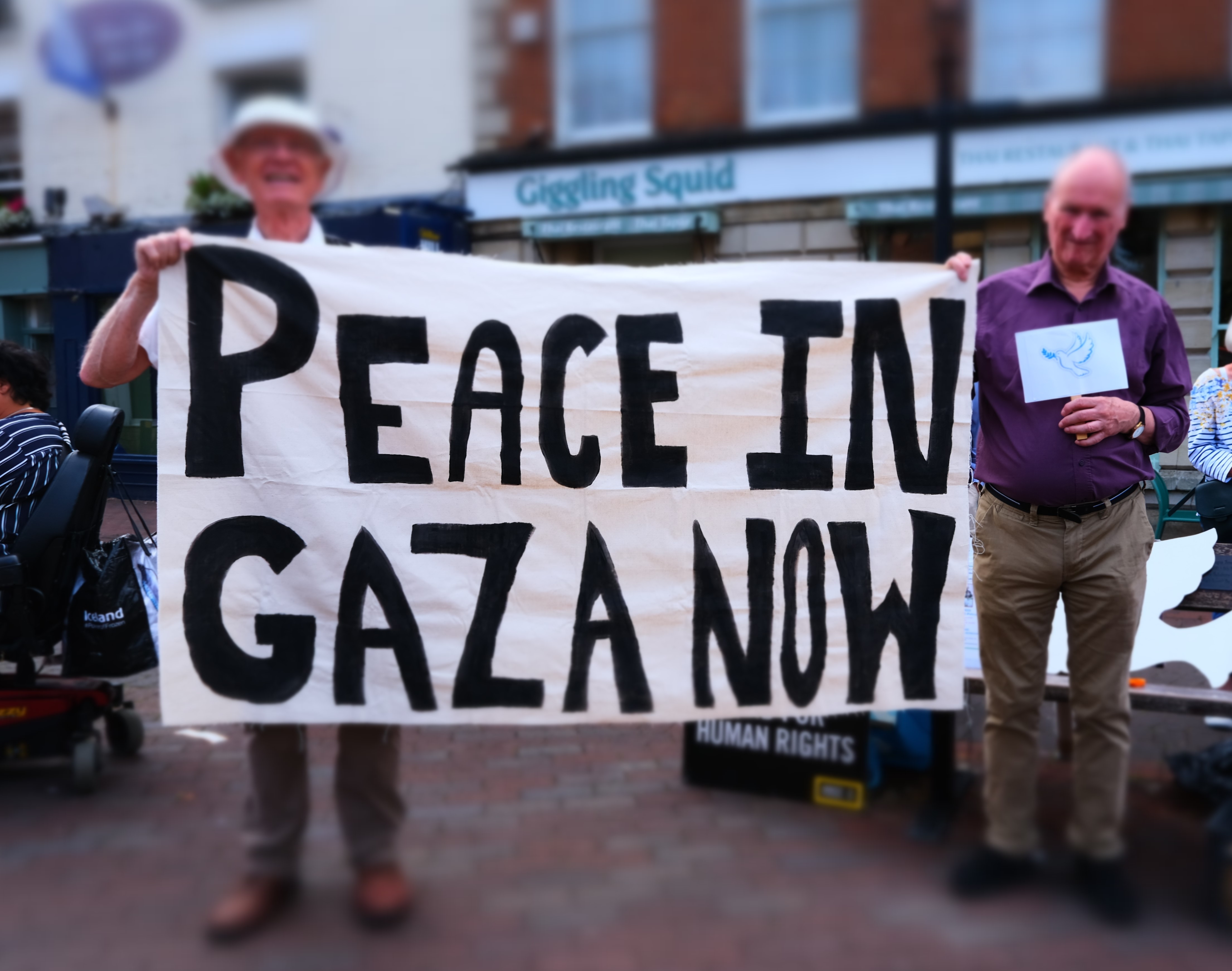
Thirty eighth vigil


August 2024

With the death toll in Gaza over 40,000 and no sign of a peace deal, our weekly Vigil continued today – 24th August – with just under 30 in attendance. Some passers by stop and take part which is encouraging. We had one person shout at us from afar. We shall be back on 31st at 5pm as usual.

Three of the participants. Photo: Salisbury Amnesty

Gaza Death Toll Passes 40,000: Global Concerns and Peace Talks Update


August 2024

Still they continue and just under 40 attended the Vigil in Salisbury on Saturday 17th August. A grim milestone was reached during the week when the Health Ministry announced the death toll in Gaza has passed 40,000 and shows no sign of ending. The Israeli authorities dispute these figures but the evidence suggests they are an underestimate since many thousands are buried and unaccounted for.

Peace talks are taking place in Doha and are being spoken about optimistically by the Americans at least although Hamas are not in attendance. Today’s reports are less optimistic.

There are signs of patience running out in Western capitals and the new Foreign Secretary David Lammy is in Israel with his French counterpart to try and promote some kind of peace initiative. In a joint article in the Observer (August 18th) it is clear both governments are worried by a regional escalation.

It is not clear whether the UK will cease or reduce arms sales to the country but CAAT reported recently (6 August) that there has been no change in the government’s position. Reports that they were rethinking appear to have been premature. The major supplier is the US which is done on a government to government basis.

There has also been a perceptible change in reporting by the BBC, Channel 4 and ITV with more robust interviews and pointed questioning. On Channel 4 for example, in an interview concerning the mounting settler violence in the West Bank where a large group of them were filmed rampaging through a Palestinian village, Matt Frei used the ‘apartheid’ word at least twice. On Radio 4 where and Israeli official was casting doubt over the death statistics in Gaza, the interviewer noted that independent journalists were not allowed in to the territory: clearly the inference was that if you will not permit independent verification, it is hard for you to complain about the statistics.

What is becoming increasingly apparent is the sympathy and shock felt around the world at the horrific attack on October 7th and the continuing plight of the 100 or so hostages held captive in Gaza is diminishing. Claims that it is Hamas terrorists being targeted and killed are also being questioned in the light of vast numbers of dead women and children.

Pic: Salisbury Amnesty

Trudi Warner case dropped


The new government has decided not to appeal against the judge’s decision to throw out the contempt of court case

August 2024

Readers may recall an earlier post discussing the Trudi Warner decision. This concerned a judge not allowing defendants to say they were climate campaigners in their defence. Warner stood outside the court with a placard saying that juries had a right to decide a case based on their conscience and not necessarily as the judge directs. The government’s legal department has indicated to the Appeal Court it is dropping the matter.

Vigil


August 2024

COMPLETED EVENT

The Vigil takes place this evening (August 17th) in Salisbury Market Place starting at 5pm for half an hour. Over 40,000 are now dead in Gaza in what is certain to be an underestimate since many bodies lie unrecovered under the rubble. Reports yesterday of settler violence in the West Bank with cars and property set alight by marauding gangs and a Palestinian man killed. The violence has increased dramatically this year.

Burma: a forgotten conflict


Violence continues in Burma while the West does little

August 2024

One thing which helps a tyranny to survive and prosper is for people to look the other way. In Burma, the military has held sway for many years now and there was a belief that they were invincible and would eventually win. Three million have been displaced according to the Burma Campaign although the UN calculates the figure to be 2.3 million. Burma seldom makes the news and certainly not in comparison with Gaza and Ukraine. This relative obscurity has enabled the military, the Tatmadaw, to continue its murderous campaign and the assumption of their eventual victory meant countries and companies kept their powder dry in terms of its relations with them.

The previous UK government’s responses ‘slowed to a standstill’ according to the Burma Campaign in their latest campaign news (Issue 46, 2024). A crucial issue was the supply of jet fuel and there has been a campaign to stop the supply of this fuel which is used by the military to bomb schools, hospitals and villages. At a meeting of the UN Security Council in April, the USA and Malta called on the Council to take action to stop the supply of this fuel. In itself this was a huge step. The UK government did not support this move and unfortunately, Britain leads on Burma in the Security Council (ibid).

The lack of attention by the British media meant little pressure was put on the Conservative government to take an active role. We now have a new government and Burma News asks ‘What does the new government mean for UK Burma policy?’ It is of course early days but it does not look promising. Sir Keir is focused on the domestic agenda but has spoken on the plight of the Rohingya in the past. Disappointingly, the Foreign Secretary, David Lammy has shown no interest both recently and while he was in opposition. Other Labour politicians have offered some support but they do highlight Rushanara Ali MP who was very active and was chair of the All-Party Parliamentary group on Burma and Rohingya. She is now a housing minister so cannot continue in that role.

Aung San Suu Kyi became a hero and her time under house arrest attracted considerable international attention and sympathy. It was a huge disappointment to discover upon release that the party she led, the National Lead for Democracy, was vigorously in favour of the Rohingya genocide. She defended the military at the Hague. Although the situation is complex the basic point is that there is no desire by the NLD for Burma to be a multi-ethnic state. They believe the Bamar to be superior and there is a desire is for it to be exclusively Buddhist. The West’s image of Buddhists also came in for a knock. She is however, a popular figure still in the country.

Attitudes and policies may need a rethink however because the military it now appears is losing ground. Far from being invincible, the People’s Defence Forces have been winning back territory in many parts of the country. The UK government’s softly, softly approach and the Foreign Secretary’s lack of interest may need to change.

A glimmer of hope …


The West-Eastern Divan Orchestra brings a glimmer of hope to a troubled region

August 2024

The news from the Middle East is uniformly grim with the death toll in Gaza rising remorselessly to over 39,000 with more deaths a day or so ago following a bombing. Violence is emerging in Lebanon which threatens to worsen following the events in Tehran. A peace deal seems as far away as ever. Salisbury people still congregate every Saturday afternoon for a peace vigil.

The West-Eastern Divan Orchestra is a rare glimmer of light in the seemingly never ending gloom of conflict. Founded 25 years ago, and based in Seville, it is an orchestra consisting of both Arab and Israeli players with three desks for Iranians. Founded by Danial Barenboim and Edward Said, it is not a political venture but:

The Divan is not a love story, and it is not a peace story. It has very flatteringly been described as a project for peace. It isn’t. It’s not going to bring peace, whether you play well or not so well. The Divan was conceived as a project against ignorance. A project against the fact that it is absolutely essential for people to get to know the other, to understand what the other thinks and feels, without necessarily agreeing with it. I’m not trying to convert the Arab members of the Divan to the Israeli point of view, and [I’m] not trying to convince the Israelis to the Arab point of view. But I want to—and unfortunately I am alone in this now that Edward died a few years ago—create a platform where the two sides can disagree and not resort to knives.

Barenboim emphasises the role of dialogue and a feature of recent conflict is to note that there are people on both sides, who recognise the opinions, feelings and rights of the other. The orchestra performed at the Proms last evening (11th August) in a concert consisting of Brahms’s Violin concerto performed by Anne-Sophi Mutter, followed by Schubert’s 9th Symphony ‘the Great’. Looking down on the 80 or so players, could one tell them apart, Arab from Jew? Would one want to? A band of people from two nations tearing themselves apart, sublimely playing two wonderful pieces of music offering a glimmer of hope …

West-Eastern Divan Orchestra with Daniel Barenboim accepting applause.

Vigils continue


August 2024

The 36th Vigil took place again this Saturday, 10 August 2024 with just over 30 in attendance. When these Vigils started we did not imagine they would still be going and would attract continued support. This time we were joined by some passers by.

In that connection it is perhaps interesting to comment on the reaction of people walking past. Around 90 or so people took notice of what we were doing and registered (probably) that we were in support of peace in the region and a few took photos. This was around a quarter of those passing by. Many simply did not notice, hurrying home after work or rushing to catch a bus. Some quickly looked away for reasons we cannot know.

The conflict continues and the death toll stands at over 39,000. There seems to be no credible attempts at present to secure a ceasefire.

The next is on Saturday 17th at 5pm as usual.

Shamima Begum


Court of Appeal turns down Shamima Begum appeal to challenge citizenship ruling.

August 2024

Shamima Begum’s appeal to overturn the government’s decision to remove her British citizenship was turned down by the Court of Appeal on 7 August. They said her appeal ‘[did] not raise an arguable point of law’. She fled the country in 2015 with two others – now believed to be dead – in order to join ISIS then in the process of trying to establish an Islamic caliphate. ISIS committed a number of horrific crimes, including beheadings, and large numbers of people died during their violent reign.

Begum was 15 when she fled and once there, she became a bride, had three children all of whom died young. She is now 24 and is living in al-Roij camp in Syria. A great deal of rage settled on her and various commentators have tried to understand this – why her? Partly it seems to be a mixture of misogyny and the fact she did not conform to the standard narrative of someone who had done what she did and now sought forgiveness. She became a kind of figurehead for the rage people felt about the terrible actions of ISIS. It also seems to have been forgotten that she was a child of 15 when she left.

Removing someone’s citizenship is a severe retribution however and seems to have been done by the then home secretary Said Javid in response to tabloid rage. The argument that she was a ‘threat to national security’ is absurd and in what way was never explained. It has never been claimed that she committed any atrocity. How she would be a threat if she returned to the UK is also not explained. The government tried to argue that she could become a Bangladeshi citizen, an argument Lord Sumption described as a ‘legal fiction’.

Amnesty has issued a press release on this topic.

“It’s deeply concerning that the Supreme Court has concluded there’s no point of law to be considered on such a serious matter as stripping a British person of her citizenship – particularly when that was done on the back of her being exploited as a 15-year-old child.

Stripping Shamima Begum’s nationality was profoundly wrong – she is and has always been British.

Begum is now exiled in dangerous and inhuman conditions, along with thousands of other people, including women and children, in north-east Syria”.

The UK should follow others by taking responsibility for nationals stranded in Syria – including by assisting in their safe return to the UK, whether or not that means facing possible criminal investigation or prosecution on their return.”

It is interesting to note that in an article in the Daily Mail on line, they report that the residents of Bethnal Green (where Shamima Begum used to live) would ‘welcome her back’.

There is now likely to be an appeal to the European Court of Human rights.

Death penalty report


Latest death penalty report for mid July – August

August 2024

We are pleased to attach the latest monthly report on the state of the death penalty around the world thanks to group member Lesley for her work in compiling it. Note as ever that China does not feature where the use of the penalty is a state secret and who are believed to execute more of their citizens than the rest of the world combined.

Starmer’s wish to see more facial recognition technology


The prime minister wishes to see more facial recognition technology following riots in Southport and elsewhere

August 2024

Following the terrible murder of three little girls and the wounding of eight others in Southport last week, riots have broken out in various parts of the UK. A mixture of extremists and far right groups have assembled outside mosques and refugee centres to engage in violent acts including attacks on the police. These groups have claimed links to asylum seekers and immigrants to the murders and this has led them to take these violent actions. Several people phoning in the the BBC’s Any Answers programme on Saturday 3 August, made claims linking the murders to boat people even though the young man who has been charged is from Cardiff and is not a boat person.

People have been rightly outraged by the high-jacking of the tragic deaths of the three little girls by large numbers of far right groups many of whom travel to the area with the intention of engaging in violence. There is a natural desire to see these people to be identified, arrested and brought to justice. There is great pressure on the new government to ‘do something’ and the Home Secretary and the Prime Minister have made statements. The latter has called for the greater use of facial recognition technology (FR) in the task of identifying ‘thugs’.

We should be very wary of going down this path. It has echoes of Jeremy Bentham’s idea of a panopticon in the nineteenth century: a prison where prisoners could be watched at all times. It fed into the idea of complete control by governments or their agents as a means of social control.

There are several reasons for being wary of introducing more FR. Although it could be used to locate and arrest those involved in the current mayhem or any future outbreaks, it would introduce into the public realm greater powers for the police and politicians. The last decade has seen a number of laws enacted to prevent or seriously limit protests and demonstrations. Britain has had a history of such protests and they have led to improvements in the role of women in society, better housing, an end to slavery and a range of social improvements and rights for ordinary people. This technology would however, give police considerably enhanced powers to clamp down on protests. We may deplore the sometimes extreme actions of the climate protestors, but without such protests, the government would be unlikely to take action of climate change.

To tackle the violence and riots in other words, we would be giving the government enhanced powers over other forms of legitimate protest. There is also the vexed issue of control. The various scandals we have seen in recent years including the Post Office, the biggest one of all, have shown an inability by the vast range of controls, audits, select committees, etc. etc. to exert any kind of realistic control over these organisations. They achieve lives of their own and seem impervious to moral principles or honest dealings. Do we really want to give them yet more technology?

Another objection is that it would give yet more power to the tech giants over our lives. A feature of the riots is how easy it has been for rioters to assemble by using such media as X and Telegram. These are American firms and are more of less completely outside anyone’s control. It was Elon Musk who decided to allow Tommy Robinson back onto X for example. So we have politicians and journalists making speeches, statements and writing opinion pieces, when it was the decision by one man on the other side of the pond which has provided a key weapon for the far right groups. Although Sir Keir is making noises about the tech giants, will the government actually do anything?

Finally, it sees the solution to these problems in technological terms: we have problem, lets install some more kit and problem solved. The issues are much deeper than simply arresting some thugs. Poverty, low wages, poor housing, inflation and a host of other issues have led to groups of people feeling left behind or ignored by the politicians and to an extent the media.

We should think very carefully before giving politicians yet more power to intrude into our lives. Even though it may mean some of the rioters escaping justice. China has this system installed offering the government almost complete control over its citizens. They have 700 million such cameras used widely as a means to monitor its citizens and to repress minorities. Perhaps we should remember the Chinese proverb ‘a journey of a thousand miles begins with just a single step’. Our liberties are fragile and we should be extremely cautious of giving government’s powers to limit them further. It has the power to be the biggest threat to human rights and civil liberties in the UK.

Blog at WordPress.com.

Up ↑