Notice of extension received concerning administration of lethal injections in California
A previous urgent action was sent out concerning proposed changes to the California Code of Corrections concerning the use of lethal injections. The date for responses has now passed but we have today received a message to say this has been extended to 15 May 2016. Executions have been put on hold since 2006.
URGENT ACTION
Executions could resume if regulation adopted
The California Department of Corrections and Rehabilitation has launched a public consultation on its proposed new lethal injection protocol. The public has until 22 January (but see above) to submit comments on the regulation, the adoption of which would allow for the resumption of executions in the US state with the highest death row population.
The California Department of Corrections and Rehabilitation (CDCR) began a public consultation on 6 November on its new lethal injection protocol. Among other changes, the proposed new regulation introduces a single-drug lethal injection protocol which means that any one of four barbiturates listed in the regulations may be selected as the chemical to be used in the execution. It also establishes criteria for the selection, recruitment and training of lethal injection team members; and establishes procedures and timeframes for the movement and observation of prisoners once the execution warrant has been served.
Members of the public have until 22 January 2016 (see above – date extended to 15 May) to submit comments on the proposed new regulation, after which the CDCR will have the opportunity to amend its proposal. Amnesty International opposes the death penalty in all cases without exception, regardless of the nature or circumstances of the crime; guilt, innocence or other characteristics of the individual; or the method used by the state to carry out the execution.
California is the US state with the highest number of prisoners under sentence of death: 745 as of December 2015. The last execution was carried out in 2006 and the implementation of the death penalty has been on hold since then, as legal challenges on the state’s lethal injection procedures resulted in the invalidation of lethal injection procedures. In order to be able to resume executions, the California authorities need to put in place new operational regulations on executions.
Please write immediately in English or your own language:
ν Urging the California Department of Corrections and Rehabilitation to immediately halt its plans to adopt the new lethal injection regulation and work with other state authorities to abolish the death penalty;
ν Urging the California authorities to establish an official moratorium on all executions as a first step towards abolition of the death penalty, in line with the international and national trend and five UN General Assembly resolutions adopted since 2007;
ν Reminding them that the USA is among the minority of countries that still executes, and that there is no humane way to kill.
PLEASE SEND APPEALS BEFORE 15 MAY 2016 TO:
Chief, Regulation and Policy Management Branch
Timothy M. Lockwood
California Department of Corrections and Rehabilitation – Regulation and Policy Management Branch
P.O. 942883 Sacramento, CA
94283-0001, USA
Fax: +1 916 324 6075
Email: LI.comments@cdcr.ca.gov
Salutation: Dear Mr. Lockwood
Governor of California
Edmund G. Brown Jr.
c/o State Capitol
Suite 1173
Sacramento, CA
95814, USA
Fax: +1 916 5583160
Email: governor@governor.ca.gov
Salutation: Dear Governor
Also send copies to diplomatic representatives accredited to your country.
HIS EXCELLENCY THE HONOURABLE MATTHEW BARZUN American Embassy, 24 Grosvenor Square, London W1A 6AE, tel: 020 7499 9000. Salutation: Your Excellency Please check with your section office if sending appeals after the above date.
URGENT ACTION
Additional Information
In order to be able to resume executions, the authorities of California, USA, need to put in place new operational regulations on executions. To this aim, the California Department of Corrections and Rehabilitation (CDCR) issued the notice of public consultation 15-10 on 6 November 2015, providing details of proposed changes to Section 3349 and the adoption of Sections 3349.1, 3349.2, 3349.3, 3349.4, 3349.5, 3349.6, 3349.7, 3349.8, and 3349.9 of the California Code of Regulations (CCR), Title 15, Crime Prevention and Corrections (hereafter, the proposed new regulation).
Executions in California have been on hold since 2006. Legal challenges resulted in the invalidation of previously adopted execution procedures and were followed by a referendum in 2012 seeking to abolish the death penalty in the state. In addition to this, challenges in the sourcing of substances to be used in executions by lethal injections led to a nationwide reduction in the number of executions and increased debates on the use of the death penalty.
The US Supreme Court overturned the USA’s death penalty laws in 1972, but upheld revised laws in 1976, in Gregg v. Georgia. In a dissent from a ruling on lethal injection on 29 June 2015, Justice Stephen Breyer argued that the time had come to revisit the constitutionality of the death penalty, given the evidence of its arbitrariness and unreliability. Joined by Justice Ruth Bader Ginsburg, he wrote that:
Unlike 40 years ago, we now have plausible evidence of unreliability… In sum, there is significantly more research-based evidence today indicating that courts sentence to death individuals who may well be actually innocent or whose convictions (in the law’s view) do not warrant the death penalty’s application.
Since 1976, more than 140 wrongful convictions in capital cases have been uncovered in the USA, a period that has seen 1,414 executions. Since 2007, five US states have abolished the death penalty and a further three have established official moratoriums on executions, including most recently Pennsylvania in February 2015.
Today, 140 countries are abolitionist in law or practice. In 2015 three more countries – Fiji, Madagascar and Suriname – abolished the death penalty for all crimes and Mongolia adopted a new Criminal Code that bans the use of the ultimate cruel, inhuman and degrading punishment in the country. The USA is among the small minority of countries – ten on average – for which Amnesty International has recorded executions every year in the past five years.
UA: 287/15 Index: AMR 51/3065/2015 Issue Date: 14 December 2015



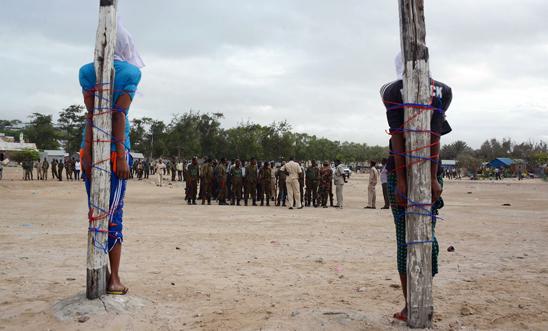 Two Somalis are tied to stakes as they await execution by firing squad on 15 July 2014 in Mogadishu © AFP/Getty Images


 Amnesty in Salisbury & South Wiltshire