
Fuller version of the death penalty summary
 Campaigning against the Death Penalty has continued to be a major focus for the Salisbury Group. Regrettably, there has been no national campaign coordinated by Amnesty International in London. We hope this might change in 2016 as we have taken part in a Survey currently being carried out by HQ confirming that we would like this important aspect of Amnesty’s work to be taken up again – particularly in the light of the recent changes in the priorities of the Foreign and Colonial Office (see later).
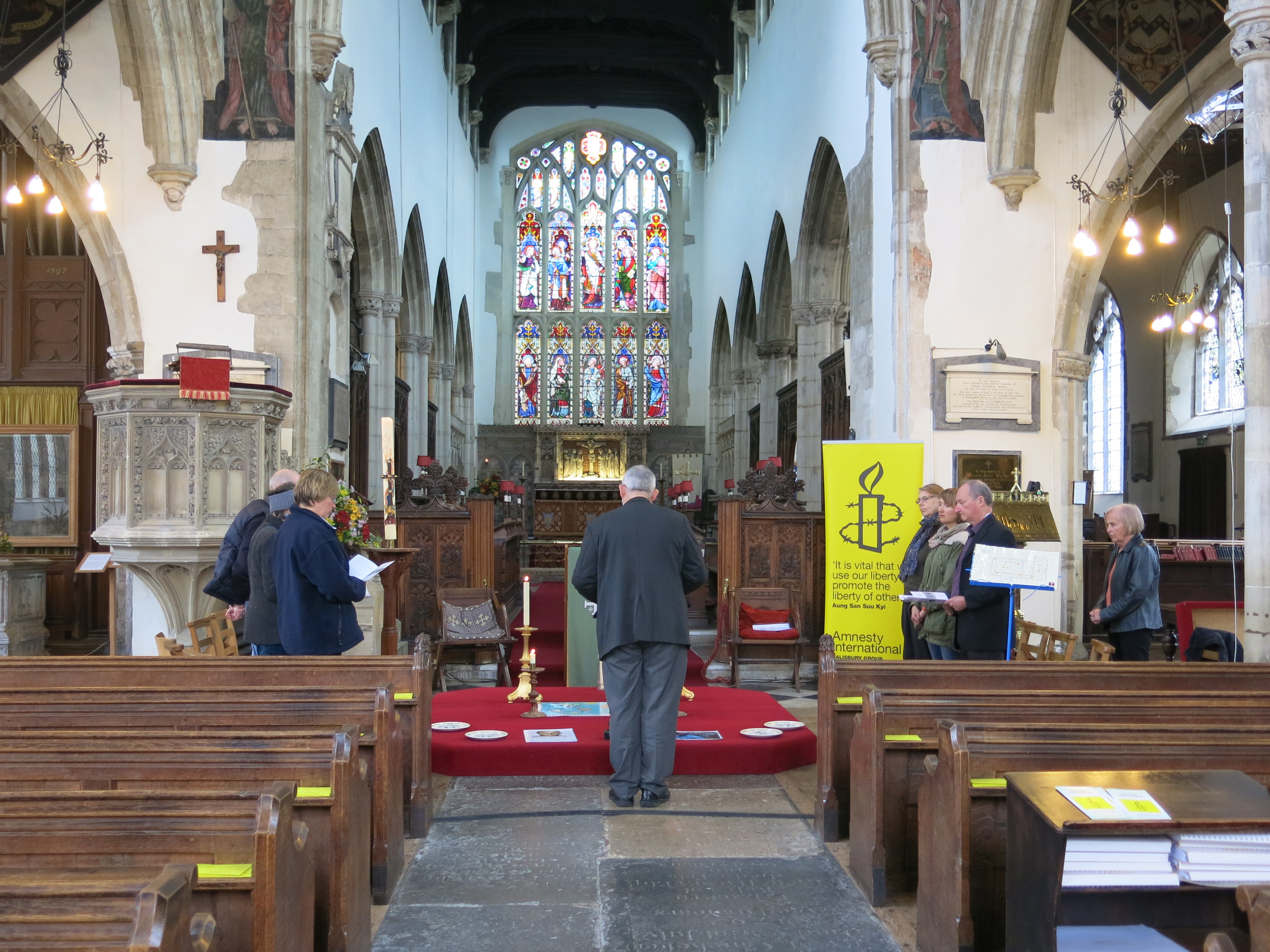
In the meantime, we have identified particular issues around the Death Penalty on which we have campaigned. Throughout the year we have responded to all the Urgent Actions received in respect of individuals under threat of execution – 31 in total. The majority of these have been for prisoners in Saudi Arabia, Iran and the USA. We have worked on the cases of individuals sentenced to death within Amnesty’s Campaign against torture – most notably Moses Akatugba and Saman Naseem (see later), including them in letter writing, card signings and petitions, and have also continued to campaign on behalf of Reggie Clemons (see later). In partnership with St Thomas’s Church, we held a Vigil as part of the World Day Against the Death Penalty. This was our first such venture, and it has to be said that public support was disappointing, but the Group felt it had been very worthwhile.
2015 has been a challenging year:
- We saw an unprecedented rise in executions in Saudi Arabia following the accession of King Mohammad bin Salman. At least 151 had taken place by early November, and executions are now at a 20 year high. Disproportionate use is made against foreigners, particularly from poor countries, who do not understand arabic and are denied adequate translation in court. Barbaric methods of execution are employed – beheading, stoning and crucifixion. Death sentences have been passed for a range of offences, including ‘apostasy’
- There has been a rise in the number of executions in Iran – at least 694 in the first half of the year
- There are considerable concerns at the numbers of countries now using the death penalty to deal with real or perceived threats to State security under the guise of terrorism – Pakistan, Tunisia, Chad and Egypt as well as Saudi Arabia and Iran. Initial fears that the legislation would be used to include a wide range of ‘crimes’ other than terrorism were more than justified. A report by Reprieve states that those executed in Pakistan have included individuals sentenced to death as children and victims of police torture
- Concerns have been raised at the numbers being sentenced to death and executed for alleged crimes committed when children. Countries with the worst records for this are Saudi Arabia, Iran and Pakistan. This issue has been taken up by the Salisbury Group – as mentioned above, it was the focus of our Death Penalty Vigil for this year’s World Day Against the Death Penalty. We highlighted the case of Saman Naseem, a Kurd arrested at 17, tortured and sentenced to death for being a member of a banned organisation. Reports earlier in the year of his execution proved to be unfounded, and he has now been granted a re-trial
- There has also been the issue of the growth in sentences and executions for drug-related offences, particularly in Indonesia
- China continues to refuse to publish details of the numbers of executions, but is believed to carry out more than the rest of the world combined. There have, however, been some encouraging signs. In January, a youth wrongly convicted of rape and executed 18 years ago received recognition of his innocence and a posthumous pardon. In May a number of Judges contributing to a Symposium on “Mistaken Cases” called for reforms which would go some way to meeting standards for a fair trial. Also in May, the sentence for a woman convicted of the killing of her abusive brother was commuted from death to life in prison
- The year for the USA in respect of the death penalty has been mixed. Its use continues to decline across America – the number of death sentences handed down dropped by a third in 2015 , with only six states – Texas, Missouri, Georgia, Florida, Oklahoma and Virginia – carrying out executions. Public attitudes to the death penalty are also changing, partly because of concerns at costs incurred from keeping prisoners on death row for many years and the lengthy appeal process, but also because of an increasing recognition of the risk of unsafe convictions. Almost 3,000 cases were identified involving unreliable or false testimony given by FBI Agents using a now discredited technique of hair analysis. Following 28 years on death row, Anthony Ray Hilton was released from death row in Alabama when his innocence was confirmed through the use of ballistic tests
- In 2015 Nebraska abolished the death penalty, and in Connecticut the death penalty abolished for new offenders in 2012, was abolished for the 11 inmates currently remaining on death row. There remain, however, pockets within the States where the use of the death penalty is disproportionate to the numbers within the population. Professor Frank Zimring of the University of Berkeley, California, believes the attitude of the district attorney to the death penalty to be a key factor
- Here in the UK it is now 50 years since the abolition of the death penalty, and it is encouraging to note that for the first time support within the country for its use fell below 50%. The Group have, however, been concerned at changes in our Government’s approach internationally to issues around human rights, and specifically to the use of the death penalty. In June we wrote to Salisbury MP John Glen to ask why the British Government could not follow the lead of the French President, Francois Hollande, in speaking out publicly while in Saudi Arabia against the use of the death penalty. His reply cited the value of behind the scenes diplomacy, seeing this as being more productive than speaking out publicly
- In August we learned that the Foreign and Commonwealth Office had dropped explicit references to abolishing the death penalty from its global human rights work. Despite the 2014 Human Rights and Democracy Report in which the Government claimed their work in this area was part of ‘sustained and long term efforts to to see an end to the death penalty world-wide’, all references to the death penalty were set to vanish from its stated priorities. In reporting on this, The Times of India made a pointed reference to the British Government’s condemnation of the hanging last year of the convicted terrorist, Ajimal Kasab. Mr Glen replied that the decision of the FCO to overhaul its approach to human rights had been made on the basis of feedback from diplomats who reported difficulties in relating our long list of human rights priorities with the issues they faced in real life. He stated that the death penalty could come under all three of the broad categories listed in the new guidelines, and this approach would enable diplomats to ‘tailor them appropriately to local circumstances’. As a group we are particularly concerned at what we see as a ‘fudged’ approach, and a serious threat to our country’s ability to be seen as promoters of human rights.
Economic prosperity was further up my list of priorities than human rights
Sir Simon McDonald, Head of the Foreign and Colonial Office in evidence to the Foreign Affairs Select Committee
This year has, however seen a number of successes in our campaigning:
- We have continued to campaign actively on behalf of Moses Akatugba, the young Nigerian accused of the theft of three mobiles and sentenced to death as a juvenile. After ten years on death row, in June Moses was granted a pardon and released. Over 34,000 had signed the petition, with more than 200 by people in Salisbury at last year’s stall for World Day Against the Death Penalty. Amnesty have received a letter of thanks from Moses, describing his feelings on learning of an experiencing his release, and describing Amnesty activists as his ‘heroes’. We were able to celebrate this success at our Vigil
- Following our long term campaign for Reggie Clemons in Missouri, in December we received the news we had been waiting for. After a long wait for a decision from the Court following the report of

Reggie Clemons (picture Amnesty USA) the Special Judge, Reggie’s conviction and sentence for first degree murder were ‘vacated’. The Court had upheld his right to a fair trial, which was all that he had sought from the beginning. We now await news of a date for his re-trial.

The Salisbury Group’s Campaigning Plans for 2016
- We will continue to write in response to individual Urgent Actions in respect of the death penalty
- We will be continuing to campaign on behalf of Saman Naseem to ensure that he receives a fair trial
- We will continue to campaign specifically on behalf of individuals sentenced for alleged crimes committed as juveniles.
- We will await news of the date of Reggie Clemons’s new trial, and campaign to ensure this is fair and in accordance with internationally agreed standards.
- We will await the outcome of the current AI Death Penalty Campaigning Survey, and will participate in any national campaign arising out of this.



 Amnesty in Salisbury & South Wiltshire