Unreliable hair evidence used in #deathpenalty trials


It has been revealed in the last week or so that FBI analysis of hair samples is seriously flawed and that astexas execution many as 32 people have been sentenced to death based on this evidence, of whom 14 have been executed or have died in prison .  The problem has arisen because of sloppy work by FBI examiners who have made claims about the ability to identify people from hair samples that are scientifically unsound.  It is, according to the Washington Post, possibly the largest forensic science scandal in America’s history.  Another 1,200 cases remain to be investigated.

Our view of the American justice system is strongly influenced by programmes like CSI and NCIS where clean cut, young, handsome and amazingly certain forensic examiners solve cases by clever scientific means.  Stories often centre (or should we say ‘center’ for our American readers) around one of them poring over a crime scene and finding a tiny piece of evidence.  Then back to the lab where they announce that said tiny piece of evidence is crucial in identifying the killer.  Forensic scientist and police officers dash about the place and sure enough, find the killer who has a matching piece of evidence tying him to the scene.  There seldom seems to be any doubt in what they say and we are left at the end of the episode with the right man or woman ‘going down’.

The problem is that not all science is like that.  There is not always that degree of certainty, merely probabilities.  When it comes to condemning a person to death – the ultimate penalty from which there is no retreat – then it is necessary to be certain.  The problem is made worse because defendants who are poor are not able to employ lawyers able to challenge the evidence properly.  Some lawyers may be doing their first capital trial and have little relevant experience.

You might think that having admitted a major flaw in the evidence given by FBI experts, speedy reviews would be underway to put matters right.  Well no, not in every state there isn’t.  Appeal courts often refuse to look at newly discovered evidence because claims of actual innocence are never grounds for habeas corpus relief.

The USA is the only country in the Americas with the death penalty and the southern states are the keenest users of it.  As we have commented before, it may seem unfair that we frequently highlight the use of the death penalty in the States:  China is the worlds biggest user of the death penalty, the precise number is unknown because it is a state secret, but it runs into thousands.  Iran is close behind.  The difference is that the States is the de facto leader of the free world.  But there is a point here that China is a closed society which severely limits access to the internet and curtails a free press.  America by contrast is a more open society and newspapers like the Washington Post are able to publish this information.  So we can read about it and comment on what we see.

No to the death penaltyAmnesty is opposed to the use of the death penalty in all circumstances.  It is the ultimate cruel and degrading punishment.  It is not a deterrent and there is plenty of evidence to show that it acts against the poor and those least able to defend themselves.  That one of the main methods of condemning people is flawed is yet another plank in the argument to end the use of this penalty in the USA.

Sources:

Washington Post: 18 April

Guardian: 23 April

Wikipedia

Social Science Research Network The Shifted Paradigm: Forensic Science’s Overdue Evolution from Magic to LawWilliam Tucker Carrington, University of Mississippi and M Chis Fabricant, Innocence Project Inc.

Death penalty report


texas executionThis month’s #deathpenalty report is attached thanks to Lesley.  It makes depressing reading especially concerning countries in South East Asia and #Pakistan.

Report

Death penalty, Iran


We attach a case raising a number of concerns in #Iran.  Iran is one of the world’s leading countries in the use of the death penalty, second to China.  This case involves a woman, Reyhaneh Jabbari who was arrested for murder but her trial was seriously flawed, she was denied legal help, kept in solitary confinement and ill-treated and possibly tortured.  She was due for execution yesterday but following an outcry, it has been delayed for 10 days.

If you can find time to write that would be appreciated.

Urgent action


Death Penalty summary


This is the April summary for the group on the #deathpenalty and its use around the world prepared by Lesley (Word).

Death penalty summary April 14


Group meeting, April


We had our monthly meeting on 10 April and these are some quick notes ahead of the minutes which will appear in the ‘about us’

Amnesty logo
Amnesty logo

tab above.

  • UPDATE [May 2015]: We must record that this money was never received by the group.  The £800 received from Bishop Wordsworth school was gratefully received and there was a discussion on how it would be spent
  • Lesley gave the update on the death penalty and there will be a separate post on that soon.  The press release on Sakineh in Iran was published in the Journal today but the fact she was due to be stoned to death was edited out
  • the North Korea campaign action on 15 April was discussed and the string of NK flags was displayed
  • John Glen’s assistant has now replied and a meeting will be arranged on a Friday evening to fit around JG’s parliamentary activities.  Probably June
  • conference planning proceeds and there was a meeting of the group yesterday.  We will be in ‘competition’ with the Cathedral who have half a million of Lottery money plus sponsorship.  No reply yet from Robert Key who is chair of their event.  However our conference will focus on the actual substance of the Magna Carta and its relevance today ie the human rights angle.  The proposed bid to the City Council was discussed and Peter will submit that by Monday
  • AI’s strategic plan was discussed.  The key point here was whether AI was offering support to groups with these campaigns?  Recent history is not encouraging.  Andrew to circulate for comments
  • film at the Arts Centre was discussed
  • the new regional rep. Caroline Butler, is to be invited to the meeting
  • there is to be a stall on 21 June
  • 10 October is the World Day Against the Death Penalty and the group will be planning an event for that
  • need to give some thought to the Cathedral Service

Sakineh released. Iran


News this week that Sakineh Mohammadi Ashtiani, who was convicted of adultery and complicity in the murder of her

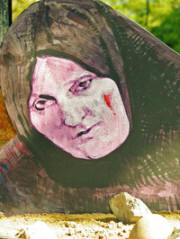
Portrait of Sakineh prepared by local support Paul Donavan
Portrait of Sakineh prepared by local artist Paul Donovan

husband and sentenced to death by stoning in 2006, is to be given ‘a leave’ from prison by the Iranian authorities.  The story was reported in the Guardian (20 March).

Readers of this site will know that the Amnesty group in Salisbury has campaigned on many occasions over the last several years on behalf of Sakineh.  It was part of a worldwide campaign.  We have sent cards to her prison, asked people to sign petitions and group members have written to the powers that be in Iran asking for her release.  Many hundreds of Salisbury people signed our petitions.  We – and the people of Salisbury who signed cards and petitions – can therefore claim to have played a small part in the successful outcome of this case.

The case caused a storm of outrage when it became national news.  For many, it was the first time that the full horror of what stoning actually involves was brought home to them.  Indeed, the group had to explain to many people what in fact it involved.  Men are buried up to their necks and women up to the waist.  Stones are delivered to the site which are neither too small nor so large that they would kill in one go.  This in a country that wants to be in the nuclear age.

Cube designed to illustrate the approximate size of stones used in stoning

Sakineh was world wide news but the scale of executions by a variety of means is at an astonishing level in Iran.  It is second only to China in the number carried out.  They are on course for nearly a thousand this year dispelling the optimism surrounding Rouhani’s election last year.

Nevertheless, it does show that concerted international pressure can and does have the occasional beneficial effect even on the most isolated regimes.

Iran


Readers of this blog and its predecessor, will recall that we have had many occasions to feature the situation in Iran, the3925 worlds second biggest executioner of its citizens.  Statistics are hard to come by and those issued by Iran itself are an underestimate.  Recent figures reveal 165 known executions in the first 2 months of 2014 which equates to just short of 1000 for the year if it carries on (Source: Iran Human Rights Documentation Centre, IHRDC).   Not only is the level of execution high but they are carried out in public, sometimes with a number of people being hanged at the same time.

We have campaigned against this in the past and in particular, the particularly nasty practice of stoning people to death.  The three methods of execution used in Iran are hanging – the most common – throwing people off cliffs, and stoning.  Children are executed as well, despite denials, and they are kept until their eighteenth birthday before the deed is done.

When Rouhani came to power, there was a wave of optimism in the West and with it a feeling that some kind of normalised relationship could be established with Iran.  An example is a BBC report of 11 November last year which quoted Jack Straw as saying ‘Rouhani was courteous, engaging, very straightforward, with a nice smile playing on his lips’.  There was hope that at last there was a moderate politician in Iran and progress could be made to have dealings with that country in a sensible way.

It is in this spirit of hope that an article in the New York Times this week under the headline ‘Mercy and Web Slow the Number of Executions in Iran’ by Thomas Erdbrink might provide some good news.  He spoke of a ‘growing distaste’ within Iran for capital punishment and he put this down in part to the spread of social media.  ‘The increasing number of executions has made the middle class upset’ a lawyer is quoted as saying.  The story was built around someone who managed to raise the funds necessary to pay the victim’s family enough to secure his release.

However, a search on the net reveals that the story is somewhat distorted and that if anything, the rate of executions is increasing under Mr Rouhani rather than diminishing.  A full report of the situation in Iran is published by the International Federation of Human Rights, Fidh and can be accessed at: http://www.fidh.org/IMG/pdf/Rapport_Iran_final_pdf  Please be warned there are some disturbing images.

It was hoped to post something positive about the country but the facts seem to point to the reality of life in Iran is much as it always was.

The group campaigns against the death penalty and if you wish to join us see the ‘Joining’ tab at the top of this site.

Blog at WordPress.com.

Up ↑