Humanist sentenced to 24 years for blasphemy is released
January 2025
We are delighted to report that Mubarak Bala has been released from prison in Nigeria having been sentenced to 24 years for the ‘crime’ of blasphemy. Two members of the Salisbury Amnesty group attended a demonstration outside the Nigerian Embassy in London organised by the Humanists.
Mubarak, President of the Nigerian Humanist Association, was arrested under Sharia law in Kano state for peacefully expressing humanist beliefs on Facebook. He was denied access to his legal team and his family and at times feared for his life.
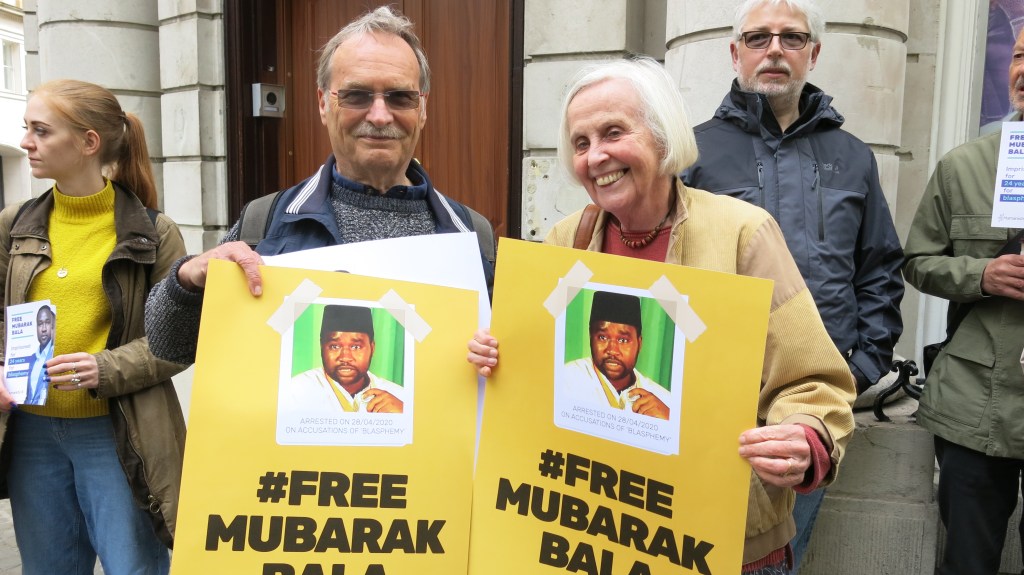
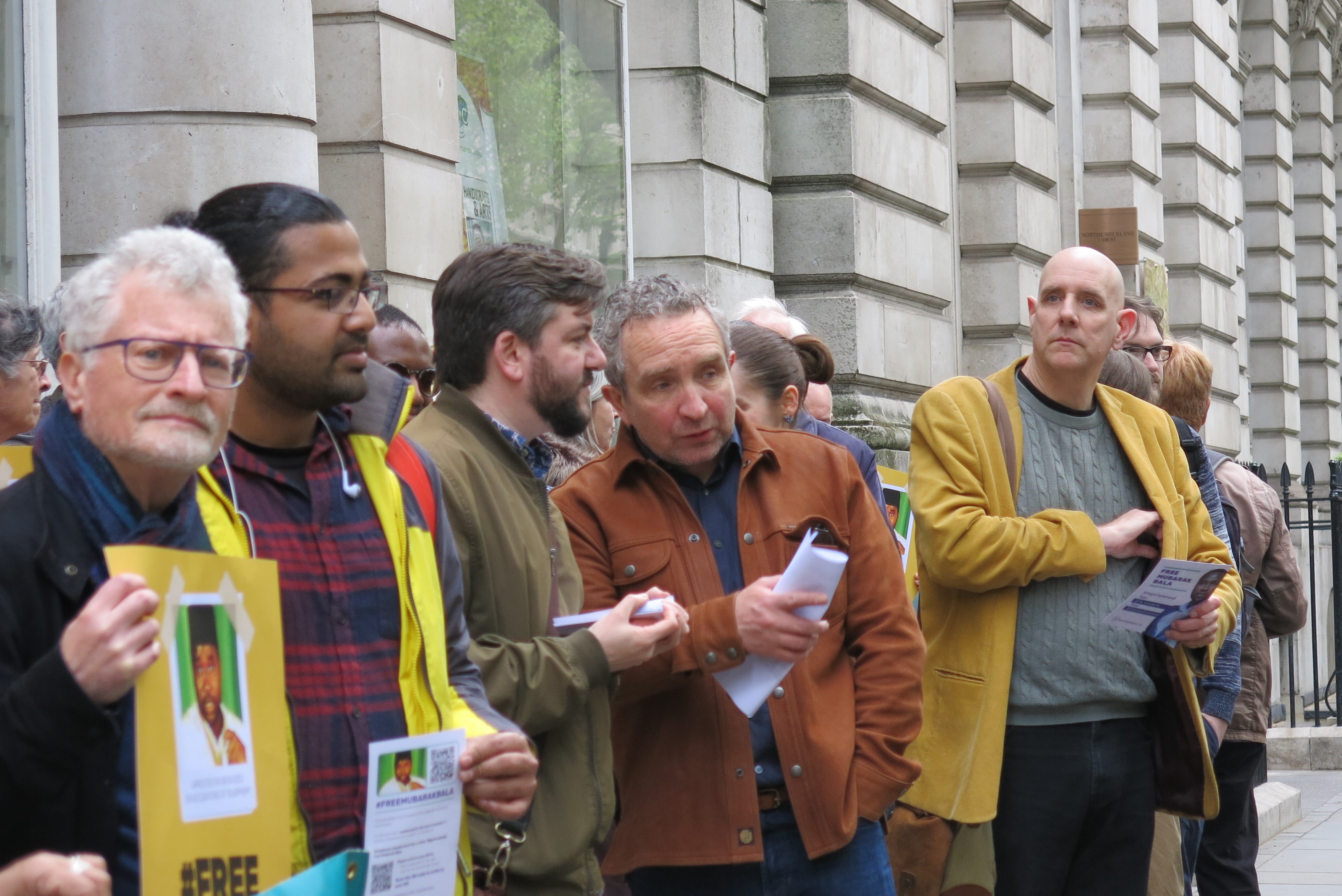
Humanists International and Humanists UK campaigned for his release and meetings were held with Foreign, Commonwealth & Development Office ministers, they staged a protest outside the Nigerian Embassy (pictured) and raised his case at the UN Human Rights Council. His case was raised on many occasions in parliament. The Nigerian Court of Appeal reduced his sentence to 5 years but the Humanists argued for his immediate and unconditional release. After four and a half years, he has now been released. He still fears for his life.
Twelve countries still have the death penalty for the so-called crime of blasphemy. Other countries will imprison such people. It encourages mobs to act violently against those who allegedly cause ‘religious offence’. The Humanists will continue to act for the repeal of all blasphemy laws.
Members of the Salisbury group took part in Humanist protest in 2022
February 2024
Pictured: Humanists UK’s #FreeMubarakBala protest outside the Nigerian High Commission, London, 2022. Two members of the Salisbury group can be seen, centre. Picture: Humanists
MPs have raised the case of Mubarak Bala, imprisoned President of the Nigerian Humanist Association, at a debate in Westminster Hall on Freedom of Religion or Belief in Nigeria. The debate was secured by Jim Shannon (Democratic Unionist Party), Chair of the All-Party Parliamentary Group on International Freedom of Religion or Belief (APPG FoRB) – of which Humanists UK is a stakeholder.
Humanists UK has been calling for Bala’s release since he was arrested in April 2020. Two years later, Bala was convicted and sentenced to 24 years’ imprisonment for posting ‘blasphemous’ content on Facebook following an unfair trial: it was repeatedly delayed and the charges against him were duplicated. Procedural irregularities were rife. Bala remained incarcerated without charge for well over a year. He was denied access to his lawyers and family for an extended period. He was denied medical attention. The Abuja High Court’s ruling that he be released on bail was ignored by Kano State authorities. His case exemplifies the need to abolish blasphemy laws, which intrinsically contravene the right to freedom of religion or belief.
During the debate, Jim Shannon said that he, alongside other members of the APPG FoRB has visited Nigeria in 2022:
‘We used our visit to speak to some of the judiciary and judges in Nigeria… and made a very good case for the release of Mubarak. We thought we had made some headway on that, and the indications coming from the judiciary seemed to say that, but he is still in prison.’
Shadow Foreign Minister Lyn Brown said:
‘I can understand the anxiety about states in Nigeria continuing to imprison people for exercising religious freedoms. We all know the case of Mubarak Bala.’
Humanists UK campaigns for freedom of religion or belief (FoRB) around the world, particularly for non-religious people facing persecution. In many countries it is impossible to be openly non-religious. Laws that criminalise blasphemy and apostasy are often the source of such persecution – as they were in Mubarak Bala’s case. The repeal of such laws is therefore a vital step in guaranteeing FoRB for all.
Director of Public Affairs and Policy Kathy Riddick commented:
‘We thank Jim Shannon MP for securing the debate and raising the case of our colleague Mubarak Bala who has been imprisoned simply for expressing his humanist beliefs.
‘The situation for humanists in Nigeria is dire. Blasphemy and apostasy are punishable by death and this is used to falsely justify the social persecution of the non-religious. Particularly worrying is that Nigeria is on the ‘safe country list’ under the Illegal Migration Act, which means that non-religious asylum seekers may face great risks if they are deported there.
‘We continue to call on the government to use all channels available to advocate for the repeal of all blasphemy and apostasy laws, and to secure not only the release of Mubarak, but the release of those convicted or imprisoned under such laws.’
Young man at risk of execution in Nigeria for alleged blasphemy
Yahaya Sharif-Aminu. Pic: thewillnigeria
YahayaSharif-Aminu (pictured), 22, a singer, is in prison in Kano, Nigeria and is at risk of execution for alleged blasphemy. This is an urgent action asking you to write to the authorities for his release.
The death sentence handed down to Yahaya Sharif-Aminu by the Upper Sharia Court in Kano state, Nigeria was widely criticized across Nigeria and also by Amnesty International after a huge outcry by several individuals and religious bodies urging the Governor of Kano state not to sign his execution warrant.
There were serious concerns about the fairness of Yahaya Sharif-Aminu’s trial and the framing of the charges against him. Before and during the trial, he was not permitted legal representation. He was granted access to legal advice to prepare an appeal after human rights lawyers and activists pressured the court to respect his right to legal representation.
In Kano state under the Sharia law, blasphemy is a criminal offence with a death penalty. The death penalty remains a legal sanction in Nigeria and continues to be imposed throughout the country. In 2019, over 54 death sentences were recorded. In total, over 2,700 people were under death sentence by the end of the year. In Nigeria, the 2004 National Study Group on Death Penalty and the 2007 Presidential Commission on the Administration of Justice both stressed that the Nigerian criminal justice system cannot guarantee a fair trial and called for a moratorium on the death penalty.
Sentence of death for singing a song
In 2008, the African Commission on Human and Peoples’ Rights (African Commission) adopted its second
resolution on the death penalty, calling on States Parties to the African Charter on Human and Peoples’ Rights –
such as Nigeria – to “observe a moratorium on the execution of death sentences with a view to abolishing the
death penalty” and to ratify the ICCPR-OP2. In a study published on 19 April 2012, the Working Group on the
Death Penalty of the African Commission reaffirmed the necessity of the abolition of capital punishment and
suggested ways for its achievement.
We would be grateful if you can find time to write. There is an email address as well.
Nigeria has been in the news recently with disturbances in several cities concerning police violence. This urgent action concerns a particular individual at risk of execution. If you have time to write that would be wonderful.
There are serious concerns about the fairness of Yahaya Sharif-Aminu’s trial and the framing of the charges against him. Before and during the trail, he was not permitted legal representation. He was granted access to legal advice to prepare an appeal after human rights lawyers and activists pressured the court to respect his right to legal representation. Sharia law, which is practiced in many states in northern Nigeria, provides for the death penalty for blasphemy. The Hisbah, a Kano State-owned security outfit is the body that enforces the Shariah law in the highly conservative state.
The death penalty remains a legal sanction in Nigeria and continues to be imposed throughout the country. In 2019, over 54 death sentences were recorded. In total, over 2,700 people were under death sentence by the end of the year. In Nigeria, the 2004 National Study Group on Death Penalty and the 2007 Presidential Commission on the Administration of Justice both stressed that the Nigerian criminal justice system cannot guarantee a fair trial and called for a moratorium on the death penalty.
We have featured Moses before on this site since news of his release has been received. Briefly, he was arrested for allegedly stealing some mobile phones. He was then brutally tortured and the confession extracted from him was used to sentence him to death. He has been in prison for 10 years but a world wide campaign has resulted in his release. The Salisbury group was active on his behalf and over 400 signatures were collected and a petition sent to the Nigerian Embassy in London.
Moses has written a description of his release and how he was reunited with his family and this can be read here:
An item on Moses and the involvement of the Salisbury Group appeared in the Salisbury Journal on 2 July which unfortunately does not appear to be available on line.
Moses’ piece ends thus:
If I have my way, and can stop torture, I will be the happiest man on earth. I don’t want any future generation to go through what I went through in that torture chamber.
The Salisbury group, along with other groups around the world, has been campaigning on behalf of Moses Akatugba in Nigeria. He was accused of stealing three mobile phones and then subjected to torture and sentenced to death. Regrettably, torture has become endemic in Nigeria and police stations even appoint ‘torture officers’ to carry it out.
We have held many signings in Salisbury and a large number of cards were sent off to the Nigerian authorities. We are pleased to report that this campaigning effort has been a success and he has been granted a total pardon. Unusually, the Governor of Delta State mentioned the Amnesty campaign in his Facebook page.
Moses himself made a statement:
I am overwhelmed, I thank Amnesty International and their activists for the great support that made me a conqueror in this situation. Amnesty International and activists are my heroes.
I want to assure them that this great effort they have shown to me will not be in vain by the special grace of God I will live up to their expectation.
I promise to be a human rights activist, to fight for others. I am thanking the Governor for his kind gesture and for keeping to his words.
Further details of our campaign can be read on the fact sheet below;
We held a stall in the Library tunnel on Saturday 11 October in aid of the #stoptorture campaign and in particular, to highlight the case of
Moses Akatugba in #Nigeria. He was arrested for allegedly stealing mobile phones, shot in the hand and tortured by the Nigerian Army. He has been in prison now for eight years and is on death row awaiting execution. Torture is routine in Nigeria and it is reported that police stations even have a ‘torture officer’.
We collected 189 signatures in three hours which is a good haul for a difficult subject which has received next to no publicity. We shall be sending the cards in two batches to the Governor of Delta state in Nigeria where Moses is being held. We have sent a report of the signing to the Nigerian Embassy in London (see under Update below).
If you would like to know more about this case then you can find it here: Nigeria fact sheet
We are grateful to all those who stopped to sign a card. The great majority of passers-by did not to sign it has to be noted for
Moses Akatugba
reasons that are never clear or revealed. 155 countries around the world have signed the UN protocol against the use of torture but according to Amnesty International figures, it is still practised in 141 of them. In other words, they sign treaties to end it but continue to use it.
Thanks to all the Salisbury Group’s team for taking part and their help in making this a success: Michael; Jonathan; Andrew; Lesley; Peter; Fiona; Eddie; Cynthia; Tony and Karen.
On Saturday 11 October we shall be manning a stall in Salisbury market to highlight the human rights situation in #Nigeria. In particular, the case of Moses Akatugba who was tortured by Nigerian police to secure a conviction. He was 16 when arrested, shot in the hand, beaten, and hung in an interrogation room for hours. Pliers were used to extract his finger and toe nails. His alleged crime was to steal three mobile phones. Unfortunately, this ill-treatment is now a commonplace in Nigeria and there are reported to be ‘torture officers’ in police stations.
Executions were resumed in June last year when four men were executed in Benin city. The bodies were not returned to the families for burial nor is the location of the graves known.
Amnesty has serious concerns about the increasing use of torture and other cruel, inhuman and degrading treatment or punishment in Nigeria. Recent research by Amnesty indicates that police and military personnel routinely use torture and other ill-treatment to extract confessions and to punish and exhaust detainees.