April 2024
Repost on the subject of Rwanda
April 2024
Amnesty in Salisbury & South Wiltshire
Promoting human rights from Salisbury UK
April 2024
April 2024
After what has seemed like a lifetime, the government has finally succeeded today, 23 April 2024, in getting its bill through both houses of parliament. The first flights are due to take off in 10 – 12 weeks that is in July. The airfield is as yet unknown but there is a possibility they will use Boscombe Down near Salisbury again as it is a military airfield surrounded by a high fence. There are some rumours to that effect.
Questions now are whether legal challenges will stand in the way. The government has declared Rwanda to be a safe country despite the evidence to the contrary. We do not know what the reaction of the European court will be. A robust challenge by them will renew calls by some politicians for us to depart from its jurisdiction.
This feels like a pivotal moment. Months have been spent on this problem and no doubt considerable civil service time has been spent on it as well. The cost has been considerable and the government has been reluctant to reveal the figures. An estimate is £370m with another £120m to come. There will be further sums for each asylum seeker despatched. There will be other administration and transport costs as well. The cost per person are difficult to estimate because it does depend on the numbers sent since some costs are fixed. As we move into what might be termed the ‘delivery’ phase of this project, issues of whether civil servants will be comfortable with the work they have to do and the response of the ECtHR are awaited.
The main purpose of the policy is to act as a deterrent. It is hoped – expected even – that news of the departures to Rwanda will deter those seeking to cross the Channel and seriously damage the business model of the smugglers. Whether this happens remains to be seen but with no end to wars and political instability in the world and the ease with which boats and outboard motors can be acquired from Turkey, suggests that this is a low risk, high reward activity unlikely to be deterred by a small percentage being sent to Rwanda.
Both local MPs, John Glen and Danny Kruger, voted for the bill.
March 2024
As usual, we lead with Rwanda. The Lords have been inflicting a number of defeats on the government over the provisions of the Bill, and the “ping pong” between the two Houses will reach a climax next week, when we will know which, if any, amendments the government will accept. Further issues have arisen over the role of the civil service in the planned scheme, with the FDA union threatening legal action against the government in the event of a clash with the European Court.
The National Audit Office has calculated the cost of the first (total?) 300 deportees to Rwanda to be £541 million, at £1.8 million per person. Indeed, the cost to date is £20 million with no flights. Ian Dunt has calculated that the cost per asylum seeker generally in 2015/6 was £7062, whereas in 2022/3 it was £20921.
The latest wheeze, as revealed in The Times today (Wednesday) is simply to pay failed claimants £3000 for a “voluntary return” – to Rwanda.
Figures released this month show that, as of 23 December 2023 the number of asylum seekers waiting for an initial decision was 128,000. The Government, of course, has claimed to have removed most of the legacy backlog, so most of these are new.
The sacking of the Independent Chief Inspector of Borders and Immigration has resulted in the sudden release of the plethora of reports he wrote, which had not previously been published. They mostly concern the implementation of the Nationality and Borders Act 2022 and are generally critical of the Home Office’s performance. It is unlikely that a replacement for Mr Neal will be found before the end of this parliament.
Refusal rates for asylum seekers went up in the last quarter of 2023, with a third of applications refused. This is unusual, as most applications end up being accepted.
The rules on Ukrainian refugees’ visas changed last week (with 4 hours notice of implementation) – The Family Scheme was closed though the Homes for Ukraine scheme is extended, but will not be processed until 2025.
This week the Council of Europe Commissioner for Human Rights, Dunja Mijatovic, criticised the Rwanda scheme along with certain French actions as acting above the law. She was concerned that two large European nations were giving a bad lead to the rest.
A small boat arrival, Ibrahima Bah, was sentenced this month to 9 ½ years in jail for “facilitating illegal entry, gross negligence and manslaughter “ following the deaths of fellow passengers. He is the first shipwreck survivor in the UK to face such charges and was not a people smuggler, but a refugee left in charge of the boat. The court concluded his age was 20, but he claimed to be 17.
Andrew Hemming
February 2024
The Rwanda (Asylum and Immigration) Bill ends its House of Lord’s stage today (12 February) and returns to the Commons. The Bill has been roundly condemned by many human rights and other organisations and the committee said that it is ‘fundamentally incompatible with Britain’s human rights obligations’.
The Supreme Court has already ruled that Rwanda is not a safe country and the government’s attempt to pass a law simply saying it is is bit like passing a law saying water can run uphill. The Committee went on to say ‘the Bill disapplies laws that might prevent and individual’s removal to Rwanda including many of the key provisions of the Human Rights Act.
‘It might also impact on Northern Ireland, that it would both undermine the Windsor Framework and the Belfast (Good Friday) Agreement’.
It also raises the point about UK’s reputation. We have they say, a reputation for respect for human rights of which ‘we should be proud’.
Immigration, and most recently the Channel crossings, have generated a considerable degree of angst and hostile media coverage. This is not recent and goes back many years and started to emerge as a political force during the Blair years. In many respects it goes back further to various waves of immigrants such as the Huguenots from France, Flemings from the low countries and Jews fleeing Russia. All have been met with hostility of some degree.
Recent immigrants are cast as not really refugees at all but economic migrants, are cheating the system, are living off benefits and so forth. Newspapers – and not just tabloids but the Daily Telegraph and the Independent – have carried hundreds of negative stories and helped keep the temperature high. The Sun even ran a story that swans were being stolen from the London parks and eaten by immigrants (invented). The raised media attention has increased public concern to which the politicians are obliged to reflect.
Anomaly
A curious anomaly is that people who’s offspring emigrate to live and work overseas (as ‘economic migrants’ no less) are spoken of in terms of pride. Emigrants good: immigrants bad.
Another curiosity is that many of the politicians leading the hostility and proposing ever harsher measures including deportation to Rwanda, are themselves sons or daughters of immigrants. Priti Patel, Kwasi Kwarteng, Suella Braverman, Rishi Sunak, Danny Kruger and going back further, Michael Howard (Romania).
The benefits of immigration to this country almost don’t get a look in. In November last year, the government’s own statistics show that around one in 5 of people working in the health service were not born in the UK. Indeed, the service would struggle to survive (even more than now) if these people were not working here.
The entire debate is based on hysteria. Boat people have assumed a disproportionate sense of anger and fear even though they represent a small proportion of all immigrants to this country. The majority do go on to claim asylum. The hysteria and media mis- and disinformation has resulted in the plan to deport a few hundred to Rwanda, a policy which is performative rather than likely to be effective.
Sources: Daily Mail, FullFact; Liberty; Hansard, Guardian (accessed 12 February 2024)
The Salisbury Amnesty group celebrates 50 years of existence this year
November 2023
A report in the Guardian suggests the government proposes to disapply the HRA and block its use to enable the deportation of asylum seekers to Rwanda. This follows the Supreme Court’s decision last week that Rwanda is not a safe country and individuals sent there would be at risk of refoulement. The government is under considerable pressure from the right of the party and in particular the ‘New’ Conservatives jointly led by Danny Kruger MP who is the member for Devizes in Wiltshire.
November 2023
This is a piece from today’s (16 November) from HRW.
| A Welcome Decision in the UK Regular Daily Brief readers may recall our story on the UK government’s obsession with cruelty, shown by its intention to ship asylum seekers to Rwanda, a country with a terrible rights record. I’m happy to report a good-news update to this story: yesterday, the UK Supreme Court said Rwanda is not a safe country for the government’s plans. As my UK colleague Emilie McDonnell writes, the decision was “a huge victory that will protect the rights of countless people who have come to the UK seeking safety.” In a unanimous judgment, the UK’s highest court drew attention to Rwanda’s poor human rights record, including threats to Rwandans living in the UK, alongside extrajudicial killings, deaths in custody, enforced disappearances, torture, and restrictions on media and political freedoms. The Prime Minister Rishi Sunak has responded by vowing to introduce emergency legislation “to confirm Rwanda is safe. ”Instead of arguing with reality, he would be wiser to ditch the government’s unlawful Rwanda deal. |
October 2023
Immigration remains a key issue for both the government and the opposition and the focus is on the large number of Channel crossings from France. The prime minister has pledged to end the crossings, however they continue to come in large numbers. The government spent considerable time trying to find countries willing to take migrants and eventually found Rwanda to which £145m was paid to set up the necessary reception facilities. The planned first flight ended when the European Court found against the deportations because under article 3 of the European Convention of Human Rights, there is an absolute ban on the use of torture and other serious mistreatment of which there is considerable evidence that it takes place in that country.
In a Country Report by the US Department of State in 2022, there is an extremely long list of problems with human rights in Rwanda. They include: unlawful or arbitrary killings; torture or cruel, inhuman, degrading treatment by the government; harsh and life threatening prison conditions and arbitrary detentions. Their activities also extend overseas and in particular in the Democratic Republic of the Congo which include killings, kidnapping and violence. The report also lists a range of activities against the media and journalists. There are similar reports from Human Rights Watch and Amnesty. Altogether it paints a picture of a country which is a stranger to human rights and where violence and repression are a way of life.
Daniel Trilling in his ‘long read’ in today’s Guardian newspaper (5 October) Inside the Rwanda deportation plan: there were so many warnings it would fail. How did it get this far? traces the whole story of where the idea came from and how it got stuck after the European Court ended it at least temporarily. The proposal was meant to act as a deterrent to further Channel crossings. This was never likely to have been the case since people willing to risk their lives in a rubber dingy having paid considerable sums to a smuggler are sufficiently desperate not to heed any such threat even if they were aware of it.
He reveals that the Foreign Office said ‘no’ to Rwanda largely because of the sort of reasons listed above. They were aware of the UN putting pressure on Rwanda to stop its troops engaging in mass killings and rape in DRC. Officials from the Foreign Office were preparing Country Policy and Information Notes CPIN, which were unfinished at the time the decision was taken.
The government was embarrassed when an undercover report secretly filmed Johnson Busingye, the high commissioner for Rwanda saying disobliging things about the UK government such as it was “immoral for the British to claim to be a compassionate country”. Asked about the shooting of twelve refugees he replied “so what”.
The Supreme Court is due to rule at the end of the year and it is likely that the prime minister Rishi Sunack will ignore the European Court if it rules in the government’s favour.
It is hard to fathom the reasoning behind the government’s position on this policy. It was designed to be a deterrent but it was advised by its own officials that this was unlikely to be effective. The numbers of immigrants who would be sent is a matter of a few thousand which, in the face of the many thousands crossing the Channel and the tens of thousands languishing in immigration centres and hotels, will be a tiny proportion. They must have been aware of the copious evidence that the country was entirely unsuitable as a place to send vulnerable people. They must also have known that Israel abandoned the very same policy and the Danish government had put its policy on hold.
At the Conservative conference this week, the prime minister cancelled the next leg of the HS2 rail project claiming that ‘the facts had changed’ and this prompted a change in policy. Yet in the case of Rwanda, the facts haven’t exactly changed but have been visible all the while. It is though the policy – described as ‘shameful’ by Amnesty International’ chief executive – has become totemic existing in a space beyond reason and facts, a kind of belief system which defies rational thinking. Partly it is because the prime minister has made stopping the boats a key policy aim and Rwanda is central to that, a policy which cannot be cancelled for fear of looking weak. If flights take place at the end of the year it will cause considerable suffering to those sent there.

October 2023
An article in the Long Read section of the Guardian newspaper entitled Inside the Rwanda deportation plan has a photo montage in which group member Lesley features holding two banners.
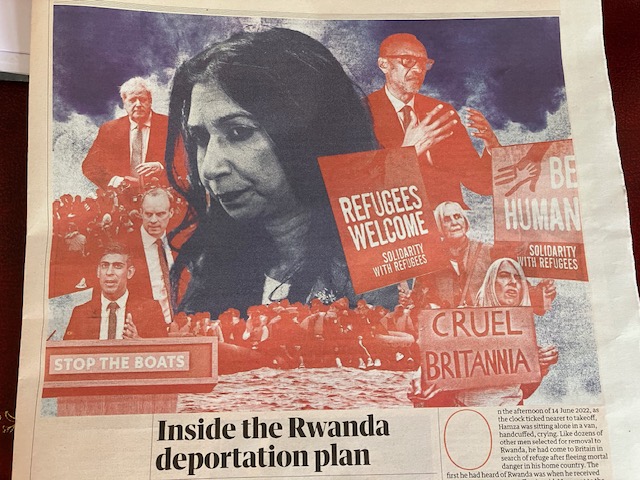
The article is by Daniel Trilling and is a detailed review of the muddle, confusion and dissembling behind the government’s desire to send unwanted migrants to Rwanda.
We received word that the first deportation flight in June was to take off from Boscombe Down, a secure airfield near Amesbury in Wiltshire. It had been moved from Stanstead at the last moment to ward off potential protests and because it is surrounded by barbed wire fencing. Two Salisbury group members were able to make it to the airfield where there was a large contingent of police officers and a bevy of cameras. The photo was taken by one of the photographers. As you know, while we waited for the take-off, a final appeal to Europe meant the flight was cancelled hence the fury about the European Court and threats to take us out of the jurisdiction of the Court to enable future deportations to take place.

June 2023
The High Court has today (29 June) ruled by a majority, that the planned flights to Rwanda are not legal. This has been a key element of the government’s policy and the first flights due to go out in June last year from Boscombe Down near Salisbury, were halted at the last minute following a ruling by the European Court deciding it breached article 3 rights against torture and bad treatment.
The case hinged on whether it is safe for asylum seekers and others to be sent to this African country. Both UNHCR and Amnesty International have expressed doubts and concerns about what life is like and the safety of those sent there. In its 22/23 report Amnesty had concerns about the asylum process procedure, the risks of detention and deportation, discrimination against members of the LGBTIQ+ community and inadequate legal representation.

Plane waiting at Boscombe Down airfield in June 2022 but which left empty. Photo: Salisbury Amnesty
There is limited freedom of expression, bloggers and journalists are harassed, persecuted, intimidated and sometimes unlawfully detained. Although the country has made promises to improve as part of the deal with the Home Office, serious doubts remain about how genuine these might be.
A report last week noted that the costs of sending individuals to Rwanda were excessive at around £170,000 per person and they also doubted the deterrent effects of the policy – a key element behind why the government wishes to do it. Altogether, the government’s policies on immigration and asylum are looking threadbare. They plan to appeal the decision. Both the prime minister and Suella Braverman have been critical of it.
Sources: BBC; UNHCR; Daily Mail, Guardian

September 2022
The change of Prime Minister this month has led to changes at the Home Office. The new minister, Suella Braverman, will have initially to deal with the question of sending asylum seekers to Rwanda, the issue of which is still under judicial review. The hearings have started this week. The new Prime Minister, Liz Truss has declared her support for the plan, indeed suggesting its extension to other countries. An aide told the Mail on Sunday: “She’s determined to see the Rwanda policy through to full implementation as well as exploring other countries where we can work on similar partnerships.” It would not seem likely that the new Home Secretary will mark much of a change from her predecessor.
Despite the legal challenge, the government plans to deport 19 people to Rwanda in the coming days. Information shared by charities indicates that six were trafficked or tortured, including one who was detained and beaten for eight weeks at a warehouse in the Libyan Desert.
Medical Justice have this week published “Who’s Paying The Price?: The Human Cost Of The Rwanda Scheme”, a comprehensive analysis of people targeted for removal to Rwanda which details medical evidence of the harm inflicted on them. The charity says: “The policy is damaging in general for anyone, acutely so for such vulnerable torture and trafficking survivors who are already paying a high human cost even before any flights have taken off to Rwanda.”
As one of the side issues to the debate, the charity Freedom from Torture is directing public attention on to the airlines who are or are intending to facilitate the flights.
Another central element of the immigration plan – the setting up of new processing centres for asylum seekers – also appears to have stalled after the Ministry of Defence admitted to the Observer that, despite evaluating 100 different sites for the Home Office since January, it has yet to publicly identify a new one that might be used. The only site named so far as “asylum accommodation” – in Linton-on-Ouse, Yorkshire – was abandoned after the Home Office failed to move any asylum seekers there and the MoD withdrew from the plan.
The Observer has revealed that the government is considering reintroducing its notorious refugee pushback policy for use against small boats crossing the Channel. Five months ago, after the heavily criticised policy was officially withdrawn by ministers, documents released under freedom of information laws suggest the government is reconsidering the tactic that has been blamed for drownings in Greece.
The numbers arriving in the country by boat continues to grow, to over 25,000 this year, given the good weather. 3,733 people crossed the Channel during the week to 28 August – twice as many for all of 2019.
Acceptances
What has been notable has been the large number of acceptances by the Home Office of asylum seekers’ claims. New rules on inadmissibility have added to the time taken to process asylum seekers, but the proportion of acceptances in the long term remains high.
A large number of Albanians has, however been returned on the grounds that the country Is safe. The government has been endeavouring to set up returnee agreements with other countries to facilitate repatriation; at present they have 5, the latest of which is with Pakistan.
By comparison with other European nations, the total number of asylum applications in the UK since 2012 has been 386,000, the 6th largest in Europe.
Outside of the refugee influx, more work visas have been issued to arrivals from India than any other nation (Ukraine is the next largest).
The Afghan emergency last year resulted in 16,000 nationals being brought over here. Of these, 9000 are still living in hotel accommodation.
The total number of Ukrainian refugees now in the UK is 115,000. Visas issued under the Family and Sponsorship schemes total 177,000. For comparison, Germany has so far taken in 971,000 Ukrainians. The UK government has, however, indicated that host households will have their “thank you” payments doubled to £700 per month.
AH
Don’t forget that you can listen to this and many other posts on this site by pressing the Spotify button at the top

 Amnesty in Salisbury & South Wiltshire