Film focusing on ‘honour violence’ to be shown in London
Honor Diaries is the first film to break the silence on ‘honor violence’ against women and girls. It features nine courageous women’s rights advocates, with connections to Muslim-majority societies, who are engaged in a dialogue about gender inequality. These women, who have witnessed firsthand the hardships women endure, are profiled in their efforts to affect change, both in their communities and beyond.
The film gives a platform to exclusively female voices and seeks to expose the paralyzing political correctness that prevents many from identifying, understanding and addressing this international human rights disaster. Freedom of movement, the right to education, forced marriage, and female genital mutilation are some of the systematic abuses explored in depth.
Spurred by the Arab Uprising, women who were once silent are starting to speak out about gender inequality and are bringing visibility to a long history of oppression. This project draws together leading women’s rights activists and provides a platform where their voices can be heard and serves as inspiration to motivate others to speak out.
On 1 June, Atena Farghadani, a 29-year-old painter and activist, was sentenced to 12 years and nine months in prison simply because she was seen to be critical of the Iranian regime in her art and in her peaceful activism.
Atena had used her right to freedom of expression to show her dissent at a new government Bill in a cartoon she’d drawn; she associated with the families of political prisoners; she posted anti-government messages on Facebook.
Atena’s peaceful activism led to her arrest in August 2014, a period of detention and release before being rearrested in November.
In June 2015, she was prosecuted by the Iranian state and found guilty of charges including:
Gathering and colluding against national security
Insulting members of parliament through paintings
Spreading propaganda against the system
Insulting the President and insulting the Supreme Leader.
Atena’s trial lasted just half a day. The ‘evidence’ against her relied on Atena’s answers under long stretches of interrogation, while she was held in solitary confinement without access to a lawyer or her family.
Atena is now imprisoned for 12 years and nine months, simply for being seen to be critical of the authorities.
Now facing adultery charges for shaking hands with her lawyer
Atena’s lawyer, Mohammad Moghimi, visited Atena in prison after her trial and shook her hand. The handshake led to charges of ‘illegitimate sexual relationship short of adultery’ and ‘indecent conduct’ being brought against both Atena and her lawyer, Mohammad Moghimi, who will be tried for those charges in due course.
Mohammad was arrested on 13 June for shaking Atena’s hand, and released three days later after he’d paid a bail amounting to around $60,000. Both Mohammad and Atena will be tried for indecent conduct and illegitimate sexual relationship for shaking hands in prison.
On 9 October we saw a note leaked from prison by Atena that said ahead of her trial for this ‘crime’ she was forced to have a virginity and pregancy test – apparently to investigate the charge against her. Such virginity testing is internationally recognised as a form of violence and discrimination against women and girls.
Iran’s judicial authorities really have reached a new low. Tell them they must immediately release Atena and investigate the mistreatment she says she’s experienced.
Prisoner of conscience
Atena has effectively been punished for her cartoons with a sentence that is itself a gross caricature of justice. No one should be in jail for their art or peaceful activism” Hassiba Hadj Sahraoui, Amnesty Deputy Director, Middle East and North Africa
Atena is a prisoner of conscience – she has committed no real crime. She is being unfairly punished simply for exercising her right to free speech, association and assembly. Iran has pledged to protect free speech, including through artistic activities, as a signatory of the International Covenant on Civil and Political Rights.
Please sign the petition and call on Iran’s Supreme Leader and the Head of the Iranian Judiciary to release Atena immediately.
Beaten in detention, punished for speaking out
Last August, 12 members of the Revolutionary Guards came to Atena’s house. They confiscated her personal belongings, blindfolded her and took her to Tehran’s notorious Evin Prison. Atena was released in November last year, but rearrested just six weeks later. In the time that she was released, she gave media interviews and posted a video on YouTube describing how the prison guards had interrogated her for 9 hours every day for six weeks. She said that female prison guards had beaten her and subjected her to degrading body searches.
Just weeks after posting her YouTube video, Atena was once again arrested – possibly as reprisal for speaking out.
Hunger strike in protest at prison conditions
Atena was kept in solitary confinement for over two weeks when she was detained last year in Tehran’s notorious Evin prison. During that time she was denied access to her lawyer or family. After her release from detention, she said that she’d been beaten by prison guards.
Three weeks after she was rearrested in January this year, Atena went on hunger strike to protest that she was being held in extremely poor prison conditions, in a jail that does not have a section for political prisoners. Atena’s health suffered considerably as a result; her lawyer told us that Atena had suffered a heart attack and briefly lost consciousness in late February as a result of her hunger strike.
Call on Iran to release Atena and reunite her with her family immediately: she has committed no crime.
If you are moved to sign the petition, please go to:
At the end of this blog we wrote ‘it seems therefore that nothing will change’. How wrong can you be as it has just been announced that the FCO will no longer be specifically campaigning for the abolition of the death penalty. The FCO message to us was dated 6 July and Mr Glen’s covering letter dated 14 July. So in the space of a few weeks abolishing the death penalty world wide has gone from ‘a human rights priority for the UK’ to being no longer a policy. The group plans to write to Mr Glen again to seek clarification.
July 2015
The Salisbury Group wrote to the local MP, Mr John Glen to ask for a more robust response by our government to the barbaric activities of the Saudi government in particular the increasing number of executions which are taking place. In our letter we said:
[we are writing] to you in connection with the increasing level of executions currently taking place in Saudi Arabia. (Over the course of the first five months of this year, the number of executions has equalled that of the whole of 2014).
You will no doubt be aware that on his recent visit to the country, President Francois Hollande made a public statement to the effect that all executions, not just those of his own nationals, should be banned, and called for the abolition of the death penalty in Saudi Arabia.
M. Hollande was prepared to do this, despite the fact that France – as does the United Kingdom – has significant financial interests in the its dealings with Saudi Arabia. The British government, however, has never seen fit to raise the issue in public, preferring to pursue a policy of ‘quiet diplomacy’. This policy has manifestly had no effect. Numbers continue to rise, and the Saudi Government have now advertised for eight additional executioners – ‘no particular skills required.’
As a group, we are asking that your government should take a much more robust line over the issue with the Saudi government.
Whereas the government – including the Prime Minister – has been vocal in its criticisms of the Islamic State for its appalling behaviour and of Russia for its activities in Ukraine, they seem strangely silent when it comes to Saudi Arabia. This contrasts with France which has openly criticised them and Sweden which has decided no longer to sell them arms.
Mr Glen replied, enclosing a letter from the FCO minister, and said:
“I enclose correspondence from the FCO minister Tobius Ellwood in reply to your recent letter about the UK’s apparent reticence when it comes to condemning the use of the death penalty in Saudi Arabia.
“As you can see, the approach taken by the government is not in any way indicative of an equivocal view on this practice, which is as barbaric as it is ineffective.
“However, the government recognises that its abolition is not a matter of mere legal reform but would require a seismic societal shift. It has therefore taken an approach which it feels is most constructive – engaging behind the scenes rather than inflaming the situation and triggering a backlash through outspoken public critique”.
The letter from the Foreign and Colonial Office is as follows:
“[…] The abolition of the death penalty is a human rights priority for the UK. The UK opposes the death penalty around the world because we believe it undermines human dignity and there is no evidence that it works as a deterrent.
“Saudi Arabia remains a country of concern on human rights, because of its use of the death penalty as well as the restricted access to justice, women’s rights, and the restrictions of the freedom of expression, freedom of assembly and freedom of religion or belief.
“Ministers, our Ambassador, and the Embassy team in Riyadh frequently raise the issue of the death penalty with the Saudi authorities, bilaterally and through the European Union. As it is part of Sharia Law, we must recognise that total abolition of the death penalty is unlikely in Saudi Arabia in the near future. For now, our focus is on the introduction of EU minimum standards for the death penalty as a first step, and supporting access to justice and the rule of law.
“The British Government’s position on human rights is a matter of public record. We regularly make our views well known including the UN Universal Periodic Review process and the Foreign and Colonial Office’s annual Human Rights and Democracy Report. We also raise our human rights concerns with Saudi Arabian authorities at the highest level. But we have to recognise that the human rights situation in Saudi Arabia reflects widely held conservative social values and that our human rights concerns are best raised in private rather than in public”.
It seems therefore that nothing will change. It is important to recognise that behind the scenes lobbying can be constructive. However, the policy of raising matters ‘in private rather than in public’ does not appear to be working. Successive governments have courted the regime and Saudis are free to invest in London and elsewhere in the UK.
It would be naïve not to recognise the reality behind this reluctance to criticise the Saudis and the importance to the government of the sale of arms and the supply of oil. Saudi Arabia is a key market for the UK and much effort is put into promoting sales including by members of the royal family – see the Guardian article: Human rights are of secondary concern.
As long as these interests are paramount, it is difficult to see how the toll of executions can be checked in the near future.
The film Bastards (12A) was shown this Wednesday 25 March starting at 7.30 and the audience reaction was very positive indeed. There were many questions to the producer Deborah Perkin.
This is a fascinating and highly-acclaimed documentary about one Moroccan woman’s struggle to legitimise her daughter and the director, Deborah Perkin will be there to answer questions. The film follows an illiterate young woman who took on her own family and the Moroccan justice system for the sake of her illegitimate child. It is a gripping, moving and uplifting documentary from the cutting edge of Islam.
Deborah Perkin is the first person to film in a court in Morocco, a country which leads the world in its legal efforts to give women and children more rights under Sharia law.
In Morocco, as in all Muslim countries, sex outside marriage is illegal and women bear the brunt of society’s disapproval. But what is the fate of the children of those single mothers? They cannot attend the better schools, are turned away from infant immunisation clinics and refused government posts. Jobs, housing and a huge range of social advantages are denied them. They are despised outcasts, condemned to a life of discrimination. Bastards is the first film to tell this story from a mother’s point of view.
We shall have a petition to sign about torture in Morocco. Morocco is one of the five countries highlighted by Amnesty International in its #StopTorture campaign. We are pleased to say many people signed our petitions at the end of the showing. Thanks to the Arts Centre.
Britain’s role in Afghanistan is coming to an after over a decade of bloodshed and war. It is doubtful that the country is in a fit state to function effectively since the Taliban and the warlords are still very much in evidence and there are reports of ISIS being present in the country as well. After all this time it is easy to forget some of the original aims which were defeating terrorism and the Taliban. We can also forget that it was the CIA who helped establish, arm and train the Taliban in order to assist them in their fight with the Russians.
One of the major victims of the years of war is women. It has turned thousand of Afghan women into refugees and widows – or both – and made it dangerous for them to seek schooling, go out to work, get healthcare or secure paid employment. Before the arrival of the Taliban in 1996, women’s rights had steadily improved and indeed, there are many photographs from that era women and girls in schools and university with not a burqa or veil in sight. Improving the rights of women became one of the additional aims of the invasion and it will be recalled that Cherie Blair – wife of the then Prime Minister, Tony Blair – hosted an event in 10, Downing Street in 2001 with this aim in mind. Kofi Annan said:
There cannot be true peace and recovery in Afghanistan without a restoration of the rights of women.
Similar sentiments were expressed by the then secretary of state Colin Powell:
The recovery of Afghanistan must entail a restoration of the rights of women, indeed it will not be possible without them.
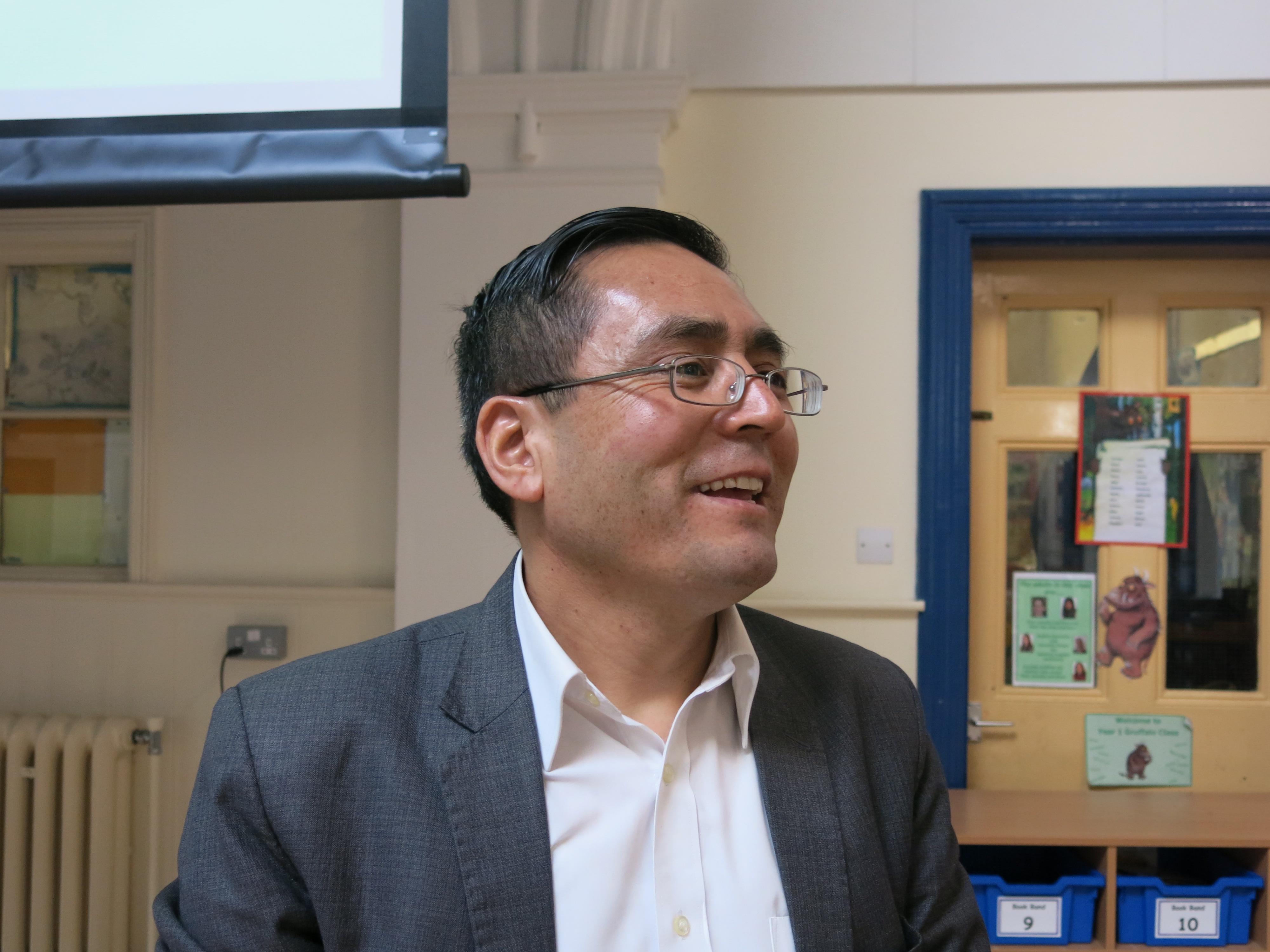
Abdul Hakim Hashemi Hademi
At the South West regional conference of Amnesty International it was heartening to hear from someone who has worked to improve the status of women through theatre and artistic groups in the countryside. The speaker was Abdul Hakim Hashemi Hamidi who set up the Simorgh Film Association of Culture and Art, SFACA. Unlike many aid programmes which tend to stay in Kabul or the main cities, SFACA goes out into the countryside and to the villages.
He has organised educational theatre workshops in prisons, juvenile correction centres, drug addiction rehabilitation centres, in schools and with the police. He has produced films with an emphasis on human rights and the role of women.
Not all the problems faced by women are solely to do with the Taliban. Another factor is honour killings which are at a very high rate in the country. 57% are identified as the responsibility of a family member and 21% by the husband. The perpetrator of 43% killings is unclear however. A telling quote from the PowerPoint display was:
A problem with women [is] because men don’t accept women have rights
He went on to discuss the problems of human rights defenders in Afghanistan. These included difficulty in
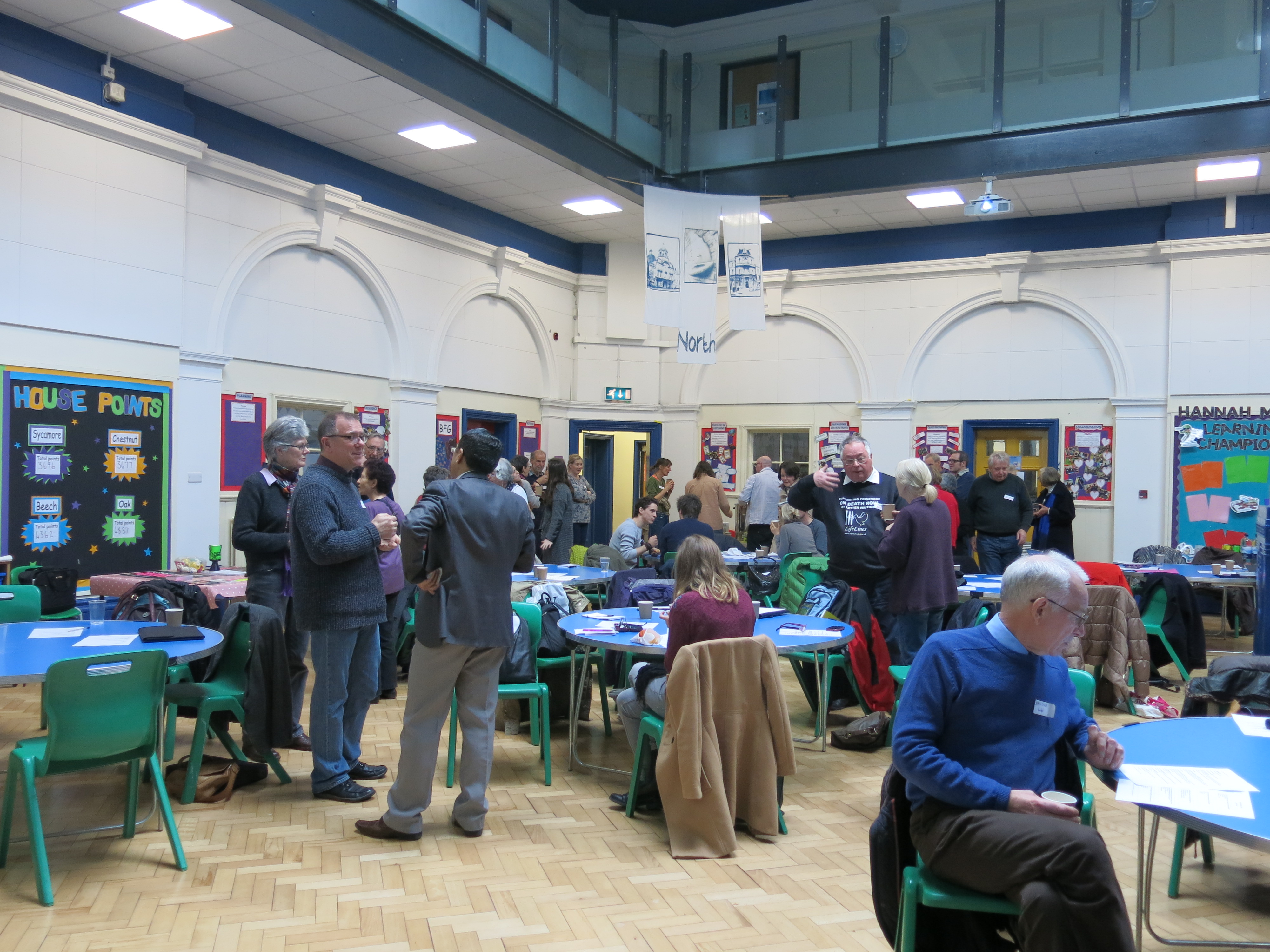
Delegates at the South West Region conference
travelling to some areas combined with a lack of government control in some parts of the country, traditional beliefs and illiteracy. Religion was a main cause he said and human rights are seen as a western construct. He urged that the UK government consider the role of human rights defenders in their discussions with the Afghans.
It was an interesting and uplifting talk by someone who has taken risks to go into the Afghanistan countryside to promote the rights of women. Abdul is a visiting fellow on the Protective Fellowship Scheme for Human Rights Defenders at York University. There is a permanent link to the York University Centre for Applied Human Rights at the bottom of the main page.

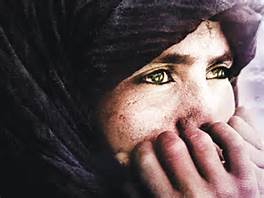 features nine courageous women’s rights advocates, with connections to Muslim-majority societies, who are engaged in a dialogue about gender inequality. These women, who have witnessed firsthand the hardships women endure, are profiled in their efforts to affect change, both in their communities and beyond.






 Amnesty in Salisbury & South Wiltshire
