And the vigils continue


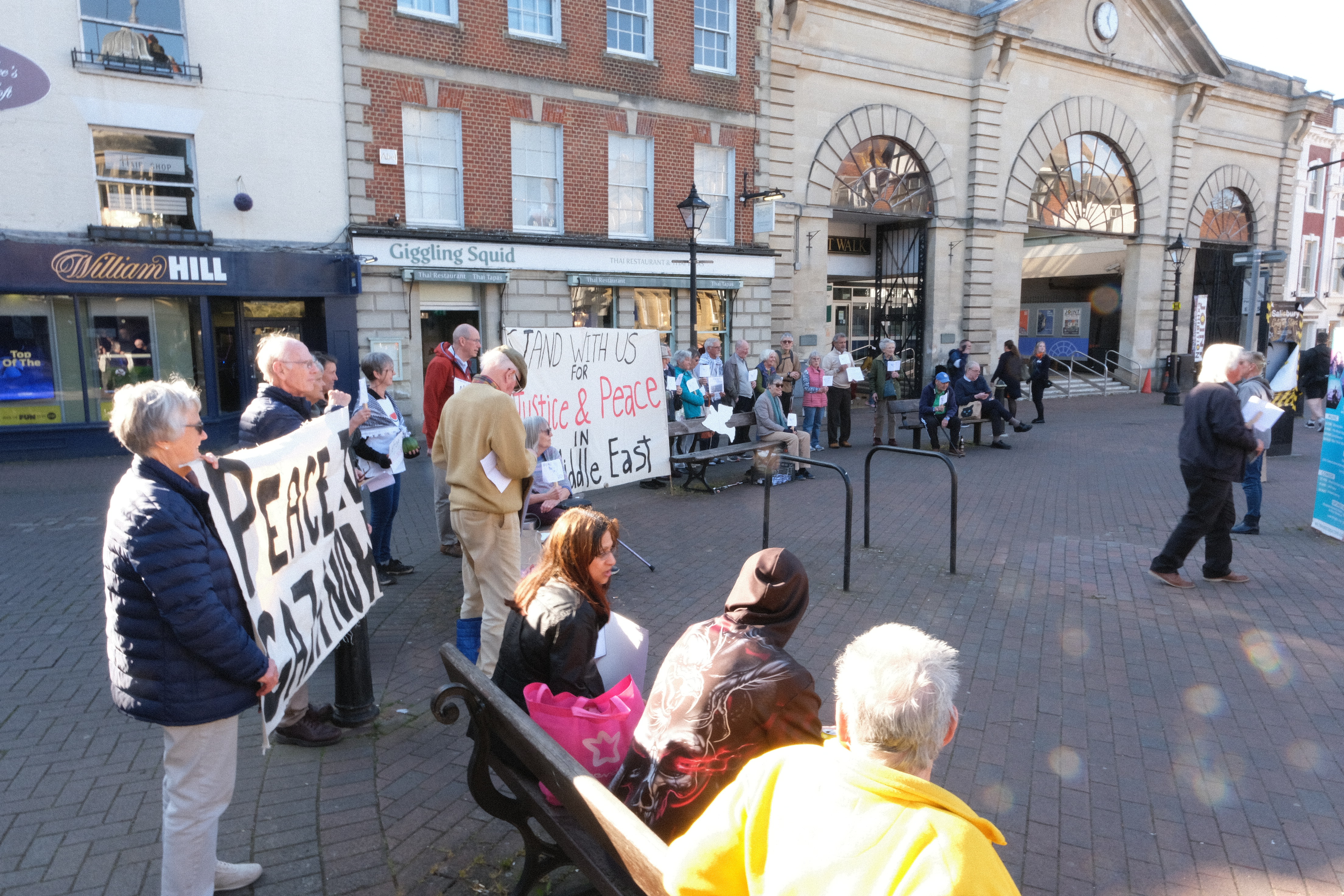
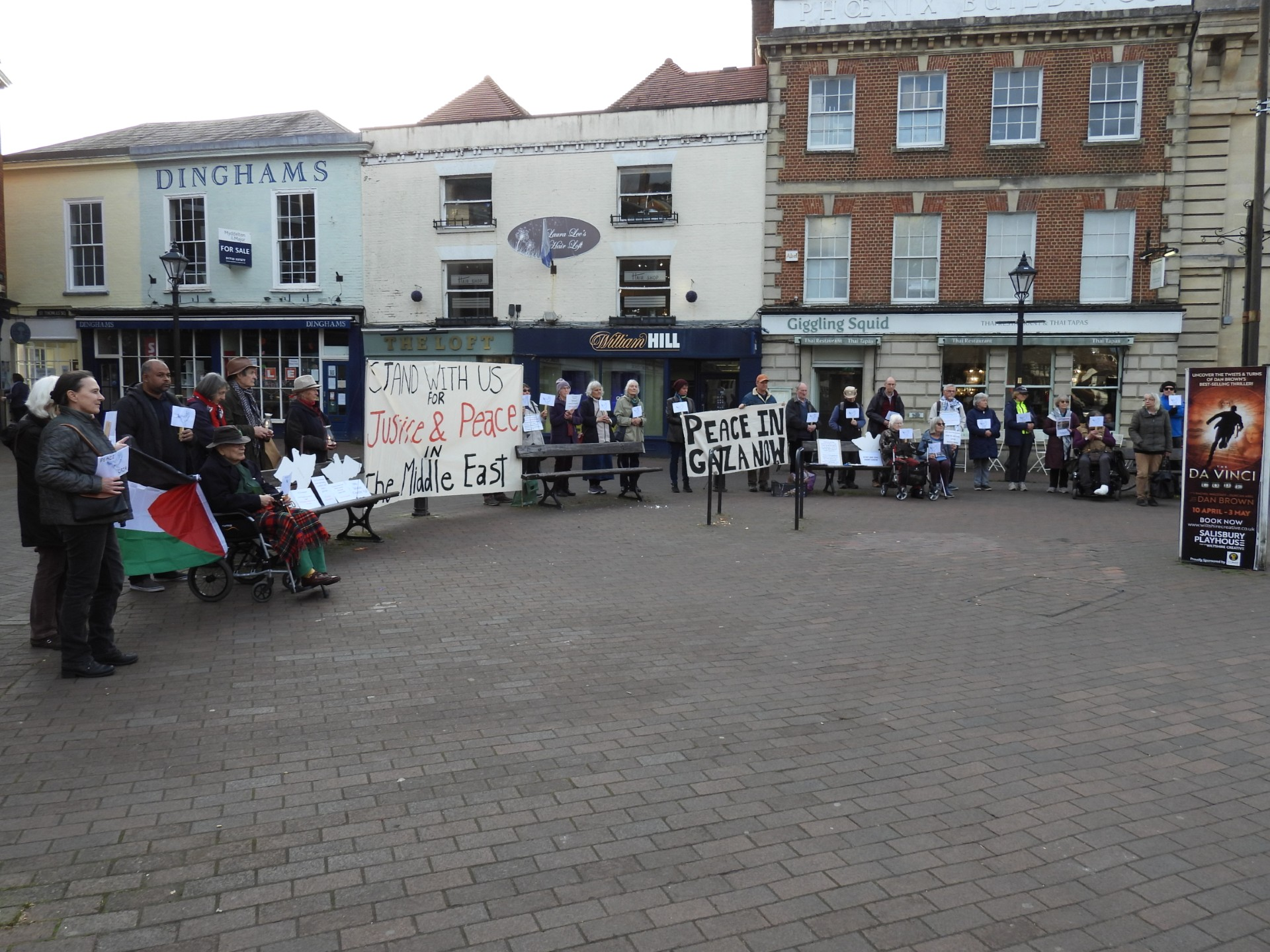
The 66th vigil held in Salisbury

March 2025

The plan was to hold the final vigil a few weeks ago with the hopeful news of a cease fire and talks being held in Qatar. The recent news is far from encouraging. The death toll stands at 48,000 with more being added to most days.

The situation now has worsened considerably. Aid convoys have been stopped and today, Israel has announced that it is cutting off all electric power. Quite apart from the effects on a state with 2 million people, the desalination plants cannot operate neither can the treatment plants. These moves target the whole population and are using water, aid and now electricity as a weapon of war.

The UK has asked the Israeli government to reverse the decision saying it risks breaking international

law. The Qatari Foreign Ministry says Israel’s actions are ‘a clear violation of the ceasefire agreement and of humanitarian law’.

The Israeli newspaper Haaretz reports that IDF soldiers are accused of using Palestinians as human shields a story also reported on in the Times of Israel. New rules issues by the Central Command enables soldiers to fire on Palestinians in the West Bank whether they are armed or not.

We shall be continuing our vigil and the next one is on Saturday 15th March starting at 5pm.

Main photo: Peter Gloyns


Minutes and Newsletter


March minutes and Newsletter March 2026 We are pleased to attach this month’s minutes and Newsletter for the group thanks to group member Lesley for preparing them. We do not publish a Newsletter as such but they contain a lot of material on the death penalty around the world, the state of UK politics as…

Middle East ‘forever’ wars


Iran, Lebanon join victims in the forever war. Vigils continue March 2026 The 119th vigil took place in Salisbury with over 25 in attendance, as the war intensified in the Middle East. We are in the third week of attacks on Iran as Israel and the US are bombing large areas of the country. Israel…

Ex Iranian prisoner to tell his story


Anoosheh Ashoori will speak in Romsey March 2026 The story of Nazanin Zaghari-Ratcliffe has been widely told and she has become a household name. A BBC film was made of her ordeal and she came to Salisbury to speak. Iran is in the news at present with the bombing campaign being carried out by Israel…

Nazanin talk at Cathedral


Talk by Nazanin Zaghari-Ratcliffe inspiring for those who heard it

March 2025

Nazanin Zaghari-Ratcliffe was interviewed in Salisbury Cathedral by the Rt Revd Bishop of Sherborne, Karen Gorham, about her experiences of being imprisoned in Iran and life after her release. Unfortunately, the sound system was such that many could not hear large chunks of what was said, some claiming only being able to hear a quarter of the discussion.

The local group was pleased that the Bishop, Nazanin and her husband all mentioned the role played by Amnesty and the introducer mentioned the local group in particular.

The event was a sell-out with nearly 1,000 people in attendance. It took place on International Women’s Day.

Nazanin made the point that there was a difference between being political prisoner and a hostage.

Being a hostage brought with it a different set of rules since what the legal case was did not matter. She also said you only appreciate freedom when you don’t have it for a long time. After release she found ‘adjustment quite difficult’. For a long time she said ‘my body was free but my mind was in prison’. Even meals were difficult because she found the rush of having to eat in prison was difficult to shake off.

She discussed the Boris Johnson affair. Johnson blurted out that Nazanin was in Iran to ‘train journalists’ which was untrue: she was there on holiday. This was used by the Iranian authorities against her. It took a long time for Johnson to meet her and he failed explicitly to apologise for his error despite the effect it had on her confinement. Both have been extremely critical of the British government during her ordeal.

Richard, her husband spoke about the ‘of the kindness of strangers’ . He also spoke of the role of Amnesty and of the symbolic nature of the Amnesty logo of a candle in a coil of barbed wire.

We apologise for the partial nature of this post for reasons outside our control. Image, Amnesty International.

BlueSky

UN expresses deep doubts about human rights


UN High Commissioner Volker Türk expresses widespread concerns about threats to human rights

March 2024

Volker Türk, addressing the 58th Human Rights Council, has expressed a range of concerns about the state of human rights today. As we said in our last post celebrating the 50th year since the formation of the Salisbury group, any idea that we were on a slow path to a better future with wider and deeper respect for rights in countries and communities around the world, is no longer believed. Not only are old threats still in existence, but new threats are appearing and gaining ground.

He begins by something of a tour d’horizon of conflicts around the world of which there are now 130

according to the Red Cross. In addition to the familiar which appear on our screens most days, there are conflicts in the Congo, Yemen (which has dropped out of the news recently), Myanmar and Haiti. He is concerned that in each of these wars, civilians are deliberately attacked and subject to sexual violence, and famine used as weapons of war.

Health care workers have suffered grievously and in 2023, 480 were killed, double the number of the previous year. Humanitarian workers are also being killed with 356 dying in 2024.

The new threat comes from individuals and corporations which have never had so much control and influence over our lives as they do today. This is something of a new phenomenon which has emerged in the last two decades or so. “A handful of unelected tech oligarchs have our data: they know where we live, what we do, our genes and our health conditions, our thoughts, our habits, our desires and our fears. They know us better than we know ourselves“. Several of these ‘techbros’ as they are called played a significant role in the recent US presidential election. Either by manipulating their algorithms, by direct financial aid or in the case of Jeff Bezos, his control over the Washington Post, they were able to play a hugely influential part in the result.

Unregulated power

Türk says that any form of unregulated power can lead to oppression, subjugation, and even tyranny – the playbook of the autocrat. We should be very concerned at the activities of the tech companies. Virtually all are American based and as we have seen in the last few days, the post-war consensus has been shattered by the new administration’s statements and policy changes.

President Putin of Russia, a demonstrable tyrant, who’s regime has murdered journalists and sent Navalny to a remote Siberian camp where he subsequently died for reasons unknown, is now being courted by the US president Donald Trump even having invaded Ukraine.

Governments seem unwilling or unable to control the companies’ activities. One by one, the companies have dropped their internal controls used to moderate content. A prime example of the effects – the murderous effects – of the tech companies was Myanmar. Hate speech and posts against religious minorities was widely spread on Facebook leading to considerable violence. Facebook was slow to remove posts and did so only after much damage was done.

Speed and scale of mis and disinformation can have dramatic and far reaching effects on people’s lives and rights. The tech companies have shown a remarkable lack of concern to control the content on their sites. They exhibit an almost mystical belief in their platforms and with the current belief in America in liberty and free speech absolutism, the risks for ordinary people are considerable. They cannot be voted out except by shareholders whose concern is profits not the effects their platforms might have.

We should be very concerned that a group of American companies, closely aligned to the politics of the White House, are able to have profound influence over the lives of millions yet are subject to almost no controls, certainly not from outside the US.

The Amnesty tree


Salisbury group assembles to mark planting of its tree

March 2025

Last year (2024) marked the fifty years since the group was founded and here we are, still going strong if sadly the only group left in Wiltshire. We had the opportunity for a tree to be planted in honour of this anniversary and today (4 March) some of the local group assembled for a photograph in Victoria Park. We were delighted to welcome two surviving members who formed the group half a century ago.

The need to keep human rights issues on the agenda is needed now more than ever. It was perhaps the belief all those years ago that the need for a human rights group would slowly melt away in the wake of the post war ideal of the new world order following WWII. This has not been the case. Rights are being slowly chipped away at home as governments have not liked protest groups drawing attention to their climate and environment failings and continued arming of Israel for example. The previous government introduced several pieces of legislation reducing rights, increasing police powers and limiting access to justice. The new government shows little inclination to repeal them. Some MPs – including both our local ones – generally vote against human rights matters according to the They Work for You website.

Overseas – well, where to start. China continues to persecute the Uyghurs and western firms continue to buy cotton produced by effectively slave labour. War and destruction continues in Sudan and other parts of sub Sahara Africa. The situation in Burma continues with the military attacking people and villages of minority groups. We continue to sell them jet fuel to enable them to carry on. The terrible death toll continues in Gaza.

So the need to keep the spotlight on human rights is needed today as it was 50 years ago. Power, in whatever form, does not like giving it up and will go to great lengths to keep it for themselves and their supporters.

If you would like to join us you would be welcome. See a list of current and future events where you can come and make yourself known. We welcome people who want to pursue a particular human rights theme – more rights for women for example.

Photo: Salisbury Amnesty

Latest posts:

Tree ceremony!


March 2025

Past event

It was the tree ceremony on Tuesday, at Victoria Park. Photos and a post later.

Vigil 65


Vigils continue despite the ceasefire

March 2025

The vigil in Salisbury Market Place continue although with the least in attendance we have seen for months. Perhaps other crises are on people’s minds and the ceasefire seemed to be holding – for now at least. The death toll in Gaza now stands at over 48,300 but thousands lie unrecorded under the rubble.

Today, Israel announced the cessation of aid going into Gaza which was part of the agreement. So an end does not seem to be in sight. The role of the Americans is a crucial factor and as we have seen with Ukraine, President Trump’s liking of strong men seems to be the name of the game.

A video prepared by Peter Gloyns can be seen here. We shall be back on 8th March at 5pm.


To all members and supporters, the tree ceremony takes place at 11:00 on Tuesday 4th in Victoria Park (by the main entrance at the south end of the park). It will only be short and if you can spare the time that would be wonderful. The tree is a recognition of the 50 years of the local Amnesty group.

Latest posts:

Abuse of medical staff by Israel


Reports of torture, beatings, starvation and humiliation of Palestinian medical staff by Israeli authorities

February 2025

With the welcome release of hostages from Gaza as part of the peace process, there has been considerable coverage of the condition of those arriving back home in Israel. Some have died in custody either as a result of bombing by Israel or by other means. Since journalists are not allowed in Gaza, obtaining independent confirmation of which is difficult. Those released have looked thin and haggard and Hamas used the process to make propaganda points. There have been no reports of torture or mistreatment however. Further coverage has shown their reception in Israel with large crowds welcoming them home.

Credible reports are emerging of the treatment of Palestinian medical people in Israel prisons. Health Care Workers Watch in a report published in December last year (accessible on their site) paints an horrific picture of their treatment. Medical staff, including surgeons, have been seized in hospitals – sometimes in the midst of performing surgery – and subjected to sustained brutal treatment and torture in Israel. Similar reports are produced by the World Health Organisation.

Medical staff have been thrown into lorries and have suffered severe beatings leaving them incapable of standing, The range of mistreatment is horrific and the detailed descriptions disturbing. In brief the treatment has included: beatings, often using rifle butts; severe injuries to genitalia; anal rape – again often with rifles; use of dogs; electrocution, sometimes while suspended from the ceiling; people forced into stress positions; prolonged solitary confinement; extremely loud music to prevent sleep, and not allowing medical prisoners to wash or change clothes for sustained periods of time sometimes months. All were eventually released without charge. WHO suggests that 297 medical staff were held, HCWW claim it was 384.

The reports paint a picture that suggests these arrests, combined with the attacks and destruction of medical facilities in Gaza itself, are part of a plan to make the territory unliveable. The reports are supported by evidence from an Israeli organisation, Physicians for Human Rights in Israel. They have visited prisoners and carried out their own interviews supporting the above allegations. A CNN report provides further horrific details. The Israeli human rights organisation B’Tselem published a report Welcome to Hell describing the cruelties and torture inflicted in Israeli prisons more widely. There is also a report by Human Rights Watch on the torture of Palestinian medics. The Israeli government has denied all these allegations saying prisoners are held and treated according to law.

People reading this post may be surprised at the information above. This is because of the widespread failure of media to report it. There is considerable coverage of the homecomings and of the release of Hamas detainees whereas the treatment described here has received limited coverage.

The importance of language

Language is important no more so than during a time of conflict. Media reports describe those released by Hamas as ‘hostages’ in exchange for ‘prisoners’ being released by Israel. This is the language used by BBC, ITV, Channel 4 and print media to describe these events. It has become the standard way to describe them. It is thoroughly misleading. It demonstrates the capture of British media by the steady drip of Israeli misinformation combined with banning journalists access on the ground. It may also be an indication of the fear media groups have of being labelled ‘antisemitic’. Almost all criticism of Israel is labelled thus. Such criticism gives rise to accusations of the critic being ‘pro Hamas’. It is conveniently forgotten that Benyamin Netanyahu was a supporter of the organisation in an attempt to weaken the PLO.

Considerable evidence – from within the country and outside – shows that Israel has seized scores of medics (the subject of this post), threw them into lorries and subjected them to sustained periods of torture, abuse, did not allowed access to lawyers and with no charges made. How is this different from hostages? The word ‘prisoner’ implies some process of law. It also implies that said prisoners had committed some kind of crime. Yet no charges were made, none were taken before a magistrate, none were allowed legal representation and they were eventually released without charge after prolonged periods of mistreatment, solitary confinement and torture.

This has enabled Israel to occupy a kind of higher moral ground. The country suffered terribly on October 7th. Hamas killed 1,200*, seized hostages in their fearful raid on October 7th 2023 and held them for months and it still holds on to some. This is a war crime. Yet Israel’s subsequent behaviour, killing around 48,300 in Gaza with over 111,000 injured (WHO figures) and the vast destruction and mounting violence in the West Bank, has lost the nation much sympathy. It has not solved its central problem of long-term security and the prospects for a two state solution seem further away than ever.

Western media, by failing to report on these issues, is guilty of misleading the public.


Sources: WHO; CNN; Guardian; Health Care Workers Watch; Physicians for Human Rights in Israel; B’Tselem; Human Rights Watch. See also Health Workers for Palestine

*revised figure – Times of Israel 11 November 2023.

Türkiye: Acquittal of Taner Kılıç


Equited after eight-year ordeal comes amid new wave of repression of rights defenders 

February 2025

The dire human rights situation in Türkiye has largely dropped out of the news in recent years but repression of rights defenders, journalists and academics continues. The case of Taner Kılıç, who was finally acquitted today after a judicial process that has lasted almost 8 years, is a stark example of the Turkish authorities’ politically motivated attempts to criminalize human rights defenders, said Amnesty International. We first mentioned his arrest in a post on this site in 2019.

Taner Kılıç, a refugee rights lawyer and former Chair of Amnesty International’s Türkiye section, was arrested in June 2017 and detained in prison for more than 14 months. Despite a complete absence of any credible evidence, in July 2020, he was convicted of “membership of a terrorist organisation” and sentenced to more than six years in prison. The end of the almost eight year ordeal for Taner Kılıç comes amid a new wave of detentions in which rights defenders, journalists, political activists and others have been targeted. 

His acquittal follows the Court of Cassation’s rejection of the prosecution’s appeal against its previous decision to overturn Taner’s baseless conviction.  

“Today, as we mark the end of Taner’s agonizing ordeal, our feelings are bittersweet. The cruelty inflicted on Taner – the years stolen from him and his family – can never be forgotten. His tenacity and resilience, coupled with our determination to undo this injustice, demonstrates that when we come together, we can move mountains,” said Agnès Callamard, Amnesty International’s Secretary General who spoke with Taner by video call today. 

For me this nightmare that has gone on for almost eight years is finally over. My imprisonment for more than a year has caused great trauma to my family. This unfair trial was like a sword of Damocles hanging not just over me but over the head of the entire human rights community in Türkiye. While it was for the prosecution to prove my guilt, this case went on for years despite my repeatedly proving my innocence,” said Taner Kılıç. 

The ordeal has created huge uncertainty in my life. The only thing I was sure of throughout this process was that I was right and innocent, and the support from all over the world gave me strength. I thank each and every one who stood up for me.” 

In May 2022, the European Court of Human Rights reaffirmed that the authorities in Türkiye did not have “any reasonable suspicion that Taner Kılıç had committed an offence” when they remanded him in pre-trial detention for over 14 months in 2017/18. It found that his imprisonment on terrorism-related charges was “directly linked to his activity as a human rights defender”.  

In November 2022, the Court of Cassation in Turkey ruled to overturn the conviction of Taner Kılıç on the grounds that the investigation was “incomplete”. The trial court agreed with the Court of Cassation ruling in June 2023, but the prosecutor appealed the decision, insisting that Taner Kılıç’s conviction should stand. With this latest and final decision, the Court of Cassation rejected the prosecution’s appeal, ending the ordeal for the human rights defender.  

Courts used to silence critics

“Taner’s protracted prosecution is emblematic of how Turkish courts have been weaponized to silence critical voices and of the ongoing crackdown by Turkish authorities on rights and freedoms and those who defend them. The flagrant miscarriage of justice he was subjected to for so long is sadly just one of many. But we will take strength from Taner’s acquittal in our fight against the curtailing of human rights in Türkiye, and on behalf of those who refuse to be silenced by the authorities’ threats,” Agnès Callamard.

The acquittal comes amid a crackdown in which more than 1,600 people have reportedly been investigated for their alleged links to the Peoples’ Democratic Congress, a platform for civil society organizations and political parties. Last week, at least 50 people were detained in several provinces and 30 among them unlawfully remanded in prison on ‘terrorism’ related allegations after being questioned about their peaceful activities dating from more than a decade ago. 

Background 

Taner Kılıç is a founding member of Amnesty International Türkiye. Over the last 20 years, he has played a crucial role in defending human rights as part of the organization and the wider human rights community in Türkiye.  

We are grateful to Amnesty UK for the bulk of the text in this post.


Latest posts

Richard Glossip case: latest


US Supreme Court rules that prosecutors violated ethical responsibilities

February 2025

The case of Richard Glossip in Oklahoma raises a number of interesting issues concerning the death penalty in the USA and in this case, the state of Oklahoma. In a 5-3 decision in Glossip v. Oklahoma issued on 25 February, the Supreme Court judges ruled that the prosecutors had ‘violated their duty to correct false testimony’. The prosecutors had also ‘suppressed material evidence concerning their star witness, Justin Sneed’ who actually committed the murder.

The case involved the murder in 1997 of Barry van Treese the owner of a motel. Sneed confessed to the killing and agreed a plea bargain claiming that Glossip had instructed him to carry out the murder. This saved him from execution. There are a number of factors which has made this a case attracting international attention.

There was very little corroboration evidence apart from the testimony of Sneed. Sneed’s mental state was not revealed to the defence (defense) team, nor was his untrustworthiness or that he had lied to the police. Glossip’s legal team has discovered that Sneed had discussed recanting his testimony before the original trial and since. This had not been revealed to them. Another not unusual factor is the doubtful quality of his defence counsel.

There is not doubt that Glossip has suffered much in the 27 years. He has had no less than nine execution dates and has eaten three ‘last meals’.

It is being said that this case will not have wider effects because so many elements are unusual. But it does highlight the problem of the death penalty. Had any one of the nine actually taken place, there would have been no chance of an appeal. If the criminal system has people willing to withhold evidence, then any chance of a fair trial is unlikely. It is also unwise to convict someone of the ultimate legal penalty without certainty which must mean at the very least, corroborative and trustworthy evidence. A defendant must also have first class attorneys to defend him. The testimony of an unreliable witness should be treated with great caution.

A new trial has been ordered.

Sources:

World Campaign Against the Death Penalty; BBC, The Hill.

Perils of predictive policing


Amnesty publishes a report warning of the perils of predictive policing

February 2025

Many TV detective series have technology at their core as our heroes vigorously pursue the wrongdoers. CCTV cameras are scrutinised for movements of the criminals, DNA evidence is obtained and of course fingerprints are taken. The story lines of countless detective series feature forensic evidence as a key component of police detection. The series and stories are reassuring by displaying law enforcement officers using all the techniques – scientific and technological – to keep us all safe and lock up the bad guys. Using science and algorithms to enable police forces to predict crime must be a good idea surely?

It is not. The Amnesty report, and other research, explain in great detail the problems and what the risks are. One of the persistent biases in the justice system is racism and it would be worth reading the book The Science of Racism by Keon West (Picador, pub. 2025). The author takes the reader through copious peer reviewed research conducted over many years in different countries explaining the extent of racism. Examples include many cv studies (US: resume) where identical cv’s, but with different names which indicate the ethnicity of candidates, produces markedly different results. There are similar examples from the world of medicine and academia. Racism is endemic and persists. As Keon West acknowledges, a similar book could be written about how women are treated differently.

The Amnesty report notes that Black people are twice as likely to be arrested; three times as likely to be subject to force and 4 times as likely to be subject to stop and search as white people. With such bias in place, the risk is that predictive policing might simply perpetuate existing prejudice and bias. The concern partly centres around the use of skin colour, where people live and their socio-economic background all used as predictive tools.

People have a deep faith in technology. On a recent Any Answers? programme (on BBC Radio 4), a debate about the death penalty and the problem of mistakes, several people showed a touching faith in DNA in particular inferring that mistakes cannot happen. People are mesmerised by the white suited forensic officers on television giving a sense of science and certainly. Technology is only as good as the human systems which use it however. There have been many wrongful arrests and prison sentences of innocent people despite DNA, fingerprints, CCTV and all the rest. Mistakes are made. The worry is that predictive policing could enhance discrimination.

People who are profiled have no way of knowing that they have been. There is a need to publish details of what systems the police and others are using. The police are reluctant to do this the report notes. What is the legal basis for effectively labelling people because of their skin colour, where they live and their socio-economic status?

The police are keen on the idea and around 45 forces use it. The evidence for its effectiveness is doubtful. The risks are considerable.

Blog at WordPress.com.

Up ↑