The Amnesty tree


Salisbury group assembles to mark planting of its tree

March 2025

Last year (2024) marked the fifty years since the group was founded and here we are, still going strong if sadly the only group left in Wiltshire. We had the opportunity for a tree to be planted in honour of this anniversary and today (4 March) some of the local group assembled for a photograph in Victoria Park. We were delighted to welcome two surviving members who formed the group half a century ago.

The need to keep human rights issues on the agenda is needed now more than ever. It was perhaps the belief all those years ago that the need for a human rights group would slowly melt away in the wake of the post war ideal of the new world order following WWII. This has not been the case. Rights are being slowly chipped away at home as governments have not liked protest groups drawing attention to their climate and environment failings and continued arming of Israel for example. The previous government introduced several pieces of legislation reducing rights, increasing police powers and limiting access to justice. The new government shows little inclination to repeal them. Some MPs – including both our local ones – generally vote against human rights matters according to the They Work for You website.

Overseas – well, where to start. China continues to persecute the Uyghurs and western firms continue to buy cotton produced by effectively slave labour. War and destruction continues in Sudan and other parts of sub Sahara Africa. The situation in Burma continues with the military attacking people and villages of minority groups. We continue to sell them jet fuel to enable them to carry on. The terrible death toll continues in Gaza.

So the need to keep the spotlight on human rights is needed today as it was 50 years ago. Power, in whatever form, does not like giving it up and will go to great lengths to keep it for themselves and their supporters.

If you would like to join us you would be welcome. See a list of current and future events where you can come and make yourself known. We welcome people who want to pursue a particular human rights theme – more rights for women for example.

Photo: Salisbury Amnesty

Latest posts:

Tree ceremony!


March 2025

Past event

It was the tree ceremony on Tuesday, at Victoria Park. Photos and a post later.

Anniversary supper


November 2024

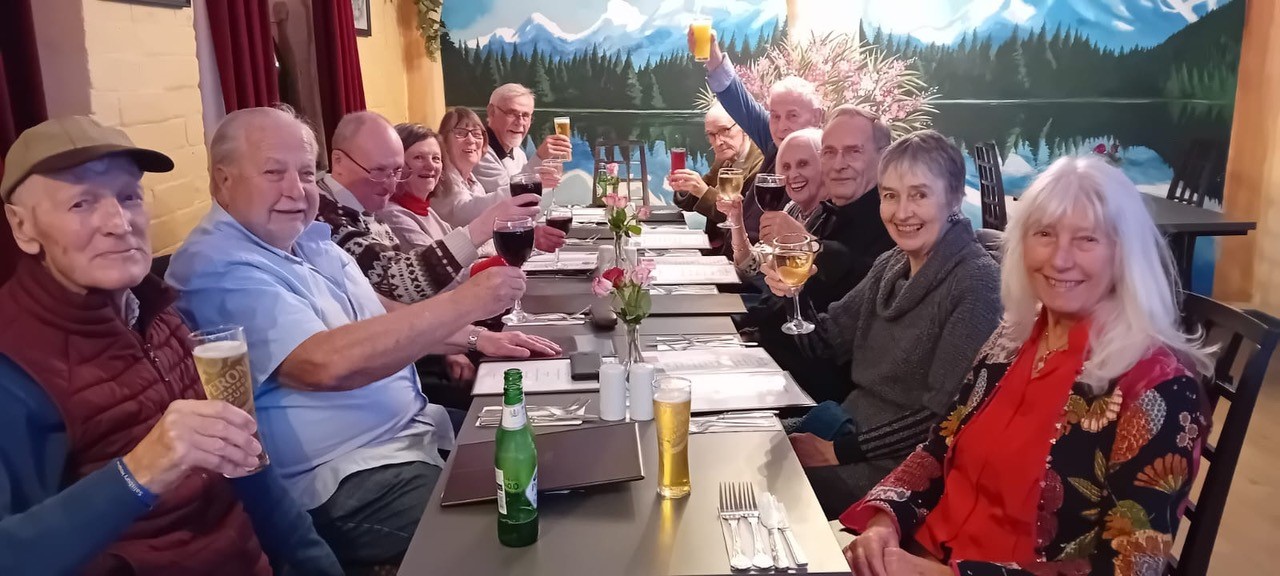
Some members of the Amnesty group met last evening to celebrate the 50th anniversary of its foundation. We are, sad to say, the last surviving group in Wiltshire. As we have noted before, the founders in 1974 may have thought that human rights were now a part of the political agenda and that it might naturally wither on the vine especially when the Human Rights Act became law in the UK. That has not been the case and the need for vigilance is ever present.

The world situation is dire for millions in countries like Burma where the minorities such as the Rohingya are persecuted; China where the Uyghurs and Tibetans suffer monstrous persecution; sub Saharan Africa where wars rage and millions flee or are driven from their homes; Syria – although quiet at present – has been a country where large numbers have been killed or driven from their homes and currently, the Middle East where a fearsome death toll and suggestions of ethnic cleansing are taking place in Gaza.

In the UK, hostility to the HRA is ever present and was a fixture of Conservative party policy for some years. Only yesterday we reported on a Daily Mail article which gave its readers only partial details of a report critical of the HRA produced by a secretive think tank. Several of the tabloids and the right wing press generally have maintained a steady stream of anti human rights stories suggesting the act is a get out of gaol card for criminals, terrorists and assorted ne’er-do-wells.

The They Work for You website reveals that both local MPs – John Glen and Danny Kruger – generally vote against human rights proposals. Kruger has written often on this subject and we have reviewed some of his activities on this site. The last Conservative government passed several pieces of legislation to limit protests and giving more powers to the police to arrest people taking part in protests. Indeed, the issue of arrests of journalists was part of the last Salisbury Democracy Café debate on Saturday 9th.

Both internationally and in the UK, the continuing need for a spotlight on human rights issues is vital and the group hopes to carry on with this work in the years to come. We always welcome new members and the best thing is to follow this site or Facebook (salisburyai) to see what we are doing and come along and make yourself known. Oh, and we had a very enjoyable meal!

Pic: Jane Miller

Group minutes – October


October 2024

We are pleased to attach the minutes of the group’s meeting held on 10 October thanks to group member Lesley for their preparation. They are longer than normal minutes as they double as our newsletter. If you live in the south Wiltshire area you would be welcome to join us and we meet on the second Thursday of each month. A good idea is to make yourself known at an event we’re running. Joining us is free but there is a fee to join Amnesty International.

The Salisbury group is 50 this year.

Group celebrates 50 years!


Salisbury Group was established half a century ago

October 2024

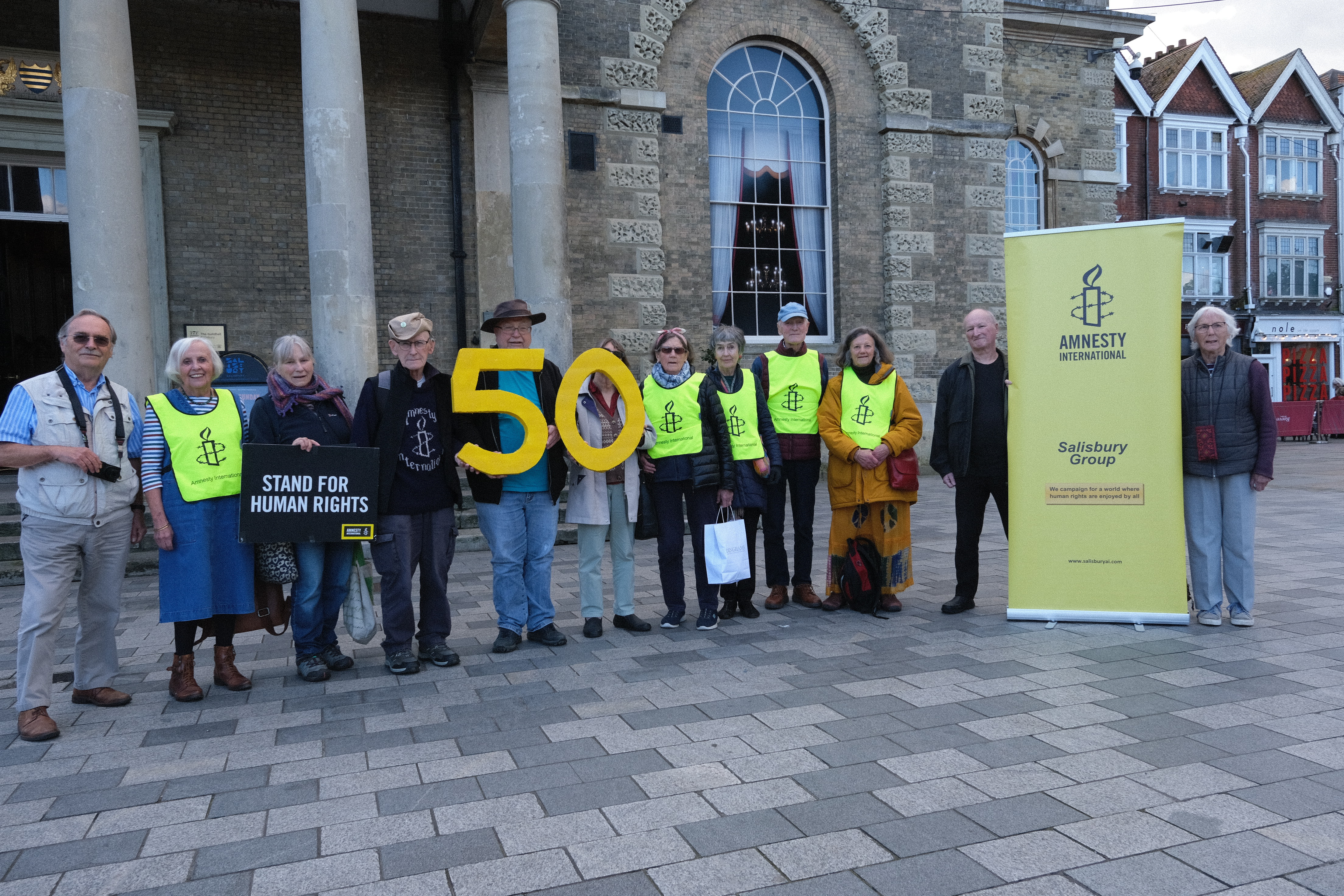
The Salisbury Amnesty group was established 50 years ago this year and some of the current members met briefly for a photo in the Market Square. It was probably not imagined in those distant days that we would still be active. After all, the purpose of a charity is to work itself out of existence. Unfortunately, human rights are in a fairly parlous state in many parts of the world. Almost wherever you look, people are imprisoned for their political beliefs. Media organisations are tightly restricted or banned. Journalists are murdered, with three quarters of recent murders in Gaza alone. Terrible events are taking place in the Middle East. Atrocities continue in Burma, almost completely unreported. Individuals are tortured and justice is denied for millions. The post-war hope ushered in by the Universal Declaration has had only mixed results.

Depressingly, it is not just foreign countries where human rights are under threat. In the UK there has been a prolonged campaign to repeal the Human Rights Act led by a vocal section of the press. Several acts have been passed making protest harder and reducing access to judicial review. Police powers have been increased. Facial recognition technology does not seem to be far away. One of the leadership contenders for the Conservative party wants the UK to leave the European Convention of Human Rights.

Sadly, we are the only extant group in Wiltshire. So the next 50 years begins …

Members and supporters outside the Guildhall on 3 October. We were particularly pleased that one of the founder members from 50 years ago was able to attend. (Picture: Salisbury Amnesty)

50 years! Don’t forget!


October 2024

Don’t forget that we shall be in the Market Square, Salisbury today, Thursday, at 2:30 for a photo to celebrate the 50 years since the formation of the Salisbury Amnesty group. If you are able to spare half an hour or so, that would be wonderful. Whether you are a member, supporter or want to celebrate with us – doesn’t matter.

Group minutes: September


September 2024

We are pleased to attach the minutes of our group meeting in September 2024 – thanks to group member Lesley for preparing them. The minutes contain a lot of interest including future group actions (see the last page). We are celebrating our formation 50 years ago and we shall be holding a brief photo op in Salisbury market square on 3 October near the Guildhall. All supporters and those with an interest in human rights are welcome to come.

We are 50 this year!

Note that we are no longer on X due to its recent history but we do have a presence on Mastodon with the handle @SalisburyAmnesty

Salisbury group at 50


The Salisbury group was established 50 years ago: did the founders think we’d still be needed half a century later?

May 2024, amended in September

Following the Observer article by Peter Benenson in 1961 which led to the formation of Amnesty International, local groups formed around the country and the Salisbury group came into being in 1974. It is the only surviving group in Wiltshire which is disappointing to report. Did the founders, it might be asked, think we would still be campaigning all these years later? It might not have been a question they asked themselves at the time but there was a feeling following the horrors of the war and the signing of the Universal Declaration of Human Rights in 1948, that we were on some kind of improving path towards better treatment for people wherever they lived. There was some kind of belief in a new future.

To an extent, the history of the UDHR and the true commitment of nations to the cause of universal rights, has been overstated. There was considerable resistance by the colonial powers, in particular the UK, to the ‘universal’ element because of the likely effect of such rights in the subject peoples of the colonies. Many were seeking independence from the Empire and this was not always achieved peacefully. America was fearful of the effects in the southern states in particular because of the treatment of the black population and the Jim Crow laws.

The human rights situation in the world today is dire. Entire peoples have been oppressed or driven from their homes, the Rohingya in Burma for example. China has oppressed Tibet and is currently detaining around a million Uyghurs in what almost amounts to genocide. Russia has invaded the Ukraine and committed many human rights violations. Wars rage in sub-Sahara Africa with millions displaced from their homes and villages – those who have not been killed that is. The Israeli response to the October 7th massacre by indiscriminate bombing in Gaza is causing widespread international concern. Around 36,000 have now been killed.

Flaws

One of the flaws of the post-war agreement was the reliance on countries to be the ‘policemen’ so to speak. The US in particular did not want to grant powers to the newly created UN to enforce rules in countries not obeying them. Since it is countries which are heavily involved in committing the crimes this is a serious weakness.

Another flaw was the rise of corporate power and the ability of major corporations to operate in ways making control extremely difficult. These companies, and the banking system which supports them, engage in arms sales, mineral exploitation, tax evasion and abuse of people in sweat shops almost with impunity. Millions suffer impoverishment and almost non-existent rights as a result of their activities yet little is done to control them.

The Declaration grew out of the European tradition since it was Britain, France and the US who were the key players after the war. Power has slowly drifted away in the last few decades however, with the rise of China, a re-emergent post-Soviet Russia and the rise of new southern hemisphere countries such as South Africa and Brazil not all of whom share all these traditions. The freedom of the individual is not something they are concerned with. The Gulf states are another group of powers where free speech, religious freedom and human rights are not supported. Women enjoy few rights in these states. The world has changed therefore and the comfortable assumptions of European Emancipation is no longer the only game in town.

UK

The international order has changed, so has the climate in the UK. Over the past two decades or so, there has been a concerted move to abolish the Human Rights Act and by some, to leave the European Convention (see the last post). Sections of the media have characterised human rights as a threat not a protection. It is claimed that they enable terrorists and criminals to escape justice because their human rights will be infringed. Stories abound of the act being used to enable pornography in prisons or hostage takers to demand a burger of their choice. Infamously, the then home secretary Theresa May, claimed someone could not be deported because they had a cat. These and other stories provide background music for a variety of MPs to demand that the act be abolished or seriously modified. Local Wiltshire MPs generally vote against human rights measures according the They Work for You website.

Too negative?

Is the above too negative? It is and it isn’t. Millions have human rights but many of those millions do not enjoy them. They live in countries which have signed up to this and that convention – against the use of torture for example – but where police and security services use it routinely and with impunity. They live in countries where free speech is part of the country’s constitution but where the media is controlled, shut down or where journalists are arrested or even gunned down outside their apartment block (Russia).

But it also true to say that human rights have entered people’s consciousness. They know they should have them and they know they are being infringed which induces a tension in society and a deep sense of anger. It has put pressure on countries in their dealings with other countries to be aware of the human rights issue even if they proceed to ignore it in the interests of their economy and jobs. Most of all, it has articulated what rights should be and it is a genie which has escaped the bottle of power and oppression. It has provided campaigners around the world with a cause.

So, fifty years on, sadly the need for a human rights group in Salisbury is still present. With several Wiltshire MPs wishing to see those rights limited, curtailed or even abolished, it is a long way from ‘job done’. Those who are in positions of power and privilege and who consort with other power holders – corporate, City and media for example – there is a natural desire to hold on to that power, and demands by ordinary people are seen as some kind of threat to the natural order of things. Human rights groups, trade unions and protest organisations are seen as a threat to that natural order. Fifty years ago it was other countries which were the subject of campaigning and it is regrettable that we now spend part of our time defending rights in this country, such has been the regression. More and more legislation, ever increasing police powers and a sometimes supine judiciary together conspire to form a pincer movement against the rights of ordinary people. So we embark on the next 50 years …

Salisbury Group at 50!


Group is 50 this year!

February 2024

The Salisbury group was established in 1974 and has been going strong for 50 years. It took us a bit by surprise today when we realised this so we haven’t thought of any celebrations yet. But as the last active group in Wiltshire we can allow ourselves a bit of pride that we are still here and still trying to promote the human rights cause in the county.

It probably seems a little different today from 50 years ago. Human rights then were regarded as a good thing and support was largely unquestioning. The war was a living memory for many and a desire never to see a repeat of the death and destruction of the war and the horrors of the Holocaust was deeply felt. 

A long time has passed however and today, we see successive Conservative governments seeking to end or curtail the Human Rights Act. Laws have been passed making protest more difficult and the police have been given more powers to arrest those protesting. Much of the media keeps up a steady campaign denigrating human rights and suggesting they are a means for terrorists and serious criminals to escape justice because their ‘rights’ have been infringed. We are made less safe they claim because of the act rather than the precise opposite. The benefits the act has brought is seldom mentioned. The success of the Hillsborough families in overturning the various coroner and court decisions and the false narrative put out by the police was a major example. 

Some sections of the media do not like the act since it provides some protection from press intrusion and this has led them to carry on a relentless campaign often supported by exaggerated stories.

In the past few years the issue of immigration has come to the fore and immigrants crossing the Channel by boat has become a political hot potato. The government is seeking to send some immigrants to Rwanda in an attempt to discourage smugglers from sending them over from France. There has always been hostility to immigrants as each wave has come over, the Jews from Russia for example at the beginning of the last century. But the notion that we would become more sympathetic and welcoming has not worked out. The question therefore is how embedded are human rights norms and beliefs in our society? The occasional desire for a return of the death penalty, hostility to refugees as just mentioned and evidence of the UK government’s involvement in torture, clampdowns on protest suggest that human rights and human dignity is only shakily rooted in our society.


If you live in the South Wilshire area, we would welcome you joining us. Follow this site for details of what we are doing.

Blog at WordPress.com.

Up ↑