Every year the group runs a jumble sale to raise funds and this year it will be in the market square starting early on Saturday 11 June. Early indications are that we have a decent amount of material after a lean couple of years. If you have anything to contribute or can come along to buy or even help, that would be appreciated. Generally books are not needed and nothing electrical please.
May minutes
The minutes of the May meeting are available and can be accessed below. Thanks to Fiona for preparing them. The meeting contained general updates and a discussion on the film evening.
Execution of juveniles in Iran
New Zealand petition
Iran, in addition to its position as the world’s number two country after China for the execution of its citizens, also executes individuals who were minors at the time of their alleged offences. Our colleagues in New Zealand have been doing sterling work on this and the link below will take you to a petition on their site. Children as young as nine can be caught in policy. International protest is slowly having an effect.
There are facts and background information on the link. We hope you will spare a few moments to sign it.
Group minutes: April

Minutes of our last meeting in April are now available thanks to group member Lesley for doing them. We discussed the death penalty report; social media statistics; filming of Fiona Bruce MP and Clare Moody MEP for the North Korean video; Arts Centre film; future events including the stall in June, and the HRA
Urgent Action: Iran
Young man arrested in his teens near to execution
Increasing world attention is being focused on Iran and its practice of executing individuals who were teenagers at the time of their alleged offences. This is one such case and if you can spare the time to read the case notes and write that would be appreciated. His name is Himan Uraminejad.
Death penalty report
March/April report now available
STOP PRESS
Since this item was posted we have received notification that Californian Dept. of Corrections and Rehabilitation has extended its written public comment period to 15 May. Full details can be found on another post.
The death penalty report for March/April 2016 is now available thanks to group member Lesley for compiling it. It has been a grim period with rises in executions in Iran and Pakistan and several executions in USA following dubious trials. Iran is coming under increasing scrutiny worldwide for its practice of executing people who were juveniles at the time of their alleged offences.
China continues to lead the world with more executions than all other countries put together.
Kenneth Fults executed
WE are sad to report that on 12th April, Kenneth Fults was executed by lethal injection in Georgia
USA. The United States is the only country in the Americas which still has the death penalty. The case revealed the usual catalogue of dubious legal practice that is so common in these cases: a black defendant poorly represented by lawyers one of whom was allegedly asleep during part of the proceedings; a plea bargain and a juror who made derogatory racial remarks about Fults. Other factors are set out in a previous blog.
Amnesty International’s senior death penalty campaigner Jason Clark said:
Those troubling factors are typical of Georgia’s use of the death penalty.
Virtually every execution that’s happened in Georgia has been emblematic of problems with the death penalty.
He noted that the 28 executions in the U.S. last year were carried out by just six states.
In states like Georgia that are still carrying on a lot of executions, it’s because they’re not implementing issues of fairness.
Amnesty is opposed to the death penalty in all cases.
A sad day…
UK government soft-pedalling over the death penalty
Amnesty sets out facts of government’s reluctance to press for an end to the death penalty in some countries
The Government has been accused of “soft-pedalling” over the death penalty and seeming to make trade
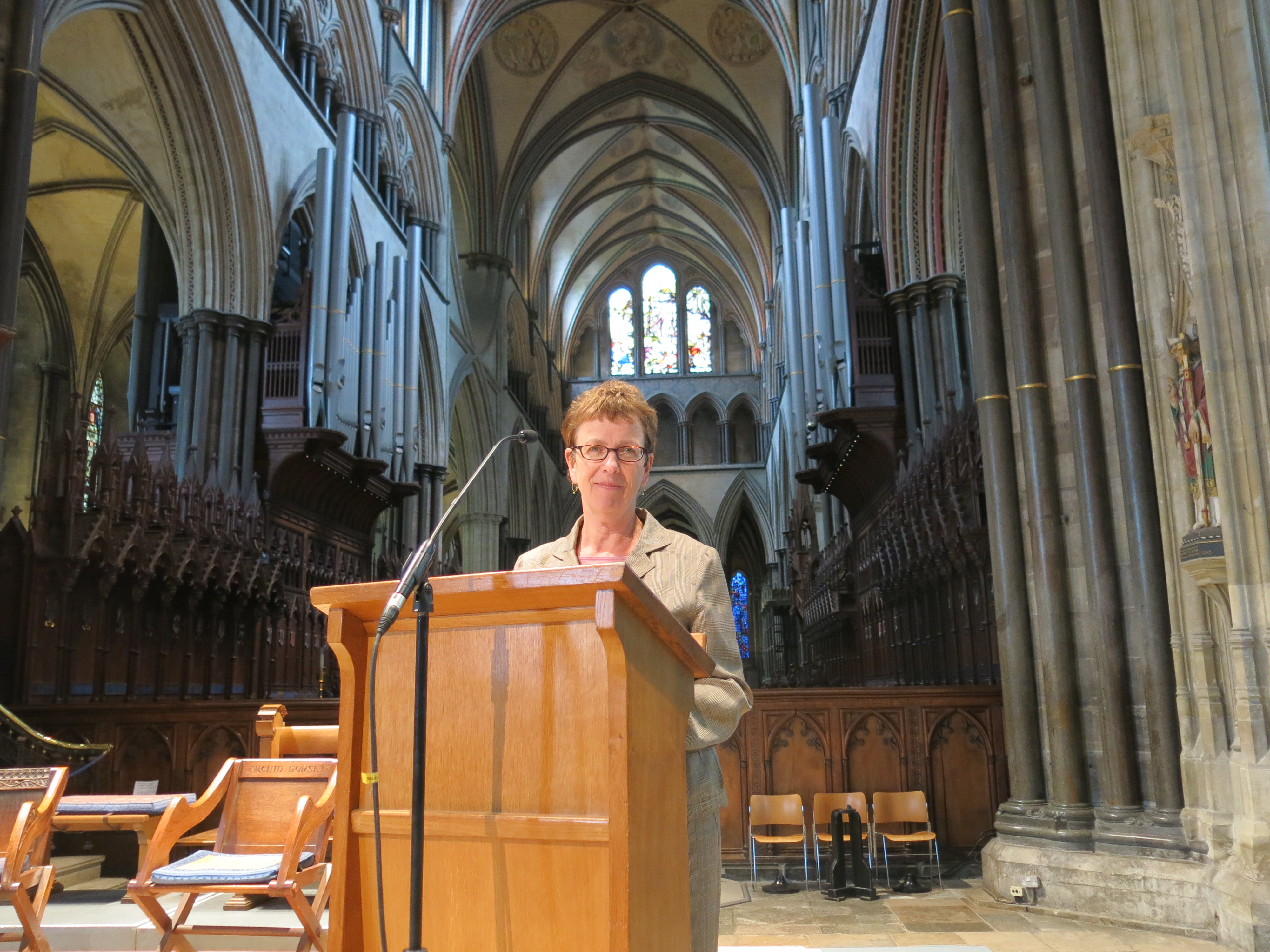
more important than human rights. The charge by Amnesty International UK’s director Kate Allen (pictured in Salisbury Cathedral last year) comes as the human rights organisation released figures showing that at least 1,634 people were executed in 2015, a rise of 54% on the year before. Despite being the highest number Amnesty has recorded since 1989, this total does not include China, where thousands were likely to have been executed but where the death penalty is a state secret.
The figures – contained in the report Death Sentences and Executions in 2015 – show that the top five executioners in the world in 2015 were China, Iran, Pakistan, Saudi Arabia and the USA.
This “profoundly disturbing” surge in executions was largely fuelled by big increases in Iran, Pakistan and Saudi Arabia, Amnesty International reported. Amnesty International’s fears have been raised just hours after MPs on the Commons Foreign Affairs Select Committee said there is “plainly a perception” the Government is prioritising trade and security with China, Saudi Arabia and Bahrain above human rights.
Ms Allen said:
Like the Foreign Affairs Committee yesterday, we’re worried that the Government has started soft-pedalling over foreign countries’ use of the death penalty, preferring to prioritise trade with countries like China, Saudi Arabia or Pakistan.
Until recently the UK’s policy of seeking global abolition of capital punishment had a clear focus and strategy. Now the death penalty’s been thrown into the pot with other concerns and it’s much harder to tell whether the Government is prioritising this life-and-death matter.
If governments in Beijing, Tehran, Islamabad and Riyadh aren’t hearing about our outrage at executions after torture and unfair trials, then the executioners are going to think they’ve got a green light to carry on killing.
We want to see the Foreign Office publishing a clear strategy for its anti-death penalty work at the earliest opportunity.”
Amnesty International’s secretary general Salil Shetty said: “Iran, Pakistan and Saudi Arabia have all put people to death at unprecedented levels, often after grossly unfair trials.”
Last year, the Foreign and Commonweatth Office’s most senior civil servant made a frank admission to MPs that human rights “is not one of our top priorities” and that the “prosperity agenda is further up the list”.
Ministers deny the issue has been downgraded but a string of trade-focused, red carpet visits to the UK by the leaders of countries with some of the worst records of rights abuses has reinforced the perception of a shift of diplomatic emphasis. Readers of this blog will know we have been following the twists and turns of this story for some months. We wrote to our local MP Mr John Glen last year on Saudi Arabia and the rising toll of executions by beheading or crucifixion and we received a bland reply from the FCO minister Tobias Ellwood. Since that time more evidence has emerged of policy changes designed it seems to scale down the human rights aspects. We noted that when George Osborne visited China to the surprise of his hosts he failed to raise the question of human rights and executions at all. Tobias Ellwood was reported by local media as congratulating the Saudis on the progress they were making with human rights.
Human rights minister Baroness Anelay said:
I am deeply troubled by the increase in the number of reported executions in 2015, which was driven by concerning increases in Pakistan, Iran and Saudi Arabia.
The UK opposes the death penalty in all circumstances and we make our opposition well known at the highest levels to countries which continue to apply it. Our message to them is clear, the death penalty is unjust, outdated and ineffective. It also risks fuelling extremism.
Despite these concerning figures there has been progress in many countries. It is welcome that in 2015 Fiji, the Republic of Congo, Madagascar and Suriname all abolished the death penalty.
The Foreign Office will continue to use its diplomatic network to push for progress towards the global abolition of the death penalty.
Maya Foa, of Reprieve, described the rise in executions as “extremely troubling” adding: “It is all the more disturbing, therefore, to see what the Foreign Affairs Select Committee this week described as an ‘apparent deprioritisation’ of human rights by the UK government.
Now more than ever, Britain needs to be speaking out against the grave abuses – including mass trials, torture and death sentences handed down to juveniles and political protesters – being committed by its allies.
It is hard not to come to the conclusion that the primary aim of the government is trade and business with human rights coming a poor second if at all. This overlooks the nature of ‘soft power’ and the fact that as a nation, we could be influential in humanising world affairs. Instead, we chose to push out the red carpet for the most frightful regimes and, as the Panama papers are revealing, allow dubious individuals to buy up large parts of London using off shore tax havens.
Death Penalty Report published
Dramatic rise in executions in 2015: the most in one year for a quarter of a century
To read the full report click here (pdf)
The past year has seen a horrific increase in executions around the world – the most we’ve recorded in a single year since 1989, and an increase of an astonishing 54% from the year before.
A few countries are executing prisoners by the hundreds, sometimes for crimes that aren’t serious, sometimes after trials and treatment that isn’t just or fair, and always violating the individual’s right to life and right to be free from torture.
From Australians Myuran Sukumaran and Andrew Chan shot by firing squad for drugs charges in Indonesia to Shafqat Hussein, hanged in Pakistan for a crime he confessed to after torture, aged just 14, over 1,634 individuals were put to death by state authorities last year.
Huge rise in executions
We recorded a huge increase in the death penalty, an increase of 54% compared with 2014. This is the largest number of state executions for a quarter of a century.
The number of countries that executed people rose – from 22 in 2014 to 25 in 2015. At least six countries resumed executions: Bangladesh, Chad, India, Indonesia, Oman and South Sudan.
Countries continued to flout other aspects of international law, putting to death people with mental or intellectual disabilities, as well as those charged with non-lethal crimes. Apart from drug-related offences, people were executed for crimes such as adultery, blasphemy, corruption, kidnapping and ‘questioning the leader’s policies’.
The death penalty is always a violation of human rights. We oppose it in every case.
The main executioners
A minority of countries are committing the majority of executions. 89% of executions in 2015 took place in just three countries: Iran, Pakistan and Saudi Arabia.
Iran
Iran continued to execute juvenile offenders like Shafqat – aged under 18 at the time of the alleged crime – in violation of international law. Authorities there sentencd juvenile offenders to death last year too.
Pakistan
Pakistan lifted its freeze on civilian executions in December 2014, and in the year that followed killed 326 people – the most we’ve ever recorded for that country in a single year.
An attack on a school in Peshawar prompted the government to start executing again, something it had not done since 2008. Initially, the freeze was lifted for those charged with terrorist-related offences, but in March 2015 the government resumed executions for all capital crimes, such as murder and blasphemy.
In a country where people are routinely denied the right to a fair trial, and evidence extracted through torture is used to seal convictions, hundreds of people are being sent to their deaths under the pretence of justice being served.
Saudi Arabia
Last year saw a huge surge in executions for an already prolific executioner. These figures don’t even include Saudi Arabia’s mass execution of 47 people at the start of this year.
The missing executioners
But these figures exclude China, where numbers remain a state secret, yet where we believe thousands of people are executed every year. We consider China to be the world’s top executioner, although the numbers are missing from this report.
We haven’t published figures for executions in China since 2008; we’re challenging the Chinese government to reveal their own figures and demonstrate that they really are limiting their use of the death penalty – something they have claimed to be doing since the country’s highest court began reviewing all death penalty cases back in 2007.
We also don’t publish figures for North Korea, a state shrouded in secrecy.
Execution sentences in 2015
At least 1,998 people were sentenced to death in 2015 and at least 20,292 prisoners remained on death row at the end of the year.
Some hope
Four countries abolished the death penalty for all crimes – the highest number to do so in the space of one year for almost a decade.
Madagascar, Fiji, Suriname and Congo all did away with the death penalty in the national laws once and for all.
Mongolia adopted a new Criminal Code outlawing the death penalty for all crimes in December which will enter fully into law in September 2016.
There is hope even in the USA, which continued to flout international law by executing people with mental disabilities. Pennsylvania abolished the death penalty for all crimes in 2015 , bringing the total number of US states that have abolished the death penalty to 18.
We still hope for a world without the death penalty, and today half the world has abolished it for good. Add to this countries which have abolished this punishment in practice, as opposed to law, and the total comes to two-thirds of the world.
China: lawyer released
Prominent lawyer released from house arrest
We are pleased to announce that a lawyer who has been active in defending the attacks on churches, has been released although the reasons for his release are unknown. It is good news however. Many lawyers have been harassed or detained in China under the current crackdown.
Full details from the Amnesty factsheet:


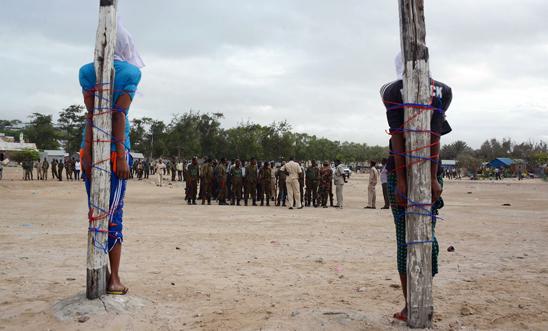
Two Somalis are tied to stakes as they await execution by firing squad on 15 July 2014 in Mogadishu © AFP/Getty Images