Timbuktu film


The film, Timbuktu, is to be shown in the Salisbury Arts Centre timbuktu-posterart this Thursday evening 3 December.  The film is extremely topical both because of the horrific activities of jihadists in Paris and today’s news of a terrorist attack in Mali which is where Timbuktu is.  This is the latest in our joint presentations with the Arts Centre.  The film has received many favourable reviews and mostly 4 stars.

Timbuktu has entered the English language as a place which is remote and unknown yet recent events have brought the country and the town into the limelight.

There will be a short presentation by an Amnesty director before the film starts and afterwards, an opportunity for people to sign a petition or some cards.

Tickets from the Arts Centre via the link above or by phoning 01722 321744.


The Chinese President’s visit


President’s visit prompts human rights concerns

This week saw the visit to this country of President Xi Jinping with a president ji xinpinghuge amount of ceremony and including a meeting with the Queen.  His visit was surrounded with considerable controversy concerning the human rights record in China.

Our government stood accused of suppressing concerns about human rights because they want us to do more business with China and because the Chinese do not like questions being asked about their activities.  They view this as interfering with the internal affairs of their country.

Human rights in China are truly dire and may even have got worse since President Xi came to power.  The essential deal in China is that the communists stay in power and in return, they deliver growth and prosperity to their people who have little say over how the country is run.  To maintain this system, there is little in the way of free speech, the internet is closely controlled, minorities – including religious minorities – are hounded and arrested, torture is common and more Chinese are executed than the rest of the world put together.

Chen Guangcheng – who was a prisoner of conscience with Amnesty and on whose behalf, the local group campaigned – fled China following his house arrest and now lives in America.  He is personally well acquainted with the human rights situation in that country.  In an article in the Independent he says:

There is no doubt human rights have worsened in his home country in the decade since President Hu Jintao’s state visit and believes that the UK must publicly criticise the regime if it wants to improve human rights in China.

I don’t think all this trade and business should be carried out as the UK sacrifices human rights in exchange for these deals.

Amnesty has noted that during a nationwide crackdown, 248 lawyers and activists were detained in the summer of whom 29 are still in custody.  Then there is the continuing story of Tibet where freedom for Tibetans is a long-lost dream.

Our media is constantly predicting the time when the Chinese economy will overtake the USA to become the largest in the world.  Projections are frequent but have recently taken a knock with the acute fall in the Chinese stock markets and devaluation of their currency.  But the essential question is: can the Chinese Communist Party’s trick of providing continuous growth whilst maintaining a monopoly on power be maintained for ever? This question is important because it points to the fact that the Chinese needs the West as much as we need them.  We provide them with a market for their goods.  They need our technologies and our expertise.  They will increasingly need our consumer goods.  They want to be able to trade the remnimbi in London.  They want greater access to the European market.

This is why the craven approach by our government to the Chinese is so misguided.  The Chinese Ambassador has claimed that mentioning human rights would be ‘offensive’ to China.  But all the people who suffer in China from house arrests; deprivation of liberties; forced sterilisations; executions of loved ones after brief trials; loss of religious freedom and no freedom to look at the internet, might also feel ‘offended’ that the man at the top of the country responsible for all this repression and cruelty, is being fawned over and given the red carpet treatment in London without any of our leaders uttering a word about these goings on.  The only thing that seems to matter is the business and investment.

It seems clear that the Chinese were seriously worried about the protests which might have marred his visit here.  A large and apparently orchestrated series of demonstrations organised by the embassy largely drowned out the few protests which manage to break through.

And what of our local MP Mr John Glen?  In the Salisbury Journal (October 22) we read:

[…] The UK takes its human rights obligations very seriously. I do not believe for one moment that having a mutually beneficial commercial relationship prevents us from speaking frankly about issues of concern.

In fact, close relationships around economic, political and security interests have a track record of enhancing our ability to positively influence governments helping to promote democratic reform and raise human rights standards

As we noted in an earlier blog in connection with Saudi Arabia, we have enjoyed ‘close relationships’ with them for some decades but there is no let up in the tidal wave of torture, beheadings, floggings and amputations being carried on there.  It is simply wishful thinking to claim close economic relationships enhances our ability to help promote democratic reform.

The whole point of the controversy around President’s Xi visit is that human rights concerns are not being mentioned.  To say also that commercial relationships should ‘not prevent us from speaking frankly about issues of concern’ – one can only reply quite so!  They fact that there was no frank speaking seems to have escaped Mr Glen’s notice.

And is Mr Glen suggesting that signing these various contracts will ‘promote democratic reform and raise human rights standards [in China]?’  In which case he must be almost the only person to believe this.  The communist party has no intention of relinquishing power and signing a few deals in London will not alter that fact one iota.  Indeed, looking at the The Global Times, the communist party newspaper in China, reveals no mention of human rights or freedoms in their report of President Xi’s visit.  Anyone who saw the BBC’s Panorama programme on 19 October would be left in no doubt that the prospects for freedom and democracy in China under this president are exceedingly remote.

Trade and investment are of course important but not at the expense of all else.  There is something unsettling about our willingness to grovel to the Chinese for the sake of money.  Perhaps at long last we are learning the true meaning of ‘to kowtow’.

Sources

The Independent; Salisbury Journal; The Global Times; The Guardian; Human Rights Watch

Vigil against the death penalty


Vigil
Vigil

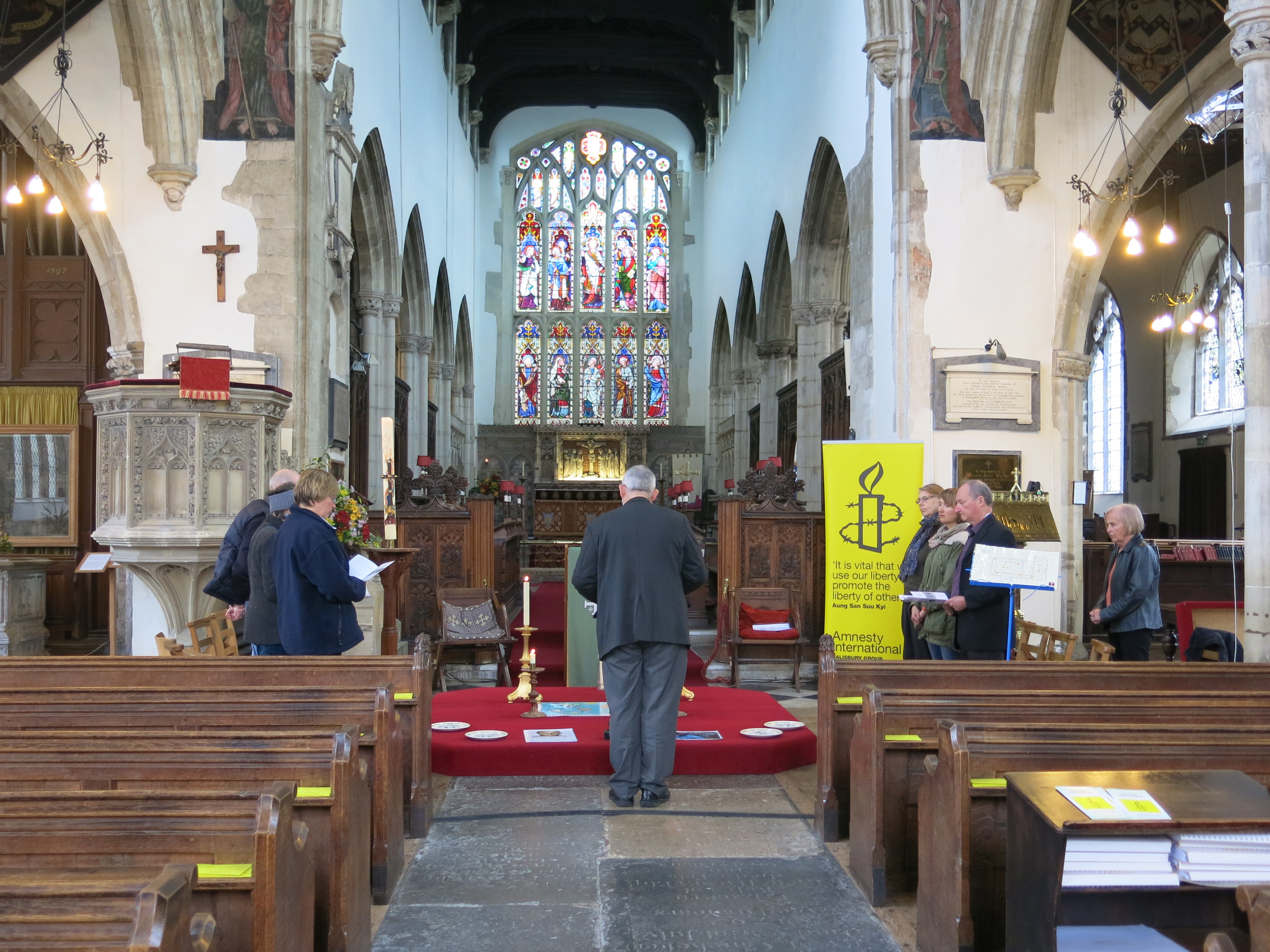
On Saturday members of the Salisbury group held a one hour vigil in St Thomas’s church to highlight the use of the death penalty around the world.  The vigil was timely as the world’s leading executioner is China whose president is on a state visit to the UK now.  Second is Iran and then Saudi Arabia.

Numbers were very disappointing partly because we were unable to achieve any publicity.

Saudi man given key human rights role


Yes, you read that right.  A Saudi by the name of Faisel Trad, who is the kingdom’s ambassador to the UN in Geneva, was elected chair of an independent panel of experts on the UN’s human rights council.

This blog – and many, many others – has highlighted the appallingsaudi flogging human rights situation in Saudi Arabia.  The big increase in the use of the death penalty, often in public, floggings including that of Raif Badawi and most recently, the proposal to crucify a man.  Along with a lack of free speech, and that women are denied basic rights and cannot drive for example, means that the country ranks as among the worst in the world.

UN Watch Director Hillel Neuer said according to the Independent (20 September):

Saudi Arabia has arguably the worst record in the world when it comes to religious rights and women’s rights and continues to imprison the innocent blogger Raif Badawi.

It’s bad enough that Saudi Arabia is a member of the council, but for the UN to go and name the regime as chair of a key panel only pours salt in the wounds for dissidents languishing ins Saudi prisons.

A UN Watch representative also said “This UN appointment is like making a pyromaniac into the town fire chief”.  It gives Mr Trad power over the appointments of key UN human rights representatives.


We have been engaged in correspondence with our local MP to persuade the government to do more and we await a reply to our letter to him.  This was sparked by the FCO’s decision to drop the abolition of the death penalty as a specific policy.

Group has Tumblr page


We now have a tumblr site which can be found at salisburyai.tumblr.com.  There isn’t much there at present but give it time …

#FCO #armssales and #humanrights


UPDATE: 8 September

Letter in today’s Guardian (8 September):

The government would do much better to raid the export credit guarantee scheme [rather than the overseas aid budget] and other subsidies to the arms trade. This would raise funds for refugee provision and reduce arms sales to Middle Eastern states, impacting directly on the latter’s ability to wage war on their and other populations in the region.

Benjamin Selwyn, Director, Centre for Global Political Economy, University of Sussex

Saudi Arabia

Last month, we wrote to John Glen MP asking that his government take a more robust line with the Saudi Arabian government in view of the large increase in executions and floggings, many of which are carried out in public.  We noted that the French president Francois Holland had spoken publicly against the practice despite large arms sales in the offing.  The British government has said it prefers to lobby in private and to pursue a policy of quiet diplomacy.  By contrast, the Swedish government has ended arms exports to the country.  As policies go, it is one which is conspicuous by its failure to achieve anything at all and in other contexts would be declared ‘not fit for purpose’.

No to the death penaltyA recently published report by Amnesty shows that Saudi Arabia is one the top three world executioners after China (which executes thousands but the statistics are a state secret) and Iran.  Between January 1985 and June 2015, 2,208 were put to death.  102 have been executed in the first 6 months of 2015.  Crimes include ‘witchcraft,’ ‘sorcery’ and ‘apostasy’.   In some cases relatives are often not notified of the execution.

The FCO’s July in-year update on Saudi says:

We remain concerned about the continued use of the death penalty in Saudi Arabia, including the fact that trials and executions do not meet the minimum standards which the EU advocates in countries where the death penalty is applied. We regularly raise the issue with the Saudi authorities, bilaterally and through the EU, and will continue to do so. There has been a significant rise in the number of executions this year. While no official figures are published, according to statistics reported by NGOs over 100 people have been executed since 1 January. NGOs report that the majority of executions were for murder and drug-related offences

In response to our letter to Mr Glen, we received a letter from a FCO minister, Mr Tobias Ellwood, which assured us that the Foreign Office was doing all it could to end the practice and that ‘the abolition of the death penalty is a human rights priority for the UK’.  The HMG Strategy for Abolition of the Death Penalty (2010 – 2015) states:

Promoting human rights and democracy is a priority for the UK.  It is a long standing policy of the UK to oppose the death penalty in all circumstances as a matter of principle (p2)

Within days of receiving this letter however, we discovered that it is no longer an explicit FCO policy.  The new policy has dropped any reference to abolishing the death penalty.  We also noted that Private Eye had a piece on the very same Mr Ellwood who had been a guest of the Saudi Government on a £6,000 fact-finding visit sponsored by a defence forum.

It’s hard not to come to the conclusion that defence sales matter far more than the dreadful human rights situation in countries like Saudi Arabia which – apart from public floggings and beheadings – tortures its citizens and has severe restrictions on the lives of its women.  Saudi Arabia is the leading destination for UK arms sales amounting to £1.6bn in 2014.

Nicholas Gilby of the Campaign Against the Arms Trade (CAAT) reported on the high level of corruption in this industry:

This paper examines the Government’s approach to corruption within the UK arms industry and shows it has very dirty hands …

… civil servants told to ‘look the other way’ and not ask awkward questions.

Chemring, which has one of its factories just outside Salisbury, had sales to Saudi Arabia of £47.8m last year and £97.6m in 2013 (source: annual report).

UK governments have invested a lot into the arms trade.  Support includes marketing support via DESO (Defence Exports Services Organisation); export credit guarantees; around £26m in R&D costs and something called ‘launch customer support’ which is buying weapons from a UK supplier even though overseas suppliers are cheaper.  There are also missions by ministers and members of the Royal family to foreign countries like Saudi.

Could it be that the Foreign Office was embarrassed by such an explicit policy in the face of a rising tide of executions in countries such as Saudi Arabia; Pakistan and India, all countries where arms sales are important?

Successive governments have claimed a devotion to human rights and a commitment to end the death penalty.  The reality it seems is that arms sales trump this commitment and in dropping the express statement of policy, the FCO is at least being honest.

Following the change of wording by the FCO which seemed to be in contradiction to the assurances given to us by the minister and Mr Glen, we wrote again asking why the policy had changed.  We await a reply…

CAAT report

Foreign Office drops reference to the abolition of the death penalty


In a previous post (20 July) we reported on the correspondence we had with Mr Glen MP concerning the government’s policy towards Saudi Arabia.  This was prompted by the increasing number of executions and public floggings taking place in that country.  Both are at high levels and are greater than the previous year.  We noted that the president of France had made public statements condemning this practice.  We might also have noted that Sweden has suspended arms sales to Saudi Arabia.

Mr Glen forwarded a letter from a FCO minister Mr Tobias Ellwood saying that these matters were raised with the Saudi authorities and that it was a ‘human rights priority for the UK government’.  Because it was part of Sharia law they did not anticipate change in the near future however.

There the matter might have rested.  But on 3 August it was reported widely in the press that the FCO has dropped any explicit reference to the abolition of the death penalty.  In response to the cuts, they are relabelling its six global thematic priorities of which the abolition of the death penalty world wide was one.  There are now to be three, relating to human rights; democratic values and the rule of law. Reference to the death penalty has gone. The ‘human rights countries of priority’ is to be replaced with the more anodyne ‘human rights priority countries’.

We noted at the end of the last blog that the reason for the lack of open criticism by the government was almost certainly connected with arms sales to Saudi.

Then, in the current issue of Private Eye (6 August No 1397) they report that Tobias Ellwood had accepted Saudi hospitality to a attend a £6,000 a head fact-finding visit organised by the arms industry lobby group UK Defence Forum.   This took place in 2013 when there were bribery allegations concerning Saudi defence deals and the defence giant EADS.  The Private Eye  piece was in connection with Mr Tobias’s complaint at having to ‘watch the pennies’ on his MP and ministerial salary.

So in just over a week after sending us the letter, the FCO seems to have downgraded its policy on the death penalty.  This is deeply disappointing and it seems strange that Mr. Ellwood appeared unaware that the policy was to change only days after sending his reply to us.  We shall be raising these matters with Mr. Glen.

June #meeting minutes are now available


Minutes of the June meeting are now available.  It includes the monthly death penalty report which is available in full as a separate blog post.

June minutes (pdf)

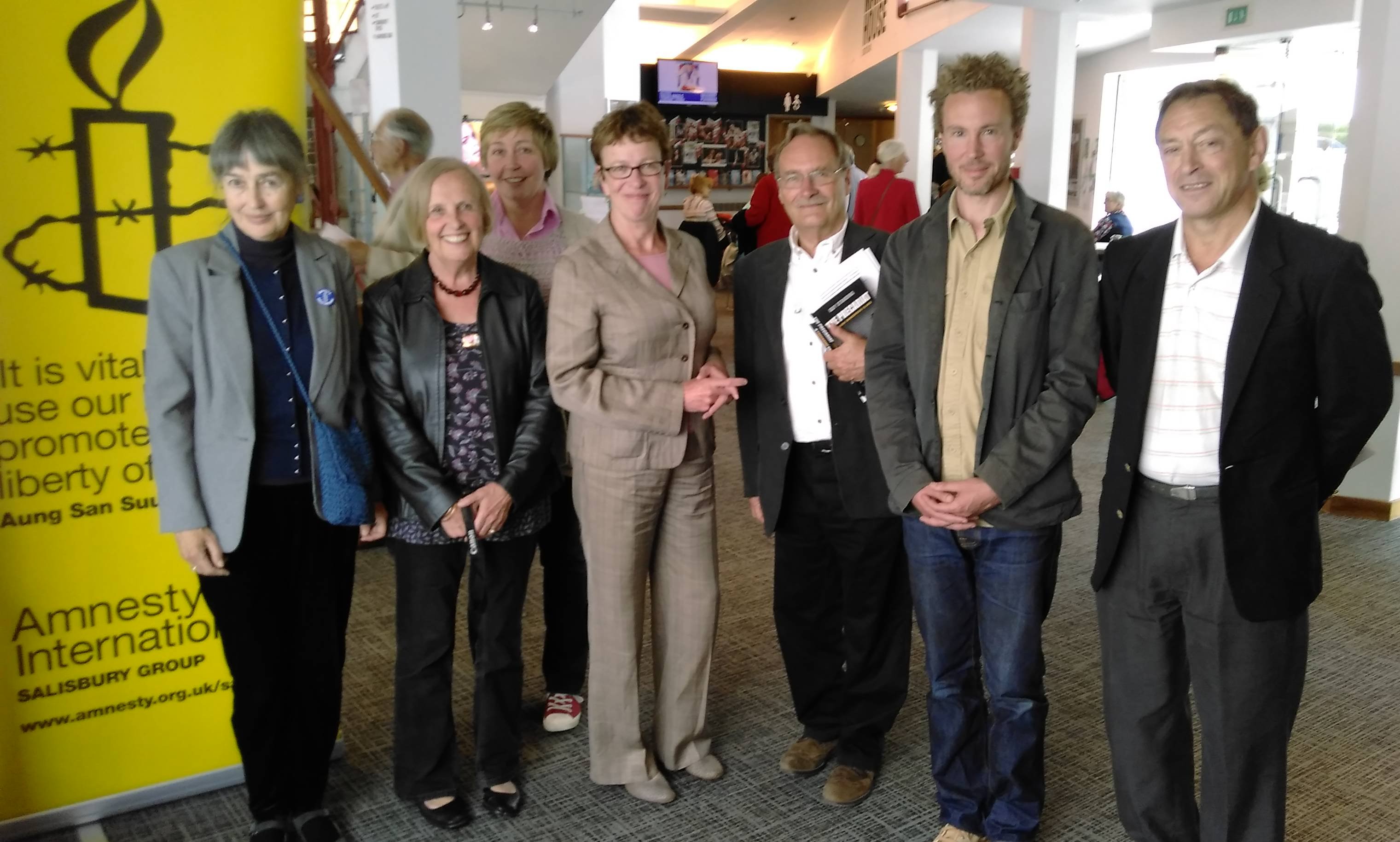
Group members and speakers at the Playhouse
Group members and speakers at the Playhouse. See blog post for full details.

Magna Carta Now – panel discusssion with readings by Edward Fox OBE


A PANEL DISCUSSION WITH READINGS BY EDWARD FOX, OBE

MAIN HOUSE

Monday 15 June at 2pm

MAGNA CARTA

Magna Carta’s importance meant that it was traditionally read out at the opening sessions of Parliament and in English cathedrals. This panel discussion about its relevance today will include Kate Allen, Director of Amnesty International UK, Professor Guy Standing, author of The Precariat: The Dangerous New Class and Ben Rawlence, formerly of Human Rights Watch. Excerpts from the charter will be read by one of our most celebrated actors, Edward Fox OBE.

Chaired by Peter Curbishley.

Presented in partnership with the Playhouse and Amnesty International.  Tickets from Salisbury Playhouse http://www.salisburyplayhouse.com or 01722 320333

French President in #Saudi Arabia calls for death penalty ban


On a visit to Saudi Arabia, the French President #FrancoisHollande, called for a ban in the use of the death penalty AFP reports.  This is significant because Saudi is in the top three countries in the world to use the penalty often carried out in public.  It is also significant because it was done reasonably publicly.  Our own UK government is shy of making public statements about the barbaric activities in Saudi and the reason is likely to be trade and in particular weapons sales which are huge.  France is equally a big supplier of weapons and yet feels able to speak out.

Human rights issues are not confined to the use of the death penalty.  Torture is routine.  Many are arrested arbitrarily and No to the death penaltyheld incommunicado for months and in some cases years.  There is no free press and there are many, many restrictions on women who are not able to travel unaccompanied or to drive for example.

The issue of what goes on in Saudi exploded earlier this year surrounding the case of Raif Badawi who was to receive 1000 lashes and fined a million Riyalls for the crime of insulting Islam.  Thousand lashes is effectively a death sentence.  Following an international outcry after the first 50 lashes – given in front of a cheering crowd – the sentence was suspended, reportedly on medical grounds, and he languishes in prison.

The second event that caused an outcry was the wish to lower our flags to half-mast following the death of King Abdullah.  This caused widespread concern – revulsion even – and put our government in a spot.  The Independent newspaper in the UK reported a meeting David Cameron, the Prime Minister, had with some young people who questioned him about this.  He is reported to have said:

We have a long-standing relationship between the Kingdom of Saudi Arabia and our United Kingdom here, a relationship between our two monarchs and between our governments.  We don’t agree with a lot of things that the Saudi do – we don’t agree with the way they treat people for instance criminals – and we make it very clear [what] those differences [are].  Independent February 2015

Interesting the use of the phrase ‘the way they treat criminals’ here implying that the justice regime is too harsh on them and moreover, is just limited to criminals.  Since torture is routine, arrests are arbitrary, people are not allowed access to lawyers, and people are flogged and executed publicly, it does seem a bit limp .

The close relationship with the royal families is also a sensitive one.  Prince Charles went to the funeral of King Abdullah and the issue of the sentence on Badawi was a live one.  Amnesty International said in a statement in February:

From the various briefings from the Palace this week, we’re cautiously optimistic the Prince Charles would raise Mr Badawi’s outrageous case.’ 

saudi floggingThat was three months ago and no doubt the optimism was real.  However, Mr Badawi is still in prison even though he hasn’t been flogged since.  The contrast between the French President’s statement and our own government’s statements – or lack of them – is marked.  When ISIS carried out beheadings, our politicians were falling over themselves in outrage.  So far this year Saudi has executed 78 people in comparison with 87 in the whole of 2014.

Blog at WordPress.com.

Up ↑