December 16th is the 50th anniversary of the abolition of the death penalty in the UK
At 8am on 13 August 1964, the last execution took place in the United Kingdom. Two men: Gwynne Evans and Peter Allen were separately executed in Manchester and Liverpool. The death penalty for murder was abolished in the following year 1965 and made permanent on 16 December 1969. Northern Ireland followed in 1973 and the last hanging offence – treason – was abolished in 1998. In the current climate however, the question has to be asked, how secure is this decision and will it last another 50 years without being repealed?
Many will remember some of the impassioned debates which took place at the time with concerns it would lead to a rise in the murder rate. Indeed, the vicar of All Saints, Clapton in London, said at the time it would be a ‘wholesale license to kill’. The police wanted to be armed if the bill was passed. Despite its abolition, the homicide rate in the UK has remained reasonable static over many years. The figures for the last 3 years for example are 721 (2016/17); 728 (2017/18) and 701 (2018/19). (Source: Statistica).
Amnesty is opposed the use of the death penalty for six reasons:
- It is the ultimate denial of human rights and is contrary to the articles 3 and 5 of the Universal Declaration of Human Rights – the right to life and the right not to be tortured or subject to cruel, inhuman or degrading punishment.
- It is irreversible. Mistakes are made and cannot be rectified.
- It does not deter. This perhaps is the strongest case made for its continued use yet many studies show it simply is not true. Violent crime rates are not significantly worse in US states which use the penalty compared to those who do not.
- It is often used with unfair justice systems. Confessions sometimes forcibly extracted are a feature. Clive Stafford Smith’s book on a particular case in Florida is instructive.
- It is often used in a discriminatory way and you are more likely to be executed if you are a member of a minority group or if you suffer from mental health problems. It is also racially biased.
- It is used as a political tool to execute people who are seen as a threat to the authorities.
World wide
There has been a decrease in the number of countries using the death penalty according the 2018 Amnesty Report on the subject. 690 people were executed in 2018 in 20 countries representing a 31% decrease on the previous year. However, these statistics exclude China – the world’s largest executioner – but where the number of executions, which is known to be vast, is a state secret. Belarus is the only country in Europe still to have the penalty and executed at least 4 people in 2018.
The five biggest countries which still execute its citizens are: China; Iran; Saudi Arabia; Viet Nam and Iraq. 78% of all executions take place in the last four countries in this list (with the caveat that the China figure is unknown). It is possible China executes more of its citizens than the rest of the world put together.
The Salisbury group monitors cases around the world and produces a monthly report.
United Kingdom
There has been a noticeable increase in rhetoric around harsher prison sentences and a desire to lock more people up for longer. The current UK Home Secretary, Priti Patel has made a number of speeches and wants to see longer sentences, more prisoners kept in prisons for longer and generally supports a tougher approach to criminal justice. She has seemed to support the death penalty although she denies that this is so. Nevertheless, she is a powerful and insistent supporter of tougher sentencing.
A Parliamentary Enquiry has warned that UK citizens are at risk of the death penalty in the US – or of being sent to Guantanamo Bay – under a fast-track data sharing deal signed by the Home Secretary, as the result of an agreement reached with Washington last month, when the details were kept secret. It is said that the deal will give police and intelligence agencies speedy access to electronic communications sent by terrorists, serious crime gangs and white-collar criminals. The House of Lords Committee has criticised the ‘asymmetric’ nature of the arrangement, which gives the US far greater powers to target UK citizens than vice-versa, and claims have been made that the UK will not be able to obtain ‘credible assurances’ that extradited suspects will not face execution. (Source: The Independent.)
Among the public YouGov polls reveal a mixed desire for restoring the penalty which depends a lot on what type of murder is involved. So for multiple murders for example, 57% are in favour and 33% against. Murder of a child shows 53% for and 31% against. The ‘all cases of murder’ figure is 45% against and 34% for.
For crime generally in the words of YouGov ‘Voters are united: criminals should be more harshly punished.’ In the general population, 70% believe that sentences are not harsh enough which rises to 87% for Conservative supporters. Further analysis for gender, age, location and social grade reveals only small differences. The major difference is between Remain and Leave voters in the Referendum to leave the European Union (Brexit). The statistic for all cases of murder shows that 64% of Remain supporters oppose the death penalty in contrast to 30% of Leave supporters – around double. The support figures are even more marked with 51% of Leave supporters in favour of the death penalty and only 19% of Remainers.
It seems therefore that in the UK population, vengeful policies for dealing with criminality and for reintroducing the death penalty for some types of murder are still quite strong. A conservative MP and former minister, John Hayes, asked the government last year to reintroduce the penalty.
Government policy has long been that we will not grant extradition to foreign countries if there is a risk of the individual being executed. This policy appeared to be weakened last year by the then Home Secretary Sajid Javid:
Sajid Javid, […] has caused controversy in September by indicating that the British government is prepared to waive its long-standing opposition to the use of capital punishment by foreign governments, in the case of two alleged jihadi terrorists originally from Britain. He has agreed to provide the authorities in the United States with intelligence evidence to assist in the trials of the two men without asking for the usual assurances that any convictions would not lead to the death penalty being imposed. Human rights champions have widely condemned this decision as compromising Britain’s principled opposition to capital punishment and as setting a dangerous precedent. Others, however, claim the two men involved deserve whatever they get. So was the Home Secretary’s decision right or wrong? YouGov 24 July 2018
Taken together, with members of the public wanting the return of the death penalty for several types of murder and an increase in harsher sentences; a weakening in the policy of not supporting the extradition to countries which execute people, and a desire to abolish the Human Rights Act, the reintroduction of the death penalty – although unlikely – may not be impossible in this country. With the Conservative government returned last week with an increased majority, things are by no means certain. That it survives as a wish in many people’s minds is a worrying fact.
Sources: YouGov; Statistica; The Independent; Guardian, Parliament.co.uk, Amnesty International
We always welcome new members and the best thing is to keep an eye on this site or on Facebook – Salisburyai – and make yourself known at an event we are organising.



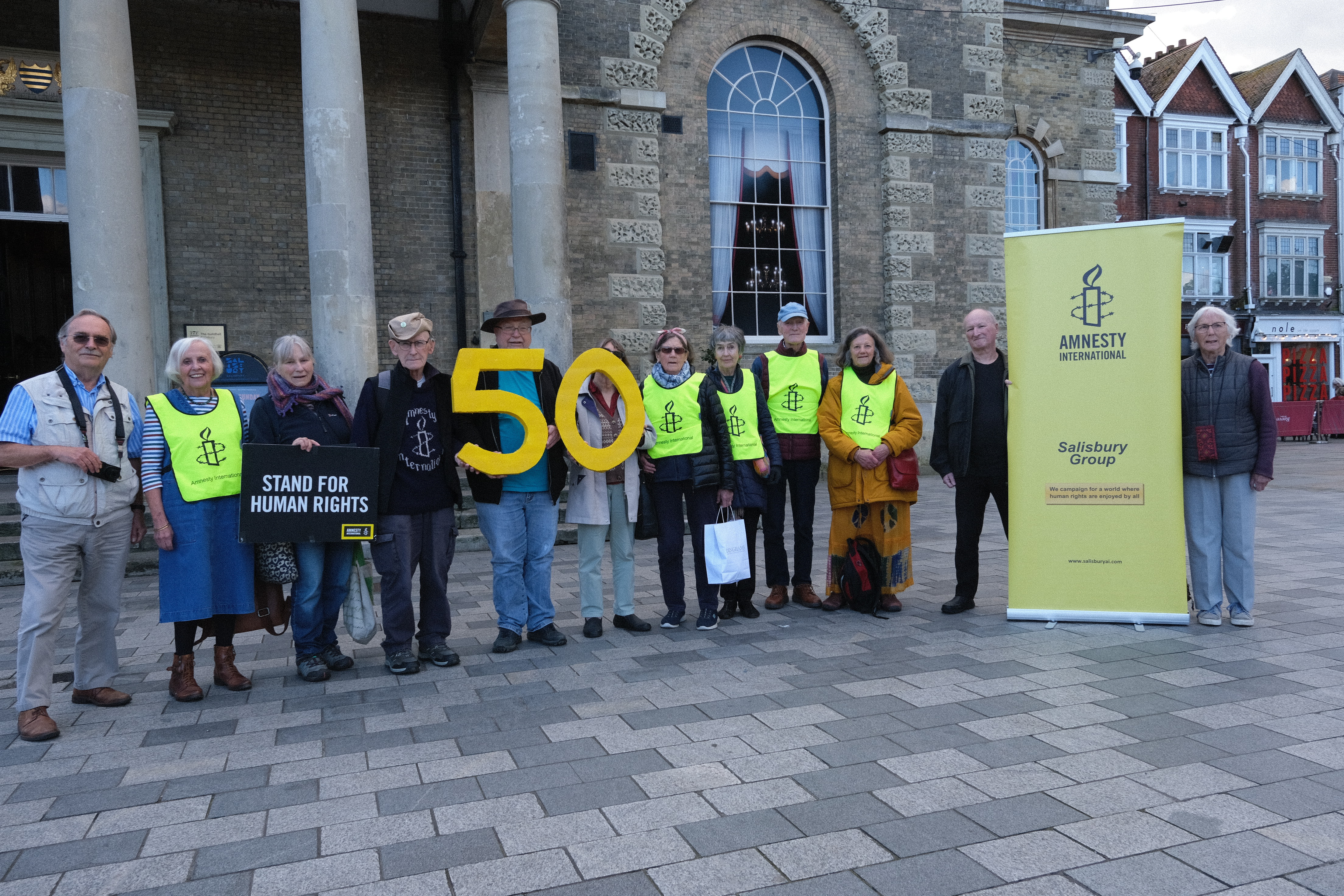




 Amnesty in Salisbury & South Wiltshire