Large crowd attends 100th vigil


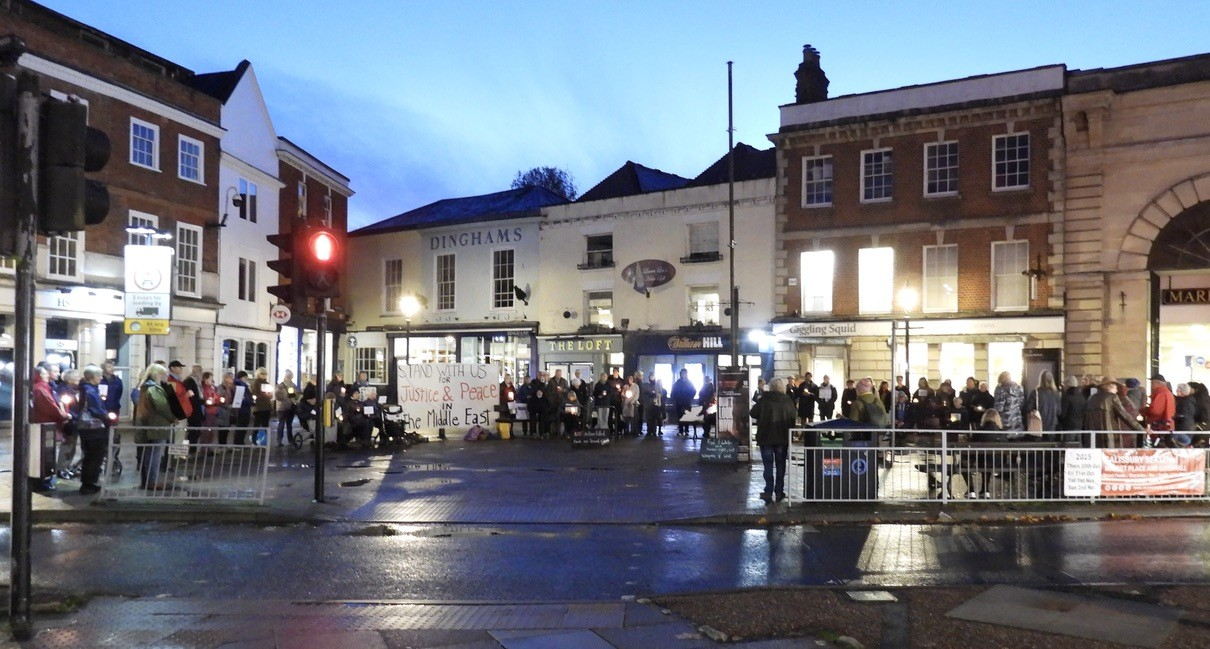
Around 90 attend the 100th vigil

November 2025

It is astonishing to report that around 90 people attended the silent vigil in Salisbury’s market place. There have been a few occasions over the past 2 years when we have considered stopping, usually after a ceasefire or peace initiative when some might have believed that the killing was over. The recent ceasefire was no exception with a huge amount of fanfare from President Trump supported by a degree of pressure on Israel to stop. Well, it hasn’t lasted with over 100 killed on Tuesday and the creation of a semi-permanent line being established taking yet more territory from Gaza. Hamas have returned the remaining live hostages and Israel has released 250 prisoners and 1,700 ‘detainees’.

There are arguments about the remaining dead hostages with Hamas claiming that they are finding it difficult to locate them in the rubble. As Israel will not allow foreign journalists into Gaza, truth is hard to determine but it would seem probable that Hamas’s account is likely.
We put detainees in inverted commas because the hostages taken by Hamas on their violent raid on October 7th two years ago received, rightly, considerable coverage and few will be unaware of the numbers killed or taken. Media coverage has consistently used the word ‘hostage’ for those taken by Hamas. Those taken by Israel – in considerably larger numbers and who were subject to horrific treatment and torture – are referred to as ‘detainees’. British media has continued with this fiction since the conflict began.

The death toll in Gaza is nearly 69,000.
That such large numbers turn out on a Saturday evening is a testimony to the strongly held convictions about many aspects of the conflict. Whilst acknowledging the brutal nature of Hamas and the horrific attack on October 7th, the destruction of Gaza, the imposition of a food and medicine blockade and the wanton killing of women and children has profoundly shocked many. The British government’s continued support for Israel – directly and covertly – has also produced great anger.

UK arms sales reached a record level in June and the notion that the UK has ‘robust’ measures to control such sales is in tatters according to Campaign Against the Arms Trade. Exact details are impossible to determine as the licensing is vague and because of secrecy. The plain fact is that we continue to supply arms and overfly Gaza despite the appalling carnage that has taken place there.


One hundred vigils and no sign of the local MP Mr John Glen at any of them nor any mention in his weekly piece in the Salisbury Journal. Mr Glen is thought to be a member of Conservative Friends of Israel.

A short video is available here thanks to Peter Gloyns. We shall be back (sadly) on November 8th.

Sudan: world’s worst crisis


Two years of war has left 20 million suffering food insecurity

April 2025

Wars in Ukraine and in Gaza have drawn much attention from the world’s media and the events in Washington are also a major distraction. Meanwhile, in Sudan a less well reported conflict is causing immense suffering, death and destruction on an heroic scale. Commendably, Channel 4’s Unreported World devoted a programme to the conflict in March this year [registration needed].

The conflict is now 2 years old and is between the Sudanese Army and the Rapid Support Forces known as the RSF. By August 2023 around 1 million had fled the country. Currently, around 20 million are suffering acute food insecurity. Another million have fled to neighbouring Chad a country not equipped to handle such a large influx.

The RSF is accused of a range of war crimes including killings – sometimes in people’s homes and including small children – looting, sexual violence and arson. It has no regard for human rights.

The war could not last this long and at such an intensity without outside support and the major players are Egypt supporting the Army and the UAE who are alleged to be supporting the RSF. The reason according to Middle East Eye is to protect its investments in the country and to gain access to its mineral and agricultural resources. UAE imports 90% of its food and has little land suitable for agriculture itself.

UK seeks to suppress criticism

Weapons and arms are another key factor and suppliers include China, Russia, Serbia, Türkiye, UAE and Yemen. Amnesty suggests technology from France has been found. UAE appear to be the main player and the UK is alleged to be active in preventing criticism of the country. The United Kingdom has reportedly tried to suppress scrutiny of the UAE’s role in Sudan. In June, a report from the Guardian reported that the Foreign, Commonwealth and Development Office (FCDO) pressured African diplomats not to criticise the UAE. There is considerable trade and commercial interests between the two countries and the UAE invests in the UK including part ownership of Gatwick airport. Clearly, the government, with its focus on growth, does not want the role of the UAE in fomenting conflict in Sudan with devastating results, to stand in the way of commercial interests.

This seems to be yet another example of how outside interests result in fearful consequences for the people who’s properties have been burnt and who have had to flee to neighbouring countries to escape violence.

Sources: Amnesty; Human Rights Watch, Middle East Eye; Crisis Group; Guardian

Ex-diplomat alleges Britain ‘complicit in war crimes’


Britain’s system of arms control ‘broken’

February 2025

Allegations by an ex diplomat that officials were instructed to manipulate findings of misuse of weapons by allies will not come as shock to readers of this site. We have frequently questioned the oft repeated statement from the Foreign, Commonwealth and Development Office that ‘Britain’s export licensing controls are some of the most robust in the world’ as palpable nonsense. We have regularly featured items published by the Campaign Against the Arms Trade, CAAT.

In this case, featured on the front page of today’s Guardian newspaper (10 February), the ex-diplomat claims that officials are ‘bullied into silence’. Processes are manipulated to produce politically convenient outcomes. The article suggests that probably the most significant of his allegations was that officials had demanded the toning down of evidence that UK arms had been used to commit war crimes. This would appear to be a clear example of manipulation of what was intended to be an objective exercise. One tactic was to say they are ‘waiting for more evidence’ as cover for inaction. The FCDO office denies these allegations.

Palestinians returning to north Gaza have been shocked to see almost total devastation of their homes, communities, medical facilities and much else. What greets them are piles of rubble where once they lived their lives. The bombing of civilian targets using dumb bombs and the killing of thousands of non-combatants including many women and children, is clear evidence of a war crime. Israelis have been able to do this with weapons such as the F-35 parts of which are manufactured in the UK. Yet the UK government refuses to ban these exports.

The ‘revolving door’ enables corruption to continue

As we have argued before, the UK is in a kind of trap when it comes to these sales. Arms exports are one of the few areas where we do well from an economic perspective. Many jobs depend on these sales and a proper regime of controls would hit the industry. Arms firms employ many lobbyists to promote themselves. CAAT have spoken of the ‘revolving door‘ whereby senior staff from the civil service, the military and government retire and emerge as consultants or directors of these firms. Such senior staff have a clear incentive therefore, to sing the industry’s songs so as not to destroy the opportunity for lucrative employment post retirement. It is as close to corruption as you can get. We must not forget however, the end result of this corruption and manipulating processes as alleged, is the death, destruction, maiming and general mayhem as the weapons are used to destructive effect.

Apart from Gaza, another area where Britain turned a blind eye and pretended not to know was Yemen. We continued arming Saudi and provided support and advice stopping just short of arming the planes thus avoiding claims of being mercenaries.

Listening to ministers opine about peace ring hollow when its own staff are allegedly manipulating evidence to enable arms sales to continue.

Questionable logic by David Lammy


David Lammy suggests insufficient numbers killed in Gaza to merit calling it genocide

January 2025

As part of a statement to the House of Commons on 28 October 2024, in an answer to a question about claims by some Labour MPs about the alleged policy of genocide, annihilation and extermination of Palestinians in Gaza, the Foreign Secretary David Lammy said: “These are legal terms, and they must be determined by international courts. I agree with [Nick Timothy MP] that those terms were largely used when millions of people lost their lives in crises such as Rwanda and the Holocaust of the second world war. The way that people are now using those terms undermines their seriousness [Citation: HC Deb, 28 October 2024, C556].

Genocide is not about numbers killed

Lammy is completely wrong about this. Genocide is not defined by numbers killed. Article II of the Genocide Convention makes clear it is about killing members of a group (a); causing serious bodily or mental harm to members of the group (b) and deliberately inflicting on to a group conditions calculated to bring about its physical destruction in whole or in part (c). Numbers killed is not mentioned. Is Lammy suggesting that if yet more are killed, some kind of threshold will be reached at which point they will deem it genocide?

The minister will be well aware of the many reports concerning actions in Gaza. Organisations such as Human Rights Watch, Amnesty International, B’Tselem, Médicins sans Frontières, the UN and various agencies of the UN, have all produced copious details about what is happening there.

David Lammy also states that the current situation began on October 7th 2023 with the Hamas raid into Israel killing over 2,000 Israelis and taking over 200 hostages. There is no dispute about the horror of this attack and that Hamas committed a war crime. But the history of this conflict did not begin on October 7th but in 1948.

The debate is about the Israeli response and the killing of large numbers of civilians, women and children and whether this level of killing is proportionate to the threat they face. The death toll is now around 46,000. Despite this evidence ‘the government is unable to conclude whether Israel’s bombing campaign and military operations in general violate International Humanitarian Law‘.

There have been many calls for the UK to end arms sales to Israel. The government has suspended 30 licences but parts for the F-35 continued to be made. It is this aircraft which is used to bomb Gaza. It has allowed many ‘open licences’ which does not identify weaponry and according to CAAT ‘leaves holes you can fly and F-35 through’ (CAAT News, Issue 271).

The government is frightened of upsetting the Americans by stopping F-35 parts being made in the UK. With Donald Trump to become the president in a few days, cancelling the contract is politically impossible for them. It also shows the power of the arms industry to call the shots as far as government policy is concerned. In the same debate Lammy claims that ‘we have one of the most robust export licensing regimes in the world’. Despite this, evidence shows that large amounts of military equipment is finding its way to Israel. His statement to the House is a nonsense.

Arms sales and the revolving door


New report from the Campaign Against the Arms Trade reveals extent of this activity

November 2024

[ADDED: 16 December] If you want to see ministers squirm in front of a select committee when discussing arms sales to Israel (via USA) watch this YouTube video. Usual claims of ignorance and unable to answer basic questions. Even though the RAF is regularly flying over Gaza, it seems they are unaware of the destruction as the purpose they say is to look for hostages.

The question of arms sales has risen up the political agenda partly because of the question of whether we should continue to sell weapons to Israel. It also cropped up with the decision recently to award a GCVO to the King of Bahrain presented by King Charles. It was also an issue during the war in Yemen where British weapons and personnel were involved in helping Saudi in their ferocious bombing campaign in that country. All these and other examples revealed an industry with considerable political influence. They result in a distortion of our political process and an almost complete disregard for the effects of the arms on people at the end of them. The destruction being carried on in Gaza is facilitated by the continuing sale of F-35 aircraft elements of which are made in the UK. An ‘ethical dimension’ to our policy seems to be a thing of the past. There is little sign that arms sales are restricted to states which ignore human rights or International Humanitarian Law.

Not so much a revolving door as an ‘open plan office’

Campaign Against the Arms Trade CAAT has campaigned on these issues for many years and their current magazine, Issue 270, Autumn 2024 contains a number of articles on the topic of arms. One concerns what has been known as the ‘revolving door’. In an article ‘Government and Arms Industry Joined at the Hip’, they explore the deeply compromising nature of this relationship. They have published a report From Revolving Door to Open Plan Office: the Ever Closer Union Between the UK Government and the Arms Industry. They argue that the arms industry has become so deeply embedded in the government that the boundary has almost disappeared. It is now not so much a revolving door as an ‘open plan office’. 40% of top military staff and civilian personnel leaving the MOD hold positions in the arms and security industries. Transparency International research shows that one company, BAE, had more meetings with ministers and with Prime Ministers than any other company.

Private Eye carried out an extensive survey in 2016. This went into great detail and named names.

Why does it matter?

It matters for three main reasons:

  • Firstly, arms cause great misery for millions of people. The harrowing images on news programmes of property destruction, dead bodies, lines of people on the move or rows of tents housing displaced people are the result of the activities of this trade,
  • The lobbying power is such that government ministers seem to fall into line almost as soon as they assume power. Grand statements by Sir Keir Starmer and David Lammy for example are quickly forgotten as the next trade deal is signed. The arms trade seems to wield enormous power and influence over government policy,
  • Thirdly, the ‘open plan office’ means senior staff in the Civil Service and in the MOD and armed services are keeping an eye on prospects as they approach retirement. Lucrative board appointments and ‘consultancy’ contracts await them. Are they going to ask uncomfortable questions or raise difficulties with an arms contract and jeopardise these prospects?

As CAAT put it:

‘When these ‘revolvers’ leave public service for the arms trade, they take with them extensive contacts and privileged access. As current government decision-makers are willing to meet and listen to former Defence Ministers and ex-Generals, particularly if they used to work with them, this increases the arms trade’s already excessive influence over our government’s actions.

‘On top of this, there is the risk that government decision-makers will be reluctant to displease arms companies as this could ruin their chances of landing a lucrative arms industry job in the future. Beyond individual decisions, the traffic from government to the private sector, and vice versa, is part of a process where the public interest becoming conflated with corporate interest, so that it becomes normal to unquestioningly meet, collaborate and decide policy with the arms industry, then take work with it.’

Burma


Hope is a possibility in Burma

April 2024

The news at present focuses on the terrible events in Gaza with over 33,000 dead and many thousands injured or missing. Even today, there is news of the death of aid workers three of whom are Britons. Russia’s invasion of Ukraine continues and there are problems in Sudan with thousands fleeing for their lives. News today seems to focus on one crisis at a time partly because of resources and partly because there is what some call ‘compassion fatigue’.

Burma and the terrible activities of the Burmese military has slipped off the radar somewhat but the latest news from the Burma Campaign has a hint of encouragement in it which is good news.

The situation up to now has been dire. The military, known as the Tatmadaw, have waged war on many of its own citizens and has run an apartheid state. Thousands have been driven from their homes, villages have been bombed and burned. Tens of thousands have fled to Bangladesh to escape the violence. Some of the methods used by the military are vicious beyond belief and include burning people alive.

The British government has not done enough to make life difficult for the regime. For example, the bombing is carried out by jets which need jet fuel to fly. The ships bringing in the fuel are insured in London and there seems little chance that this will cease. Recently, Lord Cameron headed a deputation of people to the far east, including Burma, and was accompanied by several representatives of arms companies. A big source of income for the regime is the export of gems by state owned companies and little has been done to restrict this.

But it seems there is hope. It appears the military is losing more territory as people fight to free their country from military occupation. The Economist has reported that more and more soldiers are deserting the army. There is real hope that the country could be free of the military. The Burma Campaign recently joined others outside the Foreign Office and showed placards with David Cameron’s head on an image of a snail. It was urging the government to act more quickly.

Sources: Burma Campaign, Amnesty UK, The Economist, CAAT.


The Salisbury group was established 50 years ago this year

Sportswash – again


In a previous post we mentioned the case of Anthony Joshua, the boxer and the fight which took place in Saudi Arabia for which he received a multi-million pound purse.

Human rights groups were critical of his decision to fight there and said it was an example of Sportswash: using sport to try and sanitise a dubious regime. In the case of Saudi this involves executions by beheading; floggings; imprisoning opposition people, lawyers and human rights workers as well as their appalling bombing activities in Yemen.

Lo and behold, within days of this happening and the criticism which it produced, Joshua turns up on the Graham Norton Show on the BBC. This is a show which features actors and celebrities of various kinds who come on to promote their activities and seemingly have a good time. Joshua came on to great acclaim and was variously embraced and fawned over by the other guests. Joshua himself said at the time of the fight that he did not know about Amnesty as he was too busy training but one suspects that Graham Norton, his producers and production team know and must have been aware of the furore surrounding his fight in Saudi. Not a word was said about this.

So what do we call this? Is it Sportswash? The BBC has come in for an increasing amount of criticism for bias and to some extent this is understandable during an election. This is not bias however, it is simply not wanting to see. No doubt his promoters or PR people want to rehabilitate Joshua’s reputation – which took a knock – and what better than to parade him on a lightweight entertainment show like Graham Norton where no awkward questions were asked. But why did the BBC agree to this? Did the other guests know he was coming on and were they not concerned? If they were they did not show it with lots of kisses, backslapping and embracing – typical activity when celebs come together. We do not know of course if other potential guests were sickened by his presence and declined the gig.

So have the BBC been used as part of a plan to rehabilitate Anthony Joshua’s reputation?  Is what is happening in Yemen and Saudi of so little interest to the BBC that inviting this man on for our entertainment matters more than the suffering of people in those two countries?


Film


Nae Pasaran this week

The film Nae Pasaran is on this Wednesday 13th at the Arts Centre in Salisbury starting at 7:30 and tickets are available at £8.00 each.  The film is set in Scotland.  Details about the film can be seen here.

Yemen arms ruling


Good news today that the Court of Appeal has upheld the appeal by the Campaign Against the Arms Trade who are trying to stop the British government supplying lethal weapons to the Saudis who are using them to cause terrible death and destruction in Yemen.

There will be more about this in future posts.  A previous post on this subject can be read here.


Yemen: new developments


Congress votes to end military aid to Saudi

In our last post two days ago, we highlighted the Dispatches programme which described in graphic detail the role our weapons supplies were having in Yemen.  The Saudis, using jets supplied by us, were creating suffering on an almost unimaginable scale with tens of thousands of deaths, a cholera outbreak and starvation of its people.

Today, 4 April 2019, the US Congress has voted 247 to 155 to end military aid to Saudi Arabia.  Further votes are planned to stop weapons supplies as well.  It is expected that President Trump will veto the actions but nevertheless, it sends a strong message of what Americans think of this terrible regime and its countries continuing military support for it.

This puts the UK in a tricky position.  A chief ally stepping back leaves this country somewhat exposed.  We shall have to see over the coming days what feeble excuses are trotted out to justify our support and role in the killing.

Sources: The Nation, Washington Post, the Guardian


Blog at WordPress.com.

Up ↑