Refugee report


Events in Syria may see many return

December 2024

To begin with more positive news, the collapse of the regime in Syria has led to a rush among exiles to return to the country. Refugee camps just outside Syria have been particularly active. The down side is that, as a result, European governments (including the UK) have paused processing active asylum claims from Syrians. The UNHCR has calculated that the largest number of refugees from Syria leaving for other countries under Bashar al-Assad were Turkey 3.1 million, Lebanon 774,000, Germany 717,000 and Jordan 628,000.

Statistics released this month indicate that the net migration totals for the UK have dropped to 728,000 for y/e June 2024, but of course most of these are legal. Of the asylum claimants, the backlog of cases was at 97,200 in September, mostly appeals, as the percentage of claims granted by the Home Office has fallen over the last 12 months from 75% to 52%. At the same time, it has been said that only 52% of asylum decisions have met the Home Office’s internal quality assurance requirements. Since the Home Office has imposed a 2 hour limit on interviews with claimants in an attempt to speed thing up, this is perhaps not surprising.

Small boat arrivals have dropped substantially in the last month, due mainly to adverse weather. No boats arrived between the 17th and 30th November, and only 8 since, which means 400 arrivals in the last 3 weeks. Greece, the main point of entry to Europe for many, has received 57,000 arrivals this year so far.

A change in the law means that newly accepted asylum seekers in the UK will now have 56 days to “move on” from asylum accommodation, twice the previous limit. The Home Office is also planning to house asylum seekers in disused care homes and student accommodation. The National Audit Office has concluded that accommodation like military bases and barges do not represent value for money.

Britain has signed a deal with Iraq to tackle people smuggling gangs, particularly in the Kurdistan region. Deals with other front line countries may follow. Meanwhile the UK and Germany have pledged to share intelligence and expertise against the gangs. Germany will make it a specific offence to facilitate smuggling migrants to the UK; many of the rubber dinghies used are stored in Germany.

Andrew Hemming

Pic: NY Times


Recent posts:

Refugee report – May


Immigration, refugees and Rwanda still hot topics

May 2024

Immigration and asylum issues continue to exercise politicians and sections of the media and flights to Rwanda edge closer. We are grateful for this report produced by group member Andrew.

The Safety of Rwanda (Asylum and Immigration) Act finally became law on 25th April.  Since then, two pre-action letters have been sent (i.e. indicating intent to take the matter to court) from the FDA Union (on the grounds that civil servants cannot be expected to break international law) and Asylum Aid (claiming the legislation breaks with international law.)

It is reported that the Home Office is already rounding up refugees to send to Rwanda.  As a result many are going into missing or into hiding – or moving to Ireland.  It has also been said that countries under investigation as possible destinations include Armenia, Ivory Coast, Costa Rica and Botswana.  (Costa Rica has forcefully denied any such idea.)

A further aspect of the legislation is that Rwanda is a ‘monist’ country, meaning that it takes international law directly into domestic law.  This could mean that, if it is recognised that the Act breaks international law, it will, therefore, break Rwanda domestic law. 

The Oslo Peace Research Institute has surveyed the effect of warnings about migration rules as they affect third world countries.  Knowledge of the situation to be faced in Europe varies, but most communities are aware of messaging not to travel.  The effect on young adults has been minimal; indeed in some cases a better understanding of the bar on migrants has tended to raise expectations.

There has been a big increase this year in arrivals from Vietnam, higher even than among Afghans.  Vietnam is known as one of the worst countries for modern slavery, so trafficking appears to be rife.

The All-Party Parliamentary Groups on Poverty and Migration combined this month to produce a report on the effect of recent migration laws.  They considered that it was hard not to conclude that pushing claimants into poverty was a deliberate attempt at a deterrent.  They recommended several changes to the processing of immigrants.  The view that deterrence is not working is endorsed by this week’s report by some Calais-based charities, who note that heavy-handed action by French police to prevent the boats has encouraged the migrants to take to the boats more recklessly so as to avoid them, with dangerous consequences.  This police action is funded by the British Government.

The latest numbers of arrivals have been reduced by bad weather – an increase is expected.  1st May saw 711 arrive by boat.  The backlog of claimants awaiting processing was 83,000 in mid-April; the rate of processing has slowed in the last six months (the pre-2022 backlog, which the Prime Minister claimed had been cleared, still contains 2,300 people.)  The Refugee Council anticipate that, under the new laws, 94,000 are likely to be in permanent limbo by the end of the year.  Homelessness is also on the increase as asylum seekers are ejected from hotels after their claim is accepted.  Finally, the conditions in the Bibby Stockholm have been described as ‘prison-like’ with severe overcrowding.  An FOI request this week revealed that 1,871 children, who may be victims of modern slavery, have dropped off the register meant to support them up to the age of 18.

A depressing picture.

It was agreed the Group would monitor events for information on any proposed flights to Rwanda with a view to taking action, as previously, should Boscombe Down be the chosen airfield for departure.

The Salisbury group was established 50 years ago this year

Refugee report, December


Refugees and Rwanda continue to fill the headlines

December 2023

As the House of Commons debates the Government’s latest attempt to make their Rwanda project fly, this month’s emphasis has been very much on the small boats. On the progress of the Bill over the next few weeks, anything might happen. The government managed to get the second reading of their bill passed on 12th to clear the way for the plan to remove some people to Rwanda. 

As a topline figure, the number of arrivals by small boat this year has reached 29,000; this is about a third down on last year. It has been argued, however, that it’s the number of boats that is down, not people – they are using bigger boats. We have no confirmation of this.

The Government has changed the rules for asylum seekers/refugees following their processing; they now have 28 days to leave the temporary hostels they have been confined in and to find their own accommodation.  As a result the level of homelessness among this community has increased dramatically.  The Evening Standard claims that the numbers of homeless in the migrant community has increased 39% in a month (presumably this is a London figure).

The big increase in the number of claimant withdrawals has been exercising the legal profession.  These are migrants who have claimed refugee or asylum seeker status, but have not turned up for interview.  As a result, 17,000 claimants who have apparently withdrawn their claim are now unaccounted for, though presumably they are still in the UK (the Home Office has no knowledge of their whereabouts).  On a similar topic, of the 154 unaccompanied child asylum seekers who went missing earlier this year, 132 are still missing.

While the number of legacy cases is being reduced, new claims are still keeping the total high.  The Government’s aim of clearing the pre-June 2022 backlog has not yet been achieved (it’s believed to be still about 10,000, and these are among the most complicated cases).  Meanwhile, new applications have amounted to 90,000, leaving the total figure at around 109,000 (less than the peak).  It should be noted that Home Office staff turnover is very high and it may well be that the 17,000 alluded to above include names taken off the backlog to reduce the figures.  Also the Home Affairs Committee this week elicited the information that approval levels went down to 38% in Q2 and back up to 67% in Q3 – the reason is unclear.

Small boats population accounts for around 6.6% of the total

It is worth pointing out, as part of the argument, that the small boats population amounts to about 6.6% of the net immigration numbers for the year (the 700,000 excess of arrivals v departures) figure) and half that for the gross total (incomers only)

Another problem area has been the gap between a claimant being granted leave and receiving a Biometric Residence Permit – the Home Office claim not to know how long the average wait in limbo is.

The apparent suicide of an asylum seeker on the Bibby Stockholm has drawn attention to the cost of the barge, currently estimated at £22 million.  The number of boat people on board is not known, but is believed to be around 200 currently.

On the issue of potential refugees from Gaza, the request in October from various refugee organisations in the UK to the Government to come up with a scheme for taking numbers on, as was done with Ukraine, does not appear to have been acted upon as yet.

Finally, a survey by Labour List this week invited respondents to say how many arrivals had actually been removed to Rwanda.  The percentage saying, correctly, none was 48%.

Andrew Hemming

Refugee report: November


Reports focus on destitution and the need for cooperation concerning asylum

November 2023

We are grateful to group member Andrew for his work in compiling this report on the current state of affairs with refugees and asylum seekers. A quiet month on the legislative front, but much noise from certain quarters. It was noted that the Home Secretary’s complaint against “tent-dwellers” included the aside “many of them from abroad”, with its implication of illegal immigrants joining in the supposed lifestyle choice. This was roundly condemned by a number of refugee charities, along with homelessness support groups. 

The Joseph Rowntree Trust have published a report on destitution in the UK. Among its findings was the fact that 28% of destitute households were migrants, and rates for that group were 35% higher than the national figure. Such households also tend to have more children. 

The Institute for Public Policy Research (a centrist think tank) has also published a report, “Charting New Waters”, on dealing with those crossing in small boats. Like the Safe Passage report mentioned last month it is concerned with developing safe routes, an organized Europe-wide system to share the responsibility, and a reform of the asylum processing system. The report does not give much detail, but reinforces the feeling that the government needs to engage with our neighbours in finding solutions to the issue. 

On that topic, the numbers of asylum seekers crossing the channel has been lower this month, mainly because of the weather 

We still await the High Court decision on the Rwanda plan, but the feeling is that the government is prepared to lose the case. This would, of course, put the European Court of Human Rights in the firing line, at least with the Home Secretary. The decision is expected in the first half of December. 

Many Afghans who were promised a safe passage to the UK after the Taliban takeover are still waiting; 3000 who have been promised asylum in the UK are in UK-funded hotels in Islamabad, but the Pakistan government is ejecting all Afghan refugees. There has been no government statement, as far as we know. 

The Home Office has rolled out a new “asylum decision-making prioritisation”. This is really a pushing ahead in trying to reduce the backlog of cases awaiting decision. The government has argued that the backlog has been reduced, but in fact the total has increased due to new cases, while the “legacy” cases from pre-2022 are indeed being reduced. 

Migration lawyers have noted with pleasure that the number of refusals of claims of trafficking by new arrivals has fallen, following a change in the regulations. 

The Home Office announced this week that the number of asylum seekers to be held on the barge Bibby Stockholm is to be reduced from 500 to 425, following a fire risk assessment. This would likely make the provision 10% more expensive than housing claimants in hotels. 

On the campaigning front, next year’s Refugee Week will be from 17th to 23rd June. The theme will be “Our Home.” 

AH

Exiting the European Court possible


Some Conservative politicians again calling for the UK to exit the European Court

August 2023

The issue of the small boat crossings continues to generate considerable passions amongst many in the Conservative party in particular and in sections of the media. This week, the first of the asylum seekers arrived on the barge, Bibby Stockholm, moored at Portland with many local protests, concerns about fire safety and legal protests in train. The response to the protests and appeals from the deputy chair of the Conservative party, Lee Anderson, broke new ground when he said that if they weren’t happy with the accommodation they should ‘f–k off back to France.’ When interviewed on GB News he declined to withdraw the remark and he has received support from others in the party.

Part of the frustration that some feel is possibly based on the misunderstanding about the Court and its relationship with Europe. Brexit was largely based on a desire to regain our sovereignty and the fact that the Court has nothing to do with the EU has come as a surprise and disappointment to those who believed it did. When the Court stepped in to stop the first flight to Rwanda a year ago from Boscombe Down airfield (a mile or so away from where this is being written) it generated considerable fury and with it the threat to leave the aegis of the Court.

If we did leave the Court, we would join Belarus and Russia, hardly exemplars of sound government or decent human rights. It would, as one of the key proponents of the Court in the ’50s, be a great blow to our international standing. There are many in the Conservative party who recognise this.

In many respects, the problem of Channel crossings is as a result of successful policies elsewhere to prevent other forms of crossing. Channel ports are now surrounded with razor wire and boarding and aeroplane is now a major exercise in logistics and checking of details. Legal routes barely exist and the ability of someone to claim asylum in their own country is all but impossible. Getting on a boat is almost the only way.

The ECHR is a threat to British democracy

Daily Telegraph, 10 August

In previous posts we have commented on many aspects of the government’s policy and how exporting people to Rwanda – tried and abandoned by Israel – will be of limited utility. Hundreds will be deported, if it comes into being, while the backlog is in the tens of thousands. Ascension Island is also being rumoured: another expensive and impractical solution.

On 18 July, the government passed the Illegal Migration Bill which means those who arrive by crossing the Channel will not be able to claim asylum. This is likely to be a breach of the Refugee Convention, hence the call to exit the ECHR.

It is a pity that the connections between causes and results is not discussed more. The coup in Niger is the latest example of a desire to grab mineral resources. Western countries along with China and Russia, are desperate to secure supplies of these resources and the rights of people who get in the way are nearly always ignored. We are happy for the City of London for example to fund companies and to enable the vast wealth to be routed through the city. We pay little attention to the ‘front end’ so to speak and the activities of corporations in their thirst for rare earths, oil, gold, uranium or other commodities. The resulting conflicts and displacement of peoples, some of whom end up on the northern coast of France, suddenly results in angst and furious editorials in our tabloids. A man reaps what he sows as the Bible tells us. Perhaps if government spent more time concerning itself with the activities of our mining and resource companies then fewer would be forced from their homes and land, dispossessed or otherwise maltreated and fewer would end up at Calais and thence onto a boat. Fewer then would need to f–k of back to France.

UPDATE: 12 August 2023. Migrants taken off the barge because of the risk of Legionnaires disease (11th). Ascension Island no longer an option it is reported.

Rwanda flights ‘unlawful’


High Court rules flights to Rwanda unlawful

June 2023

The High Court has today (29 June) ruled by a majority, that the planned flights to Rwanda are not legal. This has been a key element of the government’s policy and the first flights due to go out in June last year from Boscombe Down near Salisbury, were halted at the last minute following a ruling by the European Court deciding it breached article 3 rights against torture and bad treatment.

The case hinged on whether it is safe for asylum seekers and others to be sent to this African country. Both UNHCR and Amnesty International have expressed doubts and concerns about what life is like and the safety of those sent there. In its 22/23 report Amnesty had concerns about the asylum process procedure, the risks of detention and deportation, discrimination against members of the LGBTIQ+ community and inadequate legal representation.

Plane waiting at Boscombe Down airfield in June 2022 but which left empty. Photo: Salisbury Amnesty

There is limited freedom of expression, bloggers and journalists are harassed, persecuted, intimidated and sometimes unlawfully detained. Although the country has made promises to improve as part of the deal with the Home Office, serious doubts remain about how genuine these might be.

A report last week noted that the costs of sending individuals to Rwanda were excessive at around £170,000 per person and they also doubted the deterrent effects of the policy – a key element behind why the government wishes to do it. Altogether, the government’s policies on immigration and asylum are looking threadbare. They plan to appeal the decision. Both the prime minister and Suella Braverman have been critical of it.

Sources: BBC; UNHCR; Daily Mail, Guardian

Refugee march


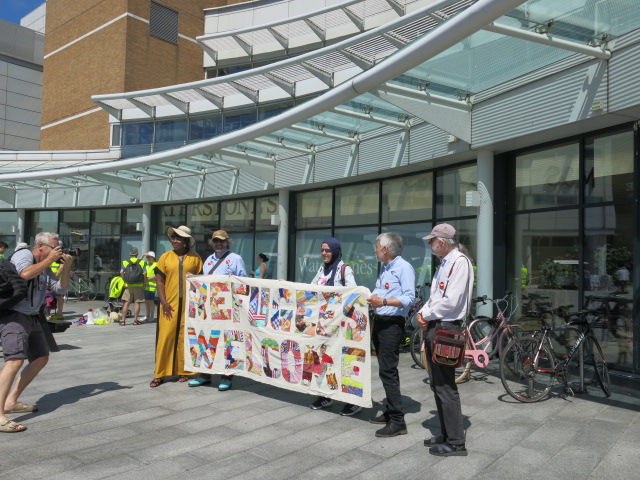
Members of the Salisbury group joined the refugee march in Southampton

June 2023

Some members of the Salisbury Amnesty group went over to join the march in Southampton held in support of refugees. It goes without saying that refugees are getting a terrible press at present with tabloid fury at the boat crossings showing no signs of abating. Politicians are in full cry and new legislation is promised to make asylum even harder. Plans to send them to Rwanda are still in place and there is a section of the Conservative Party which would be happy for the UK to withdraw from the European Court to achieve this. In a previous post we drew attention to some of the inconsistencies in the attitudes towards refugees and asylum seekers. We were sad not to meet colleagues from the Soton group.

Pics: Salisbury Amnesty

Refugee report: February


February 2023

The report for February/January 2023 thanks to group member Andrew for the work on this post.

As we await yet another immigration bill (this time designed to send anyone arriving here “illegally” on their way immediately) let us consider what legal means of arrival still exist.

The Johnson government committed the government to providing safe and legal routes of entry as part of a broader programme of asylum reforms outlined in its New Plan for Immigration policy statement (March 2021).  It wanted fewer people to come to the UK as asylum seekers and more to come through safe and legal routes.

December 2022 statement by the Prime Minister went further.  Rishi Sunak announced that the Government now intends to make further legislative changes so that “the only way to come to the UK for asylum will be though safe and legal routes”.  He said that the Government would create additional legal routes “as we get a grip on illegal migration” and would introduce an annual quota for refugee resettlement.

Refugee rights campaigners have previously called for an annual target for refugee resettlement.  But they have also cautioned that safe and legal routes are not available to everyone who needs protection.  Consequently, they want them to be provided alongside an accessible in-country asylum system.

The other continuing issue about immigration is the endeavour by the government to prevent legal stays to the proposed deportation policy.  Much of the debate has centred on possible appeals to the European Court of Human Rights, which is referred to as a “foreign court”, but is actually an international body on which the UK is represented.  The Home Secretary is keen to leave the ECHR in the event of dispute, putting the UK in a class with Russia and Belarus.  There is opposition to the possibility of this happening, not only in the legal profession but also in the Conservative Party.  Also, the High Court has now allowed appeals against their finding in favour of the government over the legality of the Rwanda plan to go ahead.

Elsewhere, the head of the Windrush inquiry has expressed disappointment after the home secretary confirmed the government was dropping three key commitments made in the wake of the scandal.  The Home Secretary Suella Braverman, told MPs she would not proceed with the changes, including establishing a migrants’ commissioner. They were put forward in the report into the wrongful deportation of UK citizens of Caribbean descent. Wendy Williams said “crucial” recommendations had been scrapped.

Ms Williams’s formal inquiry examined how the Windrush scandal unfolded at the Home Office – when British residents, many of whom had arrived in their youth from Caribbean countries in the 1950s and 60s, – were erroneously classified as immigrants living in the UK illegally.  In a written statement in the House of Commons, Ms Braverman insisted the Home Office was looking to “shift culture and subject ourselves to scrutiny”.  But she confirmed that plans to beef up the powers of the immigration watchdog; set up a new national migrants advocate; and run reconciliation events with Windrush families would be axed.

The government plans to end providing accommodation for Afghan refugees by the end of the year. Currently, 9000 Afghans are living in hotels.

The stories above have contributed to Human Rights Watch, in its annual report, declaring that the actions of the UK government breach domestic human rights obligations and undermine international human rights standards.

Debate about the right to work for asylum seekers has become more prominent lately. Canada allows claimants to work straight away, Germany after 3 months, compared to the UK’s 1 year if the claimant is still waiting a decision.

Asylum support cost in 2022 was £898 million; £5.6 million a day was spent on hotel accommodation.

Final fact: for those applying for visas for partners to come to the UK the cost of the process has been calculated at £8,110 over 5 years and £13,326 over 10 years, not counting lawyers’ fees.  It has been suggested that this money could have been spent into the economy rather than the government’s coffers.

AH

Refugees in the UK


Report on refugee and asylum issues in the UK

September 2022

The change of Prime Minister this month has led to changes at the Home Office. The new minister, Suella Braverman, will have initially to deal with the question of sending asylum seekers to Rwanda, the issue of which is still under judicial review. The hearings have started this week.  The new Prime Minister, Liz Truss has declared her support for the plan, indeed suggesting its extension to other countries.  An aide told the Mail on Sunday: “She’s determined to see the Rwanda policy through to full implementation as well as exploring other countries where we can work on similar partnerships.”  It would not seem likely that the new Home Secretary will mark much of a change from her predecessor.

Despite the legal challenge, the government plans to deport 19 people to Rwanda in the coming days. Information shared by charities indicates that six were trafficked or tortured, including one who was detained and beaten for eight weeks at a warehouse in the Libyan Desert.

Medical Justice have this week published “Who’s Paying The Price?: The Human Cost Of The Rwanda Scheme”, a comprehensive analysis of people targeted for removal to Rwanda which details medical evidence of the harm inflicted on them.  The charity says: “The policy is damaging in general for anyone, acutely so for such vulnerable torture and trafficking survivors who are already paying a high human cost even before any flights have taken off to Rwanda.”

As one of the side issues to the debate, the charity Freedom from Torture is directing public attention on to the airlines who are or are intending to facilitate the flights.

Another central element of the immigration plan – the setting up of new processing centres for asylum seekers – also appears to have stalled after the Ministry of Defence admitted to the Observer that, despite evaluating 100 different sites for the Home Office since January, it has yet to publicly identify a new one that might be used. The only site named so far as “asylum accommodation” – in Linton-on-Ouse, Yorkshire – was abandoned after the Home Office failed to move any asylum seekers there and the MoD withdrew from the plan.

The Observer has revealed that the government is considering reintroducing its notorious refugee pushback policy for use against small boats crossing the Channel.  Five months ago, after the heavily criticised policy was officially withdrawn by ministers, documents released under freedom of information laws suggest the government is reconsidering the tactic that has been blamed for drownings in Greece.

The numbers arriving in the country by boat continues to grow, to over 25,000 this year, given the good weather.  3,733 people crossed the Channel during the week to 28 August – twice as many for all of 2019.

Acceptances

What has been notable has been the large number of acceptances by the Home Office of asylum seekers’ claims.  New rules on inadmissibility have added to the time taken to process asylum seekers, but the proportion of acceptances in the long term remains high.

A large number of Albanians has, however been returned on the grounds that the country Is safe.  The government has been endeavouring to set up returnee agreements with other countries to facilitate repatriation; at present they have 5, the latest of which is with Pakistan.

By comparison with other European nations, the total number of asylum applications in the UK since 2012 has been 386,000, the 6th largest in Europe.

Outside of the refugee influx, more work visas have been issued to arrivals from India than any other nation (Ukraine is the next largest).

The Afghan emergency last year resulted in 16,000 nationals being brought over here.  Of these, 9000 are still living in hotel accommodation.

The total number of Ukrainian refugees now in the UK is 115,000.  Visas issued under the Family and Sponsorship schemes total 177,000.  For comparison, Germany has so far taken in 971,000 Ukrainians.  The UK government has, however, indicated that host households will have their “thank you” payments doubled to £700 per month.

AH


Don’t forget that you can listen to this and many other posts on this site by pressing the Spotify button at the top

Refugee Report – June


Refugee Summary

July 2022

Following the frenetic events of the last week, it is probably worth taking a moment to see where we stand on the refugee front, 60 years after the first Commonwealth Immigrants Act began the process of legislating against incomers. The Nationality and Borders Act has now brought into force more of its provisions, including a Home Office explanation of  ”differentiation” between different types of refugee (the proposed two-tier system).  The effect is that it will take longer for some arrivals to be granted residency and harder for them to bring family to join them, but the changes are not huge, according to human rights lawyer, Colin Yeo, who commented:

The policy exemplifies Priti Patel’s modern Home Office.  It pretends to be tough as old boots but in reality it creates genuine but fairly minor problems for very vulnerable people with no likely policy outcomes achieved.  What it does do is make more work for officials, thereby worsening the backlogs in the asylum system.  It is not just pointless; it is actually counterproductive.

However, AI has commented in its monthly report to local groups the effect of the government’s effective withdrawal from the UN Refugee Convention (See foot of page).

The Afghanistan Citizens’ Resettlement Scheme (ACRS), which had opened in January, and is meant to take 20,000 refugees, has now added guidance on those seeking to come via Pathway 3 (mostly employees of UK organisations in Afghanistan).  Three groups have been established; those who had places allocated, but missed out (who will be assisted); those who came via the UNHCR (who can now begin to be referred) and those others at risk, such as women and girls (1500 places allocated).

In May, 2,871 migrants were apprehended crossing the Channel by small boat compared with 1,627 in May 2021, a 75% increase. Similarly, during the first three months of 2022, 4,540 people were detected arriving by small boats compared with 7,432 during the last half of April, May and June after the MoD took over.  The Navy is said to be keen to be let off enforcing control f the Channel, a policy on which they were not consulted.

By mid-June 77,000 Ukrainian refugees had entered the UK and 135,000 visas issued.  It may be noted that Germany has so far taken 700,000 refugees.

Although the courts have not yet decided whether offshoring asylum seekers to Rwanda is lawful, the Home Office plans further flights.  The HO said “No court has actually ruled that this partnership is unlawful and that includes the ECHR.”  Thanks are due to group members Peter and Lesley for protesting the planned flight from Boscombe Down and subsequent press appearances.

On the subject of tagging claimants, a 12-month pilot scheme is planned to test its value as a monitor and for collecting data – it is already in use for those on bail.

On the vexed issue of the actual ages of asylum seekers, the Home Office is recruiting 40 social workers to help assess claimants’ ages using “scientific” methods.

Statistics
  • Asylum claims Jan-Mar 2022 12,508 (for 2021 2,022)
  • Main countries of departure – Afghanistan, Iran, Iraq, Syria, Eritrea
  • Number waiting more than 6 months for a decision Q1 70,000 in 2017 the number was 14,000)
  • 75% of applicants receive grants of protection (Syrians are at 98%).
  • It is worth noting that the equivalent percentage in 2010 was 25% and in 1995 4% (with fewer applicants, iof course).
  • The number of enforced returns in 2020 was 3,000 (in 2010 15,000),
  • And voluntary returns 5,000 (against 30,000).

Clearly, asylum seekers are far more likely to be granted residence now than in earlier years, but are subject to far longer waits for the process to complete. Whether the new Act will alter this is open to debate.

Also: –

The Napier Barracks, which became notorious as an inadequate location for prospective arrivals, has been deemed to have improved since the original aim.  No immigrants now will spend more than 90 days there.

A Lords Committee looking into the document “Life in the UK”, prepared for those seeking settlement or citizenship, have described it as a “random election of obscure facts and subjective assertions.”

Refugee Week was held in late June this year, but passed with disappointingly little media coverage. AI supported a number of events under the umbrella.

Amnesty’s comment on the new refugee legislation:

On 28th June, the UK’s interpretation of the definition of a refugee and the rights to which every person who is a refugee is entitled will significantly change from that required by the Refugee Convention. What does this mean? It means the government is unlawfully rewriting its shared obligations under international law. To the extent, it is dangerously undermining what our country, not only agreed to, but helped draft and negotiate in 1951. 

These changes are lawless and reckless.  Its consequences directly contradict our values of shared humanity and compassion and have been rightly rejected by the UN High Commissioner for Refugees, leading lawyers, and former senior judges in the UK.

Here are five things you need to know:

  1. The evidence refugees need to provide will become overly obstructive and wrongly prevent some refugees from proving their status and rights, making the lives of people that have fled war and persecution even harder.
  2. People who claim asylum based on their sexual identity or orientation being the cause of the persecution they face, will need to meet extra tests.  This will exclude thousands from the asylum they are entitled to and that they need to safeguard them from persecution.
  3. Refugees that arrive or enter the UK without prior permission will be penalised, both by criminal prosecution, imprisonment and by exclusion from their full rights to asylum in the UK, directly violating the Refugee Convention. 
  4. It will lead to the government refusing asylum to those who arrive or enter the UK without prior permission, presenting a grave risk that people are sent back to torture and other forms of persecution.
  5. It will discriminate between refugees in the UK by denying many of them their full and equal rights to asylum under the Refugee Convention. It will leave them:
  6. Insecure by periods of short-term permission to stay that must be constantly renewed by formal application
  7. Impoverished by exclusion from public funds
  8. Separated from family by denying or delaying family reunion rights.

Andrew Hemming

Blog at WordPress.com.

Up ↑