
The effects on those responsible for carrying out executions is often overlooked
February 2025
In discussions about executions the focus is, naturally enough, on the individual who is about to be put to death. We forget that there are many prison officers who are closely involved with those on death row, sometimes for many years, even decades. This post draws on material produced by the Death Penalty Information Center in the US for which we are grateful. The Salisbury group is focusing on the state of Oklahoma. We are grateful to group member Lesley for the work in compiling this.
Executions can cause prison staff to suffer psychological distress similar to what veterans experience
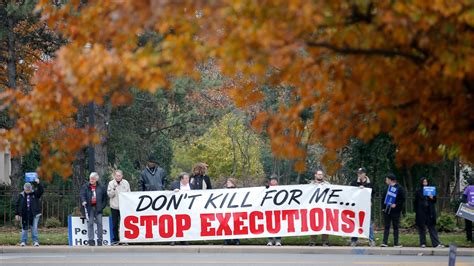
after war. A 2022 NPR investigation found that corrections officers faced symptoms such as insomnia, nightmares, panic attacks, suicidal thoughts, personality changes, and substance abuse – all hallmarks or comorbidities of post-traumatic stress disorder. Of the 16 people NPR interviewed who participated in executions, none supported the death penalty in their wake. Psychologists use the term “moral injury” to describe how committing an act that contradicts one’s deeply held beliefs, such as causing another person’s death, creates a severe psychological disruption. Robert Jay Lifton and Greg Mitchell coined the term “executioner stress” to describe the specific mental impact of carrying out the death penalty.
The stress may also extend to guards who do not participate in the execution itself, but develop close relationships with death-sentenced prisoners over the course of decades working on death row. Some corrections officers have remarked that they spend more time with the people on death row than their own families. They may come to see the condemned prisoners as friends, or witness the prisoners’ mental or physical vulnerabilities. In studies, officers have expressed concerns about the arbitrariness of the death penalty, noting that they had worked with many people with life sentences who committed equivalent or worse crimes than the people the officers helped put to death.
“There is a part of the warden that dies with his prisoner,”
The psychological toll of performing executions is not a new phenomenon. Donald Cabana and Jerry Givens both conducted executions in the beginning of the modern era, in the late 1970s and early 1980s, and went on to publicly oppose the death penalty. “There is a part of the warden that dies with his prisoner,” Mr. Cabana often said.
Journalist Jennifer Gonnerman researched New York’s last four executioners, who oversaw the use of the electric chair from 1913 through 1963, a period during which hundreds of people were put to death. Several of the men experienced medical issues around the time of executions, such as migraines or fainting spells. One, Robert Elliot, later became a prominent death penalty abolitionist. Two of the men, John Hulbert and Dow Hover, died by suicide.
Yet prison staff have long faced a culture of silence about execution-related trauma. “We don’t talk about it,” said Justin Jones, director of the Oklahoma Department of Corrections from 2005 to 2013, who joined the effort to increase the time between executions (see Oklahoma below.) “Correctional officers are public servants on the lowest salaries in state government, and they get home at the end of the day and just absorb it.” NPR’s investigation revealed that some execution team members had never even told their families they participated. “We all knew to keep it silent,” said Catarino Escobar, who worked on the execution squad in Nevada. Mr. Escobar was strapped to the gurney when he played the prisoner during a practice session, and he grew panicked and became convinced he was going to die. NPR found that only one of the officers they interviewed had ever received mental health care related to their position, and even when care was offered, it was “overwhelmingly optional” and “many of them avoided asking for it so as not to seem weak.”
Oklahoma
In this context, unified efforts by corrections staff to address the psychological effects of executions represented a milestone. In March 2024 a group of nine former Oklahoma corrections officials wrote a letter to Attorney General Gentner Drummond and, based on the detrimental impact of the job and the lack of mental health support, asked for an increase from a time of 60 to 90 days between executions. They noted that execution team members experience an increased risk of PTSD, suicide, and substance abuse, and the gruelling preparation schedule puts staff members throughout the prison on edge due to “near-constant mock executions being conducted within earshot of prisoners’ cells, staff offices, and visiting rooms.” With few state resources at their disposal, some employees even resorted to talking with defence mental health experts visiting the prison “about the distress they are experiencing due to the nonstop executions.”
This compressed execution schedule also increases the risk of something going wrong during the execution process because the stress created by each execution compounds the difficulty of an already complex procedure. If even a routine execution can inflict lasting harm on corrections staff, the traumatic impact of a botched execution is exponentially worse. Oklahoma has experienced this harm on multiple occasions and should not needlessly place its hardworking correctional staff at risk of another such mistake.
“Prison staff need to ‘man up'” Judge says
Judge Gary Lumpkin dismissed these concerns, telling officials that prison staff needed ‘to suck it up’ and ‘man up’. Prison staff were reportedly angered by Judge Lumpkin’s comments that they needed to “man up” and the suggestion that their concerns were not valid. “Anybody that thinks that executing somebody is no problem has not been a part of the process,” said Justin “JJ” Humphrey, the state assembly chair of a criminal justice and corrections committee and 20-year veteran of the corrections department. The Oklahoma Court of Criminal Appeals eventually granted the extension request in May.
(Source: Death Penalty Information Centre – December 2024). Image: USA Today.

 Amnesty in Salisbury & South Wiltshire