Importance of Human Rights: UK Support for the ECHR


November 2025

Nigel Farage’s proposal for the UK to leave the European Convention on Human Rights was defeated on 29 October by 154 votes to 96, a majority of 58. The vote was largely symbolic: a ten-minute bill without government backing is often used simply to air an issue. The Liberal Democrats led the opposition to the bill, a number of Conservatives joined Reform UK in supporting it and many Labour backbenchers chose not to abstain but voted against it, fearing that were it to pass even symbolically, it would send a negative message to European allies.

The position of the Government remains that while it may pursue some changes to the interpretation of the Convention it would under no circumstances seek to abolish it.

75th  Anniversary 

A statement of support for the ECHR was signed by almost 300 organisations to mark the 75th anniversary of the Convention. Organised by Liberty, the statement highlighted the many ways the Convention has helped ordinary people from victims of sexual violence to LGBT+ service personnel, public interest journalists to mental health patients and victims of grave miscarriages of justice, as with the Hillsborough and Windrush cases.

It calls on the government to make the positive case for the UK’s human rights protections and claims that the way the Convention has been scapegoated in recent years has had devastating real world consequences. 

Meanwhile a survey for Amnesty by the widely respected agency Savanta concluded that more than 8 in 10 UK adults say that human rights protections are as important – or more important – today than when the ECHR was created after the Second World War. When asked which rights matter most to them, UK adults chose: the right to a fair trial (42%); the right to life (41%); the right to privacy, family life and respect for your home (40%).   

Support for staying in the ECHR is almost twice as high as support for leaving.  48% want the UK to remain part of the ECHR.  Only 26% want to leave.  

People believe rights should be universal, permanent, and protected from political interference:   87% agree that rights and laws must apply equally to everyone, 85% agree we need a legal safety net to hold the Government accountable in cases like the infected blood scandal and Grenfell and 78% agree rights should be permanent, not something the Government of the day can reduce. 

Respondents were shown a list of major UK scandals or institutional failings and asked which made them feel the importance of strong legal protections and accountability. The top five were: 

Grenfell Tower – 46%; Hillsborough disaster and cover up – 42%;   Infected blood scandal & the COVID inquiry – 37%; The murder of Sarah Everard – 36%;   Windrush scandal – 29%.   

ECHR and Immigration

In response to critics attributing the real problems of the UK’s immigration system to the ECHR, the Good Law Project set out some basic facts about the Convention, namely that it does not provide a right for people to enter or remain in a country of which they are not a national; that the Court rarely rules against the UK on immigration issues at all  – since 1980 only on 13 of the 29 cases concerning either deportation or extradition. And while the Human Rights Act of 1998 incorporating ECHR rights into UK law makes it unnecessary to go to Strasbourg, successful claims to stay in the UK are rare. Last year out of a total inward immigration of 948,000 only 3,790 cases related to the Human Rights Act were won at immigration tribunals.

Protect the Protest: Palestine Action and Judicial Review

Amnesty and Liberty will be making the case to lift the ban on the proscribed activist group Palestine Action in the Judicial Review scheduled for 25 – 27 November.

Defend Our Juries are urging the police not to bow to pressure from the Government but to allow the

peaceful protests organised throughout November at the continuing crisis in Gaza, the West Bank and Israel. They say that police are struggling to enforce the law in the face of peaceful protesters, many of them elderly. Some police forces are refusing outright to make arrests. International and national human rights groups, politicians and United Nations representatives have condemned both the ban and the subsequent attacks on civil liberties. Unions are declaring that they will not recognise the ban, with over 2,100 now arrested under ‘terror charges’ related to this peaceful sign-holding campaign.

Sacha Deshmukh, Amnesty’s Director, criticised the Home Secretary for statements “that create a chilling effect by dissuading people from exercising their fundamental right to peaceful protest. At any time, any interference with freedom of expression must be strictly necessary, proportionate and in full accordance with the law.” 

In a further incident of Transnational repression Sheffield Hallam University terminated a staff member’s project about Uyghur forced labour after Chinese security officers interrogated a staff member in Beijing and a Chinese company named in the report filed a defamation lawsuit in the UK. The university retracted the ban but only after  Professor Laura Murphy, specialising in human rights and modern slavery, began legal action against it for violating her academic freedom.

Latest posts:

All our posts are free to use by other Amnesty or human rights sites.

Refugee report – October


October 2024

The problem of boat crossings has largely dropped out of the news recently with the conflict in the Middle East soaking up media attention. The Conservative party’s leadership election is also a focus of interest particularly as the two remaining candidates have hard line opinions on immigration.

As the new government prepares to reveal its Border Security, Asylum and Immigration Bill (largely designed to replace the jettisoned Illegal Migration Act), it is worth looking at the current situation with the small boats. Under the IMA, all applications are deemed inadmissible. This has left us with a backlog of 33,000 claimants in limbo (mainly Afghans and Syrians). Before the IMA, 90% of claims had been accepted. This might not be the case in the future as the Home Secretary also wants enhanced return procedures.

The high levels of pending cases has been exacerbated by the lower levels of acceptance (down to about 60% of cases) with a resulting big increase in the number of appeals. In passing, the Independent notes that the oldest asylum claim at the Home Office was made nearly 17 years ago. Also, Switzerland has improved its processing, which used to take up to 4 years, but is now about 100 days, which may be a pointer for a way forward.

The charity Safe Passage sees signs of improvement  (e.g. now allowing children to join relatives who are not parents) but meanwhile the total number of arrivals this year is over 25,000 – slightly more than last year but fewer than 2022. The government is keen to align with European procedures on irregular arrivals, but within Europe itself cracks are showing. This week 17 EU countries pushed for more effective return procedures for rejected applicants under the new Asylum and Migration Pact. At present the actual return rate for those to be sent back is only around 30%. An amended return process is presently stuck in the European Parliament.

Following the Ukraine war, the percentage of the world’s refugees in Europe has increased to over 20%. New research this week suggests that the numbers of irregular migrants in Europe is not increasing substantially (still at around 1% of the population for most countries). The MIrreM project calculate that between 2.6 and 3.2 million irregular migrants are living in the 12 countries they researched, with 594,000 to 745,000 in the UK. Figures are not completely reliable owing to many arrivals staying under the radar.

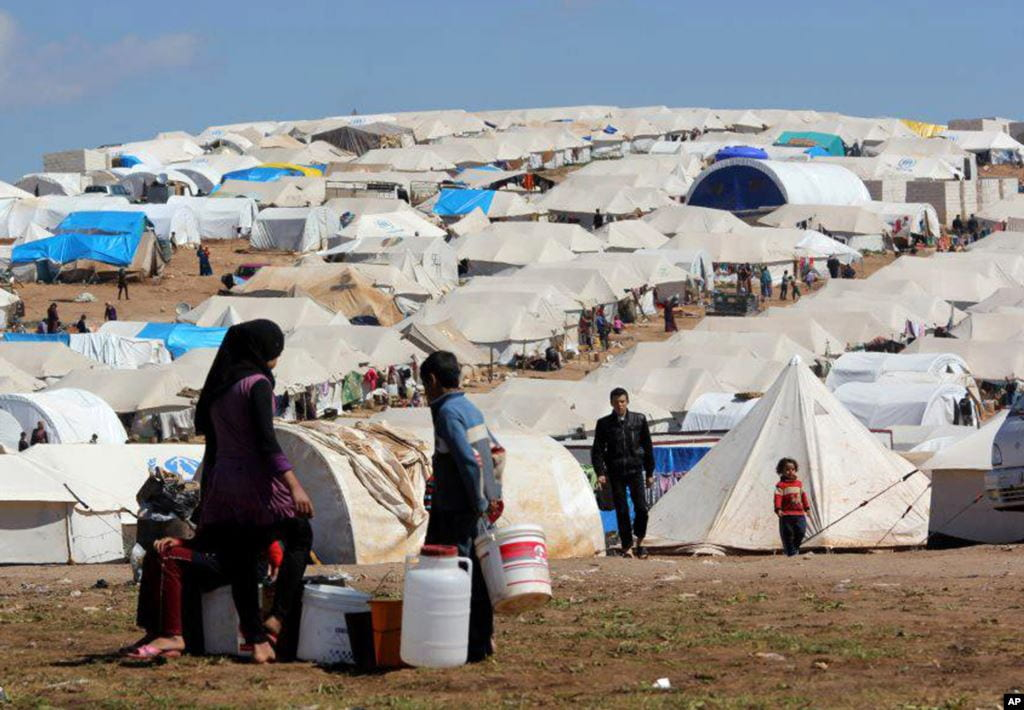
While we concern ourselves with the relatively small number of refugees arriving on the south coast, it is worth looking at the worldwide situation. With war zones in the Middle East, Sudan and Myanmar, not to mention Ukraine, the number of displaced persons has mushroomed in the last year. Ten million Sudanese have been displaced, 2 million to another country, 4.5 million Yemenis are internally displaced, while in Gaza 90% of the population and in Lebanon 1 million out of 5 ½ have had to move under Israeli attack, in some cases many times. In the larger Palestine, plus Jordan, Lebanon and Syria, there are 58 recognised camps housing 1.5 million refugees (1 in 3 of all Palestinians, some dating back to 1948. The UN authorities in the area (UNRWA and UNIFIL) have pointed out that many of the displaced inhabitants may well choose to head for Europe, adding to the pressure on countries there.

In Myanmar, not only  those under threat from the military, but also many Rohingya have left the country, about 1.3 million, mostly to Bangladesh.

AH

Rwanda bill passes


Government succeeds in getting the Rwanda bill passed

April 2024

After what has seemed like a lifetime, the government has finally succeeded today, 23 April 2024, in getting its bill through both houses of parliament. The first flights are due to take off in 10 – 12 weeks that is in July. The airfield is as yet unknown but there is a possibility they will use Boscombe Down near Salisbury again as it is a military airfield surrounded by a high fence. There are some rumours to that effect.

Questions now are whether legal challenges will stand in the way. The government has declared Rwanda to be a safe country despite the evidence to the contrary. We do not know what the reaction of the European court will be. A robust challenge by them will renew calls by some politicians for us to depart from its jurisdiction.

This feels like a pivotal moment. Months have been spent on this problem and no doubt considerable civil service time has been spent on it as well. The cost has been considerable and the government has been reluctant to reveal the figures. An estimate is £370m with another £120m to come. There will be further sums for each asylum seeker despatched. There will be other administration and transport costs as well. The cost per person are difficult to estimate because it does depend on the numbers sent since some costs are fixed. As we move into what might be termed the ‘delivery’ phase of this project, issues of whether civil servants will be comfortable with the work they have to do and the response of the ECtHR are awaited.

The main purpose of the policy is to act as a deterrent. It is hoped – expected even – that news of the departures to Rwanda will deter those seeking to cross the Channel and seriously damage the business model of the smugglers. Whether this happens remains to be seen but with no end to wars and political instability in the world and the ease with which boats and outboard motors can be acquired from Turkey, suggests that this is a low risk, high reward activity unlikely to be deterred by a small percentage being sent to Rwanda.

Both local MPs, John Glen and Danny Kruger, voted for the bill.

Refugee report


April 2024

This month, the report starts with the EU. The Freedom United charity note that so far this year more than 200 people have died trying to leave Libya, many shot by the Libyan Coast Guard. The EU continues to help fund the LCG, and the Institute of Migration say that 600,000 people are trapped in Libya seeking to get to Europe. Needless to say, there are many allegations of breaking international law in this crisis.

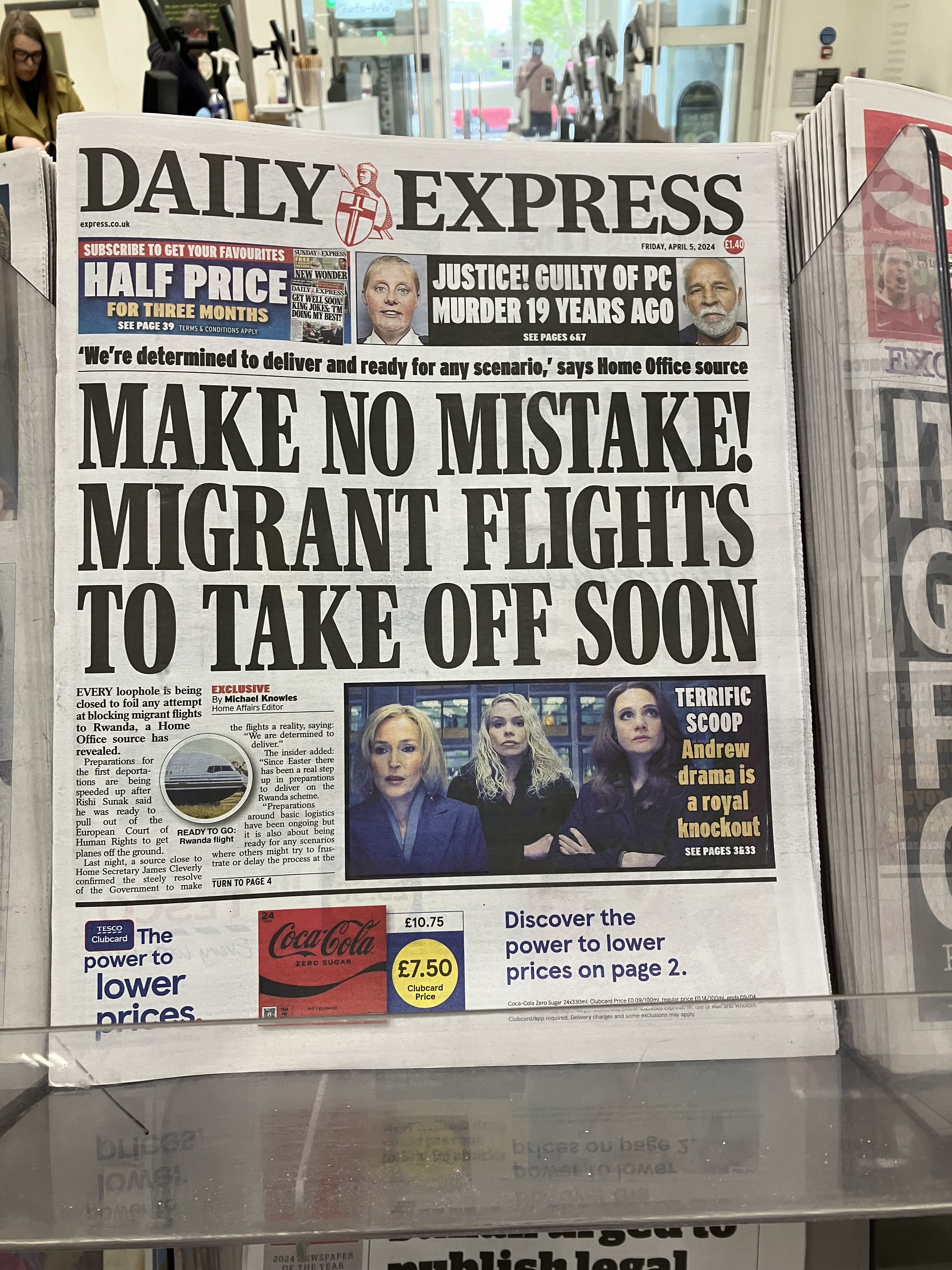
Also beyond the UK, the latest news from Rwanda is that, following the lack of progress in deportations, 70% of the properties allocated to receive deportees have now been sold to local buyers. On this topic, the Rwanda Bill returns next week for more ping pong – it could yet go for the Royal Assent within a few weeks. Judges are being given “special training” to ensure speedy delivery of those to be deported to Rwanda, according to the Daily Express. The airline Air Tanker is reported to be in discussions with the government about providing the transport, although they withdrew from previous similar discussions. RwandAir has already declined for fear of reputational damage.

The Prime Minister has claimed that 24,000 irregular migrants were deported last year. Full Fact have checked this and argue that only about 25% were enforced returns, the rest being voluntary. The number of arrivals in small boats this year stands at 4,644 at the end of March – bad weather has reduced the number in the last few days, but the figure is still higher than last year.

Charities and law firms have sent a letter to the Home Secretary seeking a Ukraine-style visa scheme for Palestinians who have family in the UK. The Home Office has also refused to decide on whether to drop the need for biometric data for reuniting family

arrivals from Gaza, although obtaining such data is virtually impossible in the crisis; the Upper Tribunal ruled against the Home Office in two test cases.

In their annual report, the Office of the Immigration Services Commissioner note that the number of immigration advisers at the Home Office is growing, but not fast enough to keep up (and large numbers are leaving).

Finally, back to Europe, where the European Parliament has passed the Pact on Migration and Asylum today (Wednesday 10 April) against votes from the extreme right and extreme left. The 10 provisions of the pact cover issues like relocating from over-immigrated countries, financial allocation, fast-track routes and exchange of data.

A group of 22 NGOs has issued a statement arguing that “while the adoption … is likely to lead to a detrimental degradation of people’s access to protection in Europe, the new Union Resettlement Framework (URF) adopted alongside the Pact offers a glimmer of hope.

“The URF signals the EU’s political support for global resettlement efforts and has the potential to be a step towards advancing solidarity, capacity-building and responsibility sharing. It must now be operationalised effectively to ensure that more people reach safety and find long-term solutions,” the groups, which include the International Rescue Committee and Oxfam, said.

Andrew Hemming

Refugee report


Many of the boat people are from Afghanistan

August 2023

The tragic events in the English Channel this week have served to draw attention to the fact that most of the asylum seekers affected by the disaster were from Afghanistan. This might invite the question: “But I thought that Afghans were the one group for whom official arrangements to come here had been made?” Indeed, there are two official processes by which Afghans can come to this country to escape persecution. One is the Afghan Relocation and Assistance Policy, designed to help those who had been involved with the UK administration pre-Taliban, and several thousand have arrived through this route. Asylum seekers arriving now may have worked with the British and been left behind or not, but clearly most feel threatened by any connection they may have had with the old regime. The Afghan Citizen Resettlement Scheme (ACRS) was designed for such cases.

So how has the ACRS been performing? A new report by the Refugee Council gives a gloomy assessment. The plan was to take 5,000 refugees in the first year and 20,000 in total. So far, 54 Afghans have arrived under ACRS; many are waiting in Pakistan for arrangements to be made to bring them over. Accommodation in the UK is not available however and, as the report notes, those 9,000 Afghans currently being accommodated in hotels here will be ejected at the end of the month to find their own places or become homeless.

Afghans arriving via the Channel will be sent back

Hence the large number of Afghans arriving on small boats. In the last year 8,429 have come by this route, of whom 96 have been given leave to stay. Of course, under the new Illegal Migration Act, none will be given that right and will in theory be returned to Afghanistan or a third country like Rwanda.

The report goes on to note that no method has been established to help reunite the families of asylum seekers with those who are here, despite assurances  from the government.

The Guardian has published an article by the Council’s chief executive, Enver Solomon, which gives more detail.

UPDATE: Shortly after posting this, the BBC Radio 4 programme ‘World at One’ devoted a lengthy package to this item.

AH

Rwanda: the morality question


How moral is the plan to deport asylum seekers to Rwanda?

July 2023

The wish by the government to deport asylum seekers and refugees to Rwanda has consumed considerable political capital and is a topic rarely out of the news. It is the flip side of the problem of people arriving by small boats across the Channel which causes so much fury in sections of the media. The extreme difficulty in applying for asylum from outside the UK is only occasionally mentioned. Legal routes have all but been closed off forcing those seeking asylum to engage in perilous journeys. According to ex prime minister Boris Johnson however, writing for the Daily Mail in his new job, said there are ‘numerous safe and legal routes for people to come to Britain’. His argument is that once word gets round the ‘camp fires’ of northern France that there is a chance of being sent to Rwanda, the business model of the smugglers will be broken (We must take radical action to get Rwanda done!) 30 June*.

This raises a moral question which is that the idea of deportation and treating them badly is to use people as a matter of policy. It is using deportation as a kind of punishment for a class of people no matter what the legitimacy of their claim might be. It is also logically unsound since it will be the refugees who will suffer and end up in Rwanda, not the people smugglers. The likelihood of the policy deterring the smugglers has been challenged recently in an impact assessment report which notes that the Home Office had little evidence to show that it might work. Academics say that it is issue of culture, kinship and language which are important factors and changing the rules has little effect.

Stopping the boats – assuming that to be possible – does not stop the problem. War, persecution, climate and poverty are among the factors which force people to leave their homes and embark on long, perilous journeys to seek asylum.

It has been pointed out that Rwanda is not the best of countries as far as human rights are concerned. There is little freedom of expression. Journalists are harassed and intimidated and opposition leaders find it hard to make headway. Bloggers and lawyers are intimidated and sometimes unlawfully detained. What has not been commented on however is that the deportation policy crucially depends on Rwanda being a safe place for us to send refugees and it will be extremely difficult for the UK government to stop the deportations if evidence of mistreatment by police or security forces in Rwanda subsequently emerges. It will also be difficult and embarrassing for the government to criticise President Kagame for any infringements of evidence of bad treatment. Having invested so much political capital in the policy, to admit the country is not in fact safe will be extremely awkward.

Refugees will find it hard to settle in the country as did those who went their as part of the – now abandoned – Israeli scheme. Perhaps the enthusiasm for the schemes owes something to several Australians who act in advisory roles in Downing Street. The Australians sent their asylum seekers to islands in the Pacific in a much criticised scheme.

Public attitudes toward refugees seems slowly to be changing and a recent IPSOS poll showed the UK to have one of the most positive attitudes towards immigrants at 56%. The numbers wanting our borders closed totally has declined. 54% wanted immigrants to stay. This despite the relentless rhetoric in the tabloid press.

Government attitudes seem to have hardened by contrast and ‘stopping the boats’ is one of the prime minister’s five pledges. In the i newspaper on Saturday (2 July) there was speculation that the government is considering leaving the European Court of Human Rights to enable it to overcome the courts’ objections to the deportations.

In all the commentary, the political jousting in the Commons and the seemingly relentless articles in the media, the moral argument seems seldom to emerge. The boat people are treated as though they are almost criminal and there is even an attempt to besmirch the RNLI for rescuing them in the Channel: RNLI a Migrant taxi service claims the Daily Mail (1 July*). Deportation is to be used as an instrument of deterrence.

Some indeed might be economic migrants and not ‘real’ asylum seekers. But a large proportion are desperate people fleeing desperate circumstances and need our help. We have a moral and legal obligation to hear their appeals. It is a great shame that the voices of intolerance have such salience in our media and in some members of the government.

*Articles accessed 3 July

Rwanda flights ‘unlawful’


High Court rules flights to Rwanda unlawful

June 2023

The High Court has today (29 June) ruled by a majority, that the planned flights to Rwanda are not legal. This has been a key element of the government’s policy and the first flights due to go out in June last year from Boscombe Down near Salisbury, were halted at the last minute following a ruling by the European Court deciding it breached article 3 rights against torture and bad treatment.

The case hinged on whether it is safe for asylum seekers and others to be sent to this African country. Both UNHCR and Amnesty International have expressed doubts and concerns about what life is like and the safety of those sent there. In its 22/23 report Amnesty had concerns about the asylum process procedure, the risks of detention and deportation, discrimination against members of the LGBTIQ+ community and inadequate legal representation.

Plane waiting at Boscombe Down airfield in June 2022 but which left empty. Photo: Salisbury Amnesty

There is limited freedom of expression, bloggers and journalists are harassed, persecuted, intimidated and sometimes unlawfully detained. Although the country has made promises to improve as part of the deal with the Home Office, serious doubts remain about how genuine these might be.

A report last week noted that the costs of sending individuals to Rwanda were excessive at around £170,000 per person and they also doubted the deterrent effects of the policy – a key element behind why the government wishes to do it. Altogether, the government’s policies on immigration and asylum are looking threadbare. They plan to appeal the decision. Both the prime minister and Suella Braverman have been critical of it.

Sources: BBC; UNHCR; Daily Mail, Guardian

Conservative immigration policies ‘morally wrong’


While the somewhat absurd leaks from the Home Office about wave machines in the Channel, using redundant ferries as holding centres, or sending refugees to Moldova, Morocco – or at enormous cost even to Ascension Island, 4000 miles away – may not be true, these stories do at least give an indication of the mindset of the authorities charged with dealing with a continuing flow of migrants across the Channel to this country.  It seems likely that these proposals were put out to cause alarm, so that when real ones come out, they will be regarded as relatively mild.

Use of the Navy has also been touted: Steve Valdez-Symonds, Amnesty International UK’s Refugee and Migrant Rights Programme Director, said:

Deploying the Navy to prevent people exercising their right to seek asylum in the UK would be unlawful, reckless and dangerous.  It is wholly legitimate for people to seek asylum in this country – even though relatively few people do – and sadly, for some, these dangerous journeys are the only means available.

Meanwhile, the senior civil servant at the Home Office has stated that “all options are on the table.”  This suggests that either (a) they don’t have a clue what to do or (b) all options are equally valid, so they don’t care.  Ms Patel’s speech to the Conservative Party conference today [4 October 2020] will give a sense of her ideas, but she starts from the assumption that the system is “broken”; it may be that her proposals will take some time to emerge.

The government are believed to be keen to follow the methods employed by recent Australian governments in keeping prospective immigrants in offshore holding camps.  But, as Andonea Jon Dickson explains, “a main function of [the Australian] Operation Sovereign Borders is the interception of boats at sea and their forced return to offshore immigration or their origin.  This conflicts with the Refugee Convention (1951) and Protocol (1967) in a number of ways, not least by denying a right to asylum.

The UK has been removing asylum seekers to France this year as part of a European Union policy that allows one member state to return asylum seekers to another.  When the UK leaves the EU on December 31, however, this policy will no longer apply.  There is nothing yet to suggest France would be willing to continue to accept these asylum seekers.  Lawyers have also recently exposed how the UK has been removing asylum seekers to France illegally without providing an asylum procedure.”

While there are distinctions to be made between refugees, asylum seekers and economic migrants (in terms of the threats they face at home), to the general public they will be seen as one group, dangerous or benign according to taste (and, according to a recent YouGov poll 49% of people here have admitted they have little or no sympathy for those crossing the Channel on dangerous boats).

Once again, an inconvenience has been turned into an existential threat.  In 2019, the average rate of asylum applications in the EU was 14 per 100,000 residents.  In the UK it was 5 per 100,000.  So, although, for example, the universality of the English language is a ‘pull factor’ for migrants, it isn’t that significant, and most migrants have a clear view of where it is best for them to aim for.

Dan O’Mahoney, the preposterously titled ‘Clandestine Channel Threat Commander’ – whose job is to work on “legislative, legal and operational barriers” to migrants – said Border Force is continuing to “crack down on the criminal gangs responsible”.  The total number of migrants crossing the Channel this year is around 7,000 so far (it is reckoned that 84,000 attempts to enter were made in 2015), so the crisis may not be quite as great as suggested.  In any case, putting the blame on the traffickers as procurers is pointless – they may be heartless, but they are not the cause.

Ms Patel may be playing to her gallery, or she may genuinely dislike enterprising Third World migrants, but inhumane policies cannot just be defended on political grounds, as they have a moral context.

Ian Dunt, of politics.co.uk makes the point: 

These proposals are unkind.  They are morally wrong, regardless of their efficacy or legality.  They lack compassion, a basic ethical temperament which it is not fashionable to talk about but forms a fundamental requirement of government decision-making.  2 October 2020

Amnesty International has been working for many years with other organisations, nationally and internationally, in the fields of refugees and asylum seekers.  We campaign for a world where human rights can be enjoyed by everyone, no matter what situation they are in. Amnesty has championed the human rights of refugees, asylum-seekers and migrants for decades.  We campaign to make sure governments honour their shared responsibility to protect the rights of refugees, asylum-seekers and migrants.  We condemn any policies and practices that undermine the rights of people on the move.

Detention Action


We have added Detention Action to our links at the bottom of this site.  The organisation campaigns against the harsh detention regime operated in the UK which deprives people of their liberty often without reason at considerable cost to the Exchequer.

Blog at WordPress.com.

Up ↑