Vigil 32


July 2024

Vigil continues but with a little more aggression shown

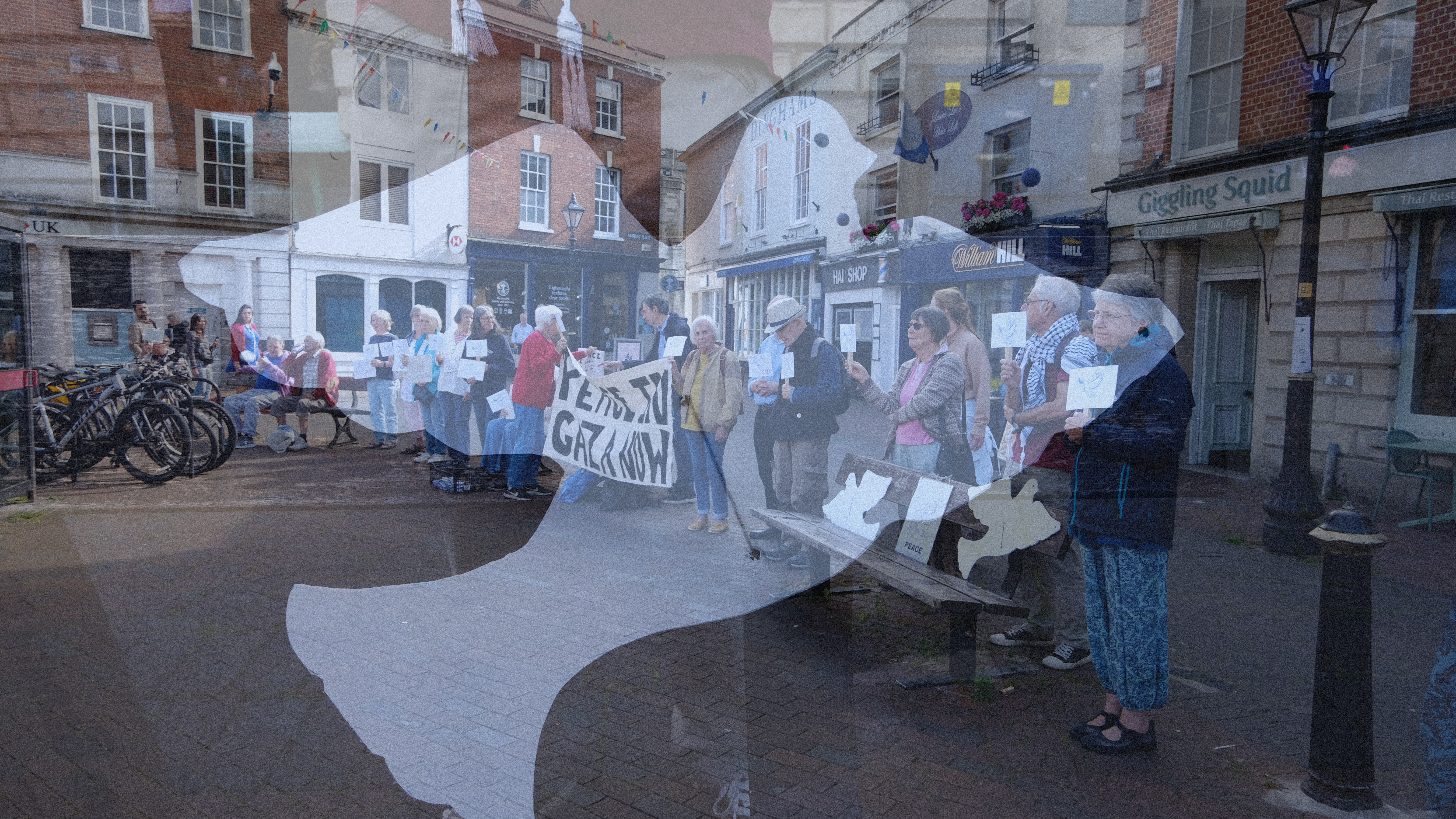
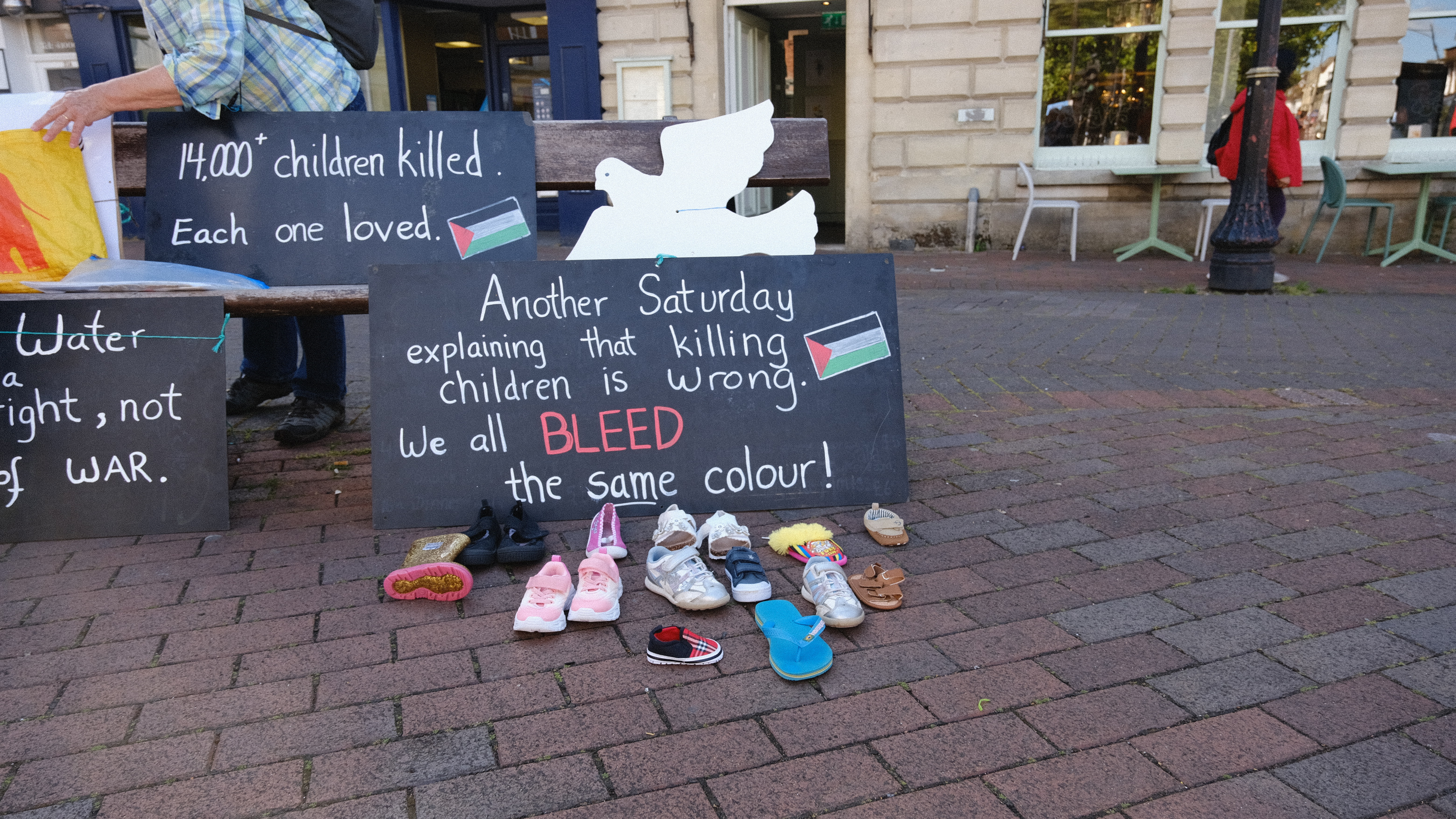
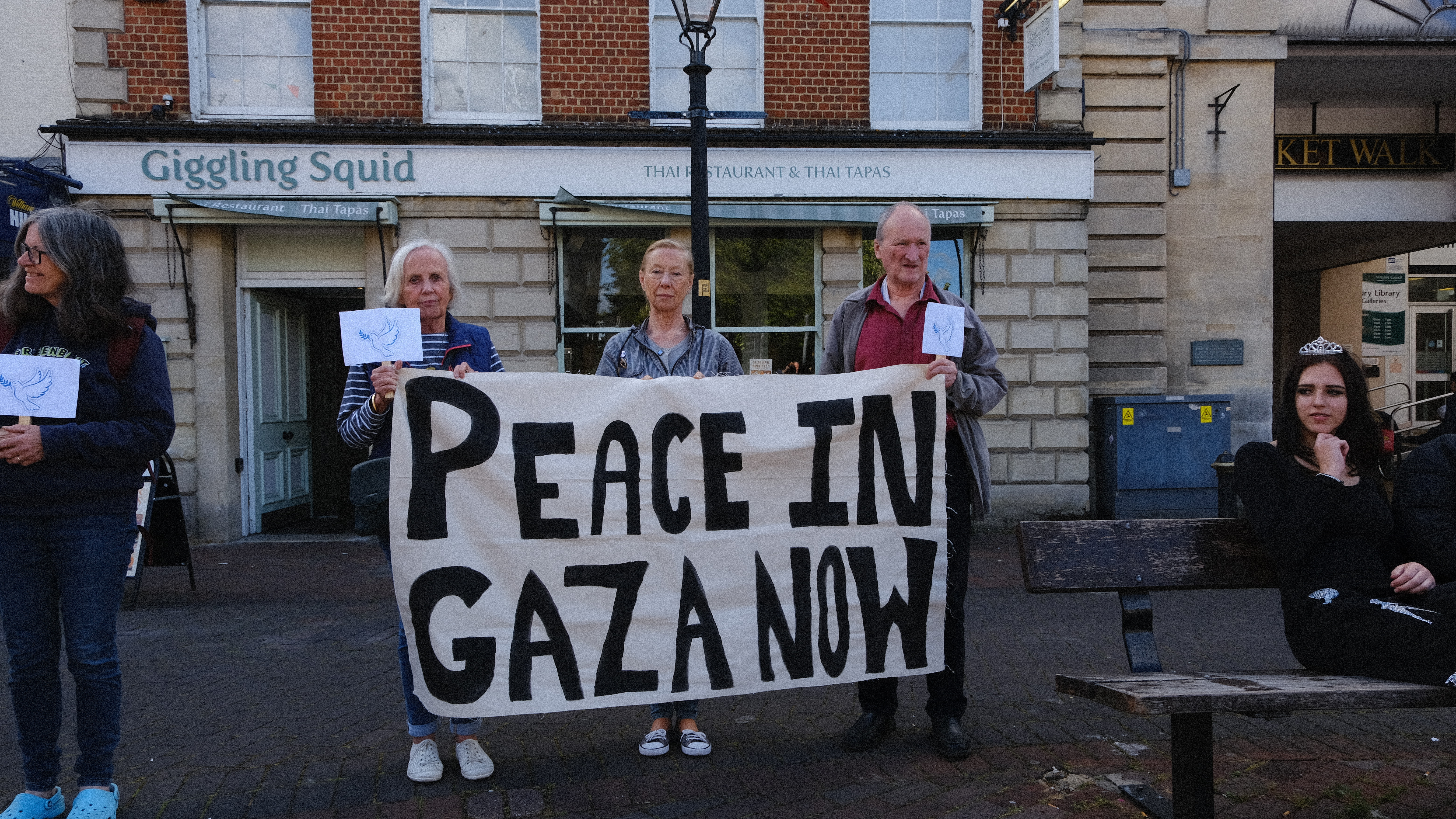
We are still carrying on with the Vigil each Saturday and the numbers were back up over 30. This time we had a little aggression towards us with one man claiming that Palestinians were terrorists. A second man kept up a prolonged and loudly delivered series of arguments which included the question why do/did we not hold similar vigils for other conflicts such as Iraq? He disputed the Lancet figures of 186,000 dead although it was not clear that he had read the report (it was found for him).

We shall be back next Saturday at 5pm as usual for half an hour.

Pic: Salisbury Amnesty

Impactful Lancet Study: Up to 186,000 Dead in Gaza, alarming Figures


Study by the Lancet estimates as many as 186,000 dead in Gaza.

July 2024

The figures previously quoted by many (and reproduced on this site) are of just under 38,000 dead in Gaza. The figures are produced by the Gaza Health Ministry and the way they are reported by British media implies that they are not necessarily true and may be exaggerated. It now appears from this study that they are far from being exaggerated and are a considerable underestimate and that the true figure may be an astonishing, not to say shocking 186,000. Claims that the figures are ‘fabricated’ are implausible and are accepted by the UN, WHO and the Israeli intelligence services.

The Lancet study explains in detail the problems in producing a reliable figure in a war zone. The previous data came from hospitals but with almost all of them destroyed this is no longer reliable. Thousands remain buried in the rubble of destroyed buildings and others are dying for want of medical attention or starvation. About the only agency able to deliver aid is UNWRA and they have been subject to considerable restrictions.

These figures have intensified calls on the (new) government to stop further aid going to Israel. Private Eye (No: 1627 p41) reports the closeness between the (previous) government and the Israel arms firms Elbit which has plants in the UK. They reveal undisclosed meetings between Professor Julia Sutcliffe, appointed by Kemi Badenoch, and the firm in an attempt to encourage them to invest £100m in the UK. The article ends by saying “The enthusiasm of the UK government departments for Elbit not only raises ethical issues – Elbit’s chief executive told investors it was “very much involved” in Gaza and was going to build weapons with “lessons learned from the war” – but also puts extra pressure on the UK not to limit arms exports to Israel of arms purchases from it”. The firm has previously been quoted as saying that drones built in the UK are not being used in Gaza.

Sources: The Lancet, al Jazeera, Private Eye

Vigils continue


31st Vigil on 6 July. Labour’s relations with Israel now significant following the general election

July 2024

UPDATE 2: The new government has announced (8 July) that it is to drop its bid to delay the ICC’s intention to issue an arrest warrant for Netanyahu for alleged war crimes in Gaza.

UPDATE: It is rare for us to update a post only hours after its publication but we have mentioned the prime minister’s uncertain history in relation to Israel and today, 7 July, he has made a statement committing his party, and now the government, in support of a two state solution. This is to be welcomed.

The vigils continue in Salisbury market place although attendance down to around 25. The conflict continues and although there are reports of peace talks, there is little confidence they will lead to a successful result. Around 38,000 Palestinians have now died including thousands of children.

The conflict spilled into the General Election which was held in the UK last week on 4 July and led to a landslide victory for the Labour party. However some seats were lost and others came close to being lost because of Sir Keir Starmer’s remark early in the election where he said that “Israel has the right to withhold power and water from the Palestinian people” then going on to say that “obviously, everything should be done within International law”. The problem is that collective action against civilians is against international law so the two comments contradict each other. Another, less noticed interview was with the Jewish Chronicle where Starmer was asked about apartheid in Israel and, despite the overwhelming evidence produced by a number of human rights organisations from both within Israel and outside the country that Israel was indeed running an apartheid system, said that Israel was not an apartheid state.

Arms to Israel

It is going to be interesting to see how the new administration handles the arms question and whether it allows further exports going to Israel. The problem for the party is that they struggled for some time to shake off the ‘anti-Semitic’ accusation following Jeremy Corbin’s time as leader. Arguably, this has led them to become fearful of making any criticism of Israeli actions and to become unquestioning supporters.

The Salisbury Amnesty group is 50 this year

Another problem for Israel – and by extension the western countries still continuing to support it – are credible reports of the widespread use of torture by the Israelis. These reports are from the UN; the International Center for Transition Justice; Middle East Monitor; Voice of America; al Jazeera and many others. In the current edition of Private Eye (No: 1627) in its ‘Gaza Watch’ column, is a report of the death in custody of Dr Iyad al-Rantisi in November last year. He was held in a Shin Bet interrogation facility. He was moving south with his family as directed by the IDF and was detained at a checkpoint. Six days later he was dead. A gag order forbade all publication of details of the case and the family have not been provided with an explanation.

He was not alone and a large number of other health care workers have also died. According to Health Care Workers Watch Palestine, 541 such workers have died at the hands of IDF to date, the highest number in any conflict in UN history. Other agencies report comparable numbers. Private Eye also quotes the EU’s European Civil Protection and Humanitarian Operations directorate which reports that 31 out of 36 hospitals in Gaza have been destroyed.

The next vigil will take place on Saturday 13th at 5pm and people concerned about the conflict are welcome to come along.

Protests

It’s perhaps also interesting to note that our protest is entirely silent and there are no loud-hailers. We undertake no violent actions and we do not chain ourselves to railings or other similar activities. We do not therefore infringe the previous government’s laws designed to limit protest. As a result we are ignored and we will not be reported on by local media. A matter on which to reflect for those who say they do not mind protests as long as they’re peaceful.

1720887540

  days

  hours  minutes  seconds

until

Salisbury Vigil

Palestine Action centre of the news


115th vigil took place following a momentous week in the courts February 2026 We discussed in a previous post the High Court’s decision that the government’s decision to ban Palestine Action was disproportionate. The ban on them has not been lifted as the government seemed determined to appeal and some experts say the Appeal Court…

Minutes and Newsletter


February 2026 We attach the group’s minutes of its February meeting thanks to group member Lesley for the work in compiling them and for other members Fiona and Andrew for their contributions. We do not produce a newsletter so these minutes, although longer than normally the case with minutes, contain items of wider interest. Human…

Palestine Action ban lifted: for now


High Court finds the ban on Palestine Action ‘disproportionate’ February 2026 The High Court has ruled that the ban on Palestine Action is disproportionate and banning it unlawful. The ban remains in place however as the government is minded to appeal the decision which will take place later this month. The decision is a major…

Vigil #30


Thirtieth vigil took place still with strong attendance

July 2024

It seems remarkable that after eight months, the peace vigil in Salisbury market place is still going strong. Another perspective is why should it be necessary but with little sign of an end to the destruction there is a strong desire for it to continue. About 30 attended on Saturday 29th June and we are pleased to attach a short YouTube video produced by Peter Gloyn.

Video

1720281600

  days

  hours  minutes  seconds

until

Vigil

Vigil #29


Encouraging numbers attended the Vigil

June 2024

Over 40 attended the Vigil this Saturday evening (22nd June) and encouragingly, the numbers swelled with new passers by stopping and spending time with us. This is especially encouraging since a lot of reporting is now focused on the general election and news of Gaza has dropped down the running order or has disappeared altogether. Approaching 37,000 have died in Gaza during the conflict and it shows little sign of ending.

We are pleased to include a video clip of this Vigil made by Peter Gloyn.

During the week, power in the West Bank passed from the IDF to the far-right politician Bezalel Smotrich in a move likely to cause more misery. There will be few controls on settler violence and further annexations have already started. Smotrich and his supporters are now in control of the West Bank and the violence against Palestinians is certain to increase thus further increasing tensions.

Previous post: UK selling arms to Israel

Picture: Salisbury Amnesty

1719676800

  days

  hours  minutes  seconds

until

Vigil #30

Vigil – 6 months


June 2024

Group members attended the Vigil in Salisbury Market Place yesterday and the numbers were back up to well over 30 who came. There were new faces as well as the stalwarts. It’s six months since we have been going to these and the violence in Gaza and the West Bank shows no sign of abating. Peace talks don’t look as though they are going anywhere. The US and President Biden are looking increasingly powerless as time goes by.

The Salisbury group was established 50 years ago this year

Arms to Israel


UK continues to issue arms licences to Israel

June 2024

The conflict in Gaza continues and 36,700 Palestinians have died and well over 80,000 have been injured many seriously. In the last four months alone, 12,300 children have been killed. The death toll inflicted on Gaza is out of all proportion to the atrocity committed by Hamas on October 7, 2023. The International Court of Justice (ICJ) has found that there is a plausible case for Israel’s actions in Gaza amount to genocide. The response by the deputy foreign secretary Andrew Mitchell is to say that ‘the ICJ does not have jurisdiction [over Israel]’ (source, Government briefing, UK Arms Exports to Israel,’ May 2024). Lord Cameron, the foreign secretary, is quoted as saying that Israel ‘is committed to complying with International Humanitarian Law’ and hence did not recommend that licences be suspended. Today, 12 June 2024, the UN has issued two reports accusing both Israel and Hamas of committing war crimes and crimes against humanity including the use of torture.

Meanwhile, over 100 licences for arms have been issued to Israel since October 7, 2023. Quite what is licensed is difficult to discern. Eight are ‘open’ licences and the statistics do not give the value of the exports. In 2022, the value of arms exports to Israel amounted to £42m. The UK is not a major supplier and the US sends around ten times as much including fighters and artillery.

The ICJ action raises serious questions for the government which may well be different after July 4th. Essentially, governments continuing to arm Israel risk being complicit in genocide which is a specific crime under the convention.

Amnesty, Human Rights Watch and a Palestinian human rights organisation al-Haq, have joined a legal action by Global Legal Action Network for a judicial review. The position of the Labour Party (who may be in government soon) is unclear but the party has had a difficult relationship with Israel and has had to weather many accusations of antisemitism which it is keen to dispel.

There are signs of movement and in March, over 100 MPs and a number of Peers signed an open letter to the government calling for and end of arm sales to Israel. Lord Cameron has been critical of them commenting on the blocking of aid and turning away entire lorries on spurious grounds such as shipments containing ‘dual use’ items (medical scissors).

The question is largely a moral one. Should we continue to supply arms to a state which is causing such damage, bombing entire blocks of apartments, almost destroyed all hospitals and killed so many men, women and children? By not allowing journalists entry, objective assessments of Israeli claims of targeting Hamas fighters is hard to verify and we simply have to rely on IDF statements.

However, the conflict shows no signs of coming to a satisfactory conclusion. A hard-line Israeli government – which has become even more so after the recent resignation of Benny Grantz – is determined to see the complete extinction of Hamas, an objective almost impossible to achieve. The violence in Gaza will be breeding the next generation Hamas fighters. Violence on the West Bank has grown markedly worse. A two-state solution looks impossible to achieve. The continued supply of weapons principally by the US but also by the UK, is simple adding fuel to the fire. More important perhaps than the actual supply of military materiel, is the implicit support that the the licences give to the Israeli government, a government which is disinclined to end the violence.

Sources: CAAT, Guardian, Amnesty,

Celebrate protest


Amnesty webinar on the state of protest in Europe

May 2024

It seems that the UK is not alone in its attempts to stifle protest and passing laws to restrict individual’s abilities to protest. Recent tensions with ministers and some of their media supporters concerned Extinction Rebellion, Rwanda and the related issue of the boat people and more recently, the events in Gaza and the treatment of the Palestinians. Amnesty International recently hosted a webinar to look at the issue of protest and some of the points made are discussed below.

Protest has a curious position in British culture and law since there is no direst right to protest: it is not a specific human right. There is a right to free speech and a right of assembly and these combine to enable people to come together to protest.

The value of protest is something that seems to be forgotten. The anger at the noise of disruption of a protest march overshadows the fact that this is a means to enable people to highlight a cause of concern. There are some who complain about the disruption and who say that they would not mind a peaceful protest, it’s the noisy and disruptive ones they object to. The problem with a peaceful and noiseless protest which causes no disruption is that no one takes any notice. Many people report that visiting one’s MP or writing letters to them is largely a waste of time. It is also forgotten that nearly all social reforms in the UK have come as a result of protest, some lasting decades. The positive history of protest is not generally known or recognised. It is seen as a nuisance and something to be curtailed or even better, stopped.

Webinar

The results of the survey will be published on July 9th and it will show some regional trends which include casting protest as a threat, claiming it is a privilege rather than a right and the increasing use of supposed public safety measures to curtail them. They conclude it is generally getting worse with a heavy police presence used to intimidate. Complaints against the police and the use of excessive force are difficult because of the lack of identification.

A lot depends on language and protestors are frequently described as ‘rioters’ with no justification. There are also attempts to cast protestors as ‘illegitimate’.

One speaker from Clidef – with a focus on climate protest – spoke about the ‘pincer movement’. This includes new legislation introduced by government together with the stretching of old laws. Police action and powers have been strengthened as already mentioned together with the greater use of prison sentences against alleged offenders: 138 Just Stop Oil protestors have been imprisoned for example. They are also trying to use conspiracy laws.

Secondly, private actors and the use of SLAPP actions [Strategic Litigations Against Public Protest] which are a means to use the law to intimidate those seeking to take action against wrongdoers. They are a means by the wealthy to use the law to silence critics since they can afford to effectively bankrupt them with costs.

Thirdly, the judiciary and he might have mentioned the legal system itself. Judges have been in the firing line for not allowing those on trial to say why they were protesting, fearful no doubt that once a jury realises that they were promoting a climate action, they would acquit. The final speaker asked ‘who are they protecting? The activists or the companies?’

The theme of the webinar and the speaker contributions was that governments are increasingly dumbing down on protest whether it be the climate, Palestine or anything else. They give the impression of not liking dissent in any form and are using increasingly draconian tactics to inhibit, arrest and imprison those to engage in it.

Media

A theme not explored was the role of the tabloid media who almost without fail demonise protestors calling them things like ‘eco-zealots’, ‘eco-mob’, ‘a rabble’, and their actions amounting to ‘mob rule’. Article after article describes protests in entirely negative terms and seldom give readers much (in fact next to nothing) in the way of an explanation of why they are protesting and the nature of their cause. It is to be presumed that they are reflecting public opinion and the views of their readers. Recent reports on the climate are extremely worrying. The fossil fuel companies are able to mount expensive lobbying campaigns to ensure their interests are looked after and extraction can continue. Protestors do not enjoy this privileged access to those in power and taking to the streets is the only way they can be heard. It is a shame that sections of the media are not able – or are disinclined – to reflect this imbalance of power and the inevitable effects it will bring to the climate.

Our right to protest is precious and should be defended.

The Salisbury group was established 50 years ago

“Amnesty a worthless sham”


Fierce criticism of Amnesty International by the editor at large of the Jewish Chronicle

April 2024

“Amnesty is an indecent, morally bankrupt sham that has nothing of value to contribute”. These are just two comments in a Times column under the ‘Thunderer’ heading in its edition of April 11th. After first saying that the organisation was once a remarkable one which campaigned on behalf of prisoners of conscience, today it has become “just another partisan NGO, with all the dreary hard-left obsessions – including the customary fixation on Israel”. There then follows a damning description of current prisoners of conscience saying that far from being law abiding citizens and writers, they were in fact dreadful terrorists who committed fearful crimes against Israeli men.

This site has referred, in several posts, to the system of Apartheid being operated in Israel against Palestinians. Many of the processes used in South Africa against the Blacks are present in the country and severely limit the movement and livelihoods of non Jewish citizens. Three detailed reports have been published: Human Rights Watch, Amnesty and B’Tselem an Israel based human rights organisation. The HRW report has received a detailed rebuttal essentially denying that Apartheid exists in any form.

The invasion of Gaza following the horrific attack by Hamas on 7 October has seen around 33,000 Palestinians killed, many of whom were women and children with thousands more buried in demolished buildings. The sympathy for Israel after the Hamas attack, has begun to dissipate following the actions of the IDF. As famine begins to set in, the blocking of aid trucks by one means or another has attracted criticism from international friends of Israel. The killing of 7 aid workers recently drew widespread criticism and renewed attention to how IDF were conducting the war in the territory.

It is not true to say that Amnesty is ‘fixated’ on Israel. It has campaigns on a wide range of issues around the world. It has argued that the root causes of the conflict in Israel and Gaza need to be addressed and has called on all parties to adhere to International Humanitarian law. Israel is by far the most sophisticated country in the area with massive resources courtesy of the USA, a powerful military and is a sophisticated society.

Stephen Pollard’s Times’ article verges on being a diatribe. It is of a piece with normal Israeli practice to demonise critics as being anti-Israel. While Israel continues its Apartheid actions in the West Bank, there is unlikely to be a satisfactory long-term peaceful solution. Using ‘dumb’ bombs to destroy entire blocks because there is (it is believed) a Hamas operative within it is not consistent with International law. Writing tirades against those who draw attention to Israeli failings are unlikely to succeed either. It is in contrast to a rather prescient article of his in the New Statesman six years ago in which he notes that the violent putting down of protests will lose the country empathy.

Refugee report


April 2024

This month, the report starts with the EU. The Freedom United charity note that so far this year more than 200 people have died trying to leave Libya, many shot by the Libyan Coast Guard. The EU continues to help fund the LCG, and the Institute of Migration say that 600,000 people are trapped in Libya seeking to get to Europe. Needless to say, there are many allegations of breaking international law in this crisis.

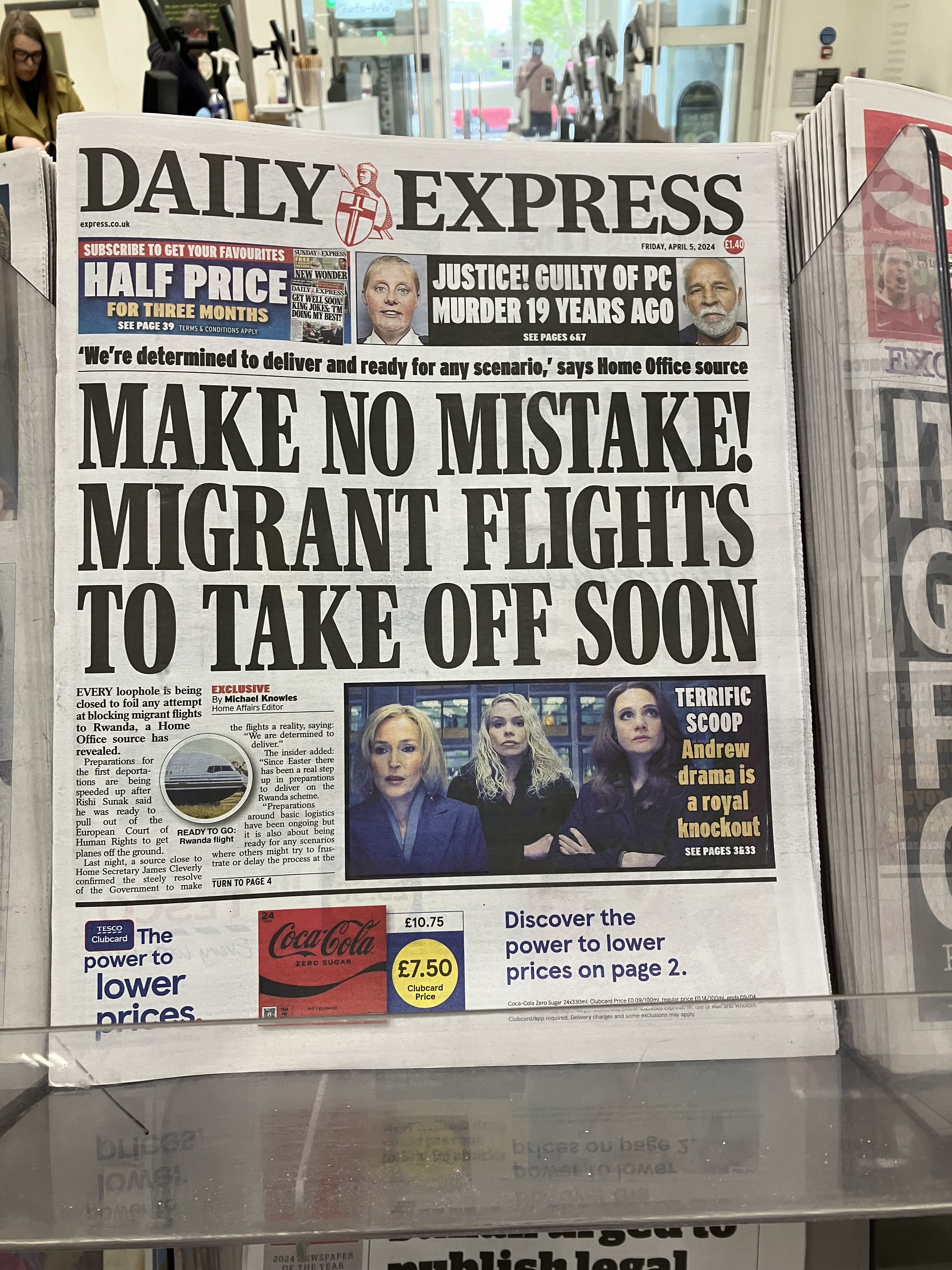
Also beyond the UK, the latest news from Rwanda is that, following the lack of progress in deportations, 70% of the properties allocated to receive deportees have now been sold to local buyers. On this topic, the Rwanda Bill returns next week for more ping pong – it could yet go for the Royal Assent within a few weeks. Judges are being given “special training” to ensure speedy delivery of those to be deported to Rwanda, according to the Daily Express. The airline Air Tanker is reported to be in discussions with the government about providing the transport, although they withdrew from previous similar discussions. RwandAir has already declined for fear of reputational damage.

The Prime Minister has claimed that 24,000 irregular migrants were deported last year. Full Fact have checked this and argue that only about 25% were enforced returns, the rest being voluntary. The number of arrivals in small boats this year stands at 4,644 at the end of March – bad weather has reduced the number in the last few days, but the figure is still higher than last year.

Charities and law firms have sent a letter to the Home Secretary seeking a Ukraine-style visa scheme for Palestinians who have family in the UK. The Home Office has also refused to decide on whether to drop the need for biometric data for reuniting family

arrivals from Gaza, although obtaining such data is virtually impossible in the crisis; the Upper Tribunal ruled against the Home Office in two test cases.

In their annual report, the Office of the Immigration Services Commissioner note that the number of immigration advisers at the Home Office is growing, but not fast enough to keep up (and large numbers are leaving).

Finally, back to Europe, where the European Parliament has passed the Pact on Migration and Asylum today (Wednesday 10 April) against votes from the extreme right and extreme left. The 10 provisions of the pact cover issues like relocating from over-immigrated countries, financial allocation, fast-track routes and exchange of data.

A group of 22 NGOs has issued a statement arguing that “while the adoption … is likely to lead to a detrimental degradation of people’s access to protection in Europe, the new Union Resettlement Framework (URF) adopted alongside the Pact offers a glimmer of hope.

“The URF signals the EU’s political support for global resettlement efforts and has the potential to be a step towards advancing solidarity, capacity-building and responsibility sharing. It must now be operationalised effectively to ensure that more people reach safety and find long-term solutions,” the groups, which include the International Rescue Committee and Oxfam, said.

Andrew Hemming

Blog at WordPress.com.

Up ↑