Further restrictions planned on protests


Home Secretary will aim to increase curbs on repeated protests

October 2025

Governments throughout history have disliked protests and demonstrations. Thousands of people marching through the streets of London loudly, or even peacefully, stating their grievance or demanding a right denied to them, has long been part of our national life. Indeed, Sir Ian Gilmour in his book Riot, Risings and Revolution* describes the very many such events which took place in eighteenth-century Britain. Such was the violence that parliament was sometimes unable to sit for fear of MPs being dragged from their carriages. It is important to remind ourselves of this because the impression is sometimes created by present day politicians and some media commentators that this is some kind of new phenomenon. They are disliked because they disturb the current order. They give voice to injustice.

As we have noted before, the current home secretary, Shabana Mahmoud, is a woman as were previous home secretaries viz. Yvette Cooper, Suella Braverman, Amber Rudd, Theresa May and Priti Patel. All have the vote, all were/are MPs and are, or were, in parliament. That this is so is as a result of prolonged protest over many decades. They became violent as a (male) parliament refused to allow female enfranchisement. We could list other protests: to allow non property owners get the vote, for safety in the factories, to stop impressment and many other causes. All have the same or similar causes: people who feel that a government is more interested in satisfying or appeasing the powerful and are not listening to the powerless. Arms companies for example, have no need to spend a Saturday marching through London streets risking arrest and blistered feet, they – or their lobbyists – have direct access to ministers and senior civil servants all too happy to accommodate their wishes.

Frequency the problem

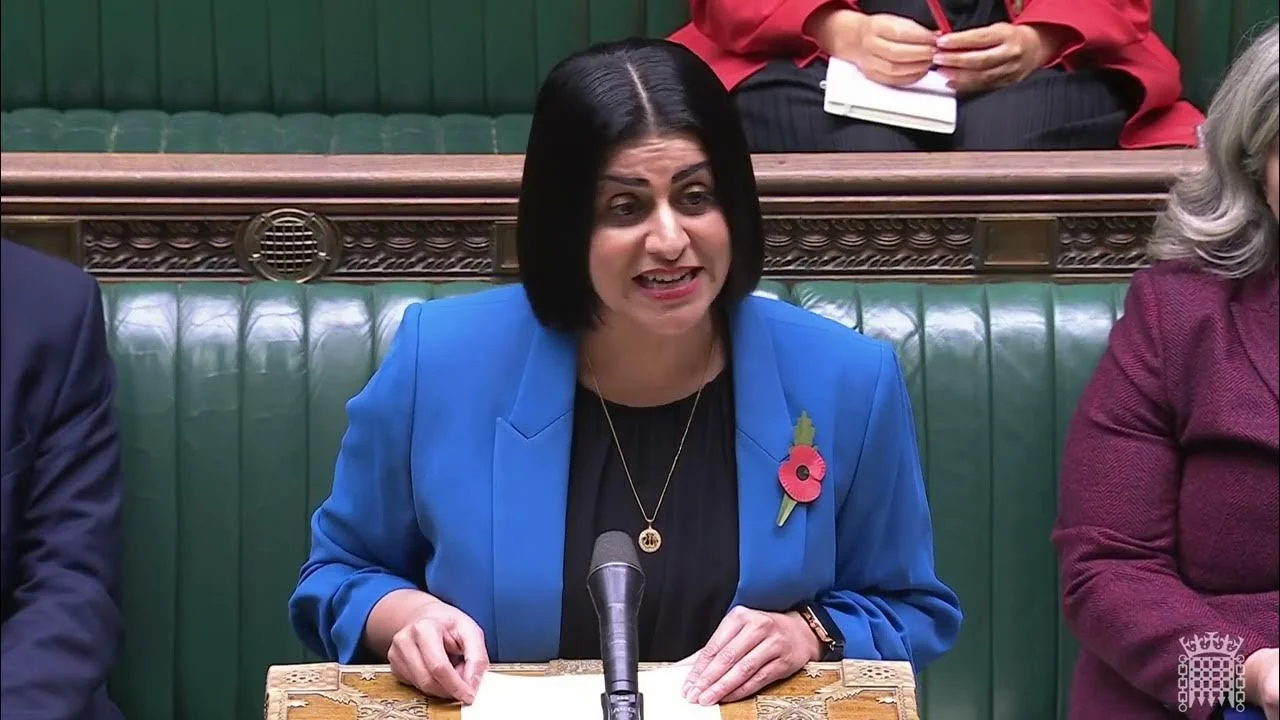
Mahmoud wants to get legislation passed to amend the Public Order Acts to clamp down on frequent protests. ‘Frequency of particular protests in particular places‘ she says ‘is in and of itself a reason for the police to be able to restrict and place conditions’. As a variety of civil rights organisations have pointed out, it is frequency which is the point. A single march or demonstration is unlikely to achieve anything much – the million or so who protested against the calamitous war in Iraq is an example.

She also claims, ludicrously, that they were ‘un-British’ and ‘dishonourable’. Clearly a minister who has only a slender grasp of British history.

There are a number of factors which seem to be at play here. The current ministerial statement came after the dreadful attack on a Synagogue in Greater Manchester. Marches were planned two days later on the Saturday in support of Palestine. There were many calls for the marches to be postponed. The organisers would not and went ahead with 488 arrested in Trafalgar Square. We can get a sense of the tensions at play in a Daily Telegraph article on 2 October Israel blames Starmer after synagogue terror attack which quoted without evidence, an Israeli source claiming the attack may have been ‘directed by Hamas’. Raphi Bloom is quoted in the Jewish Chronicle ‘that the community “will not forget the betrayal” over the UK recognising a Palestinian state, saying: “When you fail to act on constant calls to globalise the intifada, the results are that intifada came to our Manchester Jewish community with horrific consequences”.

It is clear that many people are upset and angry about the continued and wholly disproportionate killing and starvation which is taking place in Gaza. They are angry at the government continuing to allow Israel to be supplied with arms and the covert support by the RAF with their hundreds of overflights of Gaza. UK sales of arms to Israel reached a record high in June this year. They do not accept that there is a connection between the killing in Greater Manchester and Israel’s activities in Gaza and the West Bank. It can be argued that the Israeli government has perpetually conflated criticisms of its actions in Gaza and inaction in the West Bank as ‘anti-Semitic’ or ‘hatred of Israel’ and more recently as being ‘pro Hamas’.

The Home secretary’s plans to add to the legislation passed by the Conservatives is unnecessary and to quote an Amnesty director ‘ludicrous’. They may be part of a plan by government to look tough in the face of the increasing popularity of Reform and Nigel Farage. They represent a further step in increased authoritarian government and a desire to restrict protests generally.

*Pimlico (pub) 1992

Sources: Daily Telegraph, Jewish Chronicle, BBC (factcheck service), Sky News, Guardian, Wikipedia,

Numbers swell at vigil


Higher numbers still at 90th vigil in Salisbury

August 2025

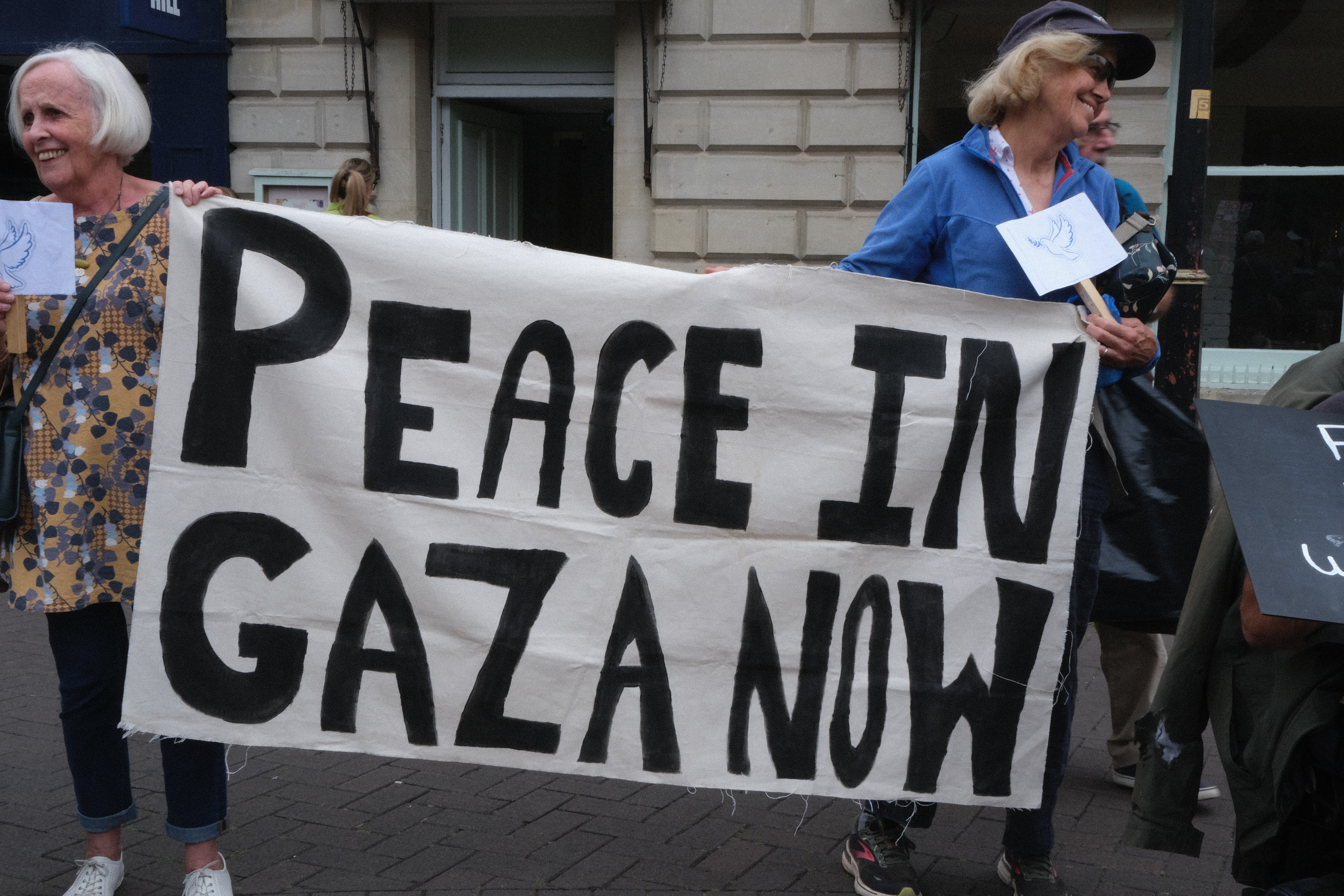
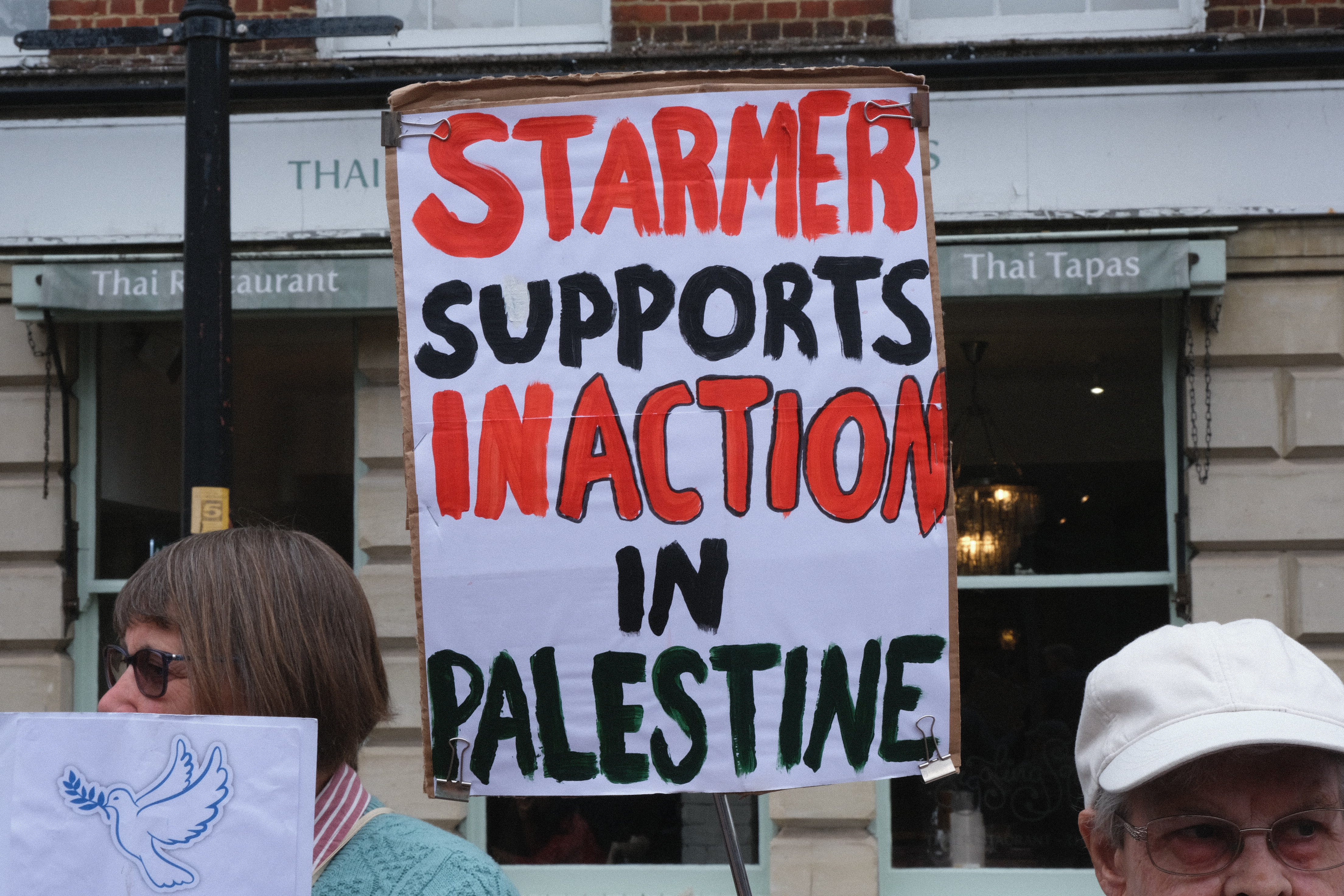
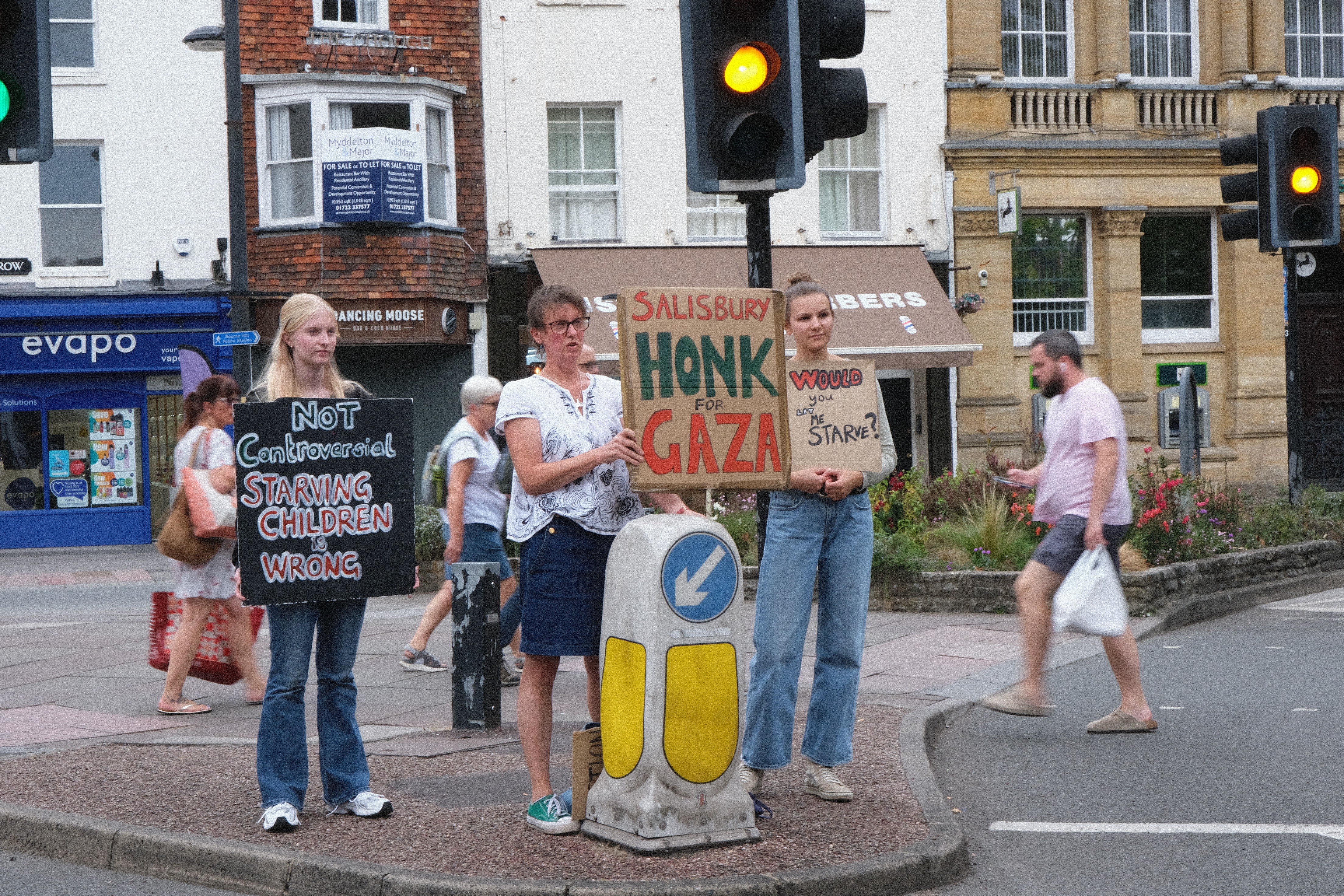
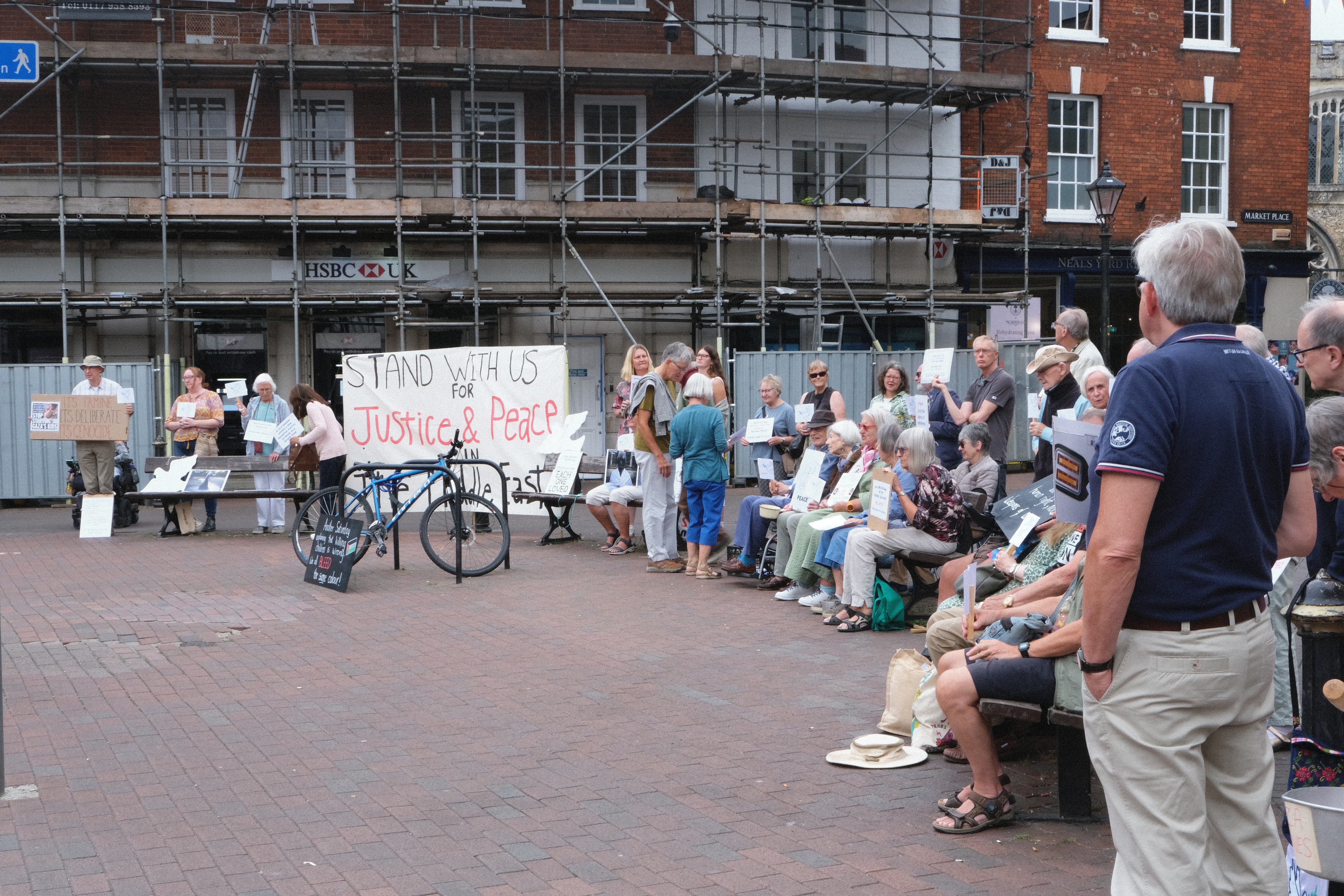
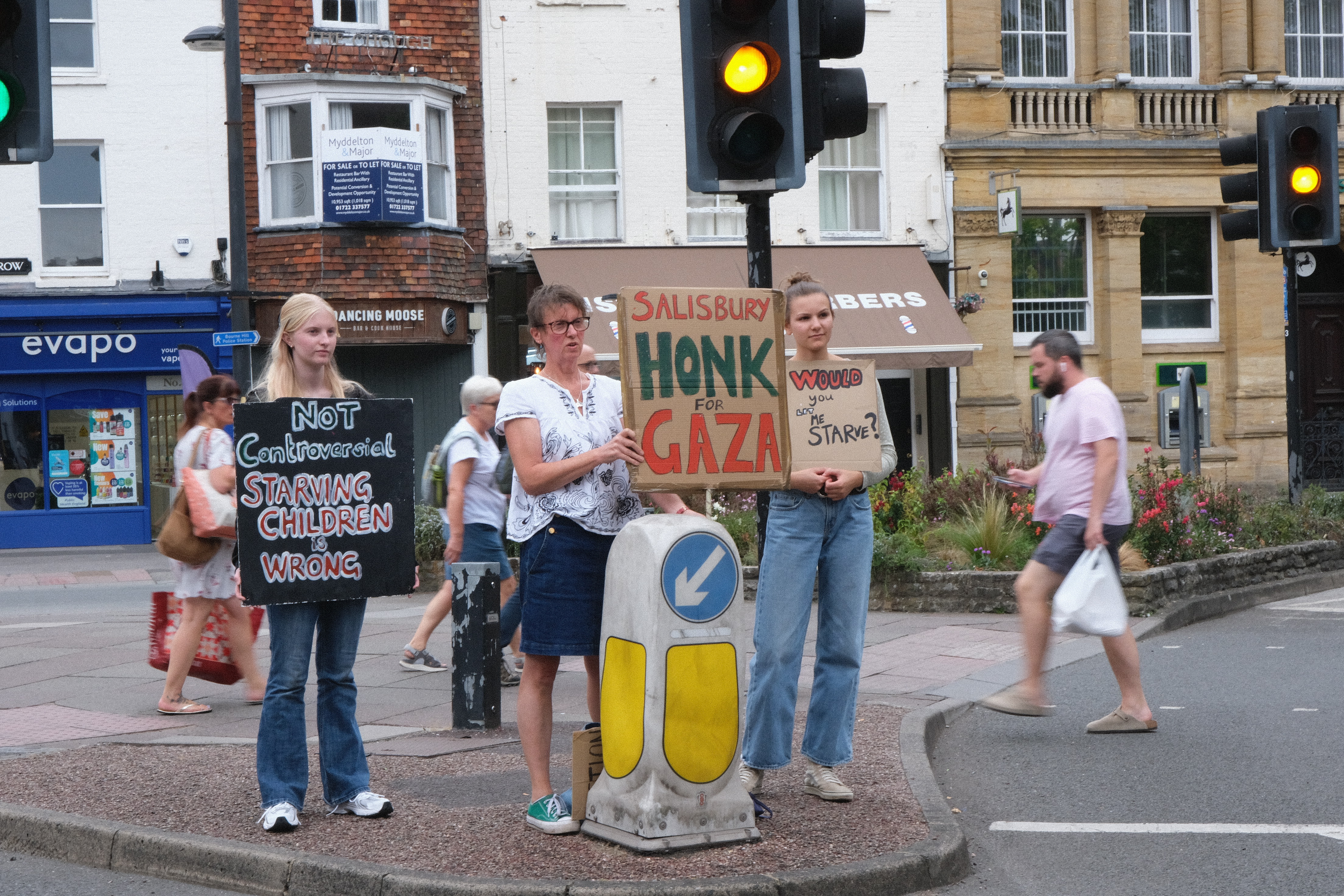
Around 55 attended this week’s vigil exceeding last weeks total. More stood and took notice and many photos were taken by passers by. The ‘Honk for Gaza’ sign attracted 32 honks. Several new faces attended which is encouraging. An excellent video of the vigil is available here courtesy of Peter Gloyns. A feature of the vigils is the range of posters and signs that people bring.

Israel is now preparing to launch an offensive to capture Gaza City. Bombing has started already causing many casualties: the total known is now 62,000. Many thousands more lie under the rubble unaccounted for. Over a 1,000 have been shot by IDF soldiers and US mercenaries at the limited food distribution sites fun by the Gaza Humanitarian Foundation GHF. What is upsetting many are the scenes of starving children, especially infants below the age of 5, for whom proper food is vital. Interviews with Israeli officials are met with denial. They claim there is no famine and that there is plenty of food available. According to Haaretz, the majority of Israelis are not aware of the famine in Gaza.

The UN declared a famine in part of Gaza this week: it is unable to do so for other areas as it cannot get sufficient data. António Guterres. the UN Secretary General said it was a ‘man made disaster, a moral indictment – and a failure of humanity itself’. Image: UN

Images: Salisbury Amnesty

Previous posts:

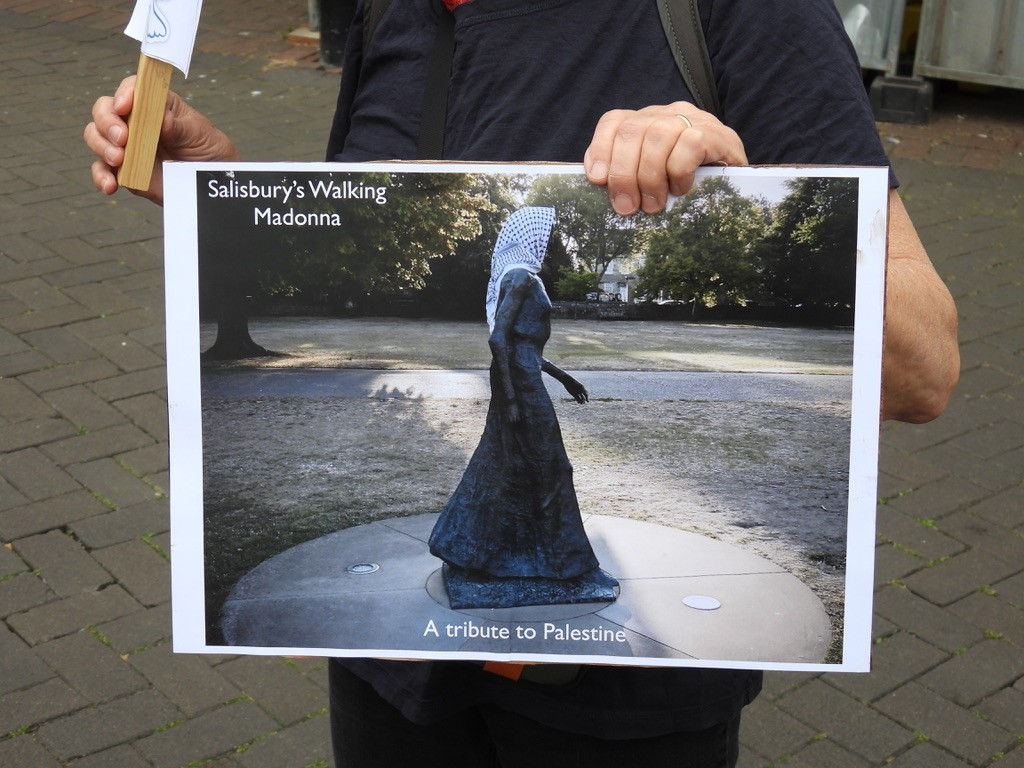
Walking Madonna is in the Cathedral Close in Salisbury.

Image: Peter Gloyns

Anti-protest law modified


High Court loosens restrictions on demonstrations

May 2025

No government likes protests. They demonstrate, all too visibly, that the public – or a part of them at least – is not happy with them or the status quo. Depending on the degree of despotism, demonstrations are controlled or in the worst of countries, banned altogether. China has an extremely restrictive policy backed up by a massive and all pervasive surveillance system making protests all but impossible. Gulf states are also highly restrictive.

Demonstrations are often how change happens. Britain has many examples throughout its history of protest bringing change. Wat Tyler and the plight of the poor (serfs); the Poll Tax riots in 1381 and 1970; the Prayer Book rebellion; the Iraq War protest and of course the Suffragettes. There are many more examples. They do not necessarily bring about immediate change. They do show to politicians and others the depth of feeling that people have about their cause.

The last Conservative government was no different to others in disliking protests. What upset them the most were the climate protests. Just Stop Oil and other groups such as Extinction Rebellion, engaged in a series of eye-catching protests which shone a light on the government’s failure (in their eyes) to do enough to stop fossil fuel extraction.

Suella Braverman, then the Home Secretary resented these protests and introduced the Police, Crime, Sentencing and Courts Act in 2022 in an attempt to seriously curtail them. Controversially they introduced a change in the threshold wording from ‘serious disruption’ to ‘more than minor’. This was done by using a statutory instrument not after proper debate in the House of Commons. This had the effect of almost banning all protests.

Successful challenge

Liberty and other groups successfully challenged this in the courts and the new Labour government decided to appeal. This seems to demonstrate that the dislike of protest is not a party political matter: governments just do not like challenge. Last week (May 2) the Appeal Court ruled that ‘serious’ is not ‘more than minor’ and said that the anti-protest laws were introduced unlawfully. The regulations gave police almost unlimited powers to prevent protests taking place. Many were arrested using these powers.

The protests which so upset the previous government concerned fossil fuels. The fossil fuel industry is extremely powerful and well-funded. Several of the various think tanks based in and around 55 Tufton Street are thought to be funded by them. These include: The Tax Payers Alliance; Civitas; Adam Smith Institute; Global Warming Policy Foundation; Centre for Policy Studies and the Institute of Economic Affairs. Their funding is opaque but is thought to be mainly from fossil fuel companies such as the Koch corporation in the USA among others. They have frequent access to the media being interviewed on various BBC and commercial stations without ever being asked ‘who funds you?’ Their opinions often appear in newspaper columns. They employ large numbers of lobbyists and enjoy close contact with ministers and civil servants. They claim to be influential in forming policies to suit their interests. It was admitted by Rishi Sunak when he was prime minister that the Policy Exchange – another of these think tanks funded by Exxon Mobil – had drafted the anti-protest legislation.

Protest is crucial to enable the ordinary person to make their voice heard. As with the arms industry we highlighted in a previous post, governments are dominated by commercial concerns, the need for growth and the enormous power and influence of companies and their army of lobbyists. Around £2bn per annum is spent by firms on this activity. It is welcome news that the Appeal Court has ruled against the government and its ‘draconian’ anti-protest legislation.

Trudi Warner case dropped


The new government has decided not to appeal against the judge’s decision to throw out the contempt of court case

August 2024

Readers may recall an earlier post discussing the Trudi Warner decision. This concerned a judge not allowing defendants to say they were climate campaigners in their defence. Warner stood outside the court with a placard saying that juries had a right to decide a case based on their conscience and not necessarily as the judge directs. The government’s legal department has indicated to the Appeal Court it is dropping the matter.

Celebrate protest


Amnesty webinar on the state of protest in Europe

May 2024

It seems that the UK is not alone in its attempts to stifle protest and passing laws to restrict individual’s abilities to protest. Recent tensions with ministers and some of their media supporters concerned Extinction Rebellion, Rwanda and the related issue of the boat people and more recently, the events in Gaza and the treatment of the Palestinians. Amnesty International recently hosted a webinar to look at the issue of protest and some of the points made are discussed below.

Protest has a curious position in British culture and law since there is no direst right to protest: it is not a specific human right. There is a right to free speech and a right of assembly and these combine to enable people to come together to protest.

The value of protest is something that seems to be forgotten. The anger at the noise of disruption of a protest march overshadows the fact that this is a means to enable people to highlight a cause of concern. There are some who complain about the disruption and who say that they would not mind a peaceful protest, it’s the noisy and disruptive ones they object to. The problem with a peaceful and noiseless protest which causes no disruption is that no one takes any notice. Many people report that visiting one’s MP or writing letters to them is largely a waste of time. It is also forgotten that nearly all social reforms in the UK have come as a result of protest, some lasting decades. The positive history of protest is not generally known or recognised. It is seen as a nuisance and something to be curtailed or even better, stopped.

Webinar

The results of the survey will be published on July 9th and it will show some regional trends which include casting protest as a threat, claiming it is a privilege rather than a right and the increasing use of supposed public safety measures to curtail them. They conclude it is generally getting worse with a heavy police presence used to intimidate. Complaints against the police and the use of excessive force are difficult because of the lack of identification.

A lot depends on language and protestors are frequently described as ‘rioters’ with no justification. There are also attempts to cast protestors as ‘illegitimate’.

One speaker from Clidef – with a focus on climate protest – spoke about the ‘pincer movement’. This includes new legislation introduced by government together with the stretching of old laws. Police action and powers have been strengthened as already mentioned together with the greater use of prison sentences against alleged offenders: 138 Just Stop Oil protestors have been imprisoned for example. They are also trying to use conspiracy laws.

Secondly, private actors and the use of SLAPP actions [Strategic Litigations Against Public Protest] which are a means to use the law to intimidate those seeking to take action against wrongdoers. They are a means by the wealthy to use the law to silence critics since they can afford to effectively bankrupt them with costs.

Thirdly, the judiciary and he might have mentioned the legal system itself. Judges have been in the firing line for not allowing those on trial to say why they were protesting, fearful no doubt that once a jury realises that they were promoting a climate action, they would acquit. The final speaker asked ‘who are they protecting? The activists or the companies?’

The theme of the webinar and the speaker contributions was that governments are increasingly dumbing down on protest whether it be the climate, Palestine or anything else. They give the impression of not liking dissent in any form and are using increasingly draconian tactics to inhibit, arrest and imprison those to engage in it.

Media

A theme not explored was the role of the tabloid media who almost without fail demonise protestors calling them things like ‘eco-zealots’, ‘eco-mob’, ‘a rabble’, and their actions amounting to ‘mob rule’. Article after article describes protests in entirely negative terms and seldom give readers much (in fact next to nothing) in the way of an explanation of why they are protesting and the nature of their cause. It is to be presumed that they are reflecting public opinion and the views of their readers. Recent reports on the climate are extremely worrying. The fossil fuel companies are able to mount expensive lobbying campaigns to ensure their interests are looked after and extraction can continue. Protestors do not enjoy this privileged access to those in power and taking to the streets is the only way they can be heard. It is a shame that sections of the media are not able – or are disinclined – to reflect this imbalance of power and the inevitable effects it will bring to the climate.

Our right to protest is precious and should be defended.

The Salisbury group was established 50 years ago

Jury trial protest


Protest at Salisbury Law Courts concerning freedom of juries to exercise their conscience

April 2024

A group of people from Defend our Juries staged a protest outside Salisbury law courts this week as part of their campaign to in support of a social worker Trudi Warner who was arrested for contempt of court while protesting outside the Inner London Crown Court. The issue concerns the right of a jury to exercise their conscience when taking their decision and relates to the question of defendants not being allowed to mention that they were engaged in a climate protest at the time of their arrest.

The last two posts concerning Hillsborough and the settlement by Hugh Grant of his legal case against the publishers of the Sun newspaper, NGN have mentioned the poor performance of the legal system in each. At Hillsborough, the relatives of those crushed at the disaster had to endure years of frustration and abuse not helped by the legal system and in the case of Hugh Grant, he has had to settle because the way the costs system works could lead him seriously out of pocket in the face of a publisher determined not to allow the hundreds of victims to have their day in court.

Another aspect which has surfaced recently is the passing of laws making protest harder and harder to undertake. The main motivation has been the environmental protestors who have carried out a number of eye-catching demonstrations which have highlighted the failure – in their view – of the government to take environmental matters seriously enough.

The Police, Crime, Sentencing and Courts Act 2022 has a series of measures which make protests much more difficult and risky. The Police now have enhanced powers to limit marches and to issue fines if those involved create too much noise nuisance for example. There is no specific right to protest but there is a right to assemble and to free speech.

The Bill is part of a hugely worrying and widespread attack on human rights from across Government which will not only see basic rights reduced across the board, but will also strip people of the means to challenge or contest their treatment.

In its reports on the bill, Parliament’s Joint Committee on Human Rights said the proposals are “oppressive and wrong”. It accuses the government of trying to create “new powers in areas where the police already have access to powers and offences which are perfectly adequate”.

The issue of juries and conscience is a complex one, and it is not the case that juries can exercise their conscience if that means ignoring the evidence given in the trial. But what might be happening here is a feeling that the government, the police and CPS are out of touch with public opinion concerning protests, and the climate. Juries are a key part of our history and are a means for 12 good men (and women) and true to exercise some common sense, a fact that sometimes seems to be lacking in our legal system. There will be many who feel that it is relevant to say that a defendant was on some kind of protest. They may also be feeling that the government has become too determined to inhibit protests. As we have noted before, many of the rights we take for granted today were achieved following sometimes years of protest. The suffragists campaigned peacefully for decades for the right for women to have the vote and were ignored. The suffragettes protested more aggressively and eventually achieved success. Female ministers keen on the new laws might wish to reflect they would not have the opportunity to do so had it not been for their sisters willing to protest and who suffered grievously when imprisoned.

Sources: BBC, Salisbury Journal, Amnesty

Scrap anti-protest laws


The government should scrap the anti-protest laws it has passed

February 2024

This call was made in the current edition of the Amnesty magazine and refers to various laws the government has passed to curb or prevent protests taking place. The first is the Police, Crime, Sentencing and Courts Act 2022 and the second is the Public Order Act 2023. They were introduced mainly as a result of climate change protestors who carried out a range of protests and campaigns which were not popular with the government, the right wing media or some of the public. 

Protests, violent or otherwise, have been a feature of Britain’s political life for centuries. Indeed, the Conservative politician Ian Gilmour, who served in Mrs Thatcher’s cabinet, wrote a book Riot, Risings and Revolution: Governance and Violence in Eighteenth Century England, (Pimlico, 1993) which described the considerable number of such things which were a regular feature of life at the time. So the activities of Extinction Rebellion are neither new nor especially harmful in the light of history. It’s possible that the two Home Secretaries who pushed through this legislation were both daughters of immigrants who may not have been aware of this history. 

It is also ironic that both politicians, who are female, owe their right to be an MP – or to vote at all – to the actions of suffragists and latterly, the suffragettes who campaigned violently for those rights It is also ironic that the suffragists campaigned peacefully for around four decades and made little progress – arguably none. There were many campaigns which have led to positive change viz: ending Apartheid in South Africa, the Chartist movement, ending slavery and protests leading to the Great Reform Act. It is true to say that many of the rights we enjoy today, owe their existence to a protest of some kind to achieve them. 

It is also a sad fact of life that peaceful protests usually get ignored. There are many marches, some quite large involving many thousands, which get no coverage. But once violence erupts, it becomes news. Governments do not like protest and see them as some kind of threat to their right to govern. But protest is about the only way ordinary people to make their concerns heard or to promote change.

Both acts should be scrapped.  


UN Rapporteur ‘seriously concerned’ at crackdown in UK


UN Rapporteur on environment matters expressed ‘alarm’ ‘distress’ and ‘serious concern’ at the crackdown on environmental activists in UK

January 2024

Between 10 – 12 January 2024, David Forst, made his first visit to the United Kingdom since he was elected as UN Special Rapporteur on Environmental Defenders under the Aarhus Convention in June 2022.

On 23 January he issued a statement in the light of the extremely worrying information he received in the course of meetings regarding the increasingly severe crackdowns on environmental defenders in the United Kingdom, including in relation to the exercise of the right to peaceful protest.

These developments are a matter of concern for any member of the public in the UK who may wish to take action for the climate or environmental protection. The right to peaceful protest is a basic human right. It is also an essential part of a healthy democracy. Protests, which aim to express dissent and to draw attention to a particular issue, are by their nature disruptive. The fact that they cause disruption or involve civil disobedience do not mean they are not peaceful. As the UN Human Rights Committee has made clear, States have a duty to facilitate the right to protest, and private entities and broader society may be expected to accept some level of disruption as a result of the exercise of this right“.

Peaceful protests

During his visit, however, he learned that, in the UK, peaceful protesters are being prosecuted and convicted under the Police, Crime, Sentencing and Courts Act 2022, for the criminal offence of “public nuisance”, which is punishable by up to 10 years imprisonment. He was also informed that the Public Order Act 2023 is being used to further criminalize peaceful protest. In December 2023, a peaceful climate protester who took part for approximately 30 minutes in a slow march on a public road was sentenced to six months imprisonment under the 2023 law. That case is currently on appeal, but it is important to highlight that, prior to these legislative developments, it had been almost unheard of since the 1930s for members of the public to be imprisoned for peaceful protest in the UK.

He also expressed alarm to learn that, in some recent cases, presiding judges have forbidden environmental defenders from explaining to the jury their motivation for participating in a given protest or from mentioning climate change at all. It is very difficult to understand what could justify denying the jury the opportunity to hear the reason for the defendant’s action, and how a jury could reach a properly informed decision without hearing it, in particular at the time of environmental defenders’ peaceful but ever more urgent calls for the government to take pressing action for the climate.

He also received highly concerning information regarding the harsh bail conditions being imposed on peaceful environmental defenders while awaiting their criminal trial. These have included prohibitions on engaging in any protest, from having contact with others involved in their environmental movement or from going to particular areas. Some environmental defenders have also been required to wear electronic ankle tags, some including a 10pm – 7am curfew, and others, GPS tracking. Under the current timeframes of the criminal justice system, environmental defenders may be on bail for up to 2 years from the date of arrest to their eventual criminal trial. 

Such severe bail conditions have significant impacts on the environmental defenders’ personal lives and mental health and he seriously questioned the necessity and proportionality of such conditions for persons engaging in peaceful protest. In addition to the new criminal offences, he was deeply troubled at the use of civil injunctions to ban protest in certain areas, including on public roadways. Anyone who breaches these injunctions is liable for up to 2 years imprisonment and an unlimited fine. Even persons who have been named on one of these injunctions without first 2 being informed about it – which, to date, has largely been the case – can be held liable for the legal costs incurred to obtain the injunction and face an unlimited fine and imprisonment for breaching it. The fact that a significant number of environmental defenders are currently facing both a criminal trial and civil injunction proceedings for their involvement in a climate protest on a UK public road or motorway, and hence are being punished twice for the same action, is also a matter of grave concern to him.

Media derision

He was also distressed to see how environmental defenders are derided by some of the mainstream UK media and in the political sphere. By deriding environmental defenders, the media and political figures put them at risk of threats, abuse and even physical attacks from unscrupulous persons who rely on the toxic discourse to justify their own aggression. The toxic discourse may also be used by the State as justification for adopting increasingly severe and draconian measures against environmental defenders. In the course of his visit, he witnessed first hand that this is precisely what is taking place in the UK right now. This has a significant chilling effect on civil society and the exercise of fundamental freedoms.

As a final note, during his visit, UK environmental defenders told him that, despite the personal risks they face, they will continue to protest for urgent and effective action to address climate change. For them, the threat of climate change and its devastating impacts are far too serious and significant not to continue raising their voice, even when faced with imprisonment. We are in the midst of a triple planetary crisis of climate change, biodiversity loss and pollution. Environmental defenders are acting for the benefit of us all. It is therefore imperative that we ensure that they are protected.

A spokesperson for the UK Home Office, the government department that tackles policing and other elements of national security, said that “while decisions on custodial sentences are a matter for the independent judiciary, the Public Order Act brings in new criminal offences and proper penalties for selfish, guerrilla protest tactics.”

Sacha Deshmukh, Amnesty International UK’s chief executive, said: “The UN special rapporteur offers a damning indictment of the repressive crackdown climate activists in the UK face for exercising their right to peacefully protest.”

“The UK Government seems more intent on creating a climate of fear than tackling the climate crisis.“

The full report can be accessed here: Aarhus_SR_Env_Defenders_statement_following_visit_to_UK_10-12_Jan_2024.pdf (unece.org)

Sources: CNN; Guardian; UN, Mail on Line. [There does not seem to be a report on this in the Daily Telegraph]. All accessed 25 January 2024

Arrests prior to the coronation


Graham Smith, the leader of Republic, was arrested prior to the coronation and held for 16 hours

May 2023

UPDATE: 8 May: Police express ‘regret’ at the arrest of Graham Smith. No charges will be brought under the new Public Order Act against any of those arrested. The only charges brought are for drugs related offences. Questions remain concerning why the arrests were made in the first place and what, if any, pressure had been put on the police to make them.

We have been warning for some time in previous posts – along with other organisations – that the desire by the present government and Home Secretary Suella Braverman, to limit the ability of individuals and organisations to protest by passing a series of laws to limit such activity and to give the police yet more powers to carry them out. The new Public Order Act was rushed into law and signed by King Charles just days before his coronation took place.

Using the act (it seems), Graham Smith the leader of Republic, an organisation which believes we should be run as a democracy and not have an inherited royal family at the head of the country, was arrested before the coronation took place. It is unclear on what the grounds the arrest was made and he was released after 16 hours. He was not the only one to be arrested and others included volunteers from Night Stars which prompted Westminster Council to say it was ‘deeply concerned’ by their arrest.

The new legislation arose because of the activities of the climate protestors who used a variety of methods to disrupt the capital including gluing themselves to pavements. Their protests did seem to shine a light on the poor performance by the government to tackle the climate emergency. They were not popular however and the disruption caused to commuters and others led the government to pass a range of laws to limit the ability to protest. The Home Secretary famously said in parliament that such people were “Guardian-reading, tofu eating, dare I say the anti-growth coalition”.

There is a tension when it comes to protesting. There are many who are in support of peaceful protests but are angry about those which are disruptive in some way or even where there is some violence. The problem with peaceful protests is that they are almost always ignored. It is the more violent type which become news and where the cause is thereby recognised. There were many decades of peaceful protests for women to have the vote for example which yielded nothing. Once more violent methods were employed by the suffragettes, change eventually occurred although there were other factors at play.

The Salisbury Amnesty group neither supports nor condemns the campaign for the country to be a Republic. The issue at stake is the right to campaign on the matter. There is no specific right of protest. We do have the right to free speech and we do have a right of assembly under articles 10 and 11 of the European Convention. Giving the police yet more powers to arrest on the pretext that the person might be disruptive is a worrying development. Another worrying development is the alleged use of facial recognition during the coronation. This technology has been widely used by repressive regimes such as China where the ability of people to move almost anywhere is tracked by the police.

Sources: Evening Standard, CNN, The Times, Amnesty International, and yes, the Guardian

Dangerous new bill


Dangerous new bill proposed by the government

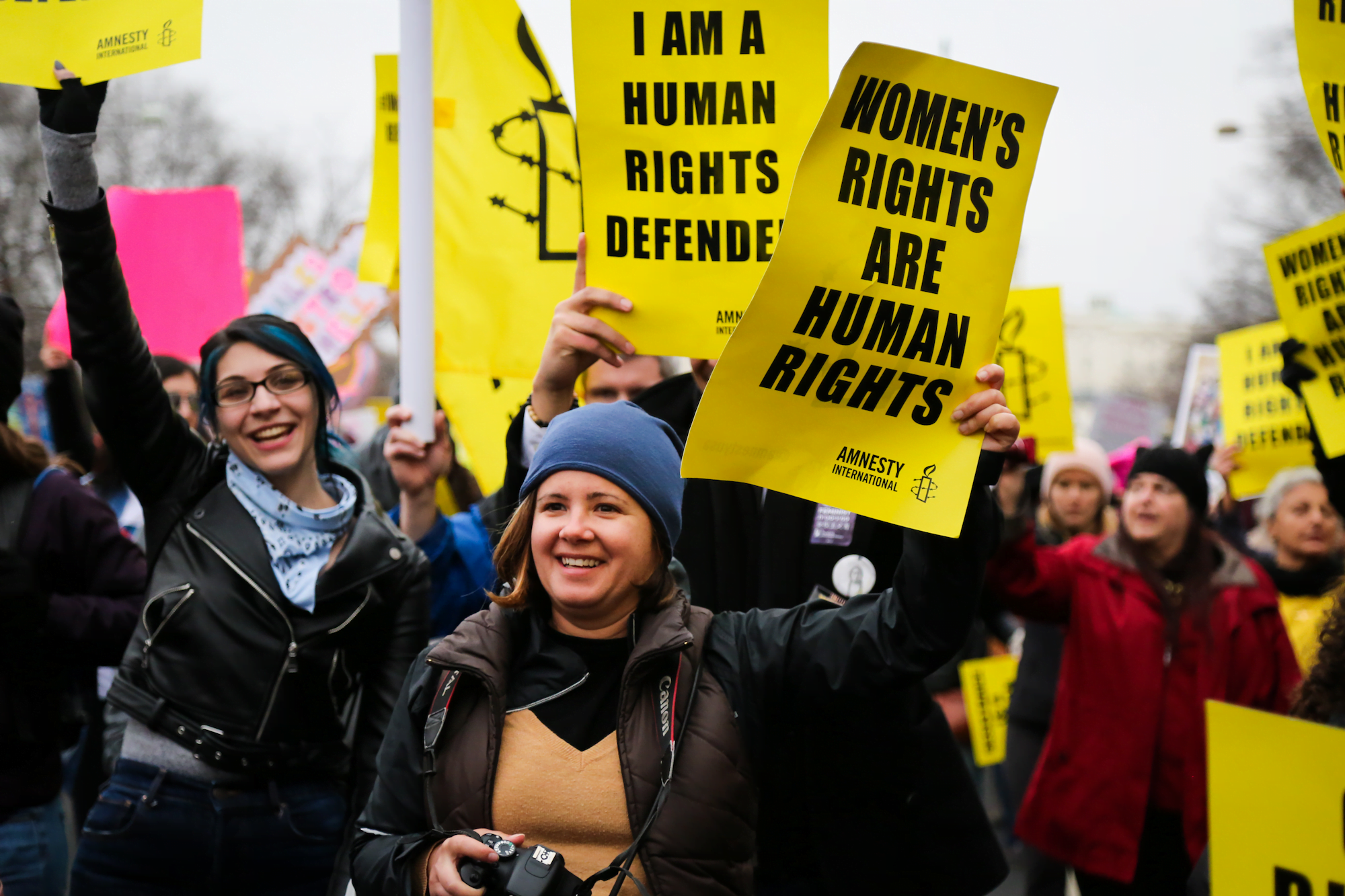
The right to protest is fundamental to a free and fair society.  It’s a right we have fought long and hard for.  Without the right to protest, accountability and freedom suffers.

A New Policing Bill

The Government’s new policing Bill gets the balance dangerously wrong.  Such an enormous and unprecedented extension of policing powers will put too much power in the hands of the state, to effectively ban protests – including peaceful ones – should they see fit.

Vigil for Sarah Everard

Worse still, this Bill alongside other efforts by the UK Government to threaten and dilute other fundamental rights and freedoms.  The claims of excessive force used by Metropolitan police against women attending a vigil for Sarah Everard on 13 March, beggars belief, and is a stark and timely warning about precisely why Parliament must not grant police further powers to stop peaceful protest.

Racism and discrimination

As well as preventing peaceful protest, sections of this Bill will most likely disproportionately impact  people who are in the minority and increase the racism and discrimination that is experienced by many of them.  For example, measures to enhance stop & search and restrict the right to roam, precisely at a time when the UK Government should be working to address these issues.

This is not the path to a free and just society.  This is the path to a clampdown on our centuries old rights of freedom of movement, expression and assembly.  This is entirely incompatible with the UK’s self-image as a place of liberty.

We cannot allow this clampdown to happen.  Take action and call on our Prime Minister to put the brakes on the Bill and stop the assault on our freedoms.

Text taken from Amnesty International

Blog at WordPress.com.

Up ↑