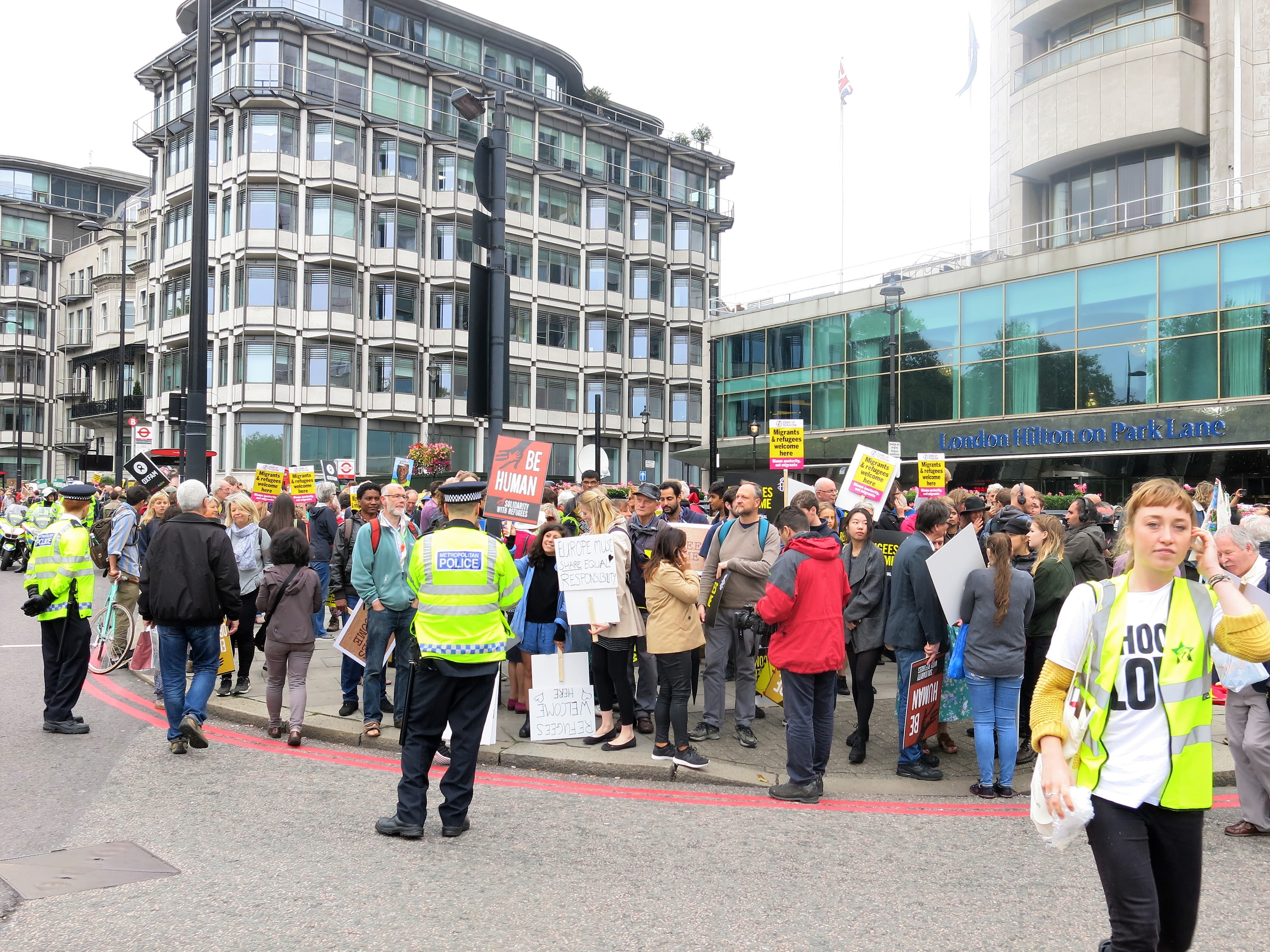
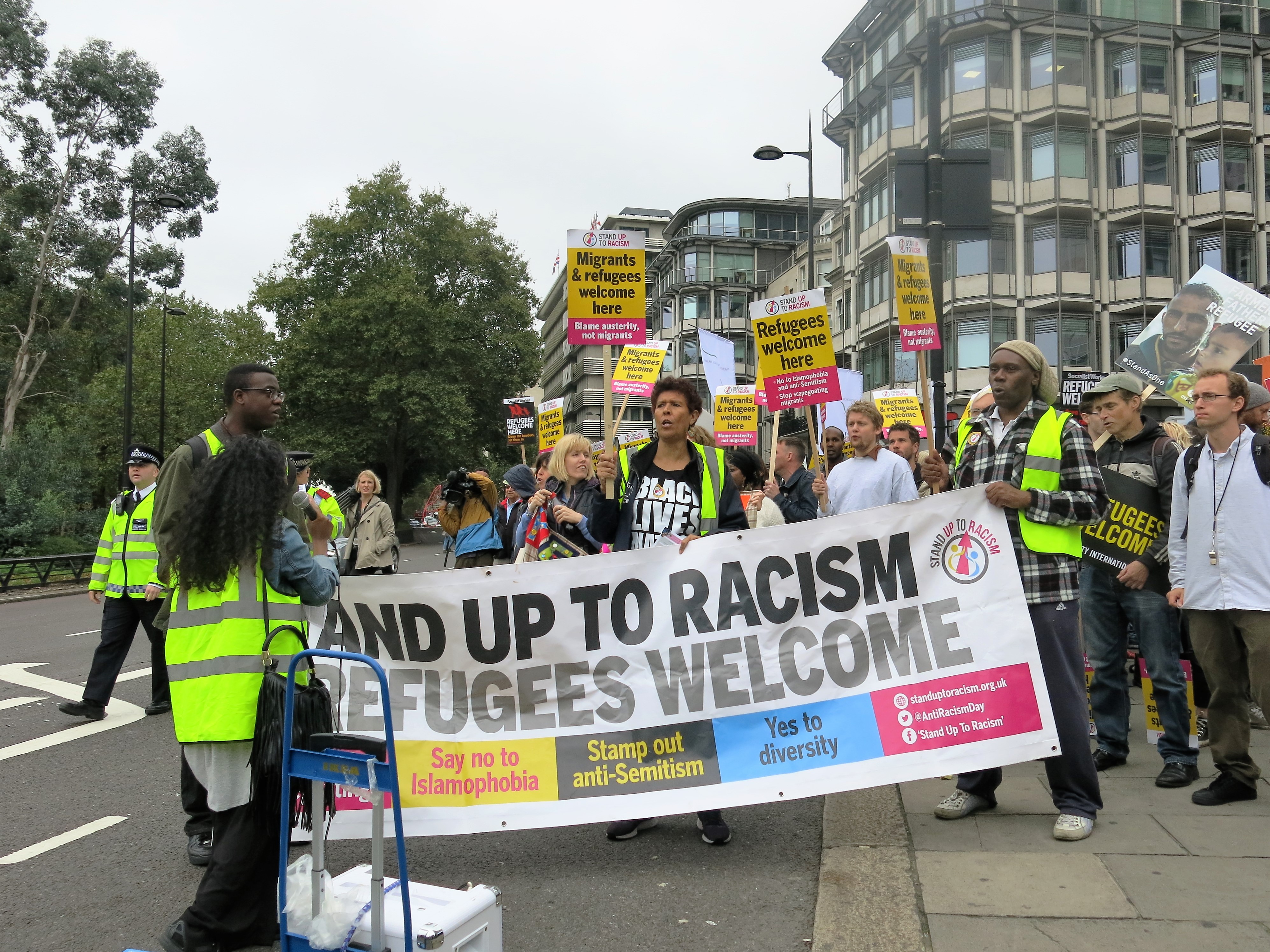
The march in aid of refugees was attended by at least 15,000 yesterday and was good natured and uplifting. It started in Pall Mall, London, and wove its way along Piccadilly ending up in Parliament square. It is encouraging in the current climate to see so many people travel from as far afield as the Wirral and Penzance to show their solidarity for a better treatment of refugees. Britain’s role has been exceptionally poor largely because of hostility towards them egged on by a xenophobic press.
The march was a huge success and was attended by at least 15, 000 people. A fuller report and pictures will be posted soon.
March in London on Saturday 17 September to support refugees
Source: Wikimedia
Women, men and children around the world are fleeing war, persection and torture. They have been forced into the hands of smugglers and onto dangerous journeys across the sea in rickety old boats and dinghys. Many have lost their lives. Those who have made it often find themselves stranded in makeshift camps in train stations, ports or by the roadside.
And still, politicians across Europe fail to provide safe and legal routes for people to seek asylum.
Meanwhile, ordinary people have responded with extraordinary displays of humanity and generosity. They’ve been moved to act after seeing thousands of people drowning in the Mediterranean, the continuing misery of camps in places like Calais, and images of the brutal conflicts across the world.
We need to tell the Prime Minister Theresa May that we want to help.
The UK government must do more – let’s call on them to:
Lead the way towards a more human global response to the millions fleeing conflict
Offer safe passage to the UK for more people who have been forced to flee their homes
Do more to help refugees in the UK rebuild their lives
The march starts at 11:30 outside Green Park station and ends in Parliament Square.
In all the discussion about the relative merits of refugees from the various war-torn parts of the world, the Syrians are presently claiming most attention. We all understand how dreadful their plight is, and so too those fleeing wars in Iraq, Afghanistan, Libya and the Sudan. But Eritrea? Eritrea is not actually at war with anyone (well, it’s in a face-off with Ethiopia, but wouldn’t dare to take on its bigger neighbor in a full-scale war), and the regime is in total control of the country. So why the desperation of people to escape to Europe? Indeed the British government has changed its view of the country in recent months to say that it is safe for asylum seekers to be returned home. The Home Office said:
its guidance on Eritrea is based on a careful and objective assessment of the situation in Eritrea using evidence taken from a range of sources including media outlets; local, national and international organisations, including human rights organisations; and information from the Foreign and Commonwealth Office.
However they have relied largely on a Danish report, the authors of which have disowned for its misinterpretation, and Eritrean government sources, rather than the reports of human rights groups.
The UK’s position is totally confused, as they are supposedly taking account also of a recent UN report, which would also give a somewhat different picture. The report, by the UN Commission of Inquiry on Human Rights in Eritrea, cites a raft of human rights violations – some, it says, which may constitute crimes against humanity – of a ‘scope and scale seldom witnessed elsewhere’. The report strongly urges continued international protection for Eritrean refugees fleeing human rights violations, and warns against sending them back to danger in a country that punishes anyone who tries to leave without permission
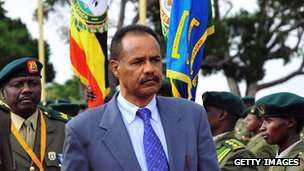
President Afeworki
Following its independence in 1991, the country has lapsed into a total disregard for the rule of law. Elections have been regularly postponed – President Isaias Afeworki has never faced the electorate – arbitrary detention is rife; torture is so common that the Commission concluded that it was government policy, and mass surveillance and neighbourhood spying is the norm. Justice is arbitrary, detention conditions are appalling, and complete disappearance not unusual. So far, so typical dictatorship but in Eritrea it is egregiously appalling.
The speciality of the state is that, under the pretext of defending the integrity of the State and ensuring national self-sufficiency, much of the population is subjected to open-ended national service, either in the army or through the civil service. When they turn 18 or even before, all Eritreans are conscripted. While national service is supposed to last 18 months, in reality conscripts end up serving for an indefinite period, up to 20 years in extreme cases. Thousands of conscripts are subjected to forced labour that effectively abuses, exploits and enslaves them for years. Women conscripts are at extreme risk of sexual violence during national service.
Many others – detainees, students, members of the militia – are also subjected to forced labour. The report says
The use of forced labour is so prevalent in Eritrea that all sectors of the economy rely on it and all Eritreans are likely to be subject to it at one point in their lives. The commission concludes that forced labour in this context is a practice similar to slavery in its effects and, as such, is prohibited under international human rights law.
The Eritrean Foreign Ministry inevitably claimed the Commission’s report contained ‘wild allegations’ which were ‘totally unfounded and devoid of all merit’ and charged the UNHRC of ‘vile slanders and false accusations’, without addressing any of the issues. The British government have since modified their stance based on Eritrean assertions that military service will be limited to 18 months to 4 years, which would render it legal, but there is no evidence of this happening.
These widespread abuses have prompted thousands of Eritreans to flee their home country in search of asylum in Europe. According to the latest estimates produced by Italian authorities, 32,000 Eritreans were rescued in 2014 as they attempted to traverse the Mediterranean – the majority of all migrants rescued by Italy’s comprehensive Mare Nostrum operation. Meanwhile, the UN refugee agency has placed the number of Eritreans under its concern outside the country at more than 357,400.
This is the country we are intending to return refugees to as being “safe”. The Government needs to think again.





 Amnesty in Salisbury & South Wiltshire