Sakineh released. Iran


News this week that Sakineh Mohammadi Ashtiani, who was convicted of adultery and complicity in the murder of her
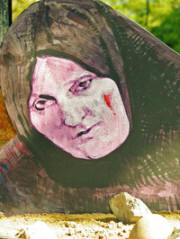
Portrait of Sakineh prepared by local support Paul Donavan
Portrait of Sakineh prepared by local artist Paul Donovan

husband and sentenced to death by stoning in 2006, is to be given ‘a leave’ from prison by the Iranian authorities.  The story was reported in the Guardian (20 March).

Readers of this site will know that the Amnesty group in Salisbury has campaigned on many occasions over the last several years on behalf of Sakineh.  It was part of a worldwide campaign.  We have sent cards to her prison, asked people to sign petitions and group members have written to the powers that be in Iran asking for her release.  Many hundreds of Salisbury people signed our petitions.  We – and the people of Salisbury who signed cards and petitions – can therefore claim to have played a small part in the successful outcome of this case.

The case caused a storm of outrage when it became national news.  For many, it was the first time that the full horror of what stoning actually involves was brought home to them.  Indeed, the group had to explain to many people what in fact it involved.  Men are buried up to their necks and women up to the waist.  Stones are delivered to the site which are neither too small nor so large that they would kill in one go.  This in a country that wants to be in the nuclear age.

Cube designed to illustrate the approximate size of stones used in stoning

Sakineh was world wide news but the scale of executions by a variety of means is at an astonishing level in Iran.  It is second only to China in the number carried out.  They are on course for nearly a thousand this year dispelling the optimism surrounding Rouhani’s election last year.

Nevertheless, it does show that concerted international pressure can and does have the occasional beneficial effect even on the most isolated regimes.

Iran


Readers of this blog and its predecessor, will recall that we have had many occasions to feature the situation in Iran, the3925 worlds second biggest executioner of its citizens.  Statistics are hard to come by and those issued by Iran itself are an underestimate.  Recent figures reveal 165 known executions in the first 2 months of 2014 which equates to just short of 1000 for the year if it carries on (Source: Iran Human Rights Documentation Centre, IHRDC).   Not only is the level of execution high but they are carried out in public, sometimes with a number of people being hanged at the same time.

We have campaigned against this in the past and in particular, the particularly nasty practice of stoning people to death.  The three methods of execution used in Iran are hanging – the most common – throwing people off cliffs, and stoning.  Children are executed as well, despite denials, and they are kept until their eighteenth birthday before the deed is done.

When Rouhani came to power, there was a wave of optimism in the West and with it a feeling that some kind of normalised relationship could be established with Iran.  An example is a BBC report of 11 November last year which quoted Jack Straw as saying ‘Rouhani was courteous, engaging, very straightforward, with a nice smile playing on his lips’.  There was hope that at last there was a moderate politician in Iran and progress could be made to have dealings with that country in a sensible way.

It is in this spirit of hope that an article in the New York Times this week under the headline ‘Mercy and Web Slow the Number of Executions in Iran’ by Thomas Erdbrink might provide some good news.  He spoke of a ‘growing distaste’ within Iran for capital punishment and he put this down in part to the spread of social media.  ‘The increasing number of executions has made the middle class upset’ a lawyer is quoted as saying.  The story was built around someone who managed to raise the funds necessary to pay the victim’s family enough to secure his release.

However, a search on the net reveals that the story is somewhat distorted and that if anything, the rate of executions is increasing under Mr Rouhani rather than diminishing.  A full report of the situation in Iran is published by the International Federation of Human Rights, Fidh and can be accessed at: http://www.fidh.org/IMG/pdf/Rapport_Iran_final_pdf  Please be warned there are some disturbing images.

It was hoped to post something positive about the country but the facts seem to point to the reality of life in Iran is much as it always was.

The group campaigns against the death penalty and if you wish to join us see the ‘Joining’ tab at the top of this site.

Blog at WordPress.com.

Up ↑