In partnership with Salisbury Arts Centre, we shall be showing the film Mustang on 15 December 2016. This award winning film by a Turkish director concerns five girls growing up in a northern Turkish town. On their way home from school they meet some boys and start some harmless frolics in the sea. This is reported to their parents and thus begins a life of confinement, forced marriage and control.
We are delighted to say that there will be a short presentation at the start by Prof. Lucy Mazdom who is Head of the Film Department at Southampton University. Her research interests include French and American film; contemporary French and British television; transnational film studies; remakes; film history in a global context and issues of cinematic distribution, exhibition and reception.
After the showing, the local group will asking people to sign a petition (to be decided nearer the time).
Tickets are available at the Arts Centre.
Follow us on Twitter and Facebook. If you are interested in joining local group, make yourself known at the film to one of us at the signing table. It is free to join the local group. Details on the ‘Joining’ tab on the home page.
Funeral bombing, Yemen. Picture: hang the bankers.com
At long last, the war in Yemen is beginning to attract the attention it deserves. Most news bulletins still lead on the atrocities in Syria but the horrific events in Yemen where the Saudis bombed a funeral killing 140 and wounding around 500 has at last brought the conflict onto the TV screens. The bombing, combined with the blockade, is causing untold misery to ordinary Yemenis. The wounded will struggle to get proper medical treatment because the hospitals are also being bombed and the blockade means medical supplies cannot get through.
We first started drawing attention to the war there over a year ago and raised the matter with our local MP. A bland letter was received from the Foreign Office minister Tobias Ellwood. Subsequent revelations have shown that the actions the FCO were claiming to have done were somewhat wide of the truth.
The core issue is the use of our arms (and those of the US, the principal weapons suppliers to the Saudis) are being used in the conflict. It was also revealed (inadvertently, and no doubt embarrassingly by the Saudis) that British service people were advising the Saudis. Quite what their role is there is disputed.
This particular attack has been condemned by the UN, the EU and the US. The Foreign Office still claims there is no need to revoke licences as there is no serious breach of humanitarian law. The UN Secretary General Ban Ki-Moon said:
The air strikes on a funeral ceremony was a “heartless attack on civilians and an outrageous violation of international humanitarian law.” He said an independent body to probe rights violations in Yemen must be set up. There must be accountability for the appalling conduct of this entire war. Mail on line [accessed 11 October 2016]
The Saudis are not alone in committing these atrocities and the Houthi rebels are likewise accused.
The Saudis can carry on with their attacks because we supply them with the weapons and we also give the regime a degree of diplomatic cover. The huge sale of weapons – over £3bn a year – is clearly a factor influencing government policy. This latest episode is making it harder for the government to ignore what is going on there and our role in helping them. The mantra about the control of arms sales is still alive and well however:
On the point of UK arms sales to Saudi Arabia, a Government spokesperson told The Independent the UK “takes its arms export responsibilities very seriously”
The key test … for our continued licensing of arms exports to Saudi Arabia is whether there is a clear risk that those exports might be used in the commission of a serious violation of international humanitarian law,” she said. “The situation is kept under careful and continual review.” Independent [accessed 11 October 2016]
But recent TV filmed reports showing the carnage going on there, hospitals full of emaciated children and widespread starvation caused by the conflict and the blockade will begin to make it harder for the government to keep up the pretence of ‘taking its arms export responsibilities seriously’.
The Salisbury group campaigns on a range of issues and we welcome new members. Follow us on Twitter or Facebook to find out when we have an action in the City and come along.
The World Day Against the Death Penalty was created in Rome on 13th May 2002, with 10th October established as the date for its annual commemoration in 2003. The World Coalition against the Death Penalty has 158 member organisations, made up of NGO’s, Bar Associations, local bodies and Unions.
Amnesty International is a member of the Coalition. It has been working to end executions since 1977, when only 15 countries had abolished the death penalty in law or in practice. That number has now risen to 140.
Since that date –
By the end of 2015, 102 Countries had completely abolished the death penalty.
1,634 executions were carried out in 2015 (excluding China – figures unknown) – an increase of 54% over 2014
89% of executions in the course of the year took place in three countries – China, Iran and Iraq – often after unfair trial
The United Nations Moratorium on the Death Penalty calls for States maintaining the death penalty to establish a moratorium on its use, with a view to abolition, and in the meantime to restrict the number of offences punishable by execution, and to respects the rights of those on death row. It also calls on States that have abolished the death penalty not to reinstate it. (Note: UN resolutions are not binding).
Amnesty International is calling for:
Countries that still use the death penalty to halt all executions immediately
Countries that have stopped executing prisoners to remove the death penalty from their legal books, for all crimes, permanently
All death sentences to be commuted to terms of imprisonment
The Salisbury Group have included the abolition of the death penalty in its campaigns from the
Members of the group at the NWR conference
beginning. It is currently focusing on the sentencing to death and execution of juveniles, in particular in Iran and Saudi Arabia.
For this year’s World Day, Amnesty are highlighting the case of the Japanese prisoner, Matsumoto Kenji. The Salisbury Group manned a stall at the NWR Conference on Saturday, (see photo) in the course of which they collected 50 signatures on cards calling on the Minister of Justice to halt the execution, to end the use of solitary confinement for death row prisoners and to end the use of the death penalty in Japan.
The following three factsheets have been produced by the group for use on stalls and on campaigns generally. They can be downloaded here (pdf files). One is about the group and what it does and has achieved; another is a death penalty case in Japan for the World Day Against the Death Penalty on Saturday, and the last is about refugees.
[If any Amnesty group would like one of these sheets we are happy to modify them, with their own group details on for example, and send you an amended pdf]
We have described the events in Yemen and the role of the UK in selling arms to the Saudis who are using them to bomb civilian targets in that country. We have been assured that the UK has a strict policy when it comes to selling arms which does not in fact seem to work. The most recent activity by our government is to block and enquiry by the European Union into allegations of war crimes in Yemen.
The UN’s Human Rights Council based in Geneva was hoping to carry out a proper enquiry but this was stymied by the UK. Only today, Boris Johnson condemned the Russians for war crimes in Syria alleging that civilians were being targeted. There seems little difference to what the Russians are alleged to be doing and what we are doing by selling arms to the Saudis who then use them to bomb civilian targets, hospitals and schools.
Amnesty protest against arms sales to Yemen
The policy has been condemned by Human Rights Watch and by the Campaign Against the Arms Trade.
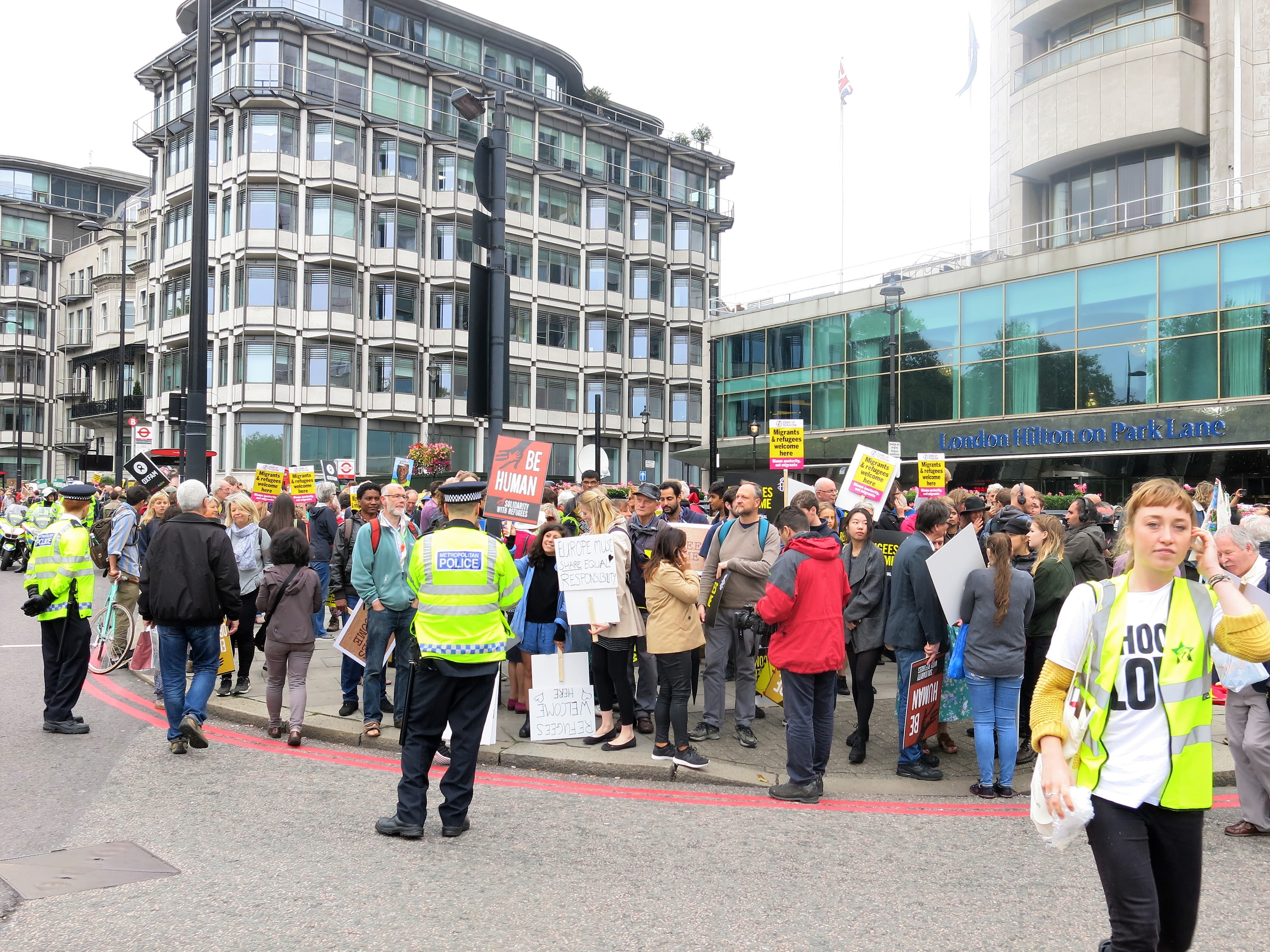
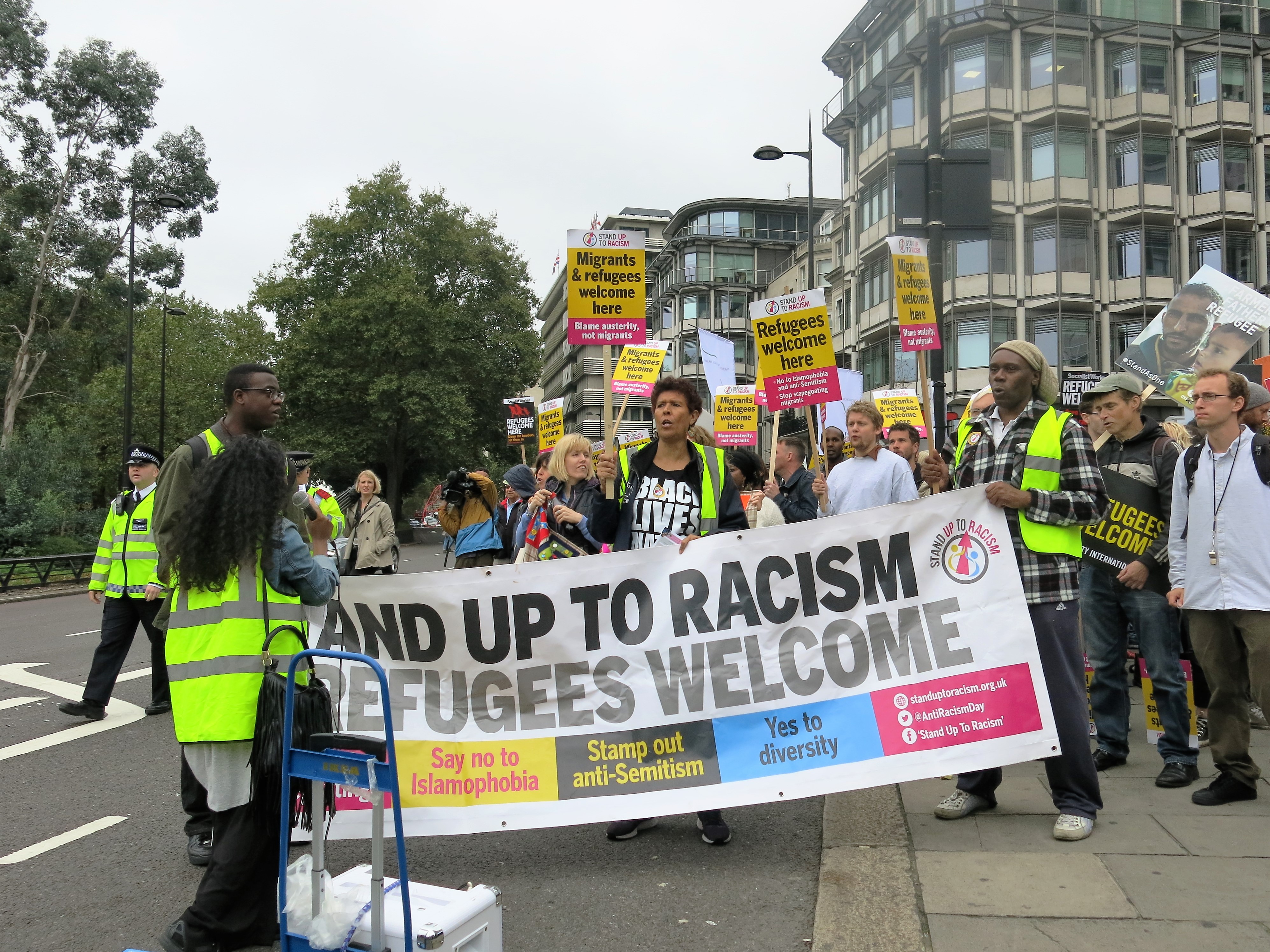
The march in aid of refugees was attended by at least 15,000 yesterday and was good natured and uplifting. It started in Pall Mall, London, and wove its way along Piccadilly ending up in Parliament square. It is encouraging in the current climate to see so many people travel from as far afield as the Wirral and Penzance to show their solidarity for a better treatment of refugees. Britain’s role has been exceptionally poor largely because of hostility towards them egged on by a xenophobic press.
Three year report on the group’s activities is published
The three year report, prepared by our chair, is published and shows what we have achieved over this time. It is always interesting to look back and review progress and for a small group, we have done a lot in the last 3 years.
The death penalty report is now available thanks to group member Lesley for the work in putting it together. The report covers several countries but it must always be remembered that China leads the world in executing its citizens.








 Amnesty in Salisbury & South Wiltshire