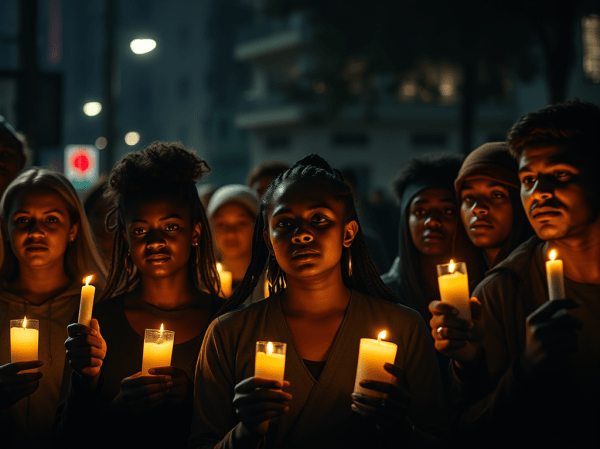
The vigils go on


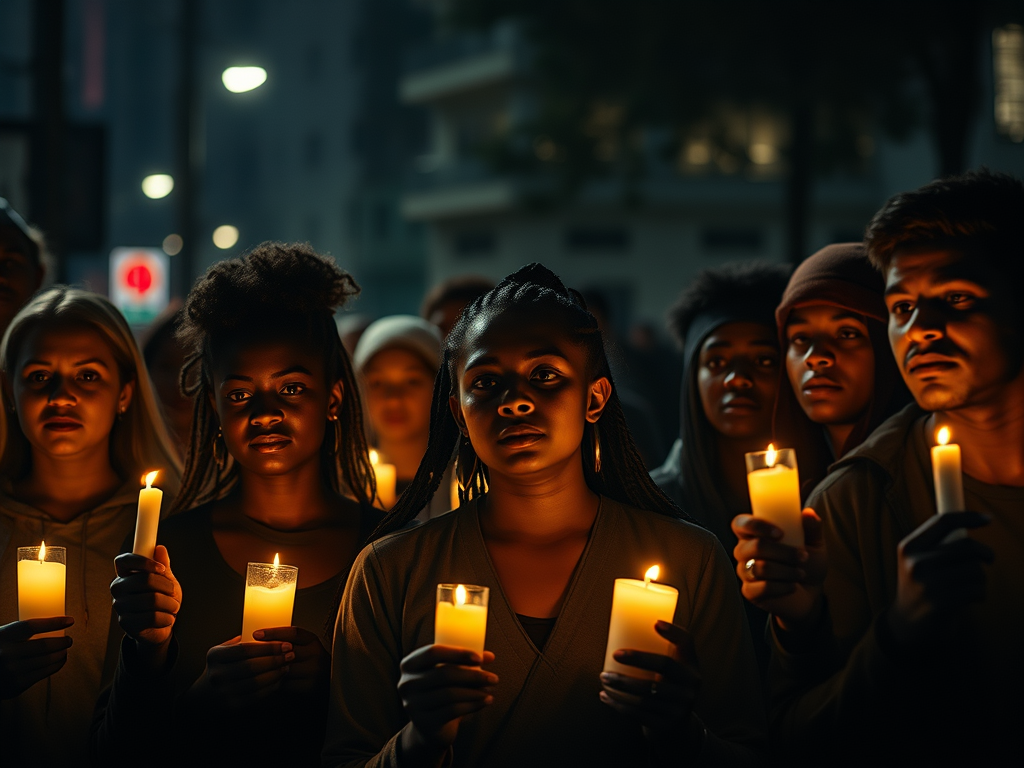
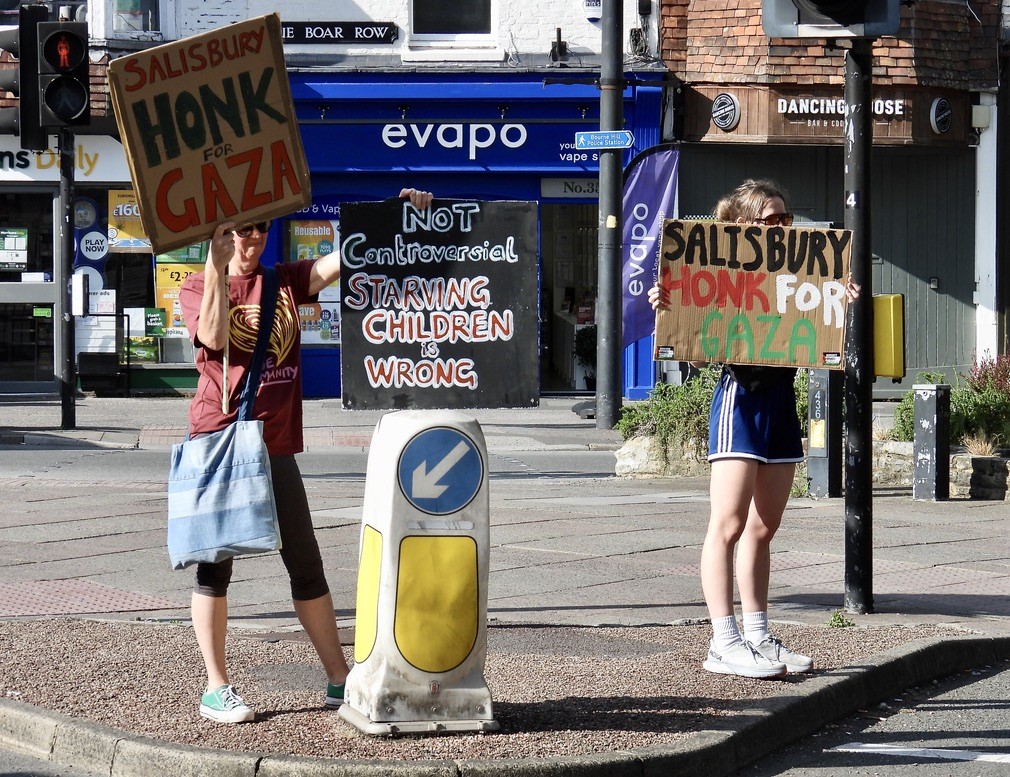
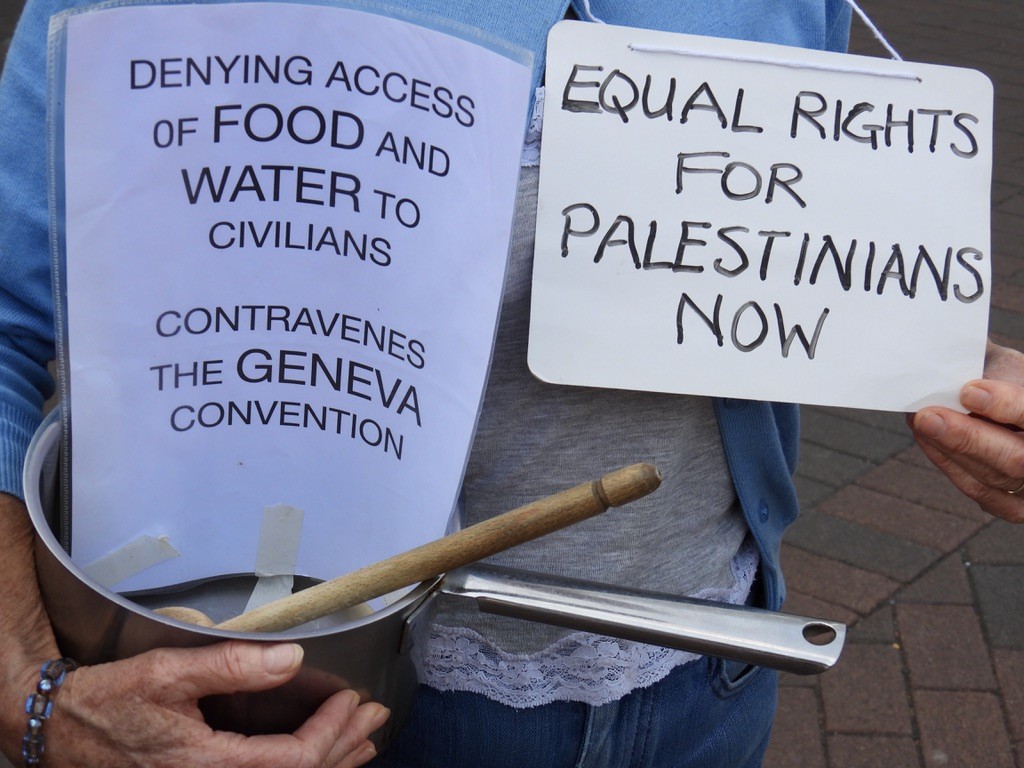
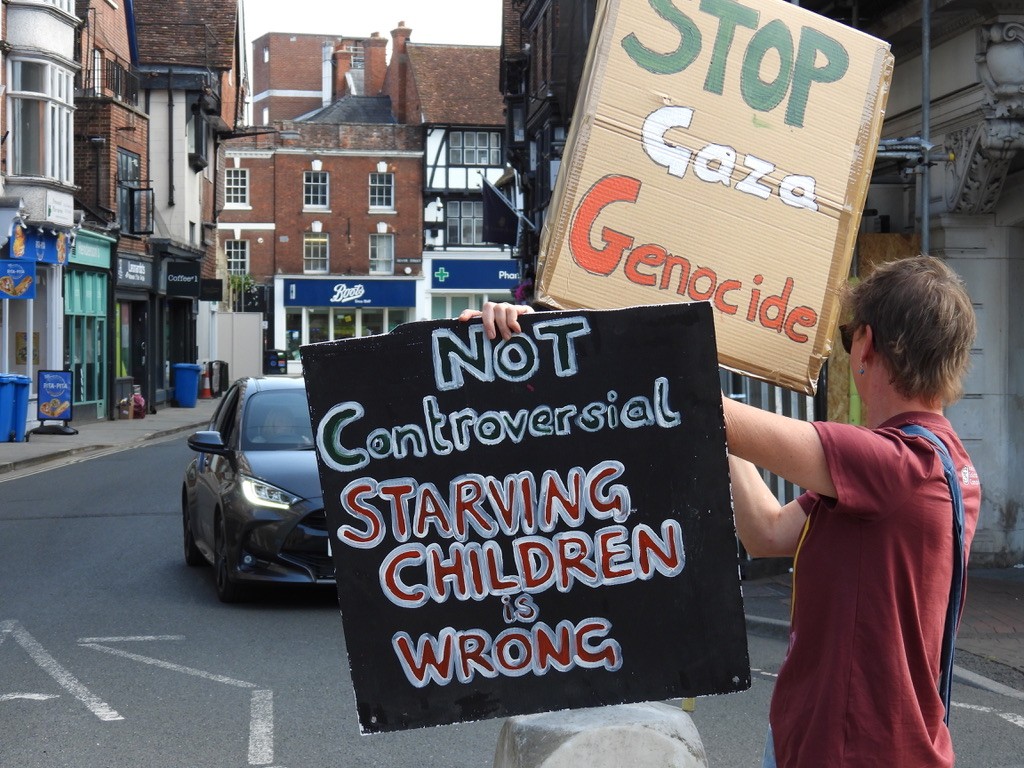
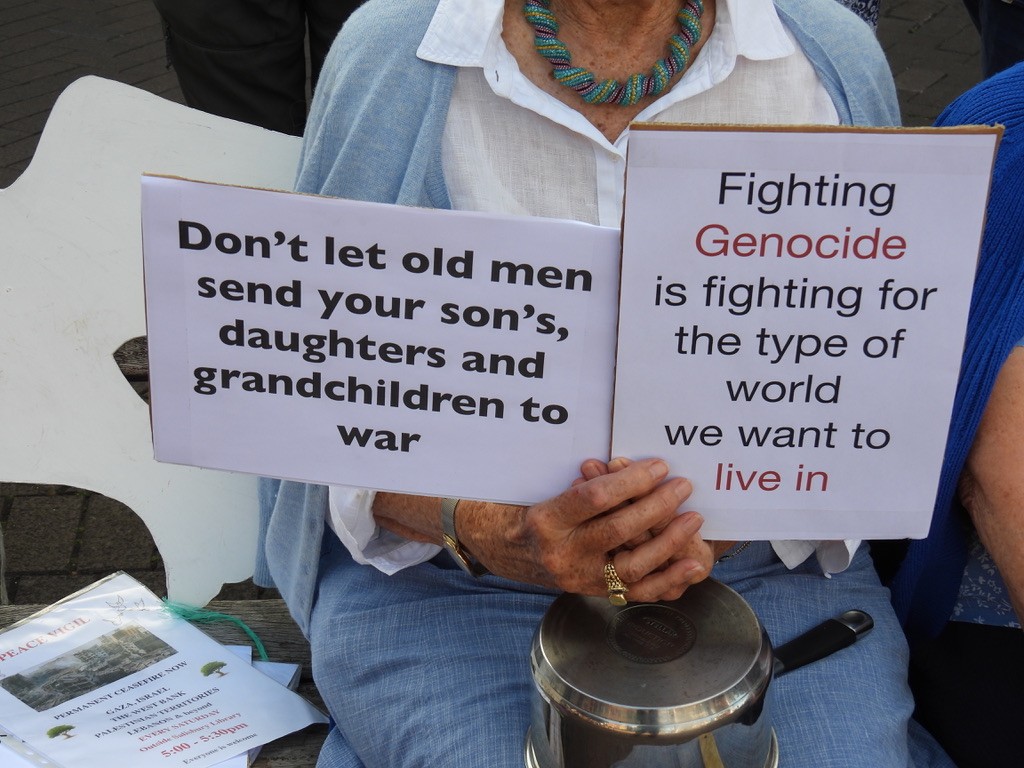
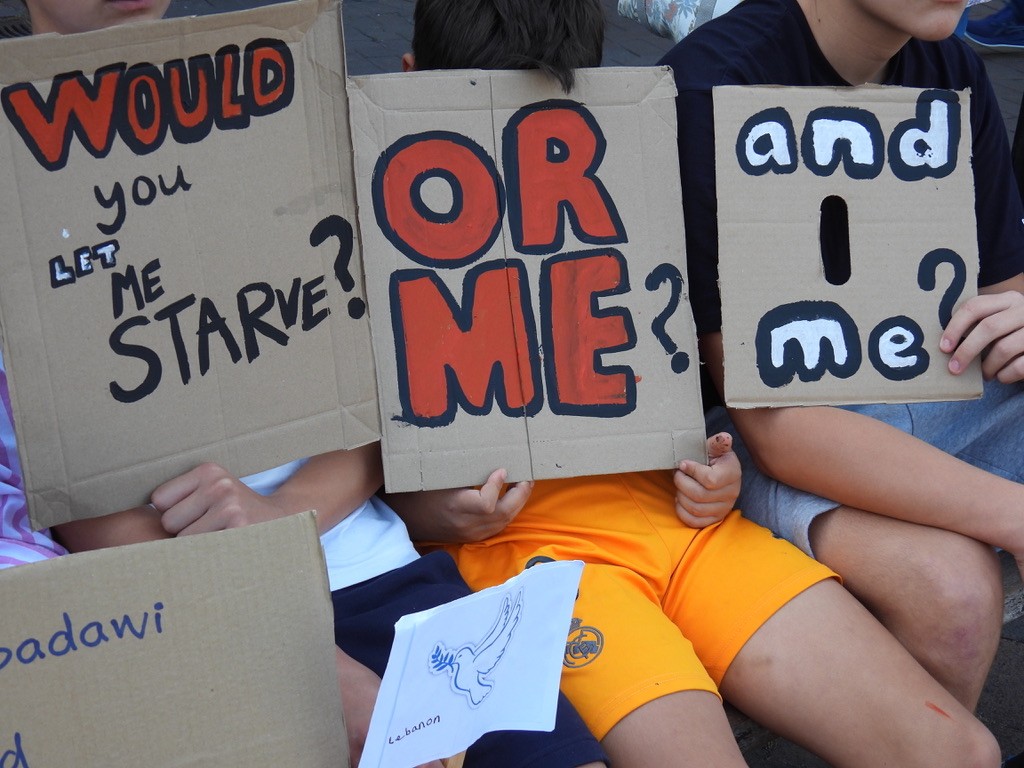
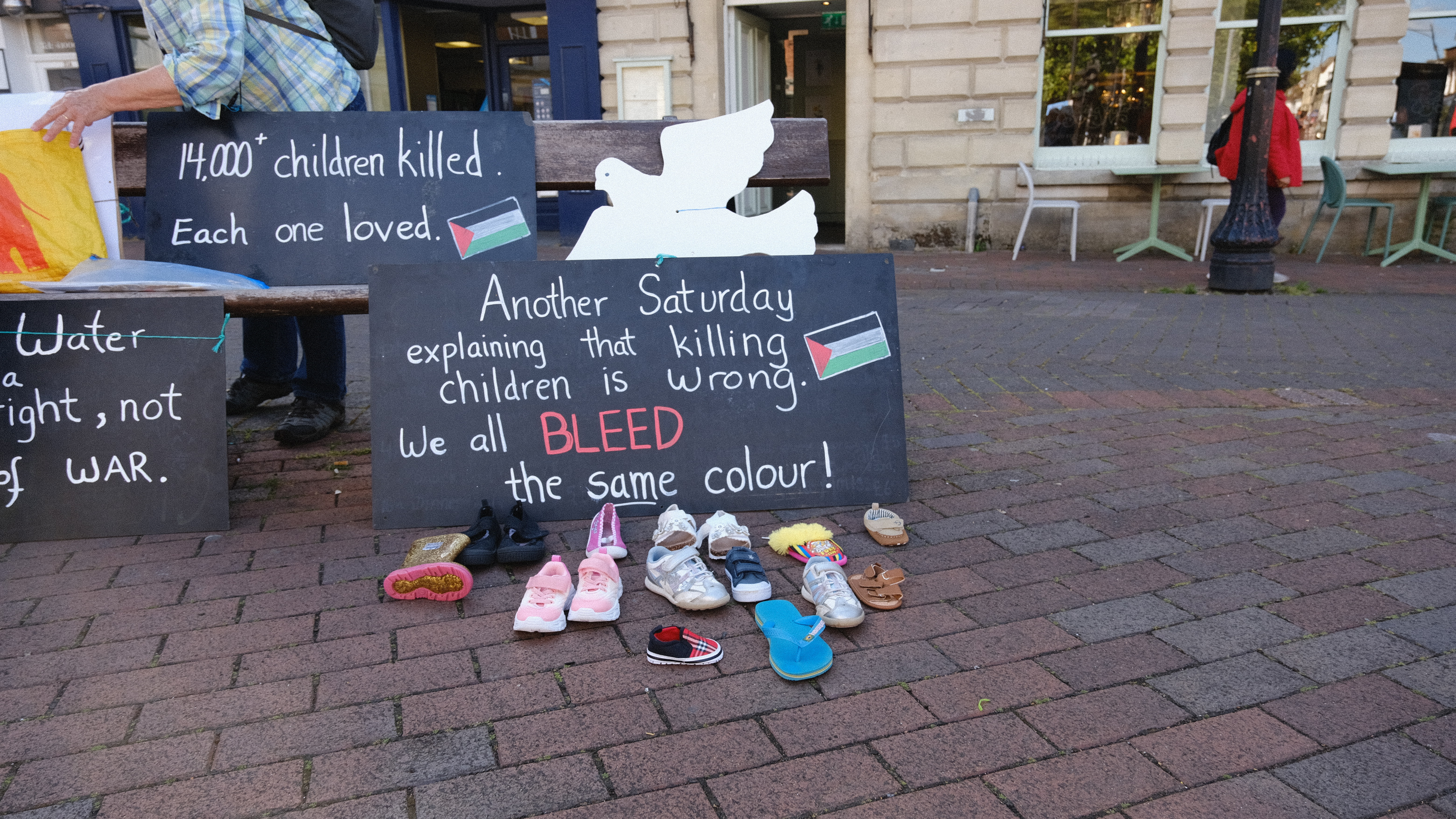
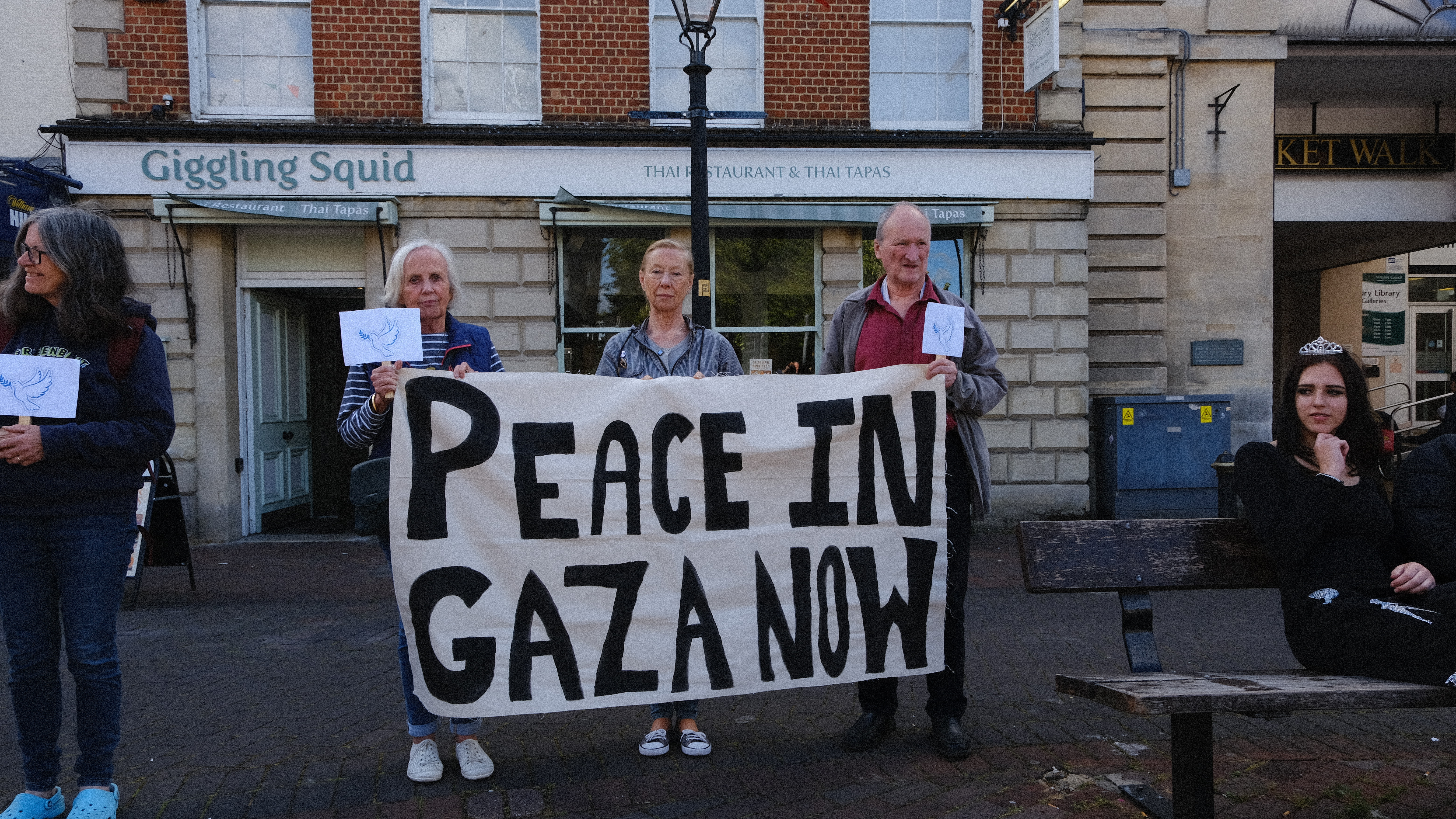
88th vigil well attended. Fears of police action unfounded

August 2025

The vigils still continue in Salisbury with unflagging attendance despite the passage of time. It must be a first that a protest of this nature has carried on for such a time despite an almost complete absence of coverage by the local paper, the Salisbury Journal. It is a demonstration that many people feel outraged by the behaviour of the IDF and the use of starvation as a weapon of war. The number of those dying this way is now over a hundred and the death toll now stands at 61,000 with many thousands more buried in the rubble that is now Gaza.

Many nations – including the UK belatedly – are beginning to withdraw their support from Israel. Germany announced last week that no more arms will be sent. German commentators have called this action ‘monumental’ and one the government would have preferred not to have taken. Germany has spent decades trying to make amends for the terrible events committed by the Nazis in the Second World War. Like many other countries around the world, the disproportionate killing of civilians in Gaza and the increasing death toll from starvation is having a profound effect on public opinion.

The Knesset last week voted to take military control of the whole of Gaza in an operation due to commence in the Autumn. It is interesting looking at the values the IDF profess to have including: The IDF and our soldiers are obligated to protect human dignity. Every individual is of inherent value, regardless of their ethnicity, religion, nationality, gender or status. IDF soldiers appear to have shot 1,373 Palestinians seeking food since the 27 May. Human dignity?

There was a rare weekend meeting of the UN Security Council on 10 August to discuss Israel’s plans to occupy the whole of Gaza seen widely as a backwards step likely to lead inevitable to more death and destruction.

There seems no end to it and the only people who can end it are the Americans who are determined supporters of Netanyahu.

Palestine Action

Over the weekend there were widespread protests and many arrests of those alleged to be in support of Palestine Action, now deemed a ‘terrorist’ organisation by the Home Secretary, Yvette Cooper. Over 500 were arrested. Cooper has defended her action saying people do not know the full truth about the organisation.

The human rights charity Amnesty International’s chief executive Sacha Deshmukh suggested the response to the protest was disproportionate.

He said: “We have long criticised UK terrorism law for being excessively broad and vaguely worded and a threat to freedom of expression. These arrests demonstrate that our concerns were justified.”

RAF flights

The depth of feeling about the government and its continued support for Israel is profound. People are deeply upset at seeing an entire population subjected to the brutal treatment by an extremely powerful army such as the IDF knowing that the UK is supporting them behind the scenes. The RAF continue to overfly Gaza with hundreds of sorties. Over 500 have taken place up to March this year with 215 since Keir Starmer became prime minister. The purpose of these flights is shrouded in mystery and the claim that they are to ‘help locate hostages’ is especially weak: 500+ flights and not to find one? Bit of a waste of money surely? There is no parliamentary oversight of these flights the purpose of which are obscure and troubling.

The RAF enjoys a fine reputation in the UK. Here in Salisbury – where Spitfires were manufactured in various places around the City and the airfield where they left for service is near where this is being typed – especially so. They valiantly defended the nation at the start of the war and ‘the Few’ are the stuff of legend. It is a shame therefore to see them being deployed in what appears to be shady activities in defence of the IDF.


Vigil No 88 – pictures courtesy of Peter Gloyns

Why Labour Leaders Are Pushing for ECHR Revisions: A Political Analysis


Alarming stories that Labour leaders are wanting to reform the European Convention

June 2025

Alarming reports have emerged over the past few days that the current government is considering some kind of revision to the European Convention of Human Rights (ECHR). Figures such as the prime minister Sir Keir Starmer, the Justice Secretary Shabana Mahmood and the Attorney General Lord Hermer have made speeches suggesting disquiet concerning aspects of the Convention. In particular it is article 3: No one shall be subjected to torture or to inhuman or degrading treatment or punishment and article 8: Everyone has the right to respect for his private and family life, his home and his correspondence.

This story has history and the statements by politicians are more than usually disingenuous. To understand the story and the reasons for this recent slew of statements it is necessary to look at causes and why there is a clamour among politicians, some of the public and the media for change.

Stage 1the media

Much of the pressure has come from sections of the media so it is necessary to look at what is going on there. Newspaper readership has declined precipitately. Between 2000 and 2010, the decline was 65% and in the following decade up to 2020 a further 55%. Add in rising costs and declining advertising, and there is something of a crisis in the newsrooms. In this climate, it is cheaper to break into the emails, phones, bank accounts and even houses of the rich and famous, politicians and footballers to achieve a juicy front page, than to carry on the normal business of journalism.

Then came the hacking exposures and the Leveson enquiry which exposed the depth and extent of the hacking and criminal activity. It included senior police officers in the Metropolitan police in particular who sold information to the newspapers. This changed the dynamic of the industry and the notion of privacy was an anathema to their business models.

Over the last two decades there have been hundreds of stories alleging that criminals were not getting their just deserts because of their human rights either because of the ECHR or the domestic Human Rights Act. It was a ‘criminal’s charter’ they alleged. Photos of wanted criminals could not be circulated because of their human rights (they can), police could not evict an armed man until they provided him with a McDonalds hamburger because of his human rights (they could but it was normal practice to accede to requests to cool the situation). Abu Qatada was seriously misreported in the tussle over his deportation to Jordan.

Sadly, positive stories about the acts were almost entirely missing. The Daily Mail used the act to defend its journalist’s rights to protects their sources but strangely forgot to mention this to its readers.

Stage 2the politicians

Then the politicians began to join in perhaps sensing from the newspaper coverage that they were onto a popular winner. After all, if the voters were reading a never ending litany of stories about the evils of the human rights laws and Europe meddling in our affairs, it was a gift. It soon became part of the Conservative manifestos to abolish the act or later reform it. It became tangled up with the Brexit crusade and it is possible that many thought that coming out of Europe would mean that the ECHR would also be history. There was the famous cat story by Theresa May which was almost complete nonsense.

There was meant to be a Leveson part II to look at the unlawful conduct between the media and police but there were allegations that in return for a softer ride from the press, Keir Starmer agreed not to set it up. These allegations are denied. There are no plans for a part II.

Stage 3 – the boat people

As the means to arrive into the UK as a refugee or an asylum seeker diminished so the numbers who took to the boats to cross the Channel rose. This became a matter of massive political importance and the Reform party made huge progress with its promises to stop it. Media stories of asylum seekers being installed in hotels are constant. Despite boat crossings being only a small part of those coming to the UK, they loom large in the public imagination and politicians on the right have taken note of this.

The problem is that the government has obligations under the ECHR and other agreements, to treat asylum seekers in a proper way. Demands to simply ‘send them back’ are difficult to do particularly as ‘back’ can mean a county riven by war or where they can face dire consequences. But in simplistic terms human rights are standing in the way, as Mahmood says: ‘voters say international law stop them achieving the changes they want to see.

Stage 4 – the Reform party

Along came Reform and quickly began to made inroads into the political landscape. The overturning of a massive Labour majority of 14,700 in Runcorn and Helsby by Reform has shaken them badly. Reform has simple answers to matters like immigration which appeal to many and which has defeated both the Conservatives and now Labour. They would pick up boats in the Channel and return them to France. Asylum seekers would be processed off shore. These and other policies quick fix policies appeal to many and saying that they are difficult or impossible to do because of our international obligations carry little weight with many voters. They are even inflammatory particularly with those who have a deep distaste for anything European.

Stage 5 – today

So the Labour government is feeling under pressure. It has not ‘solved’ the Channel crossings problem. It has lost popularity for a variety of reasons quite apart from the discussion here. Reform is making great strides and even ahead in some polls with suggestions that Nigel Farage becoming a future prime minister was not the joke it might once have been. The Home Office remains dysfunctional and would take years to reform even under competent leadership. The party is becoming desperate to be able to counter the tide of dissatisfaction present in large parts of the kingdom particularly in the red wall seats.

So this brings into where we started and speeches about trying to reform elements of ECHR. The sadness is that they cannot. It would take years to carry through any reform in Strasbourg with little likelihood of success. If the government were to resile from either or both articles 3 and 8 would it solve its problems? Again sadly, no. The opposition to human rights laws and agreements have little to do with the people at the bottom of society so to speak. Almost no part of their speeches are about the victims of injustice which human rights are about.

As we have argued, it is sections of the media who have over decades created myths and disinformation about the workings of the laws. It is their business models which are under threat not the fate of asylum seekers. Why else would the Murdoch press spend over £1 billion in keeping the facts of its intrusion and criminality out of the courts? It is an irony – almost a supreme irony – that the much prized sovereignty that people apparently so desperately want is not in fact available to them. The Judiciary are all too happy to allow these hugely expensive legal actions to go ahead and thus subvert justice and free speech. There is no justice in any meaningful sense of the word. The rich and powerful can ‘buy’ silence by paying large sums into court that no one can afford to match.

These speeches appear to be preparing the ground at present in an attempt to match the rhetoric of Reform politicians. Instead of a proper concern for justice, establishing a Leveson II enquiry into the criminality of some of the media and their friends in the police, or tackling the rampant injustice of the defamation laws which serve to protect the rich from proper enquiry, our politicians seek to curry favour and favourable headlines in those very media outlets which have distorted the public’s attitudes to the laws which in truth protect them. The sadness is that the three politicians saying this stuff are experienced human rights lawyers who know it to be a distortion of the truth. A truly bizarre state of affairs.

Refugee report


Monthly report on this politically toxic topic

April 2025

The Government’s Border Security Asylum and Immigration Bill has now completed its report stage and will next go to the Lords.  While this is going on, an update on the numbers shows that the number of small boat arrivals this year so far has exceeded 6000, the highest yet.  Meanwhile the backlog of pending asylum cases has increased to 41,000 in December.

The PM has drawn together 40 nations for his Organised Immigration Crime summit last week.  A press release went without much comment, containing the usual statements about agreeing to enhance border security and dismantle the criminal networks.  One item which did emerge was an agreement with Serbia to exchange intelligence about what is now known as the Western Balkans route into Europe.

Following this event, some 136 organisations under the umbrella of Together with Refugees wrote to the Government, unhappy about the language used by the Prime Minister, which they described as “demonising.”  The PM had claimed: “There is little that strikes working people as more unfair than watching illegal migration drive down their wages, their terms and their conditions through illegal work in their community.”

New research from the European University has suggested that attitudes in Europe to irregular migration are more nuanced and varied than previously supposed.  This was from a survey which covered 20,000 people across Austria, Italy, Poland, Sweden, and the UK designed to understand their preferences on policies regarding access to healthcare, social welfare and labour protections, as well as the obtainment of regular legal status or “regularisation” for irregular migrants. The results challenge the idea that public attitudes toward irregular migrants’ rights are simply “for” or “against”.  Instead, they found that variations in policy design matter – and when policies include both migration controls and protections for migrants, public support often increases.

Unusually, there is some emphasis this month about campaigning.  Refugee Week (third week in June) is this year under the theme of Community as a Superpower with its customary emphasis on small actions. The group might consider an action (s) which might include:

Following our action against denying asylum seekers the right to work pushing for a change in the law. Refugee Action have a petition to sign here and, for more information, you can Read the coalition’s report here. We could arrange our own petition using the Lift the Ban coalition’s resources.

  • Pressing for Salisbury to be a City of Sanctuary (Winchester and Swindon are)
  • A letter writing workshop for supporting asylum seekers (maybe using the Salisbury Ecohub)
  • A vigil for small boat arrivals (as we did a few years ago)
  • Safe Passage want us to write to our MPs about government  policy and the new bill

(They have a standard email, but this could be enhanced).

Also Refugee Action are offering speakers for local groups – they admit they would mostly be online, but they can make visits.

Finally, a recommended read is Labour’s Immigration Policy by Daniel Trilling (who many will remember gave a talk to us some years ago) in the London Review of Books for March.

Andrew Hemming

England’s Cricket Controversy: Taliban and Women’s Rights


Minister supports England playing Afghanistan despite Taliban’s actions against women
January 2025

In a recent post, we criticised the International Cricket Council’s decision to carry on with games involving Afghanistan. This decision was made despite the multiple and atrocious actions by the Taliban against women. A large number of MPs have argued that games should be banned in view of the dire nature of women’s rights in that county.

Lisa Nandy MP, the culture and sports minister disagrees and thinks the games should go ahead. She said in an interview the following:

  • It will deny sports fans the opportunity that they love,
  • She was instinctively against boycotts in sports, partly because they are counterproductive,
  • ‘I think they deny sports fans the opportunity they love, and they penalise the athletes and sports people who work very, very hard to reach the top of their game’,
  • They will not be rolling out the ‘red carpet’ she said and instanced the Winter Olympics, where she was vocal saying ‘we did not give the Chinese the PR coup that they were looking for’,
  • Keir Starmer added that he welcomed the England and Wales Cricket Board making strong representations to the ICC on Afghanistan’s Women’s cricket team. Rather missing the point that the team no longer exists.

It is likely that women in Afghanistan will be unimpressed by these arguments. Sports people being denied the ‘opportunity they love’ has to be set against the fact that women in Afghanistan do not have thls or any other opportunity. Not education, going out unescorted, being seen at a window or work are ‘opportunities’ unavailable to them. They cannot walk the street without being clad head to toe with a grill across their eyes.

And who is the ‘we’ in the statement ‘we will not be rolling out the red carpet’? It has nothing to do with Ms Nandy how much publicity, attention and coverage these games get. As for the prime minister expecting the ICC to make ‘strong representations’ to the Taliban about a non-existant women’s cricket team who have had to flee the country, it is almost laughable if it wasn’t so serious.

The essential question is: will playing cricket with an Afghani men’s team make an iota of difference to the wretched lives being lived by women and girls in that country? It is unlikely. Will playing cricket with an Afghani men’s team make matters worse? Probably. It will send a message to the Taliban that women can be treated abominably yet a British minister – and a female British minister – seems to care more for ‘not denying sports fans the sport they love’ than for women in their country. She is anxious ‘not to penalise the sports people who work so hard to reach the top of their game’. Does not the word ‘people’ include women? They won’t be working hard or working at all to reach the top of their game. Because they are banned.

To pretend that the ICC or any of these sporting bodies will make strong – or indeed any kind of representation – to the Taliban is a fantasy. Sport at this level is about money. And the Taliban will correctly assume that the ICC is more concerned about money than it is about women being allowed to play cricket. Or women being allowed to marry whom they wish. Or girls not being forced into marriage with much older men. Or women being able to acquire an education. Or women being allowed to walk the streets without being totally covered over. Or women not being allowed to get a job. Or women not receiving help and support as a result of domestic violence.

The irony is that cricket was an important element of the British Empire. The game was introduced into more or less all the colonies. But with it came a culture, the idea of gentlemanly conduct, and fair play. It was more than just a game for the colonialists. It was seen as a civilising force. It was a key showpiece for civility. We no longer have an empire but the concepts of the game live on. Yet here we have a situation where cricket is being used by a monstrous regime to promote itself on the world stage supported by a British minister.

Sources include: Portico Magazine, Kent Messenger; The Guardian

Vigils continue


31st Vigil on 6 July. Labour’s relations with Israel now significant following the general election

July 2024

UPDATE 2: The new government has announced (8 July) that it is to drop its bid to delay the ICC’s intention to issue an arrest warrant for Netanyahu for alleged war crimes in Gaza.

UPDATE: It is rare for us to update a post only hours after its publication but we have mentioned the prime minister’s uncertain history in relation to Israel and today, 7 July, he has made a statement committing his party, and now the government, in support of a two state solution. This is to be welcomed.

The vigils continue in Salisbury market place although attendance down to around 25. The conflict continues and although there are reports of peace talks, there is little confidence they will lead to a successful result. Around 38,000 Palestinians have now died including thousands of children.

The conflict spilled into the General Election which was held in the UK last week on 4 July and led to a landslide victory for the Labour party. However some seats were lost and others came close to being lost because of Sir Keir Starmer’s remark early in the election where he said that “Israel has the right to withhold power and water from the Palestinian people” then going on to say that “obviously, everything should be done within International law”. The problem is that collective action against civilians is against international law so the two comments contradict each other. Another, less noticed interview was with the Jewish Chronicle where Starmer was asked about apartheid in Israel and, despite the overwhelming evidence produced by a number of human rights organisations from both within Israel and outside the country that Israel was indeed running an apartheid system, said that Israel was not an apartheid state.

Arms to Israel

It is going to be interesting to see how the new administration handles the arms question and whether it allows further exports going to Israel. The problem for the party is that they struggled for some time to shake off the ‘anti-Semitic’ accusation following Jeremy Corbin’s time as leader. Arguably, this has led them to become fearful of making any criticism of Israeli actions and to become unquestioning supporters.

The Salisbury Amnesty group is 50 this year

Another problem for Israel – and by extension the western countries still continuing to support it – are credible reports of the widespread use of torture by the Israelis. These reports are from the UN; the International Center for Transition Justice; Middle East Monitor; Voice of America; al Jazeera and many others. In the current edition of Private Eye (No: 1627) in its ‘Gaza Watch’ column, is a report of the death in custody of Dr Iyad al-Rantisi in November last year. He was held in a Shin Bet interrogation facility. He was moving south with his family as directed by the IDF and was detained at a checkpoint. Six days later he was dead. A gag order forbade all publication of details of the case and the family have not been provided with an explanation.

He was not alone and a large number of other health care workers have also died. According to Health Care Workers Watch Palestine, 541 such workers have died at the hands of IDF to date, the highest number in any conflict in UN history. Other agencies report comparable numbers. Private Eye also quotes the EU’s European Civil Protection and Humanitarian Operations directorate which reports that 31 out of 36 hospitals in Gaza have been destroyed.

The next vigil will take place on Saturday 13th at 5pm and people concerned about the conflict are welcome to come along.

Protests

It’s perhaps also interesting to note that our protest is entirely silent and there are no loud-hailers. We undertake no violent actions and we do not chain ourselves to railings or other similar activities. We do not therefore infringe the previous government’s laws designed to limit protest. As a result we are ignored and we will not be reported on by local media. A matter on which to reflect for those who say they do not mind protests as long as they’re peaceful.

1720887540

  days

  hours  minutes  seconds

until

Salisbury Vigil

Good attendance at vigil


December 2025 UPDATED A good attendance at the 106th vigil in Salisbury with around 40 of us there. We were joined by some by some passers-by which is always encouraging. News about Gaza has been eclipsed by the continuing war in Ukraine and the appalling attack on Jews on Bondi Beach killing 15 people on…

Minutes and Newsletter, December


Minutes of our December meeting December 2025 We are pleased to attach our minutes and newsletter for the December group meeting thanks to group member Lesley for compiling them. They include several reports some of which appear elsewhere on this site with links to other sites of interest. Item 12 refers to upcoming events which…

UK Human Rights Report: Current Threats and Government Actions


Monthly report on human rights in the UK December 2025 Amnesty has for many years, focused its efforts on human rights issues overseas. Recent actions by governments of both persuasions have meant a greater focus on the threats to rights here in the UK. Only this very week, the prime minister and other ministers are…

Apartheid in Israel


The group hosted a talk on the Apartheid state established by Israel against the Palestinians

June 2023

UPDATE: 17th June. British parliament to debate the UK/Israel trade agreement in which there is a risk that illegal settlements will be recognised to be Israeli

On 13th June, the Salisbury group and Salisbury Concern for Israel Palestine (SCIP) hosted a talk on the apartheid state established by Israel against its Palestinian citizens. The talk, with slides and film clips, was given by Garry Ettle who is the voluntary coordinator for Israel, Palestine and Lebanon. It was mostly built around the report Amnesty prepared last year.

The speaker went through the main thrust of the report’s conclusions and the evidence compiled by Amnesty over a three or four year period. It is some 280 pages in length and together with similar reports by Human Rights Watch, B’Tselem in Israel (who first used the apartheid term) and the UN, represents a compelling case of how the Israel authorities have created a two state solution where the Palestinians are deprived of land and housing, denied economic and social rights, suffer from the segregation of their communities and they are subject to illegal acts against them including the arrest and mistreatment of Palestinian children.

The denial of rights for Palestinians is enshrined in the 2018 Nation State Law which says that the ‘State of Israel is the nation state of the Jewish people’. This follows years of oppression which started in 1948 with the expulsion of thousands of Palestinians and the destruction hundreds of their villages. Since 1948, 700 new Jewish settlements have been created but no Palestinian ones have been allowed. Palestinians are caught in a kind of Catch 22: their properties are demolished because they do not have permits but permits are almost never given.

The policy of fragmentation means travel around Israel is almost impossible. Gaza is essentially an open prison, with travel out of it almost impossible and there is a 3 mile limit from the coast. It is surrounded by a buffer zone. The most distressing evidence during the presentation was the arrest of children in the middle of the night who are then held, sometimes in solitary confinement and there is evidence of rough treatment.

Response

Despite the huge weight of evidence from several agencies compiled over several years, the Israeli government has not sought to refute it. They have simply accused the agencies, and Amnesty in particular, of being anti-Israel and anti-Semitic. There has been no point by point rebuttal of the evidence.

UK Government

The response by UK governments over many decades has been shameful and continues today even after the compelling evidence of the various reports mentioned above. Rishi Sunak, now the prime minister of the UK in an interview with the Jewish Chronicle in August 2022, praised Israel as “a beacon of hope“. When asked about the Amnesty report in particular said “[it] could only make a solution to the Israel, Palestine conflict more elusive“. He then made the outrageous claim that “those who label Israel an apartheid state also deny Israel’s right to exist”. But arguably the most egregious remark in the interview was “the Amnesty claim is not only factually incorrect but frankly, offensive“. No evidence is provided for these remarks and it simply seems to be an echo of the Israeli government’s own propaganda.

The Foreign Office simply says it is “aware of these reports and does not agree with the terminology used within them” (August 2022). Again, no evidence is provided. The full statement of UK government which follows is considerably one-sided. It is in response to a petition following the various reports.

[…] As a friend of Israel, we have a regular dialogue with the Government of Israel. This includes encouraging the Israeli government to do all it can to uphold the values of equality for all. Minister for the Middle East, Amanda Milling, emphasised this point in her recent meeting with Israeli Deputy Foreign Minister Roll during her visit to Israel and the OPTs“.

The response simply does not address the huge imbalance of power between the Israeli’s and Palestinians. It is blind to the fragmentation of territories which make travel for Palestinians almost impossible. To read the weight of evidence in the three reports and compare it with the FCO’s response is to wonder if it is the same country being described.

Labour Party

Labour has had its own problems concerned with alleged anti-Semitism within the party in the Corbyn years. In a video interview a year ago with Sir Keir Starmer by the Jewish Chronicle, Sir Keir was asked about the Amnesty report and did he agree with the apartheid claim made by Amnesty? His response was “No, I’m very clear about that. It is not the Labour party position”. Once again, a simple denial with no explanation. He was very insistent earlier in the interview about his desire to ‘root out anti-Semitism’ within the party.

The accusation of anti-Semitism against anyone who criticises the actions, over many decades, by the Israeli government against its Palestinian citizens seems to have struck terror into our politicians. Terrorist attacks by Palestinian groups against Israeli settlements are rightly condemned. But the numbers of Israelis who have died is but a tiny proportion of the numbers of Palestinians who have died at the hands of Israeli forces.

To criticise Israel and to provide copious evidence of its policy of apartheid, is not anti-Semitic. The evidence shows that it is and it is up to the Israeli government to rebut the evidence presented in the reports.

Starmer denies apartheid report


Sir Keir Starmer – leader of the UK Labour Party – does not accept the Amnesty report on Apartheid in Isreal

Sir Keir is quoted today* saying that ‘he did not accept the findings of the Amnesty report that Israel is an apartheid state’. This was said in connection with a visit by representatives of the Israeli Labor party in London.

Amnesty is not the only organisation to find that Israel is running an apartheid state. In January 2021, B’Tselem – an organisation based in Israel – produced a detailed report which concluded the same thing. This was followed by Human Rights Watch in July who also produced an extremely detailed report which also concluded that Israel was an apartheid state. Then there was the Amnesty report in February this year closely followed by the UN special rapporteur’s report in March. Four trusted organisations, all of whom producing factual and detailed reports and all concluding that Israel was indeed running an apartheid state as far as the Palestinians were concerned. Exactly as in South Africa, rights were removed, homes were demolished, movement restricted and two sets of laws created for Jews and Palestinians.

It is therefore extremely difficult for Sir Keir Starmer to deny the conclusions of the Amnesty report without also denying all the others. The Labour party was bedevilled by allegations of anti-Semitism during the Corbyn years a stain which still remains. Unfortunately, any criticism of the state is met by claims of anti-Semitism. All the above reports were so condemned.

Sir Keir is no doubt sincere in his desire to rid his party of any anti-Semitism. But he will not do that by denying the facts. If he does not accept the Amnesty report (and by extension all the others) he should rebut it item by item. It is disappointing that someone who wants to become leader of the country and import some integrity into our politics, should act so cravenly.

*Guardian 29 April 2022

Further link added 1 May 2022

Significance of the new Labour Party leader


Appointment of Sir Keir Starmer is an encouraging development for human rights

In previous posts, we have noted the campaign by some members of the Conservative government and  some parts of the press, against the Human Rights Act and the desire to abolish it.  The election of Sir Keir Starmer as opposition leader is an encouraging development therefore.

Sir Keir Starmer, the new Leader of the Opposition is, famously, a barrister.  He was also, famously, the Director of Public Prosecutions, a man who decided what charges should be brought and against whom. So what should we expect from a party led by someone deeply involved in human rights questions at a time when rights are under enormous pressure, not just globally but also in this country?

Once the coronavirus episode is over and normal(ish) political business returns, one of the first matters to be considered will be the increased power the government has accrued during the emergency, and what to do about it in the future.  The Labour Party has supported the emergency powers for the next 6 months, but will clearly need to review this at an early opportunity. Starmer has not expressed a view as yet, but we know that much of his previous work has been in defence of persons threatened by an overweening state.

Starmer’s career was built on work in the human rights and civil liberties field, notably in cases like the McLibel affair (environmentalists sued by McDonald’s over claims made in a factsheet) and East African and Caribbean death penalty cases.  He was named as QC of the Year in the field of human rights and public law in 2007 by the Chambers & Partners directory and in 2005 he won the Bar Council’s Sydney Elland Goldsmith award for his outstanding contribution to pro bono work in challenging the death penalty throughout the Caribbean and also in Uganda, Kenya and Malawi.  From 2003 to 2008, Starmer was the human rights adviser to the Policing Board in Northern Ireland.

Now we have (more or less) left the EU, extremists within the government may well want to detach us from the European Convention on Human Rights (nothing to do with the EU, remember), as well as rescinding the Human Rights Act.  Starmer has publicly defended the ECHR in debate (see The Lawyer 15/9/15).  In his Blackstone Lecture of 2015, he refuted the arguments against the existing HRA in considerable detail.  He has also written text books on the HRA, so is fully versed in the minutiae.

Martin Kettle has noted the change in outlook on human rights within the legal profession following the Act (see Prospect Magazine Feb 2020), and Starmer’s position at the forefront of this change.  With a liberal judiciary under pressure at the moment, his support may be important in the coming period.  Starmer will face attacks from left and right, but will be used to that.

It is notable that the Daily Mail is already leading the charge against the new man, tarring Starmer as a defender of IRA bombers (but then the Mail’s grasp of what lawyers actually do has always been rather tenuous).  The tabloid press are, of course, hostile to Starmer anyway since his decision as DPP to prosecute them over phone-hacking.

From the left, he has been criticised for – during his time as DPP – not pursuing the prosecution of the police officers accused of killing Jean Charles de Menezes and Ian Tomlinson (although in the latter case, he changed his mind in 2011 when new evidence came to light).  Also, he announced that MI5 and MI6 agents would not face charges of torture and extraordinary rendition during the Iraq War, concluding that there was insufficient evidence to prosecute, as James A Smith has pointed out in the Indy (9/1/20).

Sir Keir has given a clue as to his approach by appointing as his chief legal colleague on the front bench, David Lammy, while Lisa Nandy will be at foreign affairs, both of them with good records on human rights issues.  Lammy has been leading in parliament on the Windrush scandal, while Nandy has been strongly supportive of making businesses report on the human rights impacts of their operations.


Blog at WordPress.com.

Up ↑