Burma: the killing continues


Proposed elections are a sham. Sanctions are patchy and ineffective

August 2025

Myanmar, Sudan, Ukraine, Gaza: what links these current conflicts where thousands of women, children and the elderly die or have their homes destroyed? All are conflicts where the warring parties are equipped and supported by outside countries many of which are on the UN Security Council. Myanmar is armed and supported by Russia and China together with India and Austria with Singapore often acting as the go-between. Russia’s invasion of Ukraine is supported by China, Sudan by the UAE and Israel’s genocidal actions by America principally with other western countres in the frame including the UK.
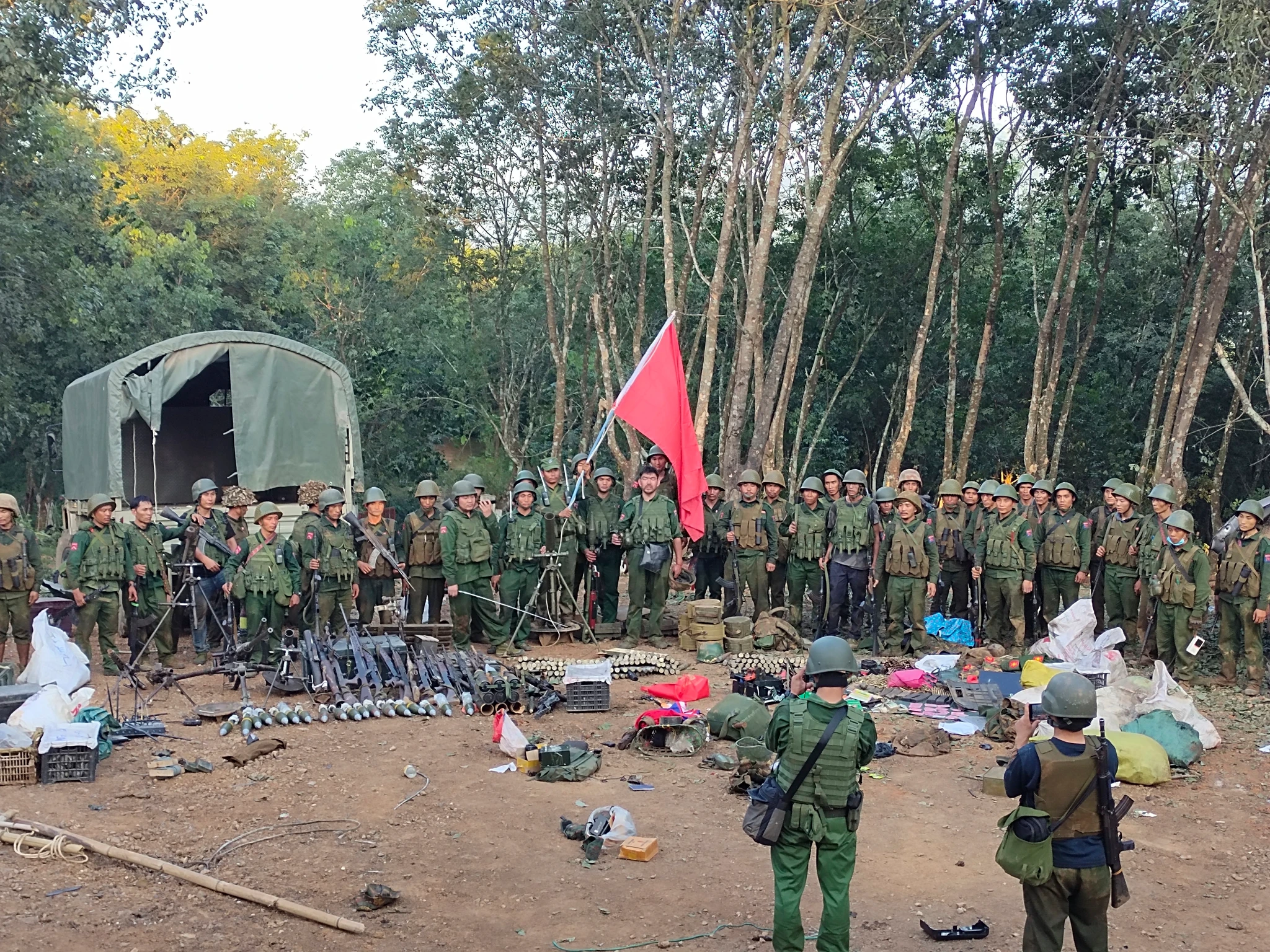
It is unlikely these conflicts would be as deadly or last as long if it was not for this outside influence and support. The support takes different forms. The straightforward supply of weapons and military materiel. Providing the financial pathways to enable the regimes to engage in trade and pay for the weapons. Allowing western countries to trade with the regimes and buy their exports. And frustrating efforts by the UN to broker peace efforts or reign in the activities of the outside countries. The Security Council supporters of the regimes frustrate these efforts by vetoing motions and allow the carnage to continue. The noble aims of the post war era when the UN was formed and there was meant to be a new world order is in tatters.

The latest edition of Burma Campaign News (Edition 48) is to hand and contains updates on the long running conflict in that country with 50,000 dead in the last four years. The country has slipped out of the news due largely to conflicts close to home and the difficulty and danger of reporting from there. After six decades of conflict, killings and attacks on minorities, the only good news is that the military is not having it all their own way. A combination of resistance, strikes, and economic boycotts, the military is slowly losing ground. The bombing of schools, hospitals and homes continues with around 5 million forced to flee. Elections are planned which will be a sham.

Many countries, including the UK, impose sanctions on the country. Unfortunately, as Office of the High Commission for Human Rights (OHCHR) points out in a report, these sanctions are not coordinated. This means there are gaps and what is sanctioned by one country may not be by another.

“There were 165 distinct entities sanctioned by the United States, European Union, and United Kingdom in response to the military coup in 2021.69 The report concluded that while the US, EU, and UK state that they are coordinating sanctions, there are significant missed opportunities to implement sanctions regimes in a coordinated manner. The report stressed that as of 1 February 2023, a mere 13 percent of the 165 entities were targeted by all three sanctions regimes, 20 percent by two, and 67 percent by only one. The report concluded that the gaps in the existing sanctions regime make it easier for the Myanmar military to evade sanctions. The report also noted that Member States seem reluctant to sanction high-impact targets such as Myanma Oil and Gas Enterprise (MOGE), which is sanctioned only by European Union, and aviation fuel, for which Canada has imposed wide ranging sanctions as of March 2023 and the UK has imposed targeted sanctions. 110. While these sanctions have been welcomed by the National Unity Government, Myanmar civil society, and international NGOs, they primarily regulate the engagement of persons under the jurisdiction of the Member State.70 As such, in the absence of economic sanctions imposed by the UN Security Council, third country actors are not legally prohibited from doing business with the sanctioned regime, person, or organization”. (Para 109)

A key source of revenue for the regime is the telecoms company Mytel described as the ‘jewel in the crown’ of the Burmese military and is highly profitable. The US sanctioned the company in January this year ‘for providing surveillance services and financial support to Burma’s military regime, enabling the regime to carry out human rights abuses through the tracking and identification of target individuals and groups’. The UK by contrast has not sanctioned them. Burma Campaign suggests contacting the Foreign Secretary asking for sanctions to be imposed: action.burmacampaign.org.uk/tell-british-government-sanction-mytel where there is a link.

A BBC report features the role of global arms firms in Burma.

A useful source of information on companies is to be found at the Business and Human Rights Resource Centre. Another useful site is Action on Armed Violence.

Recent posts:

Burma: a forgotten conflict


Violence continues in Burma while the West does little

August 2024

One thing which helps a tyranny to survive and prosper is for people to look the other way. In Burma, the military has held sway for many years now and there was a belief that they were invincible and would eventually win. Three million have been displaced according to the Burma Campaign although the UN calculates the figure to be 2.3 million. Burma seldom makes the news and certainly not in comparison with Gaza and Ukraine. This relative obscurity has enabled the military, the Tatmadaw, to continue its murderous campaign and the assumption of their eventual victory meant countries and companies kept their powder dry in terms of its relations with them.

The previous UK government’s responses ‘slowed to a standstill’ according to the Burma Campaign in their latest campaign news (Issue 46, 2024). A crucial issue was the supply of jet fuel and there has been a campaign to stop the supply of this fuel which is used by the military to bomb schools, hospitals and villages. At a meeting of the UN Security Council in April, the USA and Malta called on the Council to take action to stop the supply of this fuel. In itself this was a huge step. The UK government did not support this move and unfortunately, Britain leads on Burma in the Security Council (ibid).

The lack of attention by the British media meant little pressure was put on the Conservative government to take an active role. We now have a new government and Burma News asks ‘What does the new government mean for UK Burma policy?’ It is of course early days but it does not look promising. Sir Keir is focused on the domestic agenda but has spoken on the plight of the Rohingya in the past. Disappointingly, the Foreign Secretary, David Lammy has shown no interest both recently and while he was in opposition. Other Labour politicians have offered some support but they do highlight Rushanara Ali MP who was very active and was chair of the All-Party Parliamentary group on Burma and Rohingya. She is now a housing minister so cannot continue in that role.

Aung San Suu Kyi became a hero and her time under house arrest attracted considerable international attention and sympathy. It was a huge disappointment to discover upon release that the party she led, the National Lead for Democracy, was vigorously in favour of the Rohingya genocide. She defended the military at the Hague. Although the situation is complex the basic point is that there is no desire by the NLD for Burma to be a multi-ethnic state. They believe the Bamar to be superior and there is a desire is for it to be exclusively Buddhist. The West’s image of Buddhists also came in for a knock. She is however, a popular figure still in the country.

Attitudes and policies may need a rethink however because the military it now appears is losing ground. Far from being invincible, the People’s Defence Forces have been winning back territory in many parts of the country. The UK government’s softly, softly approach and the Foreign Secretary’s lack of interest may need to change.

Burma


Problems in Burma get overlooked because of events elsewhere in the world

August 2023

Burma crops up from time time in the news and this week (w/c 31 July) the partial release of Aung San Suu Kyi into house arrest briefly made it into news bulletins. These notes are taken mainly from Issue 44 of Burma Campaign News published by the Burma Campaign. The country remains subject to some of the worst treatment of people in the world with multiple examples of human rights infringements. Following a massive defeat of the military in elections in 2020, after half a century of control, they staged a coup the day after the newly elected government was due to take office and arrested Aung San Suu Kyi.

The effects of military control have been atrocious. Nearly 2 million have had to flee their homes. There are around 2000 political prisoners. The treatment of the Rohingya amounts to genocide. The military have been able to retain control because they can still acquire arms mostly from the Russian Federation but also from China, Singapore with smaller amounts from India and Thailand. The total amounts to around $1bn according to a UN report.

The Burma campaign has identified a ‘Dirty List’ of suppliers and have recently added 5 insurers who provide vital insurance cover without which the junta would not be able to acquire aviation fuel. They name the companies as UK P&I; Steamship Mutual; Britannia P&I and North Standard and Shipowners Club. The role of these companies was exposed by Amnesty in a report ‘Deadly Cargo‘. The UK government has so far failed to impose sanctions preventing British companies supplying aviation fuel.

While the situation in Burma is dire, the supply of arms and materiel from western countries is thought to have largely stopped according to the Campaign Against the Arms Trade. A major jewellery company has stopped sourcing rubies from the country. There have been two debates in the House of Commons and one in the House of Lords.

Little can be done to alter the situation especially while China, Russia and Singapore – the major conduit for arms – continue to supply the junta and enable them to stay in power. Singapore claims it has a policy to prohibit the transfer of arms to Myanmar, however, the UN report uncovered $253m of supplies shipped to the military between February 2021 and December 2023.

Cyclone Mocha hit the country in May and the military blocked aid to the Rohingya who were particularly badly hit as part of its genocidal policies towards them. An unknown number of people have died and many have lost homes, livestock and fields have been destroyed.

Attention on the country has often focused on Aung San Suu Kyi who was awarded the Nobel Peace Prize in 1991 and was admired in the West for her heroic stand against the generals. Her reputation suffered a precipitate slide during the Rohingya crisis where she seemed unwilling to condemn the military actions and even seemed to support them at the Hague. She was perhaps endowed with qualities which were unreal and her failure to condemn the brutality against a minority population was a truer indication of who she was. The decline in her heroic status is possibly a reason why attention has shifted away from the country and the continuing activities of the military.

An infographic can be accessed here.

Sources: UN, Burma Campaign, HRW, CAAT, Amnesty International, BBC

Blog at WordPress.com.

Up ↑