Vigils to continue. Violence intensifies on the West Bank
January 2025
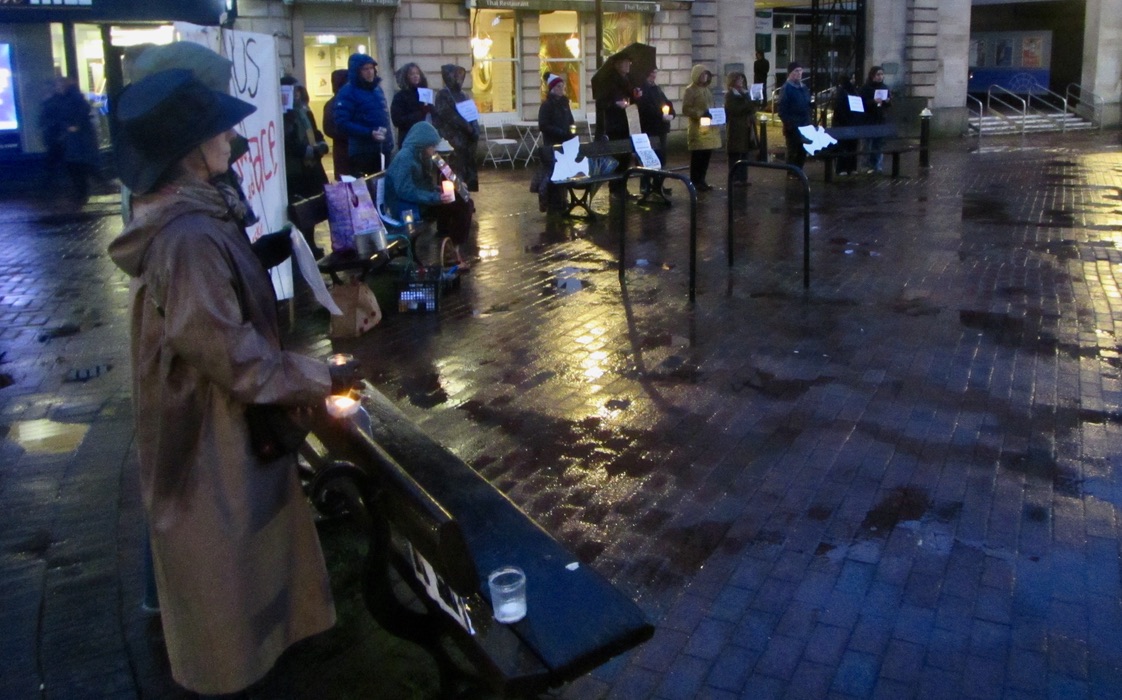
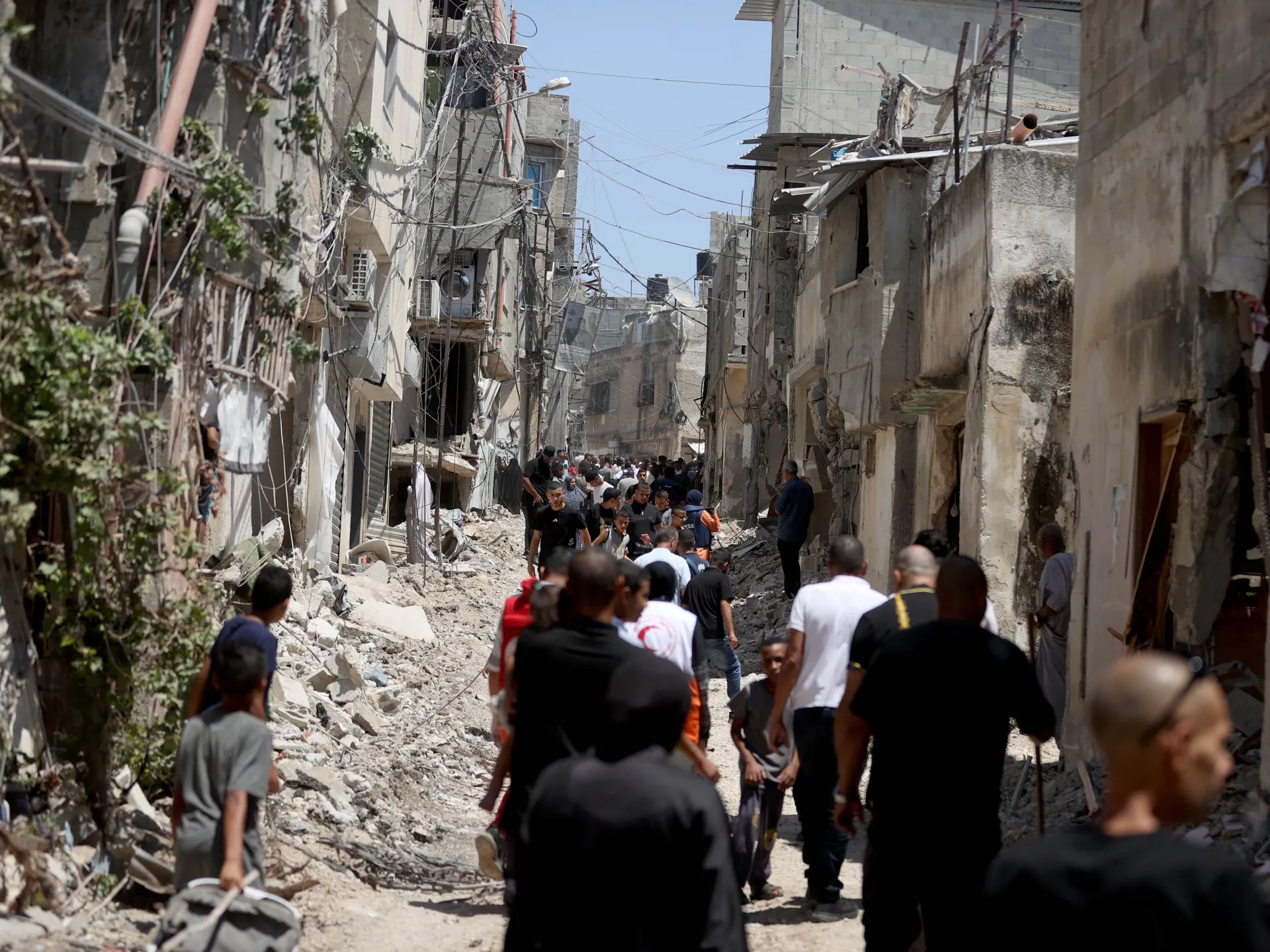
In a previous post we said we hoped that tonight’ vigil (25 January) would be the last following the cease fire deal agreed. It seems we were a trifle premature. Although the deal is holding for the moment with three more hostages released today, violence in the West Bank has escalated with settlers attacking Palestinian villages and setting fire to homes and vehicles.
“No such thing as a Palestinian” Mike Huckabee
But the biggest worry is the future with the impending appointment of Mike Huckabee as the US Ambassador to Israel. President-elect Donald Trump announced on Tuesday that he has nominated former Arkansas Governor, Mike Huckabee who is a strong defender of Israel who once argued that there was “no such thing as a Palestinian.”
Trump is quoted as saying: “Mike has been a great public servant, Governor, and Leader in Faith for many years. He loves Israel, and the people of Israel, and likewise, the people of Israel love him. Mike will work tirelessly to bring about Peace in the Middle East!”
Gov. Huckabee has been staunchly pro-Israeli throughout his career – including on what he says is the country’s claims to the West Bank. On Wednesday he said it was “of course” possible that the US would back the Israeli government if it were to try and annex the Israeli-occupied territory. The full throated support for Israel’s claims to the West Bank and the denial of a Palestinian state or indeed a two state solution, can only mean an increase in tensions in the area. The Atlantic reports that the majority of American Jews (66%) support a two state solution. He has also gone further than most US politicians with his stance on the West Bank saying: “There is no such thing as a West Bank. It’s Judea and Samaria. There’s no such thing as a settlement, they’re communities, they’re neighbourhoods, they’re cities.”
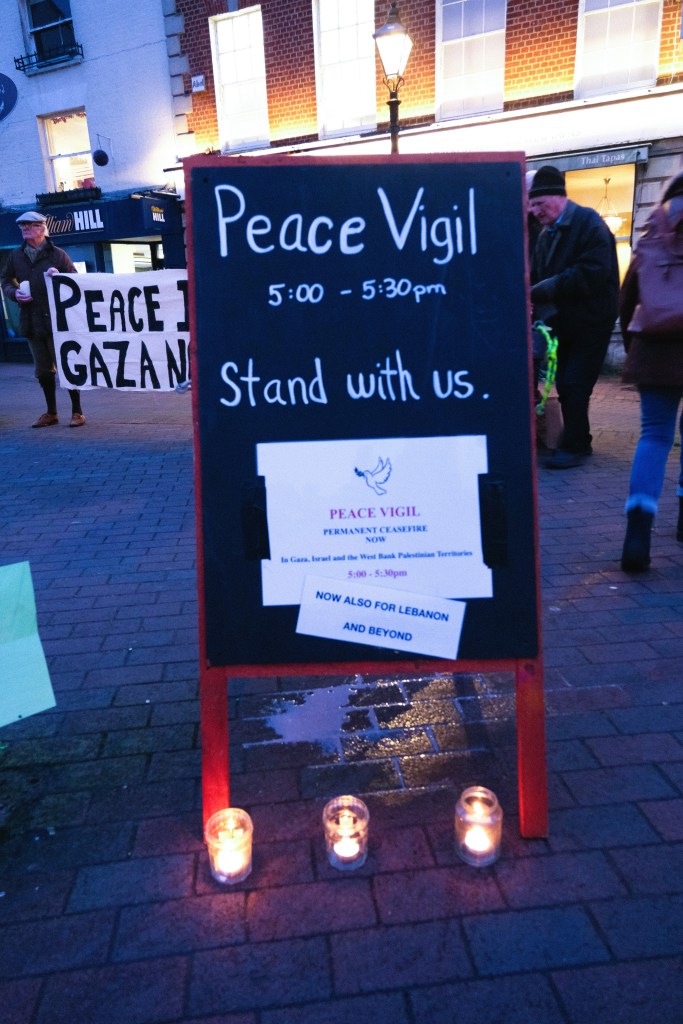
As a result, we shall be continuing with our vigil and we shall be back next Saturday 1st February at 5pm. Over 40 attended today (25 January) and we had a display of flowers thinking we had a small thing to celebrate. The increased violence in the West Bank and Huckabee’s likely appointment means continued violence is a likelihood.
Sources include: Jewish Chronicle, The Atlantic, CNN,
A talk by Nick Papadopulos describing his time in this city
September 2024
CORRECTED: 14TH September
Nick (pictured below) is the Dean of Salisbury Cathedral and has spent three months in this troubled city earlier in the year. He gave a talk last evening (September 11th) in St Thomas’s Church in the centre of Salisbury. Over 200 attended.
The conflict in the region raises great passions which are not to be seen in the same way with the Ukrainian conflict for example. Russia’s bombing of civilian targets and key infrastructure is seen straightforwardly as a war crime. The destruction of huge chunks of Gaza is not seen in such black and white terms. The increasing settler (and the word ‘settler’ came up in the talk, see below) violence receives only modest attention by news media or politicians. Indeed, Papadopulos commented on the reluctance of politicians in the UK to say or do much seeing the conflict as ‘toxic’ he said. The recent decision by the UK government for a modest reduction in arms sales suggested an effort to assuage those who argue for a total ban and a reluctance to upset the Israeli government. It looks as though they have achieved neither, one of the perils of fence sitting.
‘You can’t be neutral’
He gave a brief history of key events in the recent past starting with 1948, the declaration of the state of Israel and the displacement of three quarters of a million Palestinians which they refer to as the Nakba. He briefly discussed the 6 day war which saw the new state annex large areas of land in the region. These have been given up but they obtained control of Jerusalem, the West Bank, Golan Heights and maintained control of Gaza. Sanai reverted to Egypt. In answer to a question on this he emphasised that it was true that Israel no longer occupied Gaza but they did control it. It became the largest open air prison in the world with no access by sea or air and surrounded by checkpoints.
He described witnessing some of the arbitrary restrictions imposed by Israel on citizens in Jerusalem. One concerned a wish by Moslems to enter parts of the city to pray at the Al-Aqsa mosque. Restrictions were suddenly imposed which included only allowing men over 55 to enter and women over 45 likewise. New ID cards and a permit required giving them no time to acquire them. The result was that almost no one got in.
It was not just Moslems but similar restrictions applied to Christians who wish to celebrate Palm Sunday. 20,000 permits were applied for but only 2,000 issued too late for them to be of use. These events are confirmed by Machsom Watch a locally based women’s group which monitors checkpoints in the country. Freedom of worship is protected by article 37 of the Geneva Convention. We do not know the Israeli response to these events but they happen sufficiently often to appear to be an act of policy rather than a response to a particular threat. Checkpoints are surrounded by heavily armed soldiers with a ‘Skunk Water‘ van in attendance. These are used to drench crowds with an evil smelling fluid. The effect of these actions he said is to ‘weaken Jerusalem’s religious diversity’.
West Bank
A few items have appeared in TV news recently by BBC, ITV and Channel 4 showing the settler violence in the west bank. He described one such where Israelis arrived in the early hours and completely destroyed the Palestinian village. He also described the destruction of solar panels, important where there is no electricity. Pouring raw sewage onto land where children play was also mentioned. The various examples he gave concerned collective punishment which is contrary to article 33 of the Convention. He provided several examples of homes and facilities destroyed.
There was a question about the word ‘settler’ which by itself is a fairly neutral word and implies something small scale. In reality the settlements are almost cities and represent a permanent development. It was important to note he said that the ‘settlers’ were now part of the government.
Another question concerned the Holocaust. He reminded us that no Arab was involved in that atrocity, it was Europeans. He did not think that comparison of the Holocaust with what is going on today was helpful he said.
This was an extremely interesting illustrated talk from someone who has spent time in the region and witnessed first hand some of the oppression Moslems, Christians and Armenians experience on a regular basis. It was a pity he did not mention the ‘Apartheid‘ word which was relevant to his presentation. There seems no end to the violence at the time or writing and it does not appear the various cease fire initiatives have come to anything.
For those unable to get to this presentation, there will be a chance to hear it again on 13th November [not 3rd as we earlier posted] at the Quaker centre on Wilton Road, Salisbury.
There was a Vigil as usual this Saturday 14th September in the market place starting at 5pm for half an hour which attracted 30 people. Last week’s Vigil attracted around 35 people.
Personal testimony from a Palestinian describing destruction of villages
November 2022
Readers will be familiar with the issue of the apartheid system operating in Israel from a previous post which offered links to reports by Human Rights Watch, the UN, B’Tselem and Amnesty. The reports are detailed accounts of the system operating there which means Palestinians are denied freedom of movement, proper education and suffer from demolitions of their villages and uprooting of olive groves.
An article in the Foreign Policy Journal in 2021 – itself referring to an article in the Haaretz newspaper – describes the extensive use of firing zones and that around 18% of the West Bank is so designated. These Area C ordinances have ‘a degree of control so suffocating that every aspect of Palestinian life – freedom of movement, education, access to clean water and so on – is controlled by a complex system of Israeli military ordinances that have no regard whatsoever of the well-being of beleaguered communities‘. The areas are under military law whereas Israeli citizens are under civil law.
In last night’s Amnesty webinar (1 November 2022) we heard from witnesses as to how this system actually works. Cars are confiscated (and the FPJ refers to the seizure of the only vehicle conveying medical supplies) and people are forcibly evicted from their homes. There are checkpoints everywhere with lengthy delays to get through. The community described is called Masafer Yatta.
If a Palestinian should lodge an appeal in the courts they said, the Army will arrive and demolish homes and clinics before the court has time to sit. Entire villages have been so demolished. No alternative locations are offered it was claimed. The Israelis say the homes have been built without permission but since courts refuse most permissions this seems a somewhat unworthy argument.
The Israeli government’s response to the Amnesty report in particular has been described in various articles as ‘hysterical’. Whereas the HRW and B’Tselem reports could largely be ignored, Amnesty has a much larger profile and so a major effort had been launched to counter it. An analysis of Israeli responses can be read here. They amount to 1. Amnesty is antisemitic, 2. it denies the right of Israel for self-determination and 3. holds Israel to ‘uniquely harsh standards’ it does not apply elsewhere. The main point is that we were unable to find a detailed response to the findings of the reports pointing out errors of fact in the Amnesty or other reports.
We would like to draw your attention to a photographic exhibition to be held in January at the Methodist
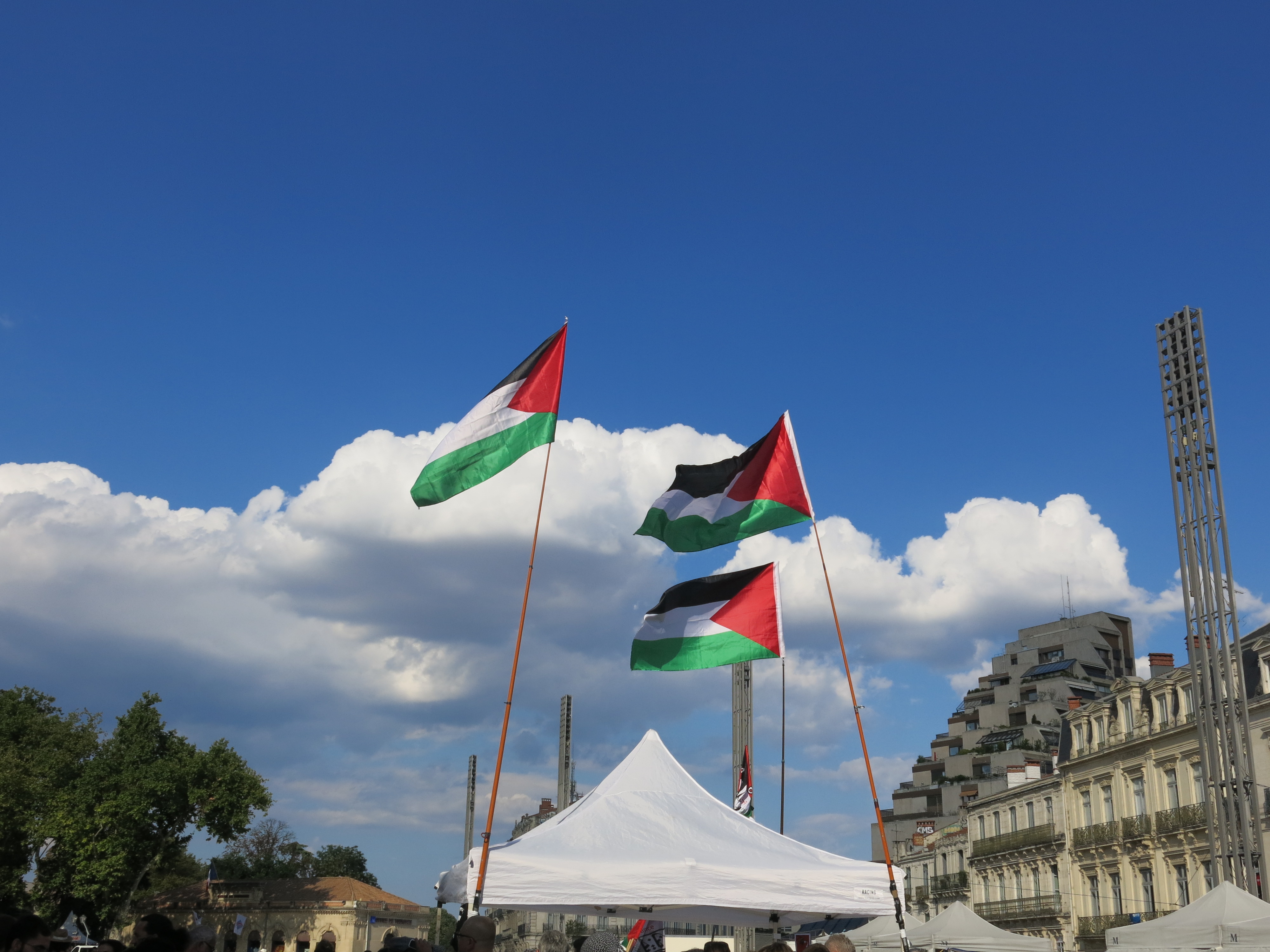
Palestinian flags
Church in St Edmund’s Church Street Salisbury. It is of a village in the occupied west bank of Palestine seen through the eyes of children. It starts on 6 January and runs through until 31st and is open from 10 to 12 o’clock.