Rwanda flights ‘unlawful’


High Court rules flights to Rwanda unlawful

June 2023

The High Court has today (29 June) ruled by a majority, that the planned flights to Rwanda are not legal. This has been a key element of the government’s policy and the first flights due to go out in June last year from Boscombe Down near Salisbury, were halted at the last minute following a ruling by the European Court deciding it breached article 3 rights against torture and bad treatment.

The case hinged on whether it is safe for asylum seekers and others to be sent to this African country. Both UNHCR and Amnesty International have expressed doubts and concerns about what life is like and the safety of those sent there. In its 22/23 report Amnesty had concerns about the asylum process procedure, the risks of detention and deportation, discrimination against members of the LGBTIQ+ community and inadequate legal representation.

Plane waiting at Boscombe Down airfield in June 2022 but which left empty. Photo: Salisbury Amnesty

There is limited freedom of expression, bloggers and journalists are harassed, persecuted, intimidated and sometimes unlawfully detained. Although the country has made promises to improve as part of the deal with the Home Office, serious doubts remain about how genuine these might be.

A report last week noted that the costs of sending individuals to Rwanda were excessive at around £170,000 per person and they also doubted the deterrent effects of the policy – a key element behind why the government wishes to do it. Altogether, the government’s policies on immigration and asylum are looking threadbare. They plan to appeal the decision. Both the prime minister and Suella Braverman have been critical of it.

Sources: BBC; UNHCR; Daily Mail, Guardian

Reform of Human Rights Act scrapped


Government confirms plans to scrap the HRA will not now go ahead

June 2023

It seems to have been a permanent fixture of Conservative party manifestos and in ministerial statements, a desire to rid the country of the Human Rights Act, an act brought into being as a result of cross-party consensus. It is also a fixture of tabloid rage with hundreds, possibly even thousands of articles, referring to the act as a ‘terrorists’ charter’ and a means for criminals of all kinds to escape their just deserts.

But when it came to it, defining quite what was to be abolished and, more particularly, what it would be replaced with, seemed to defeat party legislators and the announcement that it was to be shelved appeared almost to put them out of their self-imposed agony. The Justice Minister, Alex Chalk, said “[it] was committed to a human rights framework which is up to date and fit for purpose and works for the British people“. The implication is that the current act does not work for the British people yet little or no evidence is put forward to this effect. It is also interesting to note that the government itself relied on the act when it came to the matter of releasing information to the Covid enquiry. Another organisation which routinely rails against the Act, the Daily Mail, relied on its provisions to prevent its journalists being identified in the Prince Harry libel trial.

The core problem is the people crossing the channel in small boats. Only this week, a report has been published which estimates that the cost of sending one individual to Rwanda could be in the region of £170,000 and hardly shows value for money. They also doubt the claim that it would have a deterrent effect.

It is good to note that the plan to abolish the act is now no longer an immediate threat. But the thinking behind it and the ceaseless criticism of it as being a cause of problems in our society is regrettable. The Act gives protections to ordinary people and enables them to seek justice from the state’s actions. Without it the victims of the Hillsborough disaster for example would not have succeeded against the state, the police and the media who all in their various ways, blamed the victims for the tragedy.

Palestine trade deal


Government under pressure to ensure the trade deal is legal

June 2023

Trade Secretary Kemi Badenoch will be under pressure at Business Questions on Thursday 29 June to ensure that the free trade agreement her Department is negotiating with Israel complies with international law. Three MPs have tabled questions asking her how she will square the deal with United Nations Security Council 2334 – supported and largely drafted by the UK – which creates an obligation on all countries not to treat settlements as part of Israel. Under the current trade deal, signed by the EU in 1995 and rolled over in a transitional deal in 2019, Israeli exports benefit from zero- or low-tariff trade but settlement goods do not.

However, Israel refuses to identify which exports are from settlements, leaving the customs authorities in the importing country to work out which goods qualify for tariff reductions from a list of postcodes. This gives UK Customs a choice between tracking down the origin of each box of herbs from its postcode, which is a hugely time-consuming exercise, or checking only when there is hard evidence of fraud, which inevitably means that most settlement goods will reach the shops unchecked.

Alan Brown, Scottish National Party, Kilmarnock and Loudoun asked:
At a time when illegal Israeli settlers are attacking Palestinian villages, burning houses and cars, with the complicity of Israeli soldiers, who stand and watch, and the encouragement of Israeli ministers, the very least the UK could do is to stop the settlers  enjoying tariff-free exports at the expense of the UK taxpayer.

One of the benefits of Brexit is that the UK is no longer bound by the EU-Israel Association Agreement of 1995, which makes no explicit distinction between Israel and settlements, so the UK can negotiate its own trade agreement with Israel with a territorial clause to make it clear that it only applies to pre-1967 “green-line” Israel.

In any case the UK is legally obliged to do this – or something similar – under the 2016 UN Security Council Resolution 2334 which states that countries must “distinguish, in their relevant dealings, between the territory of the State of Israel and the territories occupied since 1967”.

From Palestine Briefing

The Salisbury group recently hosted a talk on the apartheid system the Israeli government operates in the occupied territories.

Refugee march


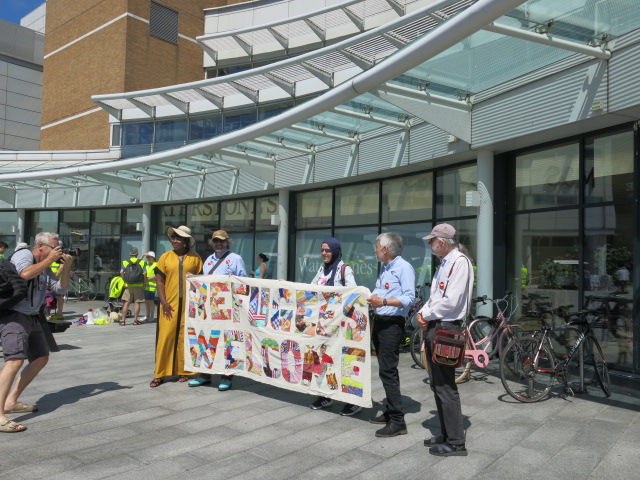
Members of the Salisbury group joined the refugee march in Southampton

June 2023

Some members of the Salisbury Amnesty group went over to join the march in Southampton held in support of refugees. It goes without saying that refugees are getting a terrible press at present with tabloid fury at the boat crossings showing no signs of abating. Politicians are in full cry and new legislation is promised to make asylum even harder. Plans to send them to Rwanda are still in place and there is a section of the Conservative Party which would be happy for the UK to withdraw from the European Court to achieve this. In a previous post we drew attention to some of the inconsistencies in the attitudes towards refugees and asylum seekers. We were sad not to meet colleagues from the Soton group.

Pics: Salisbury Amnesty

Apartheid in Israel


The group hosted a talk on the Apartheid state established by Israel against the Palestinians

June 2023

UPDATE: 17th June. British parliament to debate the UK/Israel trade agreement in which there is a risk that illegal settlements will be recognised to be Israeli

On 13th June, the Salisbury group and Salisbury Concern for Israel Palestine (SCIP) hosted a talk on the apartheid state established by Israel against its Palestinian citizens. The talk, with slides and film clips, was given by Garry Ettle who is the voluntary coordinator for Israel, Palestine and Lebanon. It was mostly built around the report Amnesty prepared last year.

The speaker went through the main thrust of the report’s conclusions and the evidence compiled by Amnesty over a three or four year period. It is some 280 pages in length and together with similar reports by Human Rights Watch, B’Tselem in Israel (who first used the apartheid term) and the UN, represents a compelling case of how the Israel authorities have created a two state solution where the Palestinians are deprived of land and housing, denied economic and social rights, suffer from the segregation of their communities and they are subject to illegal acts against them including the arrest and mistreatment of Palestinian children.

The denial of rights for Palestinians is enshrined in the 2018 Nation State Law which says that the ‘State of Israel is the nation state of the Jewish people’. This follows years of oppression which started in 1948 with the expulsion of thousands of Palestinians and the destruction hundreds of their villages. Since 1948, 700 new Jewish settlements have been created but no Palestinian ones have been allowed. Palestinians are caught in a kind of Catch 22: their properties are demolished because they do not have permits but permits are almost never given.

The policy of fragmentation means travel around Israel is almost impossible. Gaza is essentially an open prison, with travel out of it almost impossible and there is a 3 mile limit from the coast. It is surrounded by a buffer zone. The most distressing evidence during the presentation was the arrest of children in the middle of the night who are then held, sometimes in solitary confinement and there is evidence of rough treatment.

Response

Despite the huge weight of evidence from several agencies compiled over several years, the Israeli government has not sought to refute it. They have simply accused the agencies, and Amnesty in particular, of being anti-Israel and anti-Semitic. There has been no point by point rebuttal of the evidence.

UK Government

The response by UK governments over many decades has been shameful and continues today even after the compelling evidence of the various reports mentioned above. Rishi Sunak, now the prime minister of the UK in an interview with the Jewish Chronicle in August 2022, praised Israel as “a beacon of hope“. When asked about the Amnesty report in particular said “[it] could only make a solution to the Israel, Palestine conflict more elusive“. He then made the outrageous claim that “those who label Israel an apartheid state also deny Israel’s right to exist”. But arguably the most egregious remark in the interview was “the Amnesty claim is not only factually incorrect but frankly, offensive“. No evidence is provided for these remarks and it simply seems to be an echo of the Israeli government’s own propaganda.

The Foreign Office simply says it is “aware of these reports and does not agree with the terminology used within them” (August 2022). Again, no evidence is provided. The full statement of UK government which follows is considerably one-sided. It is in response to a petition following the various reports.

[…] As a friend of Israel, we have a regular dialogue with the Government of Israel. This includes encouraging the Israeli government to do all it can to uphold the values of equality for all. Minister for the Middle East, Amanda Milling, emphasised this point in her recent meeting with Israeli Deputy Foreign Minister Roll during her visit to Israel and the OPTs“.

The response simply does not address the huge imbalance of power between the Israeli’s and Palestinians. It is blind to the fragmentation of territories which make travel for Palestinians almost impossible. To read the weight of evidence in the three reports and compare it with the FCO’s response is to wonder if it is the same country being described.

Labour Party

Labour has had its own problems concerned with alleged anti-Semitism within the party in the Corbyn years. In a video interview a year ago with Sir Keir Starmer by the Jewish Chronicle, Sir Keir was asked about the Amnesty report and did he agree with the apartheid claim made by Amnesty? His response was “No, I’m very clear about that. It is not the Labour party position”. Once again, a simple denial with no explanation. He was very insistent earlier in the interview about his desire to ‘root out anti-Semitism’ within the party.

The accusation of anti-Semitism against anyone who criticises the actions, over many decades, by the Israeli government against its Palestinian citizens seems to have struck terror into our politicians. Terrorist attacks by Palestinian groups against Israeli settlements are rightly condemned. But the numbers of Israelis who have died is but a tiny proportion of the numbers of Palestinians who have died at the hands of Israeli forces.

To criticise Israel and to provide copious evidence of its policy of apartheid, is not anti-Semitic. The evidence shows that it is and it is up to the Israeli government to rebut the evidence presented in the reports.

Manchester City and sportswashing


Questions behind the club’s treble win

June 2023

The news and sports pages were full of Man City’s win in Istanbul securing them the magic treble. There were clips of the various goals, a celebratory homecoming and interviews and profiles of the various players. Fans were exultant. There were reportedly 100,000 of them to greet the team back in Manchester and considerable attention was paid to one of the players, Jack Grealish and his actions after the win. The tabloids had pages of coverage and hundreds of comments joining in the celebrations. For the owners of the club, it could not have exceeded their wildest dreams. Masses of positive coverage. There is talk of a photo of the club appearing on the cover of the next Oasis album.

So it may seem a little churlish to mention background to the win and to say something about the owners of the club who are an oppressive state. United Arab Emirates who have poured vast sums into the club – around £500m to enable them to buy the best players – are no strangers to criticisms of their human rights record. Many activists and academics are detained and their families often harassed by state officials. There are arbitrary arrests and the used of torture is widespread. Trials are unfair and victims are denied legal counsel. There is no press freedom or freedom of speech generally. There are forced disappearances and stoning and flogging are still practised. The state is near the bottom of many international measures of human rights and press freedoms. What they have is vast wealth from oil and that wealth is being used by a number of middle east states to buy their way into the sporting universe.

Other examples include the World Cup held improbably in Qatar and Saudi Arabia’s purchase of Newcastle United Football Club. Just recently, the Saudis have taken over the PGA (golf) and merged it with the smaller LIV series. The gulf states are in their various ways engaged in using sport to enhance their reputations in what is called sportswashing. They have realised that sport brings huge reputational benefits and the millions who watch or spectate sport show little interest in where the money comes from so long as their team or hero wins a trophy of some kind.

However, it does matter for a number of reasons:

  • Manchester City, and the other clubs going down this high money road, have effectively become state sides. It is not Manchester City but the UAE trading as Manchester City which has become a kind of front for a repressive regime. They are merely serving a purpose for this state to launder its reputation, safe in the knowledge that the supporters simply want to revel in success. It may only have been Channel 4 which raised questions about ownership along with the financial cheating the club is alleged to have engaged in (which they deny).
  • Other clubs will have little option to follow and seek funding from some country wanting to launder their reputations. Until the Ukraine invasion, Russian money from the oligarchs was the main source of wealth for example Chelsea FC and Abramovich.
  • The acceptance of funding from gulf states such as UAE and others ignores the moral dimension completely. Sport sits happily at the back of most newspapers or at the end of TV news bulletins where the breathless talk is of who won what, league tables, the activities of sporting stars, who has been injured and so on. That the states hosting these events or funding clubs and competitions, are engaged in inflicting misery or death on those who disagree with them or who wish for democracy, scarcely gets a mention.
  • That sportswashing helps entrench their power is also seemingly of little concern. The people of Manchester are naturally overjoyed at their club’s success (unless you are a United supporter that is). Telling them that their favourite club is a ‘front’ for a fairly despicable regime is not something they are likely to want to hear.

The use of sport to enable these regimes to gain political respectability is likely to increase as others see how successful it is. It helps facilitate arms sales and the entry of the regime leaders into polite society. Our Royal family for example, from the late Queen down, often hosted visits from the likes of Sheik Mohammed because of a shared love of horses.

Such is the significance of sport now and its use as a political cover, it maybe time for it to emerge from the back pages and for us to start asking questions about its role as a cover for anti-democratic states. Sporting success should not be the be-all and end-all.

Sources: Guardian, Private Eye, Wikipedia

Group minutes – June


June 2023

We are pleased to attach the minutes of the group meeting which took place on 8 June 2023 thanks to group member Lesley for compiling them. They contain reports on the refugee situation and on the death penalty as well as details of forthcoming events.

Human Rights and poverty


June 2023

Poverty a key element in depriving people of their rights

One of the criticisms of human rights and those who seek to promote them is the proliferation of what is regarded as a ‘right’. One such critic is Prof Eric Posner who has argued that the numbers and proliferation of rights makes them less and less effective. Others have joined in including the current Home Secretary who cites Posner in her various criticisms of human rights and how they are applied in the UK. On examination, much of what is termed ‘proliferation’ is in reality a refinement of a basic right often in the light of current circumstances. The world of social media and electronic communications with its contingent threat to the rights of individuals due to increased surveillance by states and others, would not have been anticipated by the drafters of the UN Declaration after the war. Increasing corporate power and globalisation has enable firms to move or outsource their manufacturing operations to countries with limited or no regard to the rights of their workers.

In its summer 2023 magazine, Amnesty International focuses on poverty as a key human rights issue. As James Griffin notes in his book On Human Rights (OUP, 2008) rights have little value unless people have the means to exercise them. Article 17 gives people the right to own property for example which is of little significance to those unable to get a mortgage, increasingly a concern for young people today. The government’s own statistics on poverty paint a dire situation in what, after all, one of the richest countries in the world. 11 million are in relative poverty before housing costs and 14.4 million after housing costs and there are 2.9 million children in poverty according to the report. We can argue about definitions (and these are explained in the report) but the fact remains that those who cannot afford to eat three meals a day and have to resort to food banks, who live precarious lives with low paid, uncertain jobs, or on zero hours contracts, are not going to be able to exercise many of their rights. Poverty is thus a key underlying factor.

It is one of the problems of a legally based system of rights. The law is only of comfort to those who can afford to gain access to it. For the vast majority it is expensive, extremely uncertain and of little direct value. Tackling poverty means addressing the ideas and politics which are the root causes of the problem.

Amnesty is part of a group ‘The Growing Rights Instead of Poverty Partnership GRIPP. In a report it says ‘[It] reveals how the UK government has created a system that keeps communities poor, ill, divided and isolated then blames them for the conditions they are living in.’ It was submitted to the UN Committee on Economic, Social and Cultural Rights (CESCR). The government would argue that they have introduced a variety of schemes to tackle poverty but fact remains that very large numbers of people are struggling. Recent rises in food prices – which hit the poorest the hardest as they spend a large proportion of their budget on food – rising interest rates and energy prices will have made matters worse for many. Article 25 of the UN Declaration says that ‘everyone has the right to a standard of living adequate for health and wellbeing.’

What is clear about poverty in the UK is how regionally disbursed it is. There are extremely prosperous areas and by contrast, large areas and numbers of communities where there is widespread deprivation. No one can argue that all those in such areas are somehow deficient or are responsible for their collective disadvantage. Clearly it is a systemic issue and a matter of political will or lack of it. Politicians have spoken about the problem and action has been promised, most recently with the levelling up programme. It does not seem to make a difference. The result is a significant number of people and shamefully, young people, who for no fault of their own, have significantly reduced life chances, health outcomes and opportunities mostly to do with poverty.

Poverty is thus a key factor in individual’s ability to secure a range of rights which, for the more prosperous, is taken for granted.

Refugee report – June


Refugees continue to generate considerable political tension in the UK

June 2023

We are pleased present our monthly refugee report thanks to group member Andrew for preparing it. Refugees, immigration and the boat people continue to generate a considerable degree of political and media heat in the country.

The latest immigration figures for 2022 give a total of 606,000 arrivals, but most of these are legal, and mainly students. There were 7,000 applications for asylum (by 91,000 people). In the first quarter this year 3,793 applications were received, compared to 4,548 last year. It is worth noting that the numbers are higher in France, Germany and Spain. Arrivals in the UK amount to just 7% of the European total.

Arrivals to the UK are just 7% of the European total

20,000 claimants were in detention in March, 20% fewer than last year, but the average period of detention was longer.

Few forced returns based on asylum claims have taken place, the majority of them being to Albania, where the new agreement has resulted in 90% of arrivals from Albania being returned there.

The Illegal Migration Bill is this week in committee stage in the House of Lords, and a vast number of amendments are being debated. The largest bone of contention currently is the lack of an economic impact assessment of the measures, which the government has said it will produce “in due course”. The BBC has claimed that the cost of the new rules will be up to £6 billion over the next two years. The Refugee Council have more precisely reckoned it at £8.7 to 9.5 billion over 3 years. The Home Office have admitted that numbers would have to be below 10,000 for the Act to be operational. On the plus side for the Government, former senior judge Lord Sumption has argued that justification for overruling their Rwanda plan by the ECHR would be “slender.” On this point, the Sun is reporting that the Home Office think they can make their first flight to Rwanda in September if the Court of Appeal rules in their favour.

The Prime Minister, on his visit to Dover this week, claimed that his policies were working, as the number of asylum seekers arriving in small boats was down 20% this year. Others have suggested this has had more to do with the weather in the English Channel, and the fact that most crossings take place between July and September.

It is reported that the two new vessels commissioned to house asylum seekers are cruise liners. Apart from the plan for a barge to be moored at Portland, other locations are presently unknown.

The Refugee Council has been protesting this week about the size of the accommodation made available to claimants. Operation Maximise is a deliberate initiative to cram as many claimants as possible into the available accommodation. The leader of Westminster Council has said it “defies common sense and basic decency.”

The UNHCR has produced an audit of the UK asylum system and declared it to be “flawed and inefficient.”  The report particularly points to a lack of training at the Home Office, inadequate information on claimants, lack of skill in interviewing, and an inability to assess children’s ages accurately.

An article in Coda Media has drawn attention to the EU’s International Centre for Migration Policy Development, a shady body based in Vienna that has been supplying Maghreb governments with material to aid disempowering boats aiming to cross the Mediterranean.

AH

Death penalty report – May June


June 2023

We are pleased to attach the monthly death penalty report thanks to group member Lesley for her work in compiling it. It covers a number of events in America as well as other countries such as Saudi and Iran. As ever it contains no information from China which is believed to execute more of its citizens than the rest of the world combined but details of which are a state secret.

Blog at WordPress.com.

Up ↑