April 2024
We are pleased to attach this month’s report for the period mid March to mid April thanks for group member Lesley for the work in compiling it. Reports include those from USA, Congo, Pakistan and Russia.
Amnesty in Salisbury & South Wiltshire
Promoting human rights from Salisbury UK
April 2024
We are pleased to attach this month’s report for the period mid March to mid April thanks for group member Lesley for the work in compiling it. Reports include those from USA, Congo, Pakistan and Russia.

April 2024
This month, the report starts with the EU. The Freedom United charity note that so far this year more than 200 people have died trying to leave Libya, many shot by the Libyan Coast Guard. The EU continues to help fund the LCG, and the Institute of Migration say that 600,000 people are trapped in Libya seeking to get to Europe. Needless to say, there are many allegations of breaking international law in this crisis.
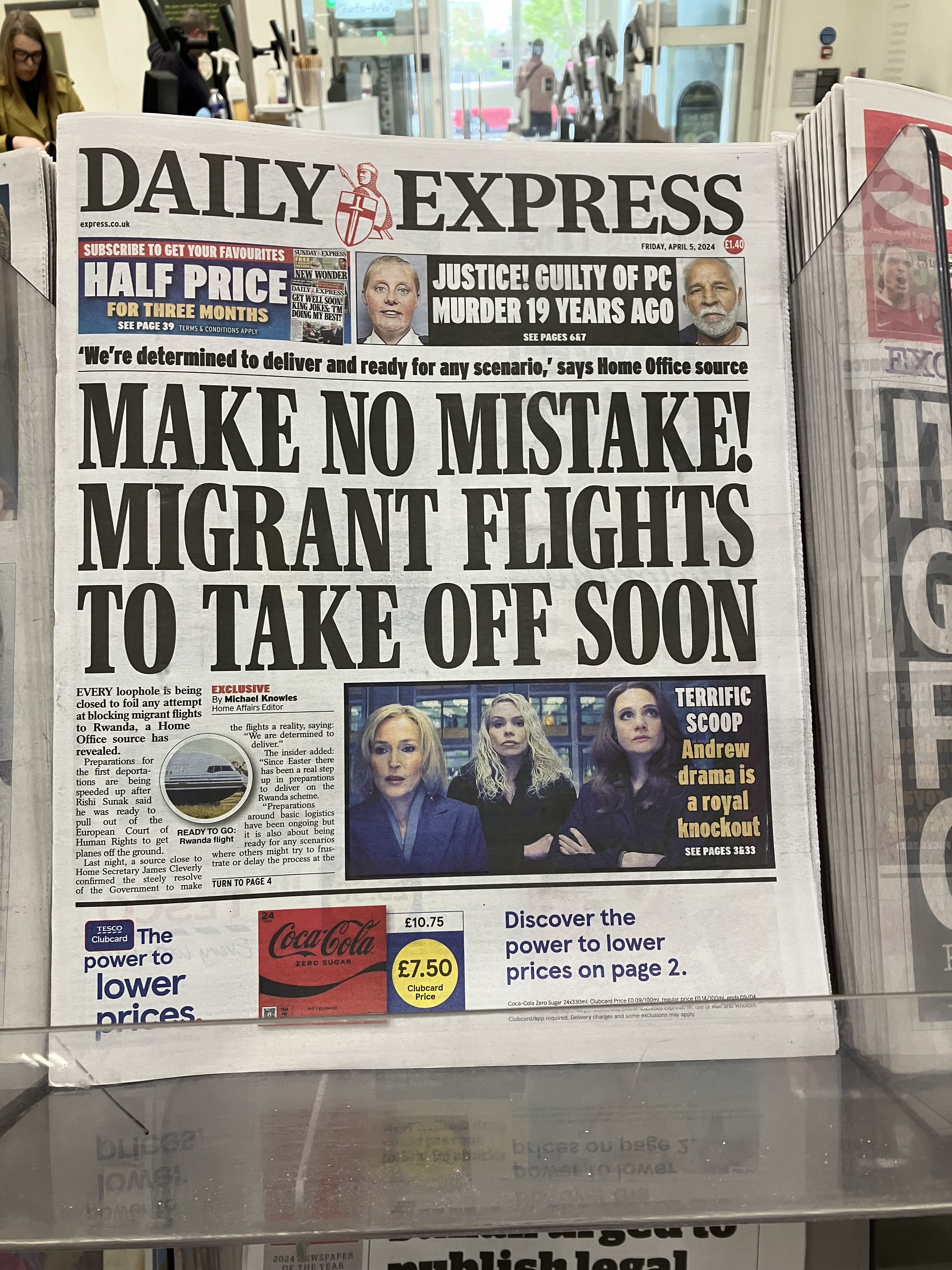
Also beyond the UK, the latest news from Rwanda is that, following the lack of progress in deportations, 70% of the properties allocated to receive deportees have now been sold to local buyers. On this topic, the Rwanda Bill returns next week for more ping pong – it could yet go for the Royal Assent within a few weeks. Judges are being given “special training” to ensure speedy delivery of those to be deported to Rwanda, according to the Daily Express. The airline Air Tanker is reported to be in discussions with the government about providing the transport, although they withdrew from previous similar discussions. RwandAir has already declined for fear of reputational damage.
The Prime Minister has claimed that 24,000 irregular migrants were deported last year. Full Fact have checked this and argue that only about 25% were enforced returns, the rest being voluntary. The number of arrivals in small boats this year stands at 4,644 at the end of March – bad weather has reduced the number in the last few days, but the figure is still higher than last year.
Charities and law firms have sent a letter to the Home Secretary seeking a Ukraine-style visa scheme for Palestinians who have family in the UK. The Home Office has also refused to decide on whether to drop the need for biometric data for reuniting family
arrivals from Gaza, although obtaining such data is virtually impossible in the crisis; the Upper Tribunal ruled against the Home Office in two test cases.
In their annual report, the Office of the Immigration Services Commissioner note that the number of immigration advisers at the Home Office is growing, but not fast enough to keep up (and large numbers are leaving).
Finally, back to Europe, where the European Parliament has passed the Pact on Migration and Asylum today (Wednesday 10 April) against votes from the extreme right and extreme left. The 10 provisions of the pact cover issues like relocating from over-immigrated countries, financial allocation, fast-track routes and exchange of data.
A group of 22 NGOs has issued a statement arguing that “while the adoption … is likely to lead to a detrimental degradation of people’s access to protection in Europe, the new Union Resettlement Framework (URF) adopted alongside the Pact offers a glimmer of hope.
“The URF signals the EU’s political support for global resettlement efforts and has the potential to be a step towards advancing solidarity, capacity-building and responsibility sharing. It must now be operationalised effectively to ensure that more people reach safety and find long-term solutions,” the groups, which include the International Rescue Committee and Oxfam, said.
Andrew Hemming
April 2024
Our new leaflet will be available soon and an online version can be accessed here:
UPDATE: 13 April. Copies will be on display in Salisbury library.

April 2024
The eighteen vigil for peace in Gaza was held on Saturday 6th April and they do not show signs of coming to an end. Indeed, with the events of last week, they could be continuing for some while yet. Over 40 turned up to this one and numbers have never been below 30 and sometimes over 50.
Last week’s attack on aid worker vehicles and the death of 7 aid workers, three of them British, seems to have been something of a defining moment in this war in Gaza. Around 33,000 have now lost their lives and many thousands lie buried the the bombed buildings. Thousands of them are women and children. There is now a real risk of famine if it isn’t already underway.
Many have been outraged to discover that Britain is supplying arms to Israel although we are a small supplier in comparison with the US and Germany. There are calls for an embargo of these sales although several argue that we must honour our agreements and stopping the supply is giving aid to Hamas.
It has taken the death of aid workers – and the manner of their deaths – to effect a change in attitudes among the public and the commentariat. People were deeply shocked by the needless savagery committed by Hamas on Israeli people living near to Gaza. There was immense sympathy for the country and support for actions to curb or eliminate Hamas from operating. Israel’s subsequent actions and the scale of killing however, has led many people to feel at the very least disquiet at IDF actions in the territory.
Amnesty argues that all parties must adhere to International Humanitarian law and Israel must address the system of Apartheid it has in in place in the occupied territories. For decades Israel has ignored UN resolutions and has largely acted with impunity.
Members of various local groups and none at the Vigil on Saturday

Pic: Salisbury Amnesty
There is also a short video
Vigil today in Salisbury market (near the Library) starting at 5pm. All welcome. A small voice for peace in these troubled times.
April 2024
The news at present focuses on the terrible events in Gaza with over 33,000 dead and many thousands injured or missing. Even today, there is news of the death of aid workers three of whom are Britons. Russia’s invasion of Ukraine continues and there are problems in Sudan with thousands fleeing for their lives. News today seems to focus on one crisis at a time partly because of resources and partly because there is what some call ‘compassion fatigue’.
Burma and the terrible activities of the Burmese military has slipped off the radar somewhat but the latest news from the Burma Campaign has a hint of encouragement in it which is good news.
The situation up to now has been dire. The military, known as the Tatmadaw, have waged war on many of its own citizens and has run an apartheid state. Thousands have been driven from their homes, villages have been bombed and burned. Tens of thousands have fled to Bangladesh to escape the violence. Some of the methods used by the military are vicious beyond belief and include burning people alive.
The British government has not done enough to make life difficult for the regime. For example, the bombing is carried out by jets which need jet fuel to fly. The ships bringing in the fuel are insured in London and there seems little chance that this will cease. Recently, Lord Cameron headed a deputation of people to the far east, including Burma, and was accompanied by several representatives of arms companies. A big source of income for the regime is the export of gems by state owned companies and little has been done to restrict this.
But it seems there is hope. It appears the military is losing more territory as people fight to free their country from military occupation. The Economist has reported that more and more soldiers are deserting the army. There is real hope that the country could be free of the military. The Burma Campaign recently joined others outside the Foreign Office and showed placards with David Cameron’s head on an image of a snail. It was urging the government to act more quickly.
Sources: Burma Campaign, Amnesty UK, The Economist, CAAT.

 Amnesty in Salisbury & South Wiltshire