Scrap anti-protest laws


The government should scrap the anti-protest laws it has passed

February 2024

This call was made in the current edition of the Amnesty magazine and refers to various laws the government has passed to curb or prevent protests taking place. The first is the Police, Crime, Sentencing and Courts Act 2022 and the second is the Public Order Act 2023. They were introduced mainly as a result of climate change protestors who carried out a range of protests and campaigns which were not popular with the government, the right wing media or some of the public. 

Protests, violent or otherwise, have been a feature of Britain’s political life for centuries. Indeed, the Conservative politician Ian Gilmour, who served in Mrs Thatcher’s cabinet, wrote a book Riot, Risings and Revolution: Governance and Violence in Eighteenth Century England, (Pimlico, 1993) which described the considerable number of such things which were a regular feature of life at the time. So the activities of Extinction Rebellion are neither new nor especially harmful in the light of history. It’s possible that the two Home Secretaries who pushed through this legislation were both daughters of immigrants who may not have been aware of this history. 

It is also ironic that both politicians, who are female, owe their right to be an MP – or to vote at all – to the actions of suffragists and latterly, the suffragettes who campaigned violently for those rights It is also ironic that the suffragists campaigned peacefully for around four decades and made little progress – arguably none. There were many campaigns which have led to positive change viz: ending Apartheid in South Africa, the Chartist movement, ending slavery and protests leading to the Great Reform Act. It is true to say that many of the rights we enjoy today, owe their existence to a protest of some kind to achieve them. 

It is also a sad fact of life that peaceful protests usually get ignored. There are many marches, some quite large involving many thousands, which get no coverage. But once violence erupts, it becomes news. Governments do not like protest and see them as some kind of threat to their right to govern. But protest is about the only way ordinary people to make their concerns heard or to promote change.

Both acts should be scrapped.  


Palantir and the NHS


Human rights concerns with the use of Palantir software in the NHS

February 2024

The current issue of the Amnesty magazine (Spring 2024) poses some human rights questions concerning the use by the NHS of the American firm Palantir to create a data platform. With recent revelations surrounding Fujitsu’s Horizon program used by the Post Office and which destroyed the lives and livings of nearly a thousand sub postmasters, we should take a careful look at the firms being used to do this IT and data work. 

And looking at Palantir is not a pretty sight. Founded by the CIA, its primary interest is treating people as suspects or targets. Its software is used by both NSA and GCHQ and is designed as a surveillance tool. It is used by some police forces in the US in what is called ‘predictive policing’ which has a dubious history. It was used for workplace deportation raids also in the US as part of Donald Trump’s actions against immigrants. Another troubling use is by the Israeli military to ‘help the country’s war effort’. 

A key investor is Peter Thiel, founder of PayPal who is, paradoxically, hostile to the notion of an NHS and to government aid programmes generally. He is a funder and supporter of Donald Trump.

The Amnesty article says ‘Any company linked to serious human rights abuses should be excluded from tendering for NHS contracts on grounds of ‘professional misconduct”. Essentially, the British public needs to be reassured that information gathered by Palantir won’t be harvested by them for other purposes. 

American companies have had their eyes on the NHS for many years and have spent considerable sums trying to get contracts. It was likely to be a key issue in the UK/US trade deal negotiations post Brexit, now a lost cause. Palantir offered to assist the Covid-19 response for a fee of £1 (not one million) because it gave them an ‘in’ and the ability to build a datastore. 

As we have learned from Horizon and the Post Office, as well as other IT disasters, there are many concerns about IT firms, their actual ability to do what they claim they will do, their integrity and the security of the data they collect. Major firms like X, Facebook, WhatsApp and others have shown a cavalier attitude to online safety for the young and other vulnerable individuals. We also have British politicians and ministers openly hostile to human rights issues and some would like to see the Human Rights Act abolished. This is a toxic mix. We will have the usual platitudes and reassurances about ‘online safety is our number one concern’ and other bromides, the reality being that it is way down their lists of priorities. 

The people organising these contracts, the civil servants and the various ministers, have next to no experience of placing contracts or having anything like the expertise needed to keep an eye on this as was explained in Ian Dunt’s book How Westminster Works: and Why it Doesn’t. Twenty ministers came and went during the Post Office, Horizon scandal and did – or were able to do – nothing. 

To use a firm with the history that Palantir has, with the history of blunders surrounding IT contracts and with ministerial oversight feeble or missing altogether is to court disaster and is a huge risk for the confidentiality and security of our private medical information. 

The Salisbury and South Wiltshire group is 50 this year

Rwanda report


Cross party committee on human rights criticizes the government’s Rwanda policy

February 2024

The Rwanda (Asylum and Immigration) Bill ends its House of Lord’s stage today (12 February) and returns to the Commons. The Bill has been roundly condemned by many human rights and other organisations and the committee said that it is ‘fundamentally incompatible with Britain’s human rights obligations’.

The Supreme Court has already ruled that Rwanda is not a safe country and the government’s attempt to pass a law simply saying it is is bit like passing a law saying water can run uphill. The Committee went on to say ‘the Bill disapplies laws that might prevent and individual’s removal to Rwanda including many of the key provisions of the Human Rights Act.

‘It might also impact on Northern Ireland, that it would both undermine the Windsor Framework and the Belfast (Good Friday) Agreement’.

It also raises the point about UK’s reputation. We have they say, a reputation for respect for human rights of which ‘we should be proud’. 

Immigration, and most recently the Channel crossings, have generated a considerable degree of angst and hostile media coverage. This is not recent and goes back many years and started to emerge as a political force during the Blair years. In many respects it goes back further to various waves of immigrants such as the Huguenots from France, Flemings from the low countries and Jews fleeing Russia. All have been met with hostility of some degree. 

Recent immigrants are cast as not really refugees at all but economic migrants, are cheating the system, are living off benefits and so forth. Newspapers – and not just tabloids but the Daily Telegraph and the Independent – have carried hundreds of negative stories and helped keep the temperature high. The Sun even ran a story that swans were being stolen from the London parks and eaten by immigrants (invented). The raised media attention has increased public concern to which the politicians are obliged to reflect. 

Watch the Amnesty video

Anomaly

A curious anomaly is that people who’s offspring emigrate to live and work overseas (as ‘economic migrants’ no less) are spoken of in terms of pride. Emigrants good: immigrants bad. 

Another curiosity is that many of the politicians leading the hostility and proposing ever harsher measures including deportation to Rwanda, are themselves sons or daughters of immigrants. Priti Patel, Kwasi Kwarteng, Suella Braverman, Rishi Sunak, Danny Kruger and going back further, Michael Howard (Romania). 

The benefits of immigration to this country almost don’t get a look in. In November last year, the government’s own statistics show that around one in 5 of people working in the health service were not born in the UK. Indeed, the service would struggle to survive (even more than now) if these people were not working here. 

The entire debate is based on hysteria. Boat people have assumed a disproportionate sense of anger and fear even though they represent a small proportion of all immigrants to this country. The majority do go on to claim asylum. The hysteria and media mis- and disinformation has resulted in the plan to deport a few hundred to Rwanda, a policy which is performative rather than likely to be effective. 

Sources: Daily Mail, FullFact; Liberty; Hansard, Guardian (accessed 12 February 2024)


The Salisbury Amnesty group celebrates 50 years of existence this year

Group minutes: February


February 2024

We are pleased to attach the minutes of the group’s meeting in February 2024 thanks to group member Lesley for compiling them. We should say that these are quite long for minutes but as we do not have a newsletter, they contain information in a more expansive way than you would find in just minutes, for example information on refugees and the death penalty. 

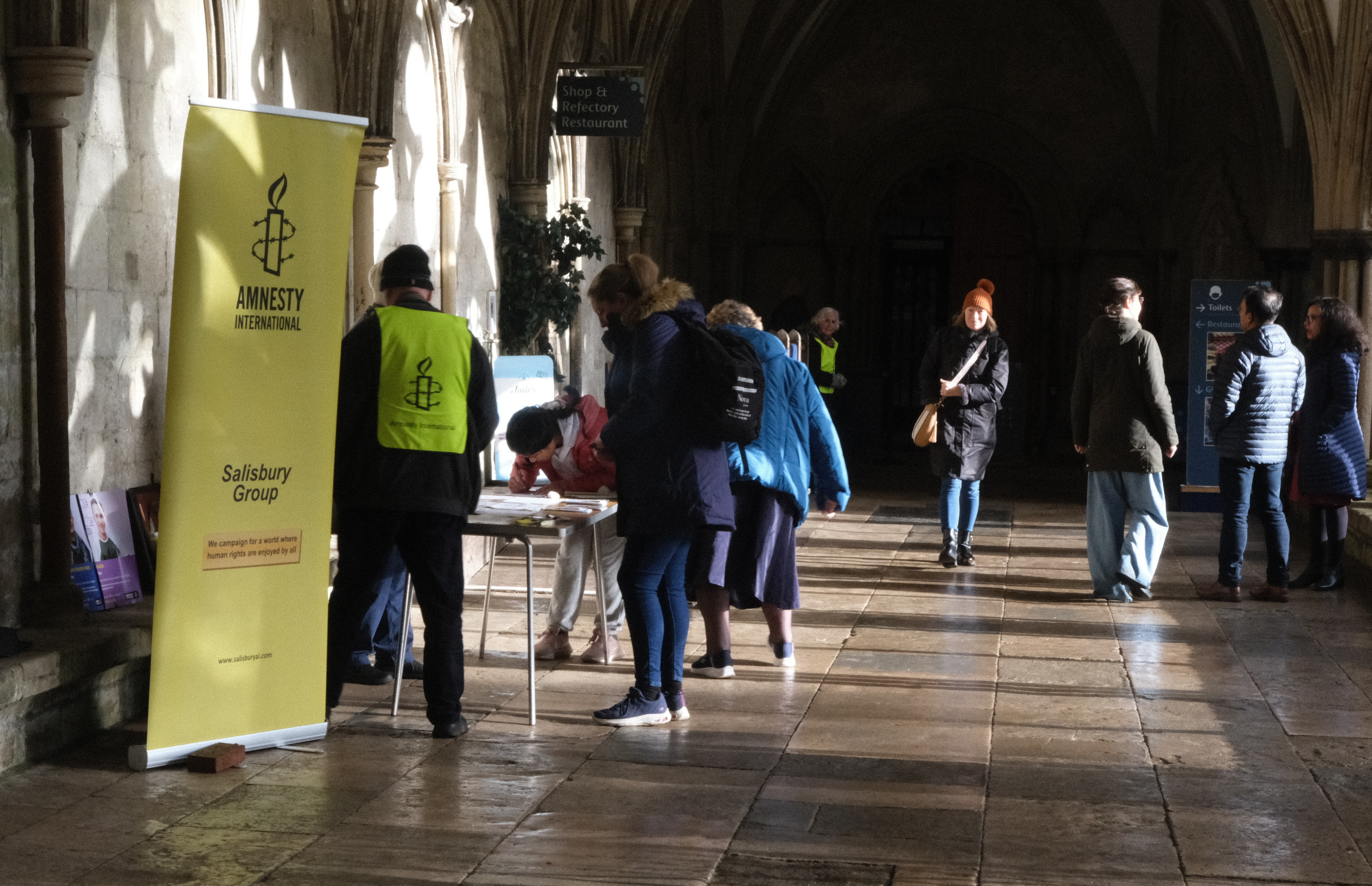
New members are always welcome and at the end you will find details of upcoming events where you can make yourself known to a member of the group. As the only Amnesty group left in the county, we do welcome people from all of south Wiltshire.

The Salisbury and South Wiltshire group is 50 this year

Nigerian protest


Members of the Salisbury group took part in Humanist protest in 2022

February 2024

Pictured: Humanists UK’s #FreeMubarakBala protest outside the Nigerian High Commission, London, 2022. Two members of the Salisbury group can be seen, centre. Picture: Humanists

MPs have raised the case of Mubarak Bala, imprisoned President of the Nigerian Humanist Association, at a debate in Westminster Hall on Freedom of Religion or Belief in Nigeria. The debate was secured by Jim Shannon (Democratic Unionist Party), Chair of the All-Party Parliamentary Group on International Freedom of Religion or Belief (APPG FoRB) – of which Humanists UK is a stakeholder. 

Humanists UK has been calling for Bala’s release since he was arrested in April 2020. Two years later, Bala was convicted and sentenced to 24 years’ imprisonment for posting ‘blasphemous’ content on Facebook following an unfair trial: it was repeatedly delayed and the charges against him were duplicated. Procedural irregularities were rife. Bala remained incarcerated without charge for well over a year. He was denied access to his lawyers and family for an extended period. He was denied medical attention. The Abuja High Court’s ruling that he be released on bail was ignored by Kano State authorities. His case exemplifies the need to abolish blasphemy laws, which intrinsically contravene the right to freedom of religion or belief.

During the debate, Jim Shannon said that he, alongside other members of the APPG FoRB has visited Nigeria in 2022:

We used our visit to speak to some of the judiciary and judges in Nigeria… and made a very good case for the release of Mubarak. We thought we had made some headway on that, and the indications coming from the judiciary seemed to say that, but he is still in prison.’

Shadow Foreign Minister Lyn Brown said:

I can understand the anxiety about states in Nigeria continuing to imprison people for exercising religious freedoms. We all know the case of Mubarak Bala.’

Humanists UK campaigns for freedom of religion or belief (FoRB) around the world, particularly for non-religious people facing persecution. In many countries it is impossible to be openly non-religious. Laws that criminalise blasphemy and apostasy are often the source of such persecution – as they were in Mubarak Bala’s case. The repeal of such laws is therefore a vital step in guaranteeing FoRB for all.

Director of Public Affairs and Policy Kathy Riddick commented:

‘We thank Jim Shannon MP for securing the debate and raising the case of our colleague Mubarak Bala who has been imprisoned simply for expressing his humanist beliefs. 

‘The situation for humanists in Nigeria is dire. Blasphemy and apostasy are punishable by death and this is used to falsely justify the social persecution of the non-religious. Particularly worrying is that Nigeria is on the ‘safe country list’ under the Illegal Migration Act, which means that non-religious asylum seekers may face great risks if they are deported there.

‘We continue to call on the government to use all channels available to advocate for the repeal of all blasphemy and apostasy laws, and to secure not only the release of Mubarak, but the release of those convicted or imprisoned under such laws.’

Pictures: Salisbury Amnesty

Salisbury Group at 50!


Group is 50 this year!

February 2024

The Salisbury group was established in 1974 and has been going strong for 50 years. It took us a bit by surprise today when we realised this so we haven’t thought of any celebrations yet. But as the last active group in Wiltshire we can allow ourselves a bit of pride that we are still here and still trying to promote the human rights cause in the county.

It probably seems a little different today from 50 years ago. Human rights then were regarded as a good thing and support was largely unquestioning. The war was a living memory for many and a desire never to see a repeat of the death and destruction of the war and the horrors of the Holocaust was deeply felt. 

A long time has passed however and today, we see successive Conservative governments seeking to end or curtail the Human Rights Act. Laws have been passed making protest more difficult and the police have been given more powers to arrest those protesting. 

Much of the media keeps up a steady campaign denigrating human rights and suggesting they are a means for terrorists and serious criminals to escape justice because their ‘rights’ have been infringed. We are made less safe they claim because of the act rather than the precise opposite. The benefits the act has brought are seldom mentioned. The success of the Hillsborough families in overturning the various coroner and court decisions and the false narrative put out by the police was a major example. 

Some sections of the media do not like the act since it provides some protection from press intrusion and this has led them to carry on a relentless campaign often supported by exaggerated stories.

In the past few years the issue of immigration has come to the fore and immigrants crossing the Channel by boat has become a political hot potato. The government is seeking to send some immigrants to Rwanda in an attempt to discourage smugglers from sending them over from France. There has always been hostility to immigrants as each wave has come over, the Jews from Russia for example at the beginning of the last century. 

But the notion that we would become more sympathetic and welcoming has not worked out. The question therefore is how embedded are human rights norms and beliefs in our society? The occasional desire for a return of the death penalty, hostility to refugees as just mentioned and evidence of the UK government’s involvement in torture, clampdowns on protest suggest that human rights and human dignity is only shakily rooted in our society.


If you live in the South Wilshire area, we would welcome you joining us. Follow this site for details of what we are doing.

Grammar amendment April 2026

Death penalty report


February 2024

We are pleased to attach this months death penalty report covering the period mid-January to mid-February thanks to group member Lesley for the work in compiling it. It contains details from Iran, which has gone on an execution ‘spree’ to try and silence protests, Japan, Zimbabwe and China but note that it is believed to be the world’s largest executioner but details are a state secret. 

Refugee report


Refugees News Summary 

February 2024

The egregious Rwanda Bill continues its course through the House of Lords. Their Lordships defeated the Government on one vote, to say that the treaty with Rwanda should not be ratified until the protections set out in it have been fully implemented. The Committee stage begins on Monday 12th February. The UN High Commissioner for Refugees has commented that the Government’s plans are a “fake response” to migration issues.

The small boat numbers in January were higher than last year at 1335 – this was no doubt due to milder weather.

Ukraine

The visas offered to Ukrainian exiles following the invasion will run out next month, leaving large numbers to their own devices in seeking accommodation. On a related topic, a consultation has begun to reform the allocation of social housing; it is proposed that there be a “UK connection test”, only allowing allocations to those who have been lawfully resident here for 10 years. The increase in pressure on housing for migrants continues to ratchet up.

The question has been asked “Can criminals be denied refugee status?” The answer appears to be “Yes, but the crime has to be serious for this to apply.”

The Independent Chief Inspector of Borders and Immigration is looking into the Immigration Enforcement Competent Authority (sic), which decides claims of human trafficking.

Open Democracy are claiming that vulnerable people including torture victims are being housed on Bibby Stockholm in a potential breach of government guidelines.

Recommended reading: Hein de Haas: How Migration Really Works (Viking, 2024)

Recommended viewing: The Visual Politics of Refugeehood | Gresham College

By Nishat Awan

Gaza Vigil


Ninth vigil held in Salisbury

February 2024

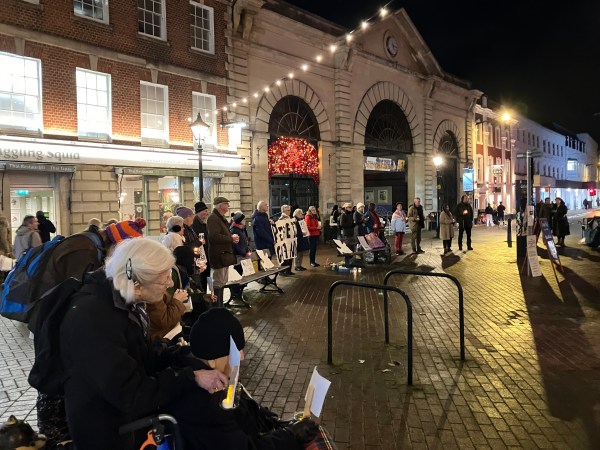
Forty and sometimes over 50, have attended half hour vigils in the Market Square in Salisbury to draw attention to the terrible events going on in Gaza. Reports of over 27,000 dead, many of whom are children with thousands more injured, some seriously, represent a terrible indictment of the state of international politics today. Just over half the buildings in the strip are demolished or severely damaged as a result of the bombing. Attempts at peacekeeping and an end to the violence have so far come to naught. 

Members of Salisbury Concern for Israel Palestine, CND and the Amnesty group attend with others.

Nine vigils have now taken place and although attendance varies it seldom dips below 40. They begin at 17:15 for 30 minutes every Saturday in February (at least). 

Pictures: Salisbury Amnesty

Alabama execution carried out


Execution of Kenneth Eugene Smith carried out yesterday despite widespread protests

January 2024

Kenneth Smith was executed yesterday (25 January) in Alabama after serving over 30 years on death row. What brought the execution to world-wide attention was the use of nitrogen hypoxia as the chosen method. Reports seem to show that the execution was prolonged and took over 20 minutes to complete. One report said he ‘thrashed violently’ while dying. This is the first time the gas has been used to execute someone and is as a result of pharmaceutical companies, in America and elsewhere, being reluctant to supply the drugs needed for lethal injection. 

The jury in his trial voted for a life sentence but the judge in the case overruled them. 

This was not the first attempt at executing Smith: there was an attempt in November 2022 by lethal injection but which failed after several unsuccessful efforts to find a vein. Smith suffered considerably during and after that attempt. 

Executions are declining in the USA, the only country in the Americas which still executes its citizens.

Amnesty is opposed to the use of the death penalty in all circumstances.

Sources: BBC; Death Penalty Information Center; Montgomery Advertiser; Birmingham Real-Time News

Blog at WordPress.com.

Up ↑