Death Penalty report: July


Death penalty report for mid June – July

July 2023

We are pleased to attach the death penalty report for mid June to July thanks to group member Lesley for its preparation. Features developments in USA, Tanzania and Malaysia. Note there is no material on China which is believed to execute more of its citizens than the rest of the world put together but details are a state secret.

Refugee report: July


Refugee report with an update on the current state of play with legislation

July 2023

The Illegal Migration Bill continues its dizzying route to completion, despite 20 defeats in the House of Lords. The Commons has rejected all the amendments, and the Bill will return one more time to the Lords and, presumably, back to the Commons next week before the recess in a process called ‘ping pong’. Despite the enormous interest in this subject and its high political salience, it was reported that fewer than 40 MPs turned up for the debate and only 20 or so stayed to the end.

We are grateful for group member Andrew for this report.

The latest situation update:

All of the Lords’ amendments were overturned by the Commons, but several had some support from the Conservative benches (Tim Lough-ton complained that they had not had enough time to mull over the government’s changes). The Home Office offered several concessions on Monday evening, The bill’s provisions will no longer apply retrospectively to anyone deemed to have arrived illegally from March 7 (10,000 people will escape the legislation’s measures, according to the Daily Mail) … the detention of unaccompanied children will be limited to eight days (significantly longer than the 24 hours backed by peers) … and the detention of pregnant women will be limited to 72 hours (extendable to seven days by ministers). Other issues still in play from the Lords debates include:

• Removing unaccompanied children from within the scope of the Bill
• Allowing anyone not removed within 6 months to re-enter our asylum system and have their claims heard
• Ensuring Local Authorities maintain care of unaccompanied children and that children are protected during the age assessment process
• Ensuring LGBT+ people are not removed to countries where they risk persecution, and that victims of trafficking are not included within scope of the Bill (as sought by Theresa May). These will presumably come up again in the next Lords session.

Elsewhere

The highest number of small boat arrivals on a single day this year occurred last week at 686. The total for the year to last weekend was 12,119, slightly down on last year.

UNHCR report says the worldwide figure for refugees is now 29.4 million excluding Palestine. 76% in low/middle income countries 70% in a neighbouring country. 339,300 refugees returned home and only 114,300 refugees were resettled out of camps last year. UNHCR estimates that 1.5 million people globally are in need of resettlement because they are in a protracted refugee situation, meaning they had been refugees for longer than five years. For each refugee that was returned or resettled in 2022, there were 16 new refugees.

Free Movement have picked up on a story that the Home Office is planning to reintroduce the concept of “reasonable force” to remove families with children. Watch this space.

Small boats

The government does not know how much its new small boats bill will cost or if it will achieve its core aim of deterring Channel crossings, an official assessment has found. Documents published over three months after the Illegal Migration Bill was presented to parliament estimated that it will cost £169,000 to deport each asylum seeker – but it is unclear how many will be removed and what “third countries” will receive them. The only existing deal is with Rwanda and the Home Office refused to publish the actual payments agreed, citing “commercial sensitivities” as a Court of Appeal ruling on the scheme looms.
A report from the Migrant and Refugee Children’s Unit argues that Albania is not a “safe country”, as the Government maintains.

Controversial plans to house asylum seekers on a barge to reduce reliance on expensive hotels will save less than £10 a person a day, according to a report. The report, Bibby Stockholm – At What Cost? from the NGOs Reclaim The Seas and One Life To Live, provides the first detailed estimated costings of the Bibby Stockholm, the barge the Home Of-fice is planning to use in Dorset to accommodate asylum seekers.

On statistics, in correspondence between the head of the UK Statistics Authority, Sir Robert Chote and Immigration Minister Robert Jenrick, Chote commented: “concerns have been raised with us about your statement in the House of Commons on 20 March that :“Today, a majority of the cases being considered for modern slavery are people who are coming into the country – for example, on small boats. We are seeing flagrant abuse, which is making it impossible for us to deal appropriately with the genuine victims, to the point that 71% of foreign national offenders in the detained estate, whom we are trying to remove from the country, are claiming to be modern slaves.”

Minister accused of using the wrong statistics

“The Home Office advised us that the quoted figure comes from a recent report about modern slavery referrals for people detained for return after arriving in the UK in small boats and that your statement was intended to refer to the proportion of foreign national offenders (FNOs) that are referred to the National Referral Mechanism (NRM) as potential victims of modern slavery. The report explains that while an increasing proportion of all those in detention after arriving by small boat are referred to the NRM up from 52% in 2020 to 73% in 2021 (and subsequently falling to 65% between January and September 2022), the proportion among foreign national offenders is much lower (at around 20% between January and September 2022)”. This argument came up again in the Commons when Theresa May claimed Jenrick was using the wrong statistics.

Beyond Europe, it seems that the UN estimates that more than 31 mil-lion Africans live outside the country of their birth, mostly within the continent (only a quarter head for Europe). AlJazeera is running a se-ries of articles on this subject.

The BBC’s More or Less programme presented a special episode on immigration, featuring Colin Yeo as well as several other experts, which is recommended.


Migrant Help runs a guidance and advice helpline to assist asylum seekers in the UK as they move through the process. The charity is not part of the Home Office but is the advice by The Independent, a Migrant Help adviser said: “I am afraid Migrant Help are not contracted to respond to MPs correspondence and have forwarded the attached to the MP correspondence team. Our call handlers will reach out to the service user to see if there is any further support they can provide.
I would like to clarify that not responding to MP enquiries is not a Migrant Help policy but a directive given to us by the Home Office as part of our work under the advice, issue reporting and eligibility (AIRE) contract. I have expressed con-cerns regarding this process

The ‘New’ Conservatives


Danny Kruger: the leader of the New Conservatives

July 2023

Danny Kruger, the MP for Devizes in Wiltshire, whose odd ideas on human rights we have had occasion to highlight before, is the founding member of the New Conservative grouping within the party. All their manifesto concerns considerable hardening of attitudes towards immigration. Their ten point plan is:

  1. Closing temporary schemes that grant work visa eligibility for care workers and senior care workers.
  2. Raising the minimum income required to gain a skilled work visa.
  3. Extending the closure of the student dependant route.
  4. Closing the graduate route to students.
  5. Reserving university Study Visas for the brightest international students.
  6. Monitoring the reduction in visa applications under the humanitarian schemes.
  7. Implementing the provisions of the Illegal Migration Bill rapidly.
  8. Capping the number of refugees legally accepted for resettlement in the UK.
  9. Raising the minimum combined income threshold for sponsoring a spouse and raising the minimum language requirement.
  10. Capping the amount of social housing that councils may assign to non-UK nationals. [Source Wikipedia]

Several of these policies run counter to the UK’s treaty obligations and would have significant impacts on human rights particularly concerning the Illegal Migration Bill currently struggling in the House of Lords. The care worker proposal for example, would make an already serious situation considerably worse. Their policies are all concerning immigration at present and are reported to be designed to appeal to Red Wall voters which, curiously, does not include Devizes, a safe Wiltshire seat. It is depressing that the people of Devizes should support Kruger and one assumes, these policies. The grouping claims to have 25 supporters but those listed do not add up to 25.

It is concerning that a group of MPs should see it advantageous to major on – to the exclusion of all else – a range of draconian anti-immigrant policies believing them to be popular with the electorate. Mr Kruger has previously claimed that a number of our country’s ills – long waiting lists for example – are the fault of immigrants.

The item concerning the cap on refugees would apply across the piece and would include those from Ukraine, Afghanistan and Hong Kong. Mr Kruger is a committed Christian and has spoken often about his beliefs. He is himself, the son of an immigrant and it is a curious fact that many in his party who are sons and daughters of immigrants (Priti Patel, Suella Braverman and Rishi Sunak) are so hostile to those who follow them.

Sources: Wiltshire Times, Premier Christian News, Wikipedia, Blavatnik School of Government (Oxford University), Politico

Government’s anti-boycott bill a danger


Government’s anti-boycott, divestment and sanctions’ bill a threat to human rights

July 2023

This week (3 July) we have seen a major raid into the Jenin refugee camp by Israeli forces with reports of around 10 Palestinians dead and also deaths of Israeli soldiers (4 July). It is but the latest event in the long history of gradual dispossession of Palestinian land by settlers. Following the elections, settler forces have become more vocal. The justification for the raid is to root out terrorists who are killing Israeli settlers. In a previous post we noted that UK political parties are keen to deny that Israel operates an apartheid state with both Rishi Sunak and Sir Keir Starmer denying such a thing exists.

The government has introduced a bill giving special status to Israel, preventing the Secretary of State from exempting Israel and the territories it occupies from its provisions. It also treats Israel in the same way as the territories it occupies, which is contrary to UN Security Council Resolutions the UK has endorsed. 

The ‘anti-BDS’ Bill is another example of the UK government trying to shield Israeli authorities from criticism of their human rights violations, instead of ensuring they face concrete consequences for their breaches of international law. That’s why as well as opposing the Bill, Amnesty is calling for all UK Parties to support a ban on Israeli settlement goods. 

This bill is particularly dangerous given the Israeli prime Minister Benyamin Netanyahu announced plans just last week to press ahead with building even more illegal settlements in the Occupied Palestinian Territory, which is a crime under international law. This move will see more Palestinian communities lose their homes, more pain and more apartheid. 

Even if the bill becomes law, the government could and should still ban settlement goods, because they arise from clear breaches of international law.

Rwanda: the morality question


How moral is the plan to deport asylum seekers to Rwanda?

July 2023

The wish by the government to deport asylum seekers and refugees to Rwanda has consumed considerable political capital and is a topic rarely out of the news. It is the flip side of the problem of people arriving by small boats across the Channel which causes so much fury in sections of the media. The extreme difficulty in applying for asylum from outside the UK is only occasionally mentioned. Legal routes have all but been closed off forcing those seeking asylum to engage in perilous journeys. According to ex prime minister Boris Johnson however, writing for the Daily Mail in his new job, said there are ‘numerous safe and legal routes for people to come to Britain’. His argument is that once word gets round the ‘camp fires’ of northern France that there is a chance of being sent to Rwanda, the business model of the smugglers will be broken (We must take radical action to get Rwanda done!) 30 June*.

This raises a moral question which is that the idea of deportation and treating them badly is to use people as a matter of policy. It is using deportation as a kind of punishment for a class of people no matter what the legitimacy of their claim might be. It is also logically unsound since it will be the refugees who will suffer and end up in Rwanda, not the people smugglers. The likelihood of the policy deterring the smugglers has been challenged recently in an impact assessment report which notes that the Home Office had little evidence to show that it might work. Academics say that it is issue of culture, kinship and language which are important factors and changing the rules has little effect.

Stopping the boats – assuming that to be possible – does not stop the problem. War, persecution, climate and poverty are among the factors which force people to leave their homes and embark on long, perilous journeys to seek asylum.

It has been pointed out that Rwanda is not the best of countries as far as human rights are concerned. There is little freedom of expression. Journalists are harassed and intimidated and opposition leaders find it hard to make headway. Bloggers and lawyers are intimidated and sometimes unlawfully detained. What has not been commented on however is that the deportation policy crucially depends on Rwanda being a safe place for us to send refugees and it will be extremely difficult for the UK government to stop the deportations if evidence of mistreatment by police or security forces in Rwanda subsequently emerges. It will also be difficult and embarrassing for the government to criticise President Kagame for any infringements of evidence of bad treatment. Having invested so much political capital in the policy, to admit the country is not in fact safe will be extremely awkward.

Refugees will find it hard to settle in the country as did those who went their as part of the – now abandoned – Israeli scheme. Perhaps the enthusiasm for the schemes owes something to several Australians who act in advisory roles in Downing Street. The Australians sent their asylum seekers to islands in the Pacific in a much criticised scheme.

Public attitudes toward refugees seems slowly to be changing and a recent IPSOS poll showed the UK to have one of the most positive attitudes towards immigrants at 56%. The numbers wanting our borders closed totally has declined. 54% wanted immigrants to stay. This despite the relentless rhetoric in the tabloid press.

Government attitudes seem to have hardened by contrast and ‘stopping the boats’ is one of the prime minister’s five pledges. In the i newspaper on Saturday (2 July) there was speculation that the government is considering leaving the European Court of Human Rights to enable it to overcome the courts’ objections to the deportations.

In all the commentary, the political jousting in the Commons and the seemingly relentless articles in the media, the moral argument seems seldom to emerge. The boat people are treated as though they are almost criminal and there is even an attempt to besmirch the RNLI for rescuing them in the Channel: RNLI a Migrant taxi service claims the Daily Mail (1 July*). Deportation is to be used as an instrument of deterrence.

Some indeed might be economic migrants and not ‘real’ asylum seekers. But a large proportion are desperate people fleeing desperate circumstances and need our help. We have a moral and legal obligation to hear their appeals. It is a great shame that the voices of intolerance have such salience in our media and in some members of the government.

*Articles accessed 3 July

Rwanda flights ‘unlawful’


High Court rules flights to Rwanda unlawful

June 2023

The High Court has today (29 June) ruled by a majority, that the planned flights to Rwanda are not legal. This has been a key element of the government’s policy and the first flights due to go out in June last year from Boscombe Down near Salisbury, were halted at the last minute following a ruling by the European Court deciding it breached article 3 rights against torture and bad treatment.

The case hinged on whether it is safe for asylum seekers and others to be sent to this African country. Both UNHCR and Amnesty International have expressed doubts and concerns about what life is like and the safety of those sent there. In its 22/23 report Amnesty had concerns about the asylum process procedure, the risks of detention and deportation, discrimination against members of the LGBTIQ+ community and inadequate legal representation.

Plane waiting at Boscombe Down airfield in June 2022 but which left empty. Photo: Salisbury Amnesty

There is limited freedom of expression, bloggers and journalists are harassed, persecuted, intimidated and sometimes unlawfully detained. Although the country has made promises to improve as part of the deal with the Home Office, serious doubts remain about how genuine these might be.

A report last week noted that the costs of sending individuals to Rwanda were excessive at around £170,000 per person and they also doubted the deterrent effects of the policy – a key element behind why the government wishes to do it. Altogether, the government’s policies on immigration and asylum are looking threadbare. They plan to appeal the decision. Both the prime minister and Suella Braverman have been critical of it.

Sources: BBC; UNHCR; Daily Mail, Guardian

Reform of Human Rights Act scrapped


Government confirms plans to scrap the HRA will not now go ahead

June 2023

It seems to have been a permanent fixture of Conservative party manifestos and in ministerial statements, a desire to rid the country of the Human Rights Act, an act brought into being as a result of cross-party consensus. It is also a fixture of tabloid rage with hundreds, possibly even thousands of articles, referring to the act as a ‘terrorists’ charter’ and a means for criminals of all kinds to escape their just deserts.

But when it came to it, defining quite what was to be abolished and, more particularly, what it would be replaced with, seemed to defeat party legislators and the announcement that it was to be shelved appeared almost to put them out of their self-imposed agony. The Justice Minister, Alex Chalk, said “[it] was committed to a human rights framework which is up to date and fit for purpose and works for the British people“. The implication is that the current act does not work for the British people yet little or no evidence is put forward to this effect. It is also interesting to note that the government itself relied on the act when it came to the matter of releasing information to the Covid enquiry. Another organisation which routinely rails against the Act, the Daily Mail, relied on its provisions to prevent its journalists being identified in the Prince Harry libel trial.

The core problem is the people crossing the channel in small boats. Only this week, a report has been published which estimates that the cost of sending one individual to Rwanda could be in the region of £170,000 and hardly shows value for money. They also doubt the claim that it would have a deterrent effect.

It is good to note that the plan to abolish the act is now no longer an immediate threat. But the thinking behind it and the ceaseless criticism of it as being a cause of problems in our society is regrettable. The Act gives protections to ordinary people and enables them to seek justice from the state’s actions. Without it the victims of the Hillsborough disaster for example would not have succeeded against the state, the police and the media who all in their various ways, blamed the victims for the tragedy.

Palestine trade deal


Government under pressure to ensure the trade deal is legal

June 2023

Trade Secretary Kemi Badenoch will be under pressure at Business Questions on Thursday 29 June to ensure that the free trade agreement her Department is negotiating with Israel complies with international law. Three MPs have tabled questions asking her how she will square the deal with United Nations Security Council 2334 – supported and largely drafted by the UK – which creates an obligation on all countries not to treat settlements as part of Israel. Under the current trade deal, signed by the EU in 1995 and rolled over in a transitional deal in 2019, Israeli exports benefit from zero- or low-tariff trade but settlement goods do not.

However, Israel refuses to identify which exports are from settlements, leaving the customs authorities in the importing country to work out which goods qualify for tariff reductions from a list of postcodes. This gives UK Customs a choice between tracking down the origin of each box of herbs from its postcode, which is a hugely time-consuming exercise, or checking only when there is hard evidence of fraud, which inevitably means that most settlement goods will reach the shops unchecked.

Alan Brown, Scottish National Party, Kilmarnock and Loudoun asked:
At a time when illegal Israeli settlers are attacking Palestinian villages, burning houses and cars, with the complicity of Israeli soldiers, who stand and watch, and the encouragement of Israeli ministers, the very least the UK could do is to stop the settlers  enjoying tariff-free exports at the expense of the UK taxpayer.

One of the benefits of Brexit is that the UK is no longer bound by the EU-Israel Association Agreement of 1995, which makes no explicit distinction between Israel and settlements, so the UK can negotiate its own trade agreement with Israel with a territorial clause to make it clear that it only applies to pre-1967 “green-line” Israel.

In any case the UK is legally obliged to do this – or something similar – under the 2016 UN Security Council Resolution 2334 which states that countries must “distinguish, in their relevant dealings, between the territory of the State of Israel and the territories occupied since 1967”.

From Palestine Briefing

The Salisbury group recently hosted a talk on the apartheid system the Israeli government operates in the occupied territories.

Refugee march


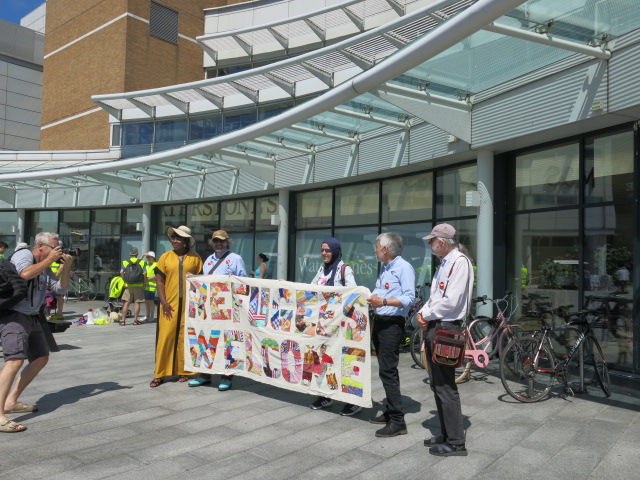
Members of the Salisbury group joined the refugee march in Southampton

June 2023

Some members of the Salisbury Amnesty group went over to join the march in Southampton held in support of refugees. It goes without saying that refugees are getting a terrible press at present with tabloid fury at the boat crossings showing no signs of abating. Politicians are in full cry and new legislation is promised to make asylum even harder. Plans to send them to Rwanda are still in place and there is a section of the Conservative Party which would be happy for the UK to withdraw from the European Court to achieve this. In a previous post we drew attention to some of the inconsistencies in the attitudes towards refugees and asylum seekers. We were sad not to meet colleagues from the Soton group.

Pics: Salisbury Amnesty

Apartheid in Israel


The group hosted a talk on the Apartheid state established by Israel against the Palestinians

June 2023

UPDATE: 17th June. British parliament to debate the UK/Israel trade agreement in which there is a risk that illegal settlements will be recognised to be Israeli

On 13th June, the Salisbury group and Salisbury Concern for Israel Palestine (SCIP) hosted a talk on the apartheid state established by Israel against its Palestinian citizens. The talk, with slides and film clips, was given by Garry Ettle who is the voluntary coordinator for Israel, Palestine and Lebanon. It was mostly built around the report Amnesty prepared last year.

The speaker went through the main thrust of the report’s conclusions and the evidence compiled by Amnesty over a three or four year period. It is some 280 pages in length and together with similar reports by Human Rights Watch, B’Tselem in Israel (who first used the apartheid term) and the UN, represents a compelling case of how the Israel authorities have created a two state solution where the Palestinians are deprived of land and housing, denied economic and social rights, suffer from the segregation of their communities and they are subject to illegal acts against them including the arrest and mistreatment of Palestinian children.

The denial of rights for Palestinians is enshrined in the 2018 Nation State Law which says that the ‘State of Israel is the nation state of the Jewish people’. This follows years of oppression which started in 1948 with the expulsion of thousands of Palestinians and the destruction hundreds of their villages. Since 1948, 700 new Jewish settlements have been created but no Palestinian ones have been allowed. Palestinians are caught in a kind of Catch 22: their properties are demolished because they do not have permits but permits are almost never given.

The policy of fragmentation means travel around Israel is almost impossible. Gaza is essentially an open prison, with travel out of it almost impossible and there is a 3 mile limit from the coast. It is surrounded by a buffer zone. The most distressing evidence during the presentation was the arrest of children in the middle of the night who are then held, sometimes in solitary confinement and there is evidence of rough treatment.

Response

Despite the huge weight of evidence from several agencies compiled over several years, the Israeli government has not sought to refute it. They have simply accused the agencies, and Amnesty in particular, of being anti-Israel and anti-Semitic. There has been no point by point rebuttal of the evidence.

UK Government

The response by UK governments over many decades has been shameful and continues today even after the compelling evidence of the various reports mentioned above. Rishi Sunak, now the prime minister of the UK in an interview with the Jewish Chronicle in August 2022, praised Israel as “a beacon of hope“. When asked about the Amnesty report in particular said “[it] could only make a solution to the Israel, Palestine conflict more elusive“. He then made the outrageous claim that “those who label Israel an apartheid state also deny Israel’s right to exist”. But arguably the most egregious remark in the interview was “the Amnesty claim is not only factually incorrect but frankly, offensive“. No evidence is provided for these remarks and it simply seems to be an echo of the Israeli government’s own propaganda.

The Foreign Office simply says it is “aware of these reports and does not agree with the terminology used within them” (August 2022). Again, no evidence is provided. The full statement of UK government which follows is considerably one-sided. It is in response to a petition following the various reports.

[…] As a friend of Israel, we have a regular dialogue with the Government of Israel. This includes encouraging the Israeli government to do all it can to uphold the values of equality for all. Minister for the Middle East, Amanda Milling, emphasised this point in her recent meeting with Israeli Deputy Foreign Minister Roll during her visit to Israel and the OPTs“.

The response simply does not address the huge imbalance of power between the Israeli’s and Palestinians. It is blind to the fragmentation of territories which make travel for Palestinians almost impossible. To read the weight of evidence in the three reports and compare it with the FCO’s response is to wonder if it is the same country being described.

Labour Party

Labour has had its own problems concerned with alleged anti-Semitism within the party in the Corbyn years. In a video interview a year ago with Sir Keir Starmer by the Jewish Chronicle, Sir Keir was asked about the Amnesty report and did he agree with the apartheid claim made by Amnesty? His response was “No, I’m very clear about that. It is not the Labour party position”. Once again, a simple denial with no explanation. He was very insistent earlier in the interview about his desire to ‘root out anti-Semitism’ within the party.

The accusation of anti-Semitism against anyone who criticises the actions, over many decades, by the Israeli government against its Palestinian citizens seems to have struck terror into our politicians. Terrorist attacks by Palestinian groups against Israeli settlements are rightly condemned. But the numbers of Israelis who have died is but a tiny proportion of the numbers of Palestinians who have died at the hands of Israeli forces.

To criticise Israel and to provide copious evidence of its policy of apartheid, is not anti-Semitic. The evidence shows that it is and it is up to the Israeli government to rebut the evidence presented in the reports.

Blog at WordPress.com.

Up ↑