Refugee summary


The October update on the current state of refugees into the UK
October 2023

The week’s big event has been the start of the Supreme Court’s review of the legality of the Rwanda deportation plan. They are expected to take 3 days to come to a conclusion, but this will not be made known for some weeks. Also, the Mayor of Portland’s planning permission protest against the Bibby Stockholm ship was heard this week (she lost) and the Home Office have reported that claimants will be sent back to the barge from 19th October. In passing, the Home Office is refusing to state the cost of the barge, as it would not be “in the public interest”.

The government’s Illegal Migration Act is facing a court challenge from the Northern Ireland Human Rights Commission (NIHRC) on the ground that it breaches the Windsor Framework. The framework is the revised post-Brexit deal for Northern Ireland, which was agreed by the UK and EU earlier this year. It deals mostly with trade issues but also includes a human rights element. It commits the UK not to water down the human rights provisions that flow from the Good Friday Agreement.

Opening up the UN Refugee Convention to reform would cause the world to “go backwards” on refugee rights, a UN leader has said. Gillian Triggs, UN Assistant Secretary-General, told the One Young World Summit in Belfast that there is a “global environment of populist rhetoric” that is damaging to refugees. The 1951 UN Refugee Convention outlines a number of protections for refugees, including basic minimum standards, and asserts they should not be returned to a country where they face serious threats to their life or freedom.

Suella Braverman

In a trip to Washington DC last month, the Home Secretary, Suella Braverman, said it should be questioned whether the application of the UN’s Refugee Convention is “fit for our modern age”.

Channel crossings

The mild Autumn has kept the small boats coming, the total people arriving for the year so far being just over 25,000. This is down by about 20% on last year, mostly because of the absence of arrivals from Albania. There have been two major reports this month: Safe Passage has been looking at safe routes for prospective refugees and the Refugee Council have looked at the data on arrivals, and discuss the impact of the new Illegal Migration Act. The Refugee Council’s analysis of new Home Office statistics shows that three in every four of the people who have crossed the channel so far this year would be recognised as refugees if the UK Government processed their asylum applications. This is higher than the Refugee’s Council previous analysis of those who made the journey in 2022, which found it was almost two-thirds. The statistics also show that:

More than half (54 per cent) of those who have made the perilous crossing come from just five countries – Afghanistan, Iran, Eritrea, Syria and Sudan.

With the exception of Albanians, the number of people crossing the channel is higher in 2023 compared to 2022.

Analysis based on the data shows that once the Illegal Migration Act 2023 comes into force:

 • Each year, over 27,000 refugees who cross the channel will be denied status in the UK.

 • As few as 3.5 per cent of those people arriving by small boat, 1,297 people, will be removed from the UK to their own country.

 • 35,409 people who arrive in the UK by small boat could be left in limbo each year, having had their asylum claim deemed permanently inadmissible but not having been removed.

• Even with a safe third country agreement in place with Rwanda which allows for up to 10,000 people to be removed there annually at least 25,409 people will be left in a state of permanent limbo each year.

(The Illegal Migration Act The Illegal Migration Act became law on 20 July. The main elements of the Act include the creation of a duty for the Home Secretary to arrange for the removal of anyone who arrives irregularly into the UK – including, but not limited to, those who arrive by small boat. Anyone who is covered by the duty to remove will also have any asylum application or relevant human rights claim deemed automatically inadmissible. )

The Safe Passage report concentrates on devising a better system of dealing with new arrivals. It recommends developing safe routes, not least to end the control of the smugglers, an organized Europe-wide system to share the responsibility, and a recommitment to the UN-based regulations under international law.

The Migration Advisory Committee has recommended that the shortage occupation list is abolished and that people in the asylum system with permission to work are allowed to work in any role. These are some of the recommendations in the full review of the shortage occupation list, published this week.

With thanks to group member Andrew for the work in producing this report.

AH

Death penalty report


October 2023

We are pleased to attach the death penalty report for mid-September to mid-October 2023 thanks to group member Lesley for the work in compiling the information. The report mentions the World Day Against the Death Penalty in which several group members took part sending an email and/or an email to Singapore concerning its use of the penalty for drugs offences. Note as ever that China does not feature as the details are a state secret. The country is believed to execute more of its citizens than the rest of the world combined.

Refugees and Rwanda


Government still in difficulty with refugees and its Rwanda policy

October 2023

Immigration remains a key issue for both the government and the opposition and the focus is on the large number of Channel crossings from France. The prime minister has pledged to end the crossings, however they continue to come in large numbers. The government spent considerable time trying to find countries willing to take migrants and eventually found Rwanda to which £145m was paid to set up the necessary reception facilities. The planned first flight ended when the European Court found against the deportations because under article 3 of the European Convention of Human Rights, there is an absolute ban on the use of torture and other serious mistreatment of which there is considerable evidence that it takes place in that country.

In a Country Report by the US Department of State in 2022, there is an extremely long list of problems with human rights in Rwanda. They include: unlawful or arbitrary killings; torture or cruel, inhuman, degrading treatment by the government; harsh and life threatening prison conditions and arbitrary detentions. Their activities also extend overseas and in particular in the Democratic Republic of the Congo which include killings, kidnapping and violence. The report also lists a range of activities against the media and journalists. There are similar reports from Human Rights Watch and Amnesty. Altogether it paints a picture of a country which is a stranger to human rights and where violence and repression are a way of life.

Daniel Trilling in his ‘long read’ in today’s Guardian newspaper (5 October) Inside the Rwanda deportation plan: there were so many warnings it would fail. How did it get this far? traces the whole story of where the idea came from and how it got stuck after the European Court ended it at least temporarily. The proposal was meant to act as a deterrent to further Channel crossings. This was never likely to have been the case since people willing to risk their lives in a rubber dingy having paid considerable sums to a smuggler are sufficiently desperate not to heed any such threat even if they were aware of it.

He reveals that the Foreign Office said ‘no’ to Rwanda largely because of the sort of reasons listed above. They were aware of the UN putting pressure on Rwanda to stop its troops engaging in mass killings and rape in DRC. Officials from the Foreign Office were preparing Country Policy and Information Notes CPIN, which were unfinished at the time the decision was taken.

The government was embarrassed when an undercover report secretly filmed Johnson Busingye, the high commissioner for Rwanda saying disobliging things about the UK government such as it was “immoral for the British to claim to be a compassionate country”. Asked about the shooting of twelve refugees he replied “so what”.

The Supreme Court is due to rule at the end of the year and it is likely that the prime minister Rishi Sunack will ignore the European Court if it rules in the government’s favour.

It is hard to fathom the reasoning behind the government’s position on this policy. It was designed to be a deterrent but it was advised by its own officials that this was unlikely to be effective. The numbers of immigrants who would be sent is a matter of a few thousand which, in the face of the many thousands crossing the Channel and the tens of thousands languishing in immigration centres and hotels, will be a tiny proportion. They must have been aware of the copious evidence that the country was entirely unsuitable as a place to send vulnerable people. They must also have known that Israel abandoned the very same policy and the Danish government had put its policy on hold.

At the Conservative conference this week, the prime minister cancelled the next leg of the HS2 rail project claiming that ‘the facts had changed’ and this prompted a change in policy. Yet in the case of Rwanda, the facts haven’t exactly changed but have been visible all the while. It is though the policy – described as ‘shameful’ by Amnesty International’ chief executive – has become totemic existing in a space beyond reason and facts, a kind of belief system which defies rational thinking. Partly it is because the prime minister has made stopping the boats a key policy aim and Rwanda is central to that, a policy which cannot be cancelled for fear of looking weak. If flights take place at the end of the year it will cause considerable suffering to those sent there.

Salisbury group member appears in national paper


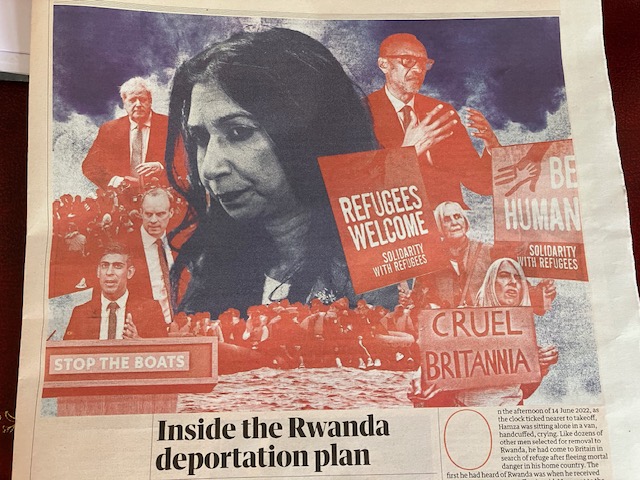
Salisbury group member Lesley appears in a montage on the front page of the Long Read in the Guardian, 5 October

October 2023

An article in the Long Read section of the Guardian newspaper entitled Inside the Rwanda deportation plan has a photo montage in which group member Lesley features holding two banners.

The article is by Daniel Trilling and is a detailed review of the muddle, confusion and dissembling behind the government’s desire to send unwanted migrants to Rwanda.

We received word that the first deportation flight in June was to take off from Boscombe Down, a secure airfield near Amesbury in Wiltshire. It had been moved from Stanstead at the last moment to ward off potential protests and because it is surrounded by barbed wire fencing. Two Salisbury group members were able to make it to the airfield where there was a large contingent of police officers and a bevy of cameras. The photo was taken by one of the photographers. As you know, while we waited for the take-off, a final appeal to Europe meant the flight was cancelled hence the fury about the European Court and threats to take us out of the jurisdiction of the Court to enable future deportations to take place.

Blog at WordPress.com.

Up ↑