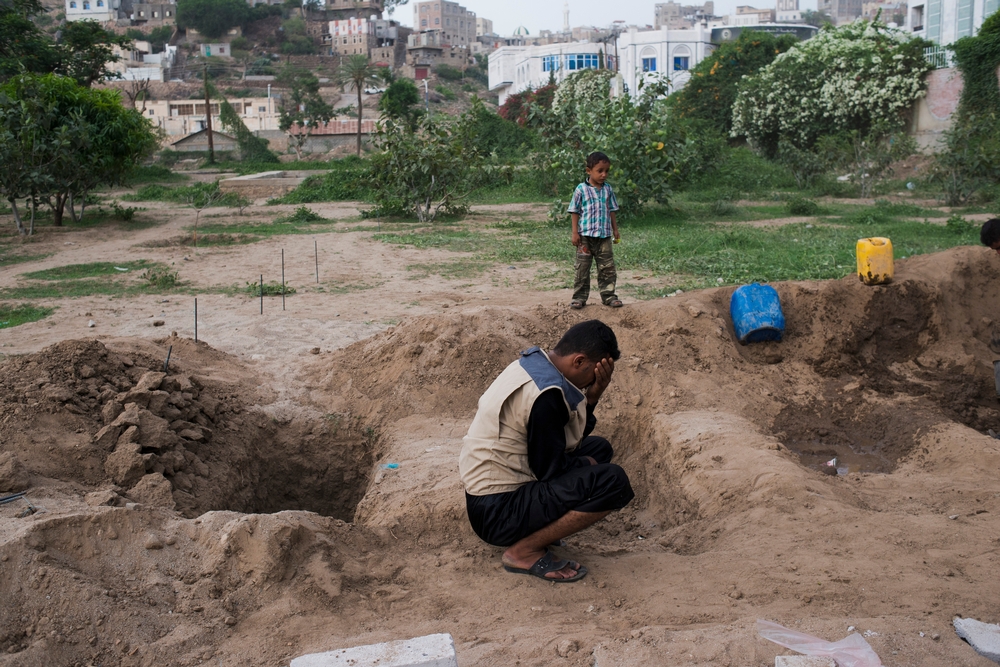
Today, 25 March 2018, marks the third anniversary of the Saudi Arabia-led coalition’s military campaign in the Yemen. We have featured this conflict on this site during that time with stories focusing especially on the UK’s involvement supplying arms and logistical support and our involvement generally in bombing Yemen.
5,974 civilians killed during the conflict
Despite three years of war, the conflict shows no sign of abating, and Yemeni civilians continue to suffer at the hands of all parties to the conflict. Warring parties have consistently shown a brazen disregard for civilian life and the their obligations under international humanitarian and human rights law. The devastation wrought and thousands of lives lost continues to fail to attract the level of attention and concern they warrant across the world.
9,493 civilians injured during the conflict
The billion dollar arms deals between Saudi Arabia and its coalition members and a host of western allies have continued throughout the past year despite mounting evidence that Amnesty and others have built to show the high risk such weapons will be used to in unlawful attacks on Yemen.
More that 2 million people currently displaced by the fighting
Hundreds of other Yemeni children have died from the worst cholera outbreak in modern history. Thousands who have succumbed to malnutrition, and the untold number of civilians killed by airstrikes on homes, streets, weddings and funerals. This has been the human price of the three-year civil war in Yemen, in which all parties have shown a callous disregard for life, but where the large majority of civilian deaths lies irrefutably at the door of Saudi Arabia.
This is the situation now and the concern is that post Brexit, the arms control regime will be weakened further especially with our desire to create and develop new markets to those lost in Europe.
More than 22.2 million people are in need of humanitarian assistance including food, water, shelter, sanitation and fuel.
What can I do? The UK government is indifferent to the suffering in the country and has recently celebrated the latest arms deals following the visit by King Salman. There are things you can do and in particular send some tweets. Suggestions include:
.@Theresa_may: stop selling weapons that fuel violations, destroy civilian lives in #Yemen #Yemencantwait
Hospitals, schools, mosques – it seems nothing off limits. Stop bombing civilians in #Yemen @King Salman
If you want to support or join the Salisbury group of Amnesty, the best thing is to keep an eye on this site or Facebook or Twitter and come along to one of our activities and make yourself known. It is free to join the local group.
This bi-annual event held in London receives a considerable amount of opposition and is a place for protest against the arms trade. The description of the event by the organisers is blandness itself:
World leading event that brings together the global defence and security sectors to innovate and share knowledge.
It paints a picture of people coming together in some kind of seminar format to discuss defence issues as though it is a think-tank. The reality is a little different as it is a place where all kinds of weapons manufacturers can display and secure deals to a wide range of countries who come to visit. If it is as benign as the description implies one has to ask why organisations like Amnesty are denied access? The purpose is to sell arms and to quote the organising company:
It’s a model that works well in the Middle East…There’s a lot of money being spent here in the UAE on homeland security technology, so it’s a good market in which to roll out our brand
Among the invitees are countries with highly dubious and questionable human rights records. These include according to the guest list: Brunei, Egypt, Bahrain, Saudi Arabia and UAE. If we look at Bahrain in particular, a recent Amnesty report on the country published earlier this year concluded, inter alia:
Since June 2016, the Bahraini authorities have dramatically stepped up their crackdown on dissent. As a result, by June 2017, Bahrain’s formerly thriving civil society had found itself reduced to a few lone voices brave enough to speak out. The majority of peaceful critics, whether they are human rights defenders or political activists, now feel the risk of doing so has become too high. Over the course of a year, the authorities increasingly resorted to a wide range of repressive tactics including arrest, harassment, threats, prosecution and imprisonment to silence peaceful critics. Amnesty International’s research concludes that the security forces have even resorted to torturing or otherwise ill-treating human rights defenders, both men and women, a practice that has not been prevalent in Bahrain since the height of the crackdown that followed the 2011 uprising.
The report went onto to describe how Bahrain has backtracked on reform and noted that in the period June 2016 to June 2017, 169 critics or relatives have been arrested, summonsed, interrogated, prosecuted, imprisoned, banned from travel or threatened. Freedom of expression is increasingly criminalised and the opposition party has in effect been dismantled. The report was compiled after a large number of interviews were carried out including with 52 victims, 58 journalists, lawyers and others, and the investigation of 210 cases.
The British government has worked hard to promote our interests with Bahrain and a Daily Mail article in 2016 detailed the many links from the Queen down through the rest of the Royal Family. Theresa May visited recently.
As far as the Arms fair DSEI itself is concerned, Andrew Smith of the Campaign Against the Arms Trade which is helping to coordinate protests said:
DSEI will bring many of the world’s most appalling regimes together with the biggest arms companies. Right now UK fighter jets and bombs are playing a central role in the destruction of Yemen; what will be the next atrocity they are used in? War, repression and injustice are fuelled by events like DSEI. It’s time to shut it down for good
DSEI was formerly part of the UK Trade and Industry Department but has now been moved to the newly formed Department for International Trade the minister of which is Liam Fox.
In an interview on the BBC today (11 September) Jeremy Corbyn, the leader of the opposition, said “[the UK] sells too many arms to countries which abuse human rights.”
The guest list shows several firms with a Salisbury link who are exhibiting at this fair. They include Babcock, Chemring’s, QinetiQ and Cubic.
The government has got itself into something of a fix over the question of arms sales. Whilst claiming to have a strict code and robust procedures, the sale of arms to questionable regimes has increased. Thousands of jobs now depend on this industry and with future problems likely to arise connected with our withdrawal from the EU, from an economic viewpoint we can ill afford to reduce sales of weapons. It is thus on a treadmill requiring it to support the sale of weapons to a range of unsavoury regimes who in turn use these weapons to intimidate their own people or to cause suffering of neighbouring countries such as the bombing of Yemen by the Saudis. It is also important to bear in mind that it is not just weapons that are involved but also security equipment. Autocratic regimes are keen to keep tabs on their citizens and need all the techniques of surveillance to do so. This kind of equipment, although not lethal of itself, does enable individuals to be monitored, watched and harassed.
The position is indefensible and some of the arguments echo those used by the slave trade in the nineteenth century where large numbers of jobs were involved in its continuation.
If you are keen to join us then come to the next event we are holding on 18 September and make yourself known.
A doctor working for Médicins sans Frontières shares her experiences of working in Yemen
July 2017
Hella Hultin is a Swedish surgeon who is working for MSF in Yemen. In the current issue, she writes of her experiences of working in Khameeer in northern Yemen.
We were about to do an appendectomy on a girl, but my Yemeni colleague thought I might be tired after the long journey. So I sat in the operating room to watch. Suddenly both our phones rang. The voice on the other end was stressed asking me to come straight to the emergency room.
“Help! How do I get there?” I thought, while I quickly put on a white coat and hurried out, so fast the cats outside scattered in all directions. “Emergency?” I asked the attendant outside, and was pointed in the right direction.
When I arrived, the Emergency room was full of people, both patients and relatives. Many patients were being rolled in on stretchers from the ambulance entrance. I was told there had been an airstrike and more injured would be arriving soon. The injured were all covered in dust and dirt, and almost all had wounds from shrapnel. Several had fractures of the arms or legs, and some had burns on their face and hands.
A desperate husband was running around the room screaming. When I managed to get the interpreter to translate what he was saying, it turned out he was missing two of his children who had been caught up in the strike. It’s not hard to imagine his anxiety.
We got to work and ended up operating all night. We transferred two of the most seriously injured to a larger hospital for specialist treatment that we were unable to provide.
Hours later I made it to bed. As I lay down, it felt like I’d been there for weeks.
We do not know from this account the nature of the airstrike but there is no suggestion that those injured are military personnel. Accounts from people working inside Yemen are scarce as the Saudi’s have blockaded the country. Only a few journalists have managed to get in and there was a radio report last week of BBC’s Radio 4 news (limited time podcast).
Follow us on Twitter or Facebook, salisburyai. If you live in the Salisbury area and would like to join us you would be very welcome. Just keep and eye on this site or Facebook or twitter and come along to an event and make yourself known. It is free to join the local group.
When we turn to our sports pages, we expect to read about who is beating Britain at cricket, the latest in the long-running saga of the English football team or Andy Murray’s latest exploits on the tennis courts. We do not expect to read about human rights or to see quotes from organisations like Human Rights Watch or this one – Amnesty. They are to be found on the news pages surely.
But on Tuesday 18 July, the Guardian in the UK devoted nearly two whole pages in its sports section to the sponsorship by Bahrain of a range of sporting activities and sportsmen in an effort to create a more favourable image for itself.
And it needs to. The country has a quite appalling record of human rights abuses. These include torture, in particular beatings and the use of electric shocks. Freedom of assembly has been severely restricted and peaceful protests have been violently put down. Nabeel Rajaab – a human rights defender is in prison.
Alan Hogarth, head of policy and government affairs for Amnesty said:
It seems pretty clear that the Bahraini authorities have stepped up efforts to associate the country with major sporting events as glitzy cover for an ever-worsening human rights crackdown. For the most part, Bahrain’s harnessing of the glamour and prestige of sport has helped deflect attention from the arrests of peaceful critics, reports of tortured detainees, unfair trials and death sentences.
But you would not know this from the sports pages where all is glamour and excitement. Pictured is the Olympic gold winner
Alistair Brownlee. Pic nztri.co.nz
Alistair Brownlee – featured in the Guardian article – promoting a Bahrain sponsored event. Other sports include F1 motor racing, football with FIFA siting its conference in the country and cycling. Spokesmen for the various organisations involved in laundering Bahrain’s image claim that they are not competent authorities to assess the human rights violations taking place there. There are also claims that the sporting activities will help overcome the problems. This might have a grain of truth if during coverage, human rights issued were raised by commentators. Of that there has been no sign.
Bahrain cycling team colours. Photo; Bettini
Their promotional activities are not limited to sport as members of the UK’s Royal family have been pressed into service. Her majesty the Queen herself welcomed King Hamad to the Royal Windsor horse show and there are pictures of Prince Charles and Prince Andrew with various members of the Bahraini royal family.
We do not have to look far for reasons for this rolling out of the red carpet for members of this royal family as it is our old friend arms sales which are behind it. It led Theresa May to visit the country last year. As CAAT reports we are keen to foster arms sales there including Typhoon jets and we have established a naval base at Mina Salman. Defence clearly trumps human rights considerations.
At present, the sportsmen and women can collect their fees and promotional monies free in the knowledge that the majority of those reading of their sporting achievements probably do not concern themselves too much with goes on in the countries like Bahrain and how they treat their own citizens. And only rarely do the stories touch on these matters since sport seems to exist in a kind of box as far the rest of coverage is concerned. Sport, money and politics are now closely entwined. Sports stars enjoy huge acclaim and some have a large fan base. They have huge influence over the young who spend large sums on their merchandise. This is a big responsibility.
But is it too much to ask that sporting people should have a conscience and should be concerned that their names and images are being used to hide serious abuses taking place? Where a regime such as Bahrain is using sport to whitewash its reputation then sporting people should be aware of the role they are playing and the harm they are doing. Should they not be concerned that they are being used by these regimes?
If you live in the Salisbury area and are interested in joining us we would be pleased to see you. The best thing is to keep an eye on our events which are listed at the end of our minutes and make yourself known at one of them. Or keep an eye on Twitter or Facebook.
The British high Court today handed down a deeply disappointing and some might argue astonishing decision that arms sales to the Saudi Arabians represents no risk to human rights law. The case was brought by the Campaign Against the Arms Trade CAAT and concerned the use of weapons sold to the Saudis and being used by them in the ‘forgotten war’ in Yemen.
We have in this blog been drawing attention to the terrible damage being done by the Saudis in Yemen who have used our weapons to bomb civilian targets in that country. These are not isolated incidents or accidents, but part of what seems to be a plan which has seen the bombing of hospitals, refugee camps, schools, wedding ceremonies and market places – indeed anywhere where civilians are likely to congregate. 10,000 have now died there and the country is in crisis. CNN has produced a short film (distressing please note) showing some of the dreadful effects of the war being waged.
Despite the considerable evidence that international human rights are being violated, that civilian targets are being targeted and banned UK produced BL-755 cluster munitions are being used, astonishingly the High Court ruled that:
The Secretary of State was ‘rationally entitled to conclude’ the coalition was not targeting civilians.
It further concluded:
Saudi Arabia was respecting humanitarian law and is in constructive dialogue with the UK about its processes and incidents of concern. There was no real risk that there might be serious violations of International Humanitarian Law.
A CAAT said it was a ‘very disappointing verdict’ and that they were going to appeal.
If the ruling is not overturned then it will be regarded by Whitehall and Westminster as giving a green light to continue arming and supplying brutal dictators and human rights abusers.
An Amnesty International spokesman said:
The shameless arms supplies to Saudi Arabia … may amount to lucrative trade deals but the UK risks aiding abetting these terrible crimes. This is a deeply disappointing outcome which gives a green light to the UK authorities – and potentially other arms suppliers – to continue authorising arms transfers to the Kingdom despite the clear risk they will be used to commit violations. James Lynch, head of Arms Control and Human Rights at Amnesty International (source: Washington Post)
It is difficult to ascribe a rational reason to the High Court’s decision. True they had access to secret information which the rest of us cannot know. But the evidence on the ground is compelling and has come from several different sources and experts. And there is the human rights record of the Saudis themselves in their own country. A record of executions, torture and amputations which puts them in a league of their own.
Behind it all is that they are major purchases of weapons and our biggest market for such materiel by far. They are the tail that wags the dog.
Few can be happy that for the sake of jobs, weapons supplied by us are being used to cause such mayhem, death and misery in an already poor country. We must sincerely hope that the Court of Appeal overturns this disgraceful decision.
Sources: the Independent; Washington Post; New York Times; the Guardian; CNN
The Campaign Against the Arms Trade CAAT, has finally managed to get the problem of our massive sale of arms to the Saudi regime into court – a process which has taken a considerable degree of legal wrangling.
At issue is our arms sales, put at £3.3bn to the Saudis, and the use of these weapons to bomb a wide range of civilian targets in Yemen. This has caused untold distress with thousands killed and injured, and there are distressing scenes of malnutrition and dying children. The Saudis have bombed schools, hospitals, weddings and funerals, sometimes returning to bomb the rescue workers causing further mayhem. An estimated 6,000 have been killed.
They have also been shown to use cluster weapons which have been banned.
In today’s hearings correspondence was revealed from the Foreign Secretary, Boris Johnson in which he says:
The issue is extremely finely balanced, but I judge at present the Saudis appear committed both to improve processes and to taking action to address failures/individual incidents.
Picture: MSF
We will of course have to see what the judges decide in this case but in the debate in the House of Commons, one of the key matters discussed was what was described as ‘glacial’ progress by the Saudi government. Although there are disagreements about the number of incidents, they number around 100 and yet the number investigations have been eight. A wide range of agencies have criticised the government and the Saudis for the raids including Oxfam, Amnesty, WWF and MSF.
It seems clear that the arms sales tail is wagging the ministerial dog. It is a real stretch to say ‘the issue is finely balanced.’ If we did not have so much tied up in these arms sales with money, jobs and local economies in the UK dependent on them, it is doubtful we would continue with such clear breaches of international humanitarian law.
We shall no doubt be returning to this topic in due course.
Good news on cluster bombs
Just before the Christmas holidays, the Government finally admitted that Saudi Arabia had indeed dropped UK cluster bombs in its bombing campaign in Yemen and in doing so, confirmed that our research was entirely correct. When we alerted the UK government to this in May 2016, the Government strongly denied it, as did Saudi Arabia. This is a major victory for our research work and campaigning to keep the government under pressure on this issue.
Amnesty joined with 100s of other organisations around the world to campaign to ban cluster bombs because of the risks they pose to civilians. Cluster bombs scatter 100s of lethal bomblets that can continue to kill and cause horrific injuries long after the conflict has ended. The UK rightly banned these horrific weapons and their use in Yemen provides yet more evidence of indiscriminate nature of the Saudi Arabian led coalition’s bombing campaign.
On 12 January 2017 the House of Commons debated the war in Yemen for the second time in less than a month having already had a debate on it on 19 December. This has been called the ‘forgotten war’ for some time since all the media and political attention has been focused on Syria. So it is to be welcomed that this war is now getting its share of attention. This was an opposition debate led by Stephen Twigg MP.
Results of bombing. Picture: Mintpress News
This is a complex war difficult to summarise but essentially the two main actors are the Saudis and the Houthi rebels. Both have committed atrocities: the Houthis with massacres, the use of child soldiers and shelling across the border into Saudi territory. The Saudis by bombing civilian targets and using cluster weapons. The December debate focused on the use of these weapons, supplied by the UK before their use was banned. One thing we learned from that debate was that the UK government has offered to exchange cluster weapons for more modern Paveway bombs but it appears the Saudis have not taken up this offer.
To an extent it is a proxy war: part of the long-running Sunni/Shia feud being fought between Iran and Saudi. There are also tribal politics mixed in. Although the role of the Houthi rebels was criticised, the point was made that it was we who were arming the Saudis and RAF personnel involved at the command and control centre.
It was lengthy running to just under 3 hours. A number of points were made. A major concern was the allegations of abuses against International Humanitarian Law (IHL) and the slow pace of investigations (‘glacial’ was the word used by Stephen Twigg) by the Saudis into them. Various figures were bandied about but over a hundred seems to be the consensus but only 9 investigations have been carried out in 14 months.
There were many tributes to DFID and its contribution to Yemen but as Stephen Twigg noted:
There is a paradox at the heart of the UK’s approach to Yemen: generous on aid but we contribute to the conflict with our arms sales.
It is interesting that during the writing of this blog, the headline of the Mail on Sunday was the result of a survey which apparently revealed that 78% of people want to end overseas aid and put the funds into the health service which is experiencing a crisis at present. The Coalition government and now the Conservatives must be praised for maintaining the levels of overseas aid despite considerable pressure from some of their backbenchers and some of the media.
Chris White MP – who is chair of the Arms Export Control Committee – said that the UK should be an example to the rest of the world in terms of our licensing regime. He reminded the House of rule 2(c) which ‘forbids the authorisation of arms sales if there is a clear risk of a violation of international humanitarian law’.
Comments
It is of course welcome that the House of Commons should have given such time to this debate on Yemen – indeed as we’ve noted the second in less than a month. The government has had something of a free ride, able to do little to end the conflict and carry on allowing our arms to be sold to Saudi – some £3.3bn worth so far. It seemed to be SNP (Scottish National Party) members who were the most forthright in condemning the arms sales. Tasmina Ahmend-Sheikh saying:
If Saudi Arabia and Iran are the puppeteers, we are the quartermasters
There were several calls for a peace process but one seems unlikely at present. It was alleged that the Saudis are resisting the process, a claim denied by Tobias Ellwood the minister in FCO.
The link between our sale of arms and the devastating effects of those weapons on the people of Yemen although made, was not strongly emphasised. Part of the problem of course is that although the Conservatives are in power now, many arms sales were made as well during the Labour administrations. So both parties are tainted.
Tobias Ellwood MP
The government is in something of a bind. The value of our exports to the region and to Saudi is considerable. One is reminded of the old adage – variously attributed to John Maynard-Keynes or John Paul Getty – that if you owe the bank a million pounds you have a problem, if you owe the bank a hundred million pounds, the bank has a problem. Because billions of pounds of weapons are sold, we are not in a position to exert much control: we are too dependent on the business. One can imagine polite words being spoken but it was clear from the debate that the Saudis think they can win this so are in no haste to agree peace terms and little more than token efforts are made to limit sales of arms. Such is the murky world of arms sales anyway, that brokers can quite easily circumvent controls certainly for the more every day weapons.
In the December debate, the Defence Secretary Michael Fallon insisted the Saudis were:
on the cusp of a major reform programme of its economy and society
The debate shone a light on the problems of the country and also on the pusillanimous nature of our foreign policy. Speaker after speaker referred to the terrible state the country was in and the enormous distress of its residents as a result of the war. It was interesting to note that at least two of the MPs said they were born there presumably from when it was known as Aden. Worries were expressed about ISIS moving in.
But the fundamental moral issue of our sale of arms to a country which uses them to wreak such havoc on another nation was not rigorously pursued. The FCO and the MoD would not be seriously disturbed by this debate.
It also provides a clue to life once we leave the EU. There will be a major push to achieve business with whichever countries we can and the morality of our dealings will not get a look in. It’s good for business they will say but not good for human rights.
The debate ended with calls for an urgent independent (ie not by the Saudis who are dragging their feet) investigation into reports of breaches of IHL on both sides of the conflict.
If you live in the Salisbury area and would like to be involved in our work we would be pleased to welcome you. See details on the Joining tab on the home page
Damning criticism of government’s blind eye to arms sales to the Saudi Arabians
Recommends suspension of arms sales to the Saudis
Picture: mintpressnews.com
Followers of this blog will be aware of the attention we have been drawing to the war in Yemen and our government’s role in it. It started by accident with a letter to our MP Mr John Glen who forwarded a bland reply from a Foreign Office Minister, Tobias Ellwood. The answers began to unravel quite quickly when it was revealed that, for example, far from reigning in the Saudi’s, we were promoting their membership of the UN’s Human Rights Council.
Now the International Development and the Business, Innovation and Skills Committees have produced a lengthy report which is extremely critical on several different levels. The chair’s summary remarks were:
The UK led the way in establishing international humanitarian law to govern the sale of arms. The conflict in Yemen has raised serious concerns that we are not showing equal determination in ensuring that these are respected.
During this inquiry we have heard evidence from respected sources that weapons made in the UK have been used in contravention of International Humanitarian Law. The Government can no longer wait and see and must now take urgent action, halting the sale of arms to the Saudi-led coalition until we can be sure that there is no risk of violation.
We call on the Government to continue the UK’s long-standing commitment to IHL and lead the international community in establishing a strong, independent inquiry. The circumstances surrounding incidents in Yemen, such as allegations of the use of cluster bombs, must be firmly established and send a clear message to all combatants in Yemen that human rights must be respected.
The current system for overseeing the sale of arms must be improved. At present we do not have sufficient transparency to hold licensing decisions to account or the confidence that the benchmarks ensuring human rights law is respected are high enough. This must be addressed immediately.
Backbench committees do valuable and largely unsung work in the House of Commons and provide an opportunity for members to question government activities more closely than they are able to do in the House itself.
Background
The background situation in the Yemen is dire. The UN categorises it as a level 3 crisis which is the most severe. UNICEF say that 1,211 children have been killed and 1,650 injured, both are likely to be under-estimates in view of the difficulty in reporting. The economy and health care systems are on the verge of collapse. Over a million people are internally displaced.
Britain however continues to profit from the war by supplying huge amounts of weaponry to the Saudis. Between April and December 2015 we supplied £1.7bn worth of aircraft and a further £1bn of air-delivered bombs. More shockingly is that, although we are no longer supplying cluster munitions, previously supplied ones have turned up on the ground. These weapons kick out tens or hundreds of sub-munitions which saturate an area the size of several football fields. Duds can be dangerous to children especially who can lose limbs or be blinded if they pick them up.
Both Amnesty and Human Rights Watch have provided evidence to the FCO about the use of these weapons.
The report
The report makes interesting reading most particularly concerning the UK government attitudes to the conflict. It contrasts the FCO’s attitude to the documented evidence it is presented with on the Yemen by NGOs including Amnesty and HRW, which it ignores, with that from Syria where evidence is accepted. David Mepham, the UK director of HRW said in evidence:
I was at a meeting with [the Foreign Secretary] several months ago when I gave him copies of our report and said, “These are the GPS coordinates; these are the strikes; these are the markets and schools that were hit.” Therefore, he has that evidence. The Foreign Office has had that evidence for months. It is extraordinary that the line comes back that they do not have evidence, when that evidence has been shared with them for a considerable period of time.
Picture: the Independent
The line from the government is that the UK has ‘the most robust arms control export regimes in the world’. The committee heard evidence of how long this robust arms control regime took to make its decisions: a matter of days. The hundreds of licences take around 20 or 25 days to approve. In comparison with other government decision making, this is merely the blink of an eye. It seems fairly obvious that little control is exercised. No licence has been refused.
In the face of the hundreds of incidents of schools, marriage ceremonies, factories and hospitals being hit by bombing, the UK government accepts the answers given it by the Saudi government. The committee was sceptical at FCO reliance on Saudi assurances and said:
We are not convinced that Saudi Arabia is best placed to investigate reports of IHL breaches and their lack of progress with reporting findings only confirms our concerns that they are obstructing progress. Of 185 incidents reported by UN, HRW and AI, only 9 investigations have taken place
UK personnel
Our involvement is not just limited to supplying weapons but military and civilian personnel are also involved in the control centre and elsewhere. The claim is that they are not directing the actual bombing. The committee were not convinced by this argument.
It is impossible, on the basis of the evidence that is before us to claim plausibly that the United Kingdom is not involved. We provide the aircraft and the bombs. This level of involvement without being party to a conflict is unprecedented. This is an area where there is much confusion and greater clarity is needed. (para 75)
Human Rights
The committee considered our political role in this conflict and our supposed commitment to an international rules based order. We were now in a tricky position. UK’s support for the Saudi led coalition primarily through the sale of arms and in the face of violations of International Humanitarian Law is inconsistent with our global leadership role in the world. The very rules the UK championed – represented by the Arms Trade Treaty – are at risk of unravelling.
The committee heard evidence that the arms companies were a huge source of employment and that if we did not supply the weapons, others would. An argument which could easily be applied to slavery.
Summary
For the sake of weapons sales, the government has become ensnared with a war which is fast becoming a humanitarian disaster. Our involvement is much to close for comfort and attempts to dissemble and hide the truth are at risk of unravelling. We also risk losing the moral argument as well. It is difficult for us to criticise the Russians and Syrians for their barbaric activities in Aleppo and elsewhere, when we are only slightly removed from doing the same things in Yemen. So far the government has been lucky: all eyes are on Syria and there are few reports emerging from Yemen. But this report is a welcome spotlight on the unsavoury and ultimately foolish activities by our government in that country. They recommend ending arms sales to the Saudis.
On 26 October the House of Commons debated the question of withdrawing support for Saudi Arabia’s war in Yemen. The intention was to send a message to the government that MP’s do not want to support a war without a UN investigation into breaches of international humanitarian law. Labour MPs did not attend and the vote was lost. Mr Glen voted against the motion. So the carnage continues.
We have described the events in Yemen and the role of the UK in selling arms to the Saudis who are using them to bomb civilian targets in that country. We have been assured that the UK has a strict policy when it comes to selling arms which does not in fact seem to work. The most recent activity by our government is to block and enquiry by the European Union into allegations of war crimes in Yemen.
The UN’s Human Rights Council based in Geneva was hoping to carry out a proper enquiry but this was stymied by the UK. Only today, Boris Johnson condemned the Russians for war crimes in Syria alleging that civilians were being targeted. There seems little difference to what the Russians are alleged to be doing and what we are doing by selling arms to the Saudis who then use them to bomb civilian targets, hospitals and schools.
Amnesty protest against arms sales to Yemen
The policy has been condemned by Human Rights Watch and by the Campaign Against the Arms Trade.