BBC ‘bias’ in Gaza conflict


Report reveals in detail how the BBC has misreported the conflict

July 2026

The BBC is widely trusted. It promotes itself as an independent media organisation dedicated to giving fair balanced news and comments about what is happening in the world. A report by the Centre for Media Monitoring analysed the BBC’s output on the Gaza conflict and found it to be anything but balanced. Indeed it concluded that the ‘BBC is systematically biased against Palestinians in Gaza war coverage‘. They echo conclusions by Peter Oborne in his book Complicit [OR Books, 2025] who was extremely critical of their reporting of the conflict.

Not that these conclusions are new. Tom Mills in his book The BBC: Myth of a Public Service [Verso, 2016] concluded that it has ‘always sided with the elite‘. Despite the constant accusations by right-wing media interests for its left-wing bias, in fact he argues ‘its journalism has overwhelmingly reflected the ideas and interests of elite groups‘.

Gaza coverage

CfMM analysed thousands of BBC pieces as part of its research and came up with 4 main conclusions:

  • Palestinian deaths are treated as less newsworthy. Despite there being 34 times more deaths among Palestinians, the BBC gave Israel deaths 33 times more coverage.
  • BBC used emotive terms 4 times more for Israeli victims, applied ‘massacre’ 18 times more to Israeli casualties, and used ‘murder’ 220 times for Israelis in contrast to once for Palestinians. We have noted that the word ‘hostage’ was applied (correctly) for those seized by Hamas after the October 7th massacre, but the word ‘prisoner’ is used for those seized by Israel and held without trial and tortured. Prisoner implies some kind of due process has taken place which it hasn’t.
  • BBC presenters shut down genocide claims in over 100 documented instances whilst making zero mention of Israeli leaders’ genocidal statements, including Netanyahu’s biblical Amalek reference. The moment an interviewee mentions the G word, a BBC person will immediately interrupt and say that there has been no conclusion to the claims despite the massive evidence to the contrary and blatant statements by Israeli politicians to that effect.
  • The BBC interviewed significantly fewer Palestinians than Israelis (1,085 v 2,350) on TV and radio, while BBC presenters shared the Israeli perspective 11 times more frequently than the Palestinian perspective (2,340 v 217). The interviews themselves are often weak and unchallenging.

The full report is available here.

Reasons

We can only speculate on the reasons for the bias. One is the myth of BBC independence. This much touted merit is not always true. The Board is appointed by Government ministers and the organisation is under constant funding threats. The Charter is up for renewal soon in 2028.

A second aspect is the charge of anti-Semitism. Anti-Semitism is of course to be condemned but it has become a cover for any and all criticism of Israel. When Amnesty and Human Rights Watch published their reports on Israel’s Apartheid policy for example, the immediate and knee-jerk response was the charge of anti-Semitism and anti-Israel. It has led the BBC we would argue to an approach of extreme caution and nervousness.

The policy of balance is also a factor. Balance does not always mean equal. This arose with debates about climate change. A scientist would be interviewed with facts and data followed by a denialist such as Lord Lawson. They received equal coverage even though Lawson was not a scientist and seldom had any evidence to support his views. Viewers were left confused. Scientists gradually refused to be interviewed. The BBC has now stopped doing this (after many protests) although it should be stressed scientists are not always right and should be challenged: but challenged by someone competent.

The tragedy is that there are many Jewish people in the UK who are concerned about the extreme violence and genocide taking place in Gaza and the increasing tide of violence against Palestinians living on the West Bank. On a recent Any Answers programme, two Jewish men phoned in with their views. They did not fit the narrative as expected and the presenter was audibly disconcerted and tried vainly to counter their views. The grim future of Israel is discussed in the Jewish academic Omar Bartov’s book Israel: What Went Wrong? [Fern Press, 2026].

Does it matter?

It matters because the BBC is a trusted source much needed in these days of mis- and disinformation and torrid material being produced by X and other online outlets. Generally, they perform well despite attempts at coercion and control. One has only to spend 10 minutes watching GBNews to witness what low standards mean.

It matters because they have a role in shaping public opinion. People were rightly angry at the seizing of hostages by Hamas and the frequent bulletins about the negotiations to secure their release increased that anger. The almost complete absence of reporting by the BBC of the seizure by Israel of medical staff and their incarceration, torture and sometimes death in an underground prison weakens their claims to be impartial.

It matters because this public opinion shapes political opinion and policies. The almost total failure by the BBC to report the hundreds of RAF overflights for example means a large chunk of British society is unaware of this help and other more covert help by our government for the regime. It means the government can continue selling arms with impunity thus playing a part in increasing the destruction of Gaza. It means the incarceration of those who support the Palestinian cause is made that bit easier because they have been labelled the ‘bad guys’. It means politicians like David Lammy can make provably misleading statements about reducing arms sales without being challenged. [David Lammy left government as this post was being written].

It matters because the distortion of language: for example selective use of words like ‘massacre’ and ‘hostage’ as we have noted above, means trust in the BBC is eroded.

The BBC fails to mention when interviewing various members of parliament, whether they are members of one or other of the Friends of Israel groups nor asks how much they have received for visits to the country. It does not ask them leaving the viewer or listener left in the dark. [To be fair, neither does the BBC nor other broadcasters ask interviewees if they are a member of one or other of the think tanks with their undeclared funding].

The organisation needs to shake off its fear of being called anti-Semitic and provide proper and balanced reports.


Will the UK’s attitude to Israel change?


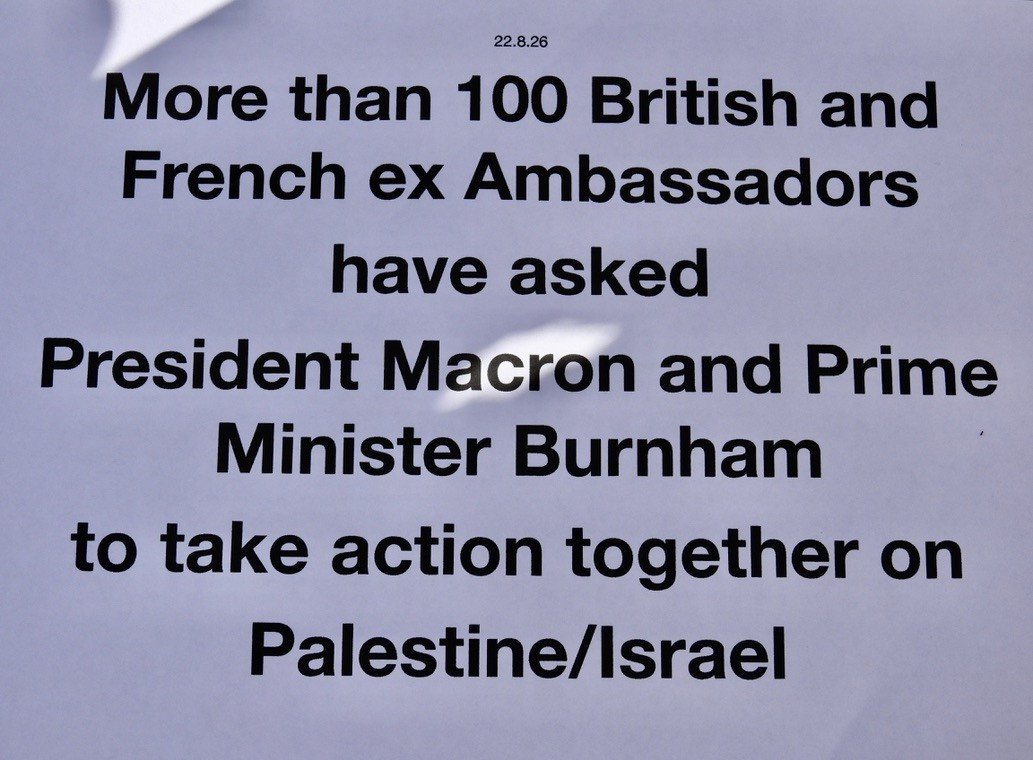
Will the new prime minister really make significant changes?

Vigil #136

July 2026

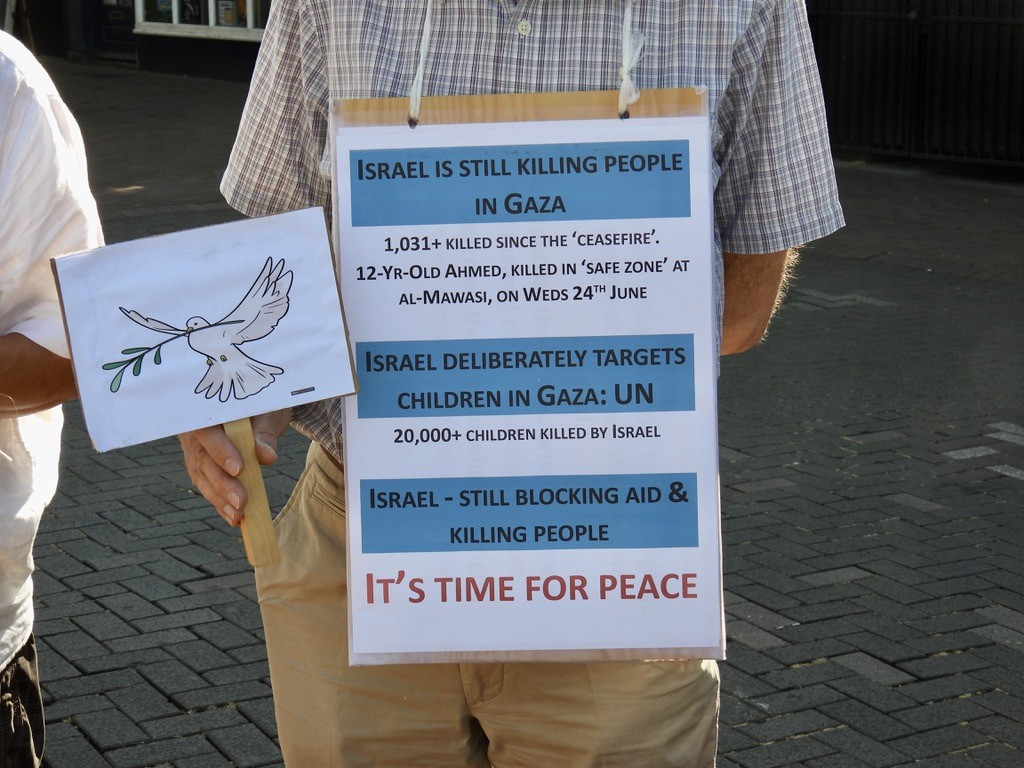
Questions, questions, which are posed following the near certainty of Andy Burnham becoming the new prime minister of Britain and his stated apologies for the UK’s uncritical support of Israel and its genocidal actions in Gaza. It is one thing to offer Israel support and sympathy after the horrific attack on October 7th but quite another to continue to offer such support while the destruction of Gaza took place including the near total demolition of medical facilities, schools and other public facilities. The deliberate killing of children, over 20,000 so far – not as an accidental consequence of military action but as a matter of stated policy – is unsupportable yet our nation has continued to support it.

We noted in a previous post that Mr Burnham waited until he had the succession in the bag so to speak, before making this announcement and wondered if this was because he was mindful of the huge number of MPs who are members of a Friends of Israel group – 69 of whom are in his own party and over 200 in the House of Commons as a whole – as well as the powerful influence Israeli lobbying has over our media including the BBC. If this is correct, the question becomes will he be able to follow through? If he did not feel comfortable with promising a reset because of fears of a lobbying backlash, how likely is it he can withstand this influence and lobbying once he gets into No 10?

It is to be questioned how an MP and more particularly senior ministers – which includes shockingly, Sir Keir Starmer, Rachel Reeves and David Lammy – be members and act impartially as a minister. Whom do they serve? A question asked of the Salisbury MP, Mr John Glen a ‘proud’ member of the much larger Conservative Friends of Israel, which he said was unworthy of an answer. Sir Keir’s support which emerged when he made the quite disgraceful comment that Israel was justified in cutting off water and power to Gaza, led in part to his defenestration as prime minister.

Vigil 136

Picture courtesy of Peter Gloyns

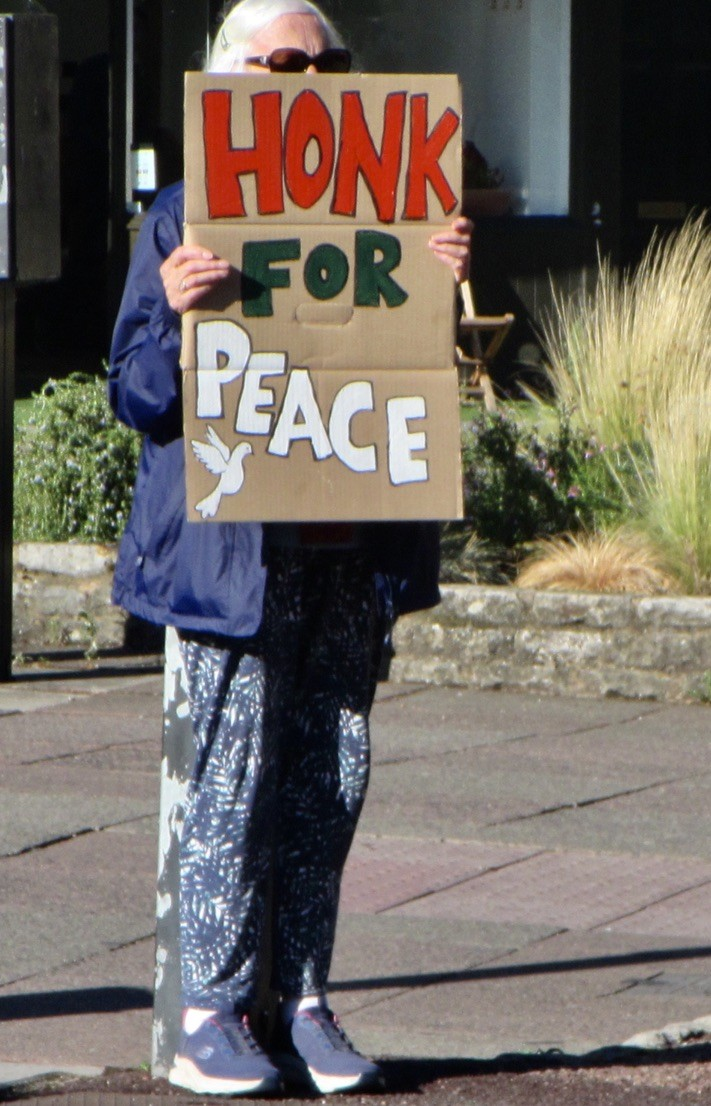
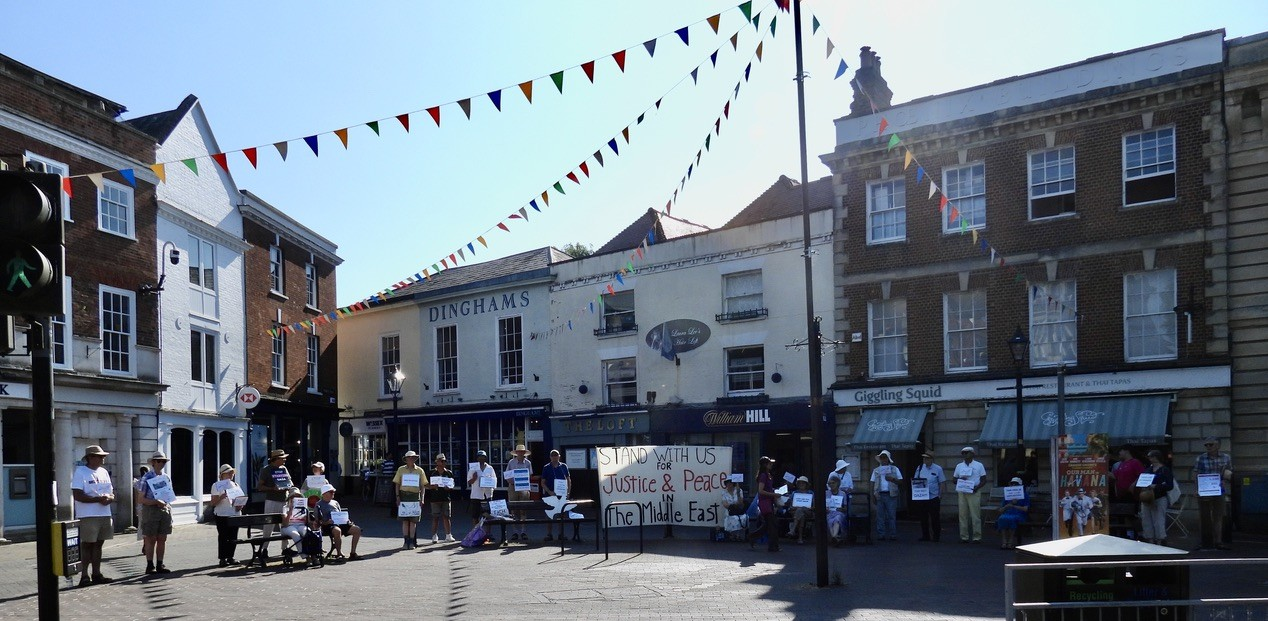
About 30 attended the latest vigil on a hot evening. Quite a lot of support and thumbs up signs and passers by taking pictures, One offensive gesture noticed. Recognition was again quite high. No sign of Mr Glen and no mention of the vigil in his weekly column in the Salisbury Journal.


A damp vigil


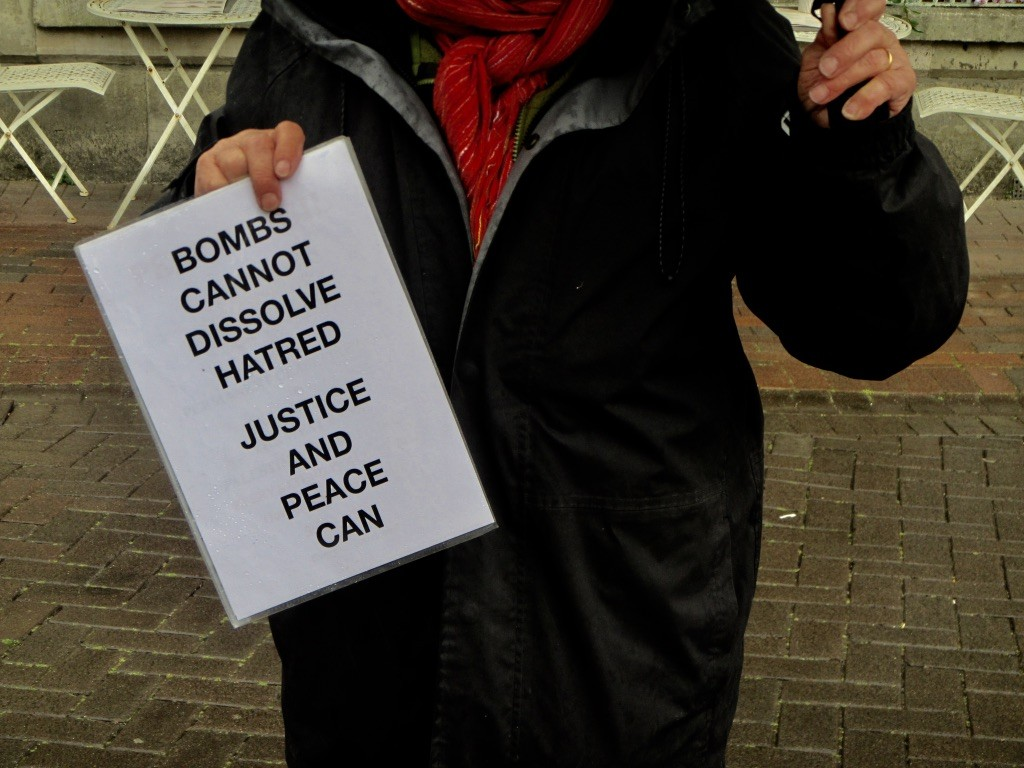
A reduced number at the latest vigil, No 128, held in the wet

May 2026

Well it still goes on. There was a report on the Channel 4 news ostensibly about a ceasefire in Lebanon followed by footage of bomb damage from the latest raids. Surreal. One wonders if there ever will be a ceasefire so belligerent are the various parties and so deep the hatreds. Things could be better if the US curbed its seemingly unconditional supply of weapons and support for Israel.

In his latest book Israel, What Went Wrong (Fern Press, 2026) the Jewish academic Omer Bartov writes:

“By what bitter cunning of history have we come to the point that not even eight decades after the Jewish state was established in 1948 – the same year in the genocide convention was adopted by the United Nations in direct response the Nazi extermination of European Jewry – Israel engages for two years in a genocidal undertaking with almost total impunity from the very international legal regime set up after World War II to prevent and punish this crime?”

Eurovision

The Eurovision song contest was held on Saturday and Israel came second to Bulgaria the winners. Five countries boycotted the contest because of Israel’s presence and there have been protests in Vienna. Coming second to Bulgaria it represents a triumph for the country despite the protests. Ireland did not to participate and RTÉ said in December that it felt Ireland’s participation would be “unconscionable given the appalling loss of lives in Gaza and the humanitarian crisis there, which continues to put the lives of so many civilians at risk”. It also said it was deeply concerned by the targeted killing of journalists in Gaza during the conflict and by Israel’s barring of international journalists from the territory. At least 235 journalists have been killed there making it the most dangerous place in the world for them to work.

It is nonetheless troubling that the Israeli entrant could perform so well with reports that the voting was ‘nail-biting’ with a chance that Israel could have won. This despite the terrible events going on in the region. The European Broadcasting Union insists the contest is not political. Last year, there were reports of aggressive marketing by Israel to help secure its second place.

Most media have simply reported the results with discussions about the merits of the performances. So we are indebted to the New York Times who have investigated the Israeli contestant and reveal that the country has invested heavily to the tune of $1 million to promote him. The full story is worth a read and reveals the extent they went to achieve their success. Further details in this Al Jazeera story. Looking at the BBC coverage for example, there is no hint of this activity leaving readers or viewers none the wiser about what happened. The British entrant got the dreaded ‘nul point’ for a second year.

Around 20 attended the vigil on Saturday, down from recent ones but People in the Park kept many away as did the weather. As ever, no sign of the local MP, Mr John Glen who is a proud supporter of Conservative Friends of Israel.

Sources: Politico, Irish Times, International Federation of Journalists, NY Times.

Photo from the vigil courtesy of Peter Gloyns


Recent posts

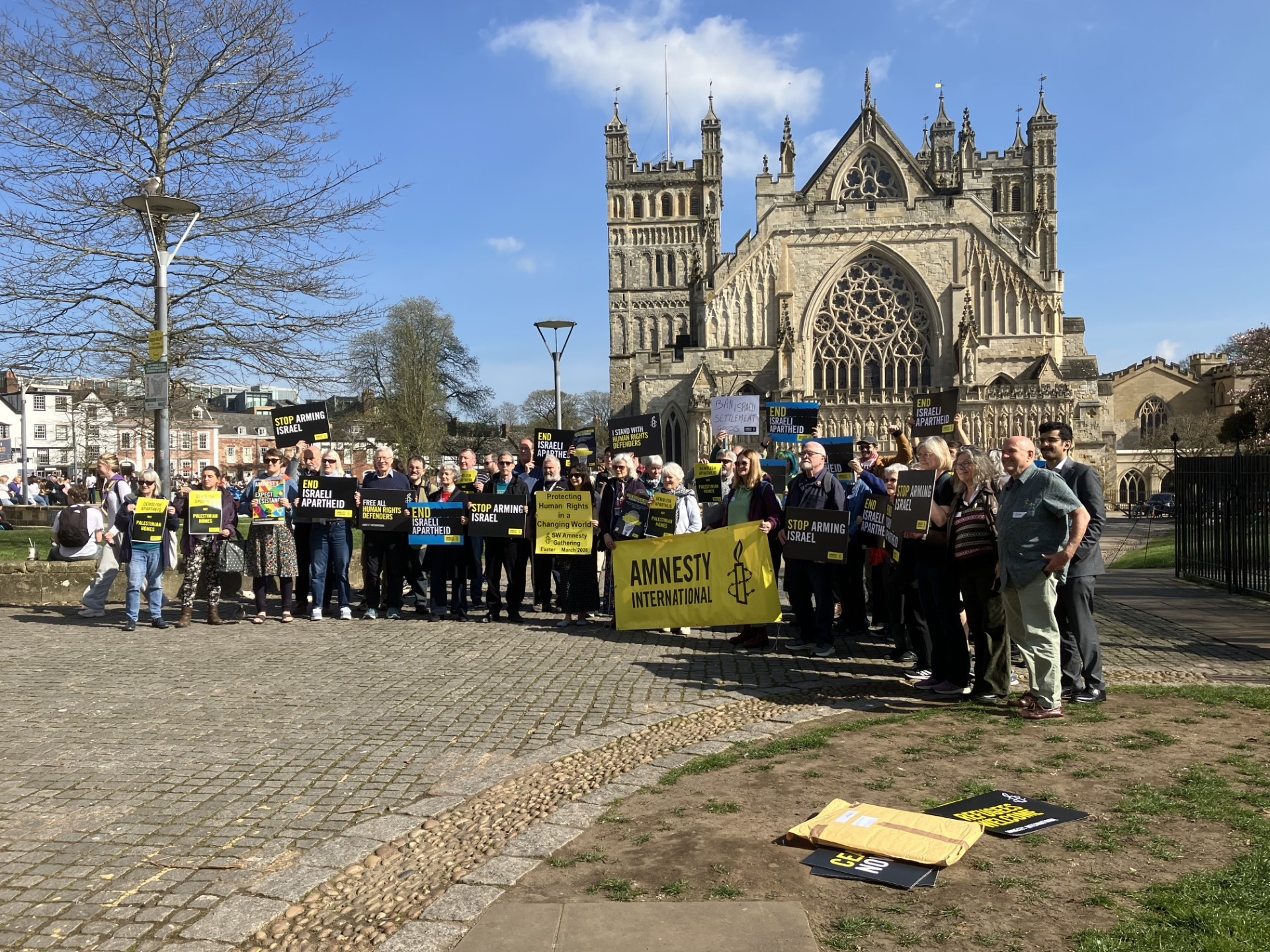
Amnesty conference in Exeter


Well attended conference with a wide range of human rights issues discussed

March 2026

The Exeter group of Amnesty puts together a conference every year and those attending this year were able to listen to a range of speakers on some of the current problems with human rights around the world. Each topic will need its own space so we shall be putting up a range of posts over the coming week or so to give them justice. For now, this is just a brief summary as a kind of ‘taster’. All credit to the Exeter group for organising this event. Six members from the Salisbury group attended and all found it worthwhile.

Tapestry

The tapestry was on display after many years absence. It was displayed in Salisbury Cathedral several years ago.

Malawi

We do not hear enough from Africa although the war in Sudan occasionally makes the news. Malawi is one of a number of countries in Africa which have anti-gay legislation. Eric Sambisa spoke of his campaign and actions to get the law on LGBTQ+ legislation changed in his country. Those laws derive from colonial times and change is proving slow.

Authoritarianism

We had two speakers on authoritarianism, first in America and second in the UK. Trump and his supporters are carrying out a range of such measures and worryingly, UK governments are quietly following suit with more laws and increased police powers designed to reduce protests. The firm Palentir was raised more than once and they represent a serious risk to our personal security.

Purchasing

A forthcoming Amnesty campaign will focus on what we buy and the human rights stories behind our purchases. Much of what we buy comes from overseas and is produced in sweat shops in the far east where – mostly women – work in terrible conditions with few if any rights. There are no trade unions. The surprising, nay shocking thing, is that big name British retailers are involved, the likes of M&S, Tesco, Next and others. Firms who’s policies have the familiar words about human rights being our ‘first priority’. The supply chains are long and as you go down them the opportunities for abuse increases.

There was discussion of Early Day Motion 1266 concerning banning goods coming from the illegal Israeli settlements. Unfortunately, there was insufficient time to discuss the large number of MPs, from all parties, who are members of the powerful Friends of Israel lobby groups. Their power means the motion is unlikely to succeed.

Palestine

The situation in Palestine was a topic as you might expect and we had a presentation from an academic at Exeter University. Part of the discussion focused on the prospects for a two state solution. There are none was the stark conclusion. Israel has systematically removed people and built settlements which make the creation of a viable Palestinian state impossible. Recent announcements of the creation of 19 new settlements cements this fact, referred to as ‘settler colonialism’. The speaker did focus on the Apartheid regime in place in Israel and the West Bank. Attacking that, much as happened in South Africa which saw that regime come to an end, was the way forward he said.

Amnesty International

There were some speakers who discussed issues surrounding Amnesty itself. In common with all charities at present and the drop in funding to the sector of £1.4bn in a year, Amnesty is having to reduce its expenditure. It has a new Chief Executive. It is facing ‘significant financial challenges’.

Photo

The photo is the traditional picture where delegates assemble in front of the cathedral.

Once again, thanks to the Exeter group for organising this excellent event. Thought of becoming a subscriber?


Recent posts:

UK Government’s Inaction on Palestinian Rights Criticized


Bishop’s letter “incredulous” at lack of government action over Gaza and West Bank

February 2026

Three Anglican bishops have today (2nd February) written a letter published in the Guardian in which they express dismay at government inaction over Gaza and events on the West Bank.

“Having returned from another visit to Palestine, we are incredulous that the UK government has still not published its legal response to the international court of justice’s advisory opinion in July 2024. This inaction has contributed to a culture of impunity that the Israeli government has used to accelerate its de facto annexation of the West Bank.

“Its instruments are administrative changes, continuous settlement expansion and growth, intensifying violence by Israeli troops and settler militia, the localised system of road closures, house demolitions, tightening access to water and electricity, deepening legal segregation and an unequal system of governance.

“While world leaders met in Davos to debate futuristic plans for the reconstruction of Gaza, which are largely disconnected from reality, we visited and listened to Palestinian Christian communities across the West Bank on their lived experience. Once more, we have heard from families living in fear and torment – an unending nightmare where they are denied even minimal dignity. The violence has robbed them of the ability to earn a living and provide for their families.

“Terrorised to the point of fearing for their lives, there is no one to protect them. Faced with such abandonment, and denied any agency as to their future, many now feel they have no choice but to leave or to die standing. This seems to be the Israeli government’s intentional strategy.

“The international community must uphold its obligations under international law to protect Palestinians. The only way is to uphold the ICJ advisory opinion. Having formally recognised the state of Palestine, the British government must publish its response and take all necessary measures “not to render aid or assistance in maintaining the situation created by Israel’s illegal presence in the Occupied Palestinian Territory”, as the court stipulated.

“The situation in the West Bank is a tragedy foretold. We must stand up and do the right thing before it’s too late”.


The Rt Rev Dr Guli Francis-Dehqani Bishop of Chelmsford; The Rt Rev Rachel Treweek Bishop of Gloucester; The Rt Rev Graham Usher Bishop of Norwich

Readers of our earlier posts about British government’s complicity in the violence and its continued political, military and diplomatic support will be aware of the shameful role our government has and is playing in the genocide taking place there.

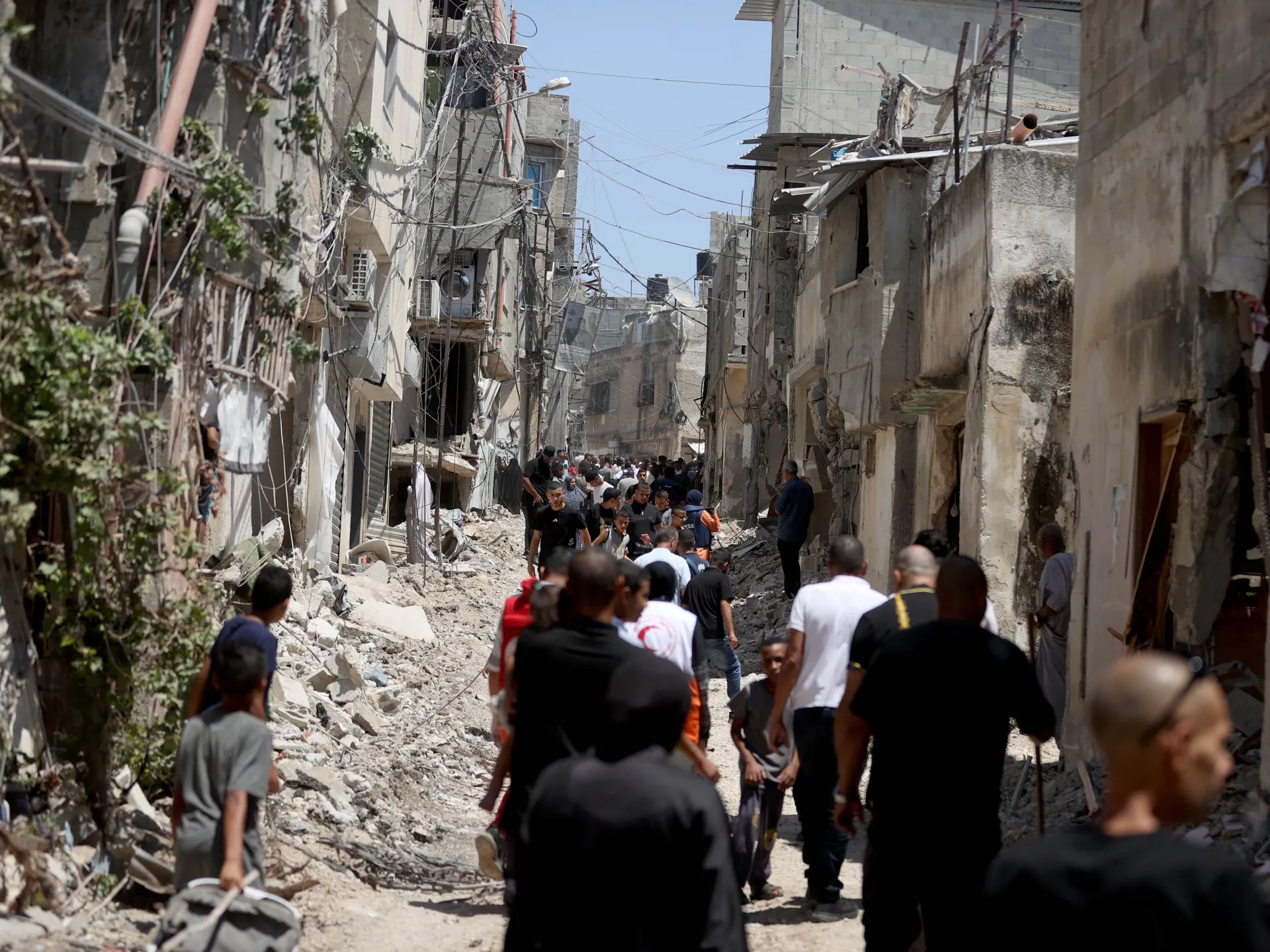
Image: Al Jazeera.

Ninety fifth vigil


95th vigil well attended. Nearly 66,000 dead in Gaza

Video added 28th.

Over 45 came to the 95th vigil and a number of passers-by stopped to ask what it was about or take photos. It has been a momentous week with speeches in the UN General Assembly. Mahmoud Abbas was not allowed to attend in person because the US would not give him a visa. President Trump berated the UN in all manner of ways. Perhaps the most surprising event was the almost complete walk out by delegates when Benjamin Netanyahu arrived to speak. The UK and the US did not leave.

A video of the vigil can be seen here thanks to Peter Gloyns for producing it.

Netanyahu condemned the recent decision by Britain and others to recognise a Palestinian state as ‘sheer madness, it’s insane and we won’t do it’ adding that recognition by several other countries is “disgraceful. The speech was transmitted to residents of Gaza through massive loudspeakers.

An Istanbul news outlet reports that at least 65,926 Palestinians have been killed in Israel’s genocidal war on the Gaza Strip since October 2023, the Health Ministry said on Saturday. A ministry statement said that 77 bodies were brought to hospitals in the last 24 hours, while 265 people were injured, taking the number of injuries to 167,783 in the Israeli onslaught. “Many victims are still trapped under the rubble and on the roads as rescuers are unable to reach them,” it added.

The BBC has reported that the Allenby Bridge between the West Bank and Jordan has been closed with no reason given. It is the only crossing which leaves Palestinians stranded.

Journalists banned from Gaza.

Israel does not want the world to report on the events in Gaza and has banned international journalists from going there. Only Palestinian journalists can report and more of them have been killed or murdered there than in any other conflict. Three news organisations [BBC, Reuters, Associated Press and Agence France Presse] have produced a short video, narrated by David Dimbleby, arguing for access by the world’s press. Israel is wont to claim that footage and reporting of their activities and claims of genocide and starvation are ‘Hamas lies’ and similar remarks. Allowing journalists to report would allow the world to see for themselves. This 2 minute video is recommended.

No sign of the local MP, Mr John Glen nor any mention in his weekly column in the Salisbury Journal of the previous 94 vigils held in his constituency. He is reported to be a member of the Conservative Friends of Israel group, thought to be the largest lobby group in Parliament.

Recent posts:

Palestinian state recognised


UK recognises the state of Palestine

September 2025

Today, 21 September, the UK government announces that it is to recognise the state of Palestine. It has joined the majority of countries around the world and joins Canada and Australia who did the same today. The decision has come after months of hesitation and was delayed until after the visit to the UK by President Trump who does not agree with it. To an extent, the government’s hand was forced. The disproportionate response to the horrific attack by Hamas on October 7th with the destruction of huge parts of Gaza, a death toll now over 65,000 many or whom are women and children and the deliberate introduction of siege conditions leading to more deaths by starvation, has left the government little option but to take action. Public opinion has also been a factor and the images of emaciated children have horrified many.

Britain’s decision is more than symbolic since the 1917 Balfour Declaration was instrumental in the creation of the state of Israel. The declaration was vague however since although it recognised that Arabs and Palestinians already lived there and said ‘nothing shall be done which may prejudice the civil and religious rights of existing non-Jewish communities in Palestine‘ it made no provision for protecting their claims or rights.

Some argue this is symbolic since with American support and ever increasing violence by settlers in the West Bank, the prospects of an actual state on the ground are receding. Some suggest that this means the conditions for statehood as set out in the 1933 Montevideo convention are not achievable. The Israeli government has rejected the decision saying ‘it categorically rejects the one-sided declaration of a Palestinian state by the UK and some other countries.’ It claims the decision does not promote peace. A spokesman for the British Board of Deputies interviewed on the BBC was critical of the decision and said it would cause deep dismay across the Jewish community in the UK. It says it is a reward for Hamas violence.

Implications

What are the implications? It will take some while for the implications to percolate through the claims and counter claims of the various political interests. It will enable the Palestinians to open an Embassy in the UK which will improve their status. It will enjoy diplomatic rights which will be significant. Up until recently, the Israelis have enjoyed almost uncritical support from governments but its continued violence in the West Bank and Gaza is seeing that support melt away.

It is unlikely to bring a peace deal any closer. Wars end because a kind of exhaustion sets in and the population goes weary of war-time restrictions and the loss of soldiers. This shows no sign of applying in Israel. Seemingly limitless weapons supplies from America and a huge military advantage in weapons and materiel mean any exhaustion is a long way off. IDF deaths are modest 464 [Jewish News Syndicate, 18 September]. The far right members of the Knesset such as Bezalel Smotrich see Gaza as a ‘property bonanza’ and claim the ‘demolition phase is over’.

Recognition will make it harder for the UK government to continue its support of Israel – open and covert – with RAF overflights for example, and ignore the plight of the Palestinians. It may even see some more robust reporting from the BBC whose lamentable performance has slowly begun to change.

Amnesty has said it is a ‘hollow gesture’ and without meaningful action to end the genocide, end violence in the West Bank and ending the Apartheid system against the Palestinian people. Real action needs to be taken to end arms sales and divest from companies which continue to sell arms to Israel. A report by CAAT sets out the details of arms export to Israel.

94th vigil


Ninety fourth vigil in Salisbury

September 2025

The latest vigil attracted around 25 attendees, lower than recently but passer-by interest was encouraging. Only one person in a car blasting his horn and made a disobliging gesture. Over 65,200 are now dead as a result of IDF bombing but the recently launched ground offensive in Gaza City is likely to see a rise in that number.

Tomorrow (Sunday) may see the British government come out with its long awaited support for a Palestinian state the subject of discussion with President Trump at his recent 2 day visit to the UK last week. We may amend this post tomorrow in the light of that.

Al Jazeera report that starvation deaths are now at 440 including 147 children.

Genocide in China


Parliamentary committee produces damning report

Report by the House of Commons Foreign Affairs Committee accuses China of genocide towards the Uyghurs in Xinjiang province. The report is entitled: Never Again: the UK’s Responsibility to Act on Atrocities in Xinxiang and Beyond. It does not pull its punches. It is perhaps one of several events which are leading to a reappraisal of our relations with China. The previous Conservative administration was keen to see an improvement in our relations and with it, increases in trade and development. The treatment of the Uyghurs, the repression in Hong Kong, threats to the integrity of Taiwan and the poor behaviour in the early months of the Covid pandemic, is slowly forcing countries to think again.

The crimes being committed against the Uyghurs and other ethnic groups in the Xinjiang Uyghur Autonomous Region (XUAR) are truly horrifying. The Chinese government is responsible for the mass detention of more than a million Uyghurs, for forcing them into industrial-scale forced labour programmes, and for attempting to wipe out Uyghur and Islamic culture in the region through forced sterilisation of women, destruction of cultural sites, and separation of children from families. It is altogether a gruesome picture and shocking behaviour from on the UN’s Security Council members.

The Committee heard that under the guise of counter-terrorism, the Chinese government is committing mass atrocities and human rights abuses against the Uyghurs and other ethnic groups in Xinjiang. Reports include the use of forced labour programmes, arbitrary detention in internment camps, cultural erasure, systematic rape, forced sterilisations, separation of children from their families, and a high-technology surveillance system – all endorsed by the Chinese government’s central leadership. Thousands of mosques have been demolished.

One element of the report relates to cotton. It is estimated that some 570,000 people are forced to work picking cotton 84% of which comes from Xinjiang. Satellite imagery shows the use of surveillance equipment, factories surrounded by barbed wire and watch towers. The report notes that ‘virtually the entire’ UK textile and clothing is linked to the abuses.

Virtually the entire UK textile and clothing industry is linked to the abuses in Xinjiang

The UK government has adopted a low profile in this matter although there are signs of a stiffening of attitudes. The Committee argues that guidance is insufficient and that ‘stricter methods’ are needed.

The problem for the public, many of whom are horrified by the stories emerging from Xinjiang, is that action is difficult. How does one know, when buying a cotton T shirt or blouse, whether it has Chinese cotton in it produced by Uyghur slaves? We have to rely on firms applying due diligence in their supply chains. Undoubtedly, some retailers will take this seriously – not just as a matter of morals but because of the risk of reputational damage – whereas others may not do so. A representative of the Ethical Trade Initiative (ETI) thought that voluntary action would not be enough for some retailers. We rely therefore on government to take the lead.

The government is financially supporting the Australian Strategic Policy Institute ASPI, which produces analysis of Chinese actions. A report on the Uyghurs is available here.

To see in more detail what the Ethical Trade Initiative says about the Chinese situation follow this link.

International Holocaust Day


Remember the Rohingya

January 27th was International Holocaust Day where we remember the terrible events of the Second World War.  That war and the appalling treatment of gypsies, gay people and Jews by the Nazi regime, led to the creation of the crime of genocide to recognise the intention to get rid of an entire race of people.  People said ‘never again’ and shortly after the war the UN Declaration of Human Rights was declared as a common standard on how states should behave towards their citizens.

Regrettably, it has not seen an end to massacres and genocide.  Since the war, we have seen massacres in Cambodia, Darfur, Rwanda, Bosnia and Uganda.  The total annihilated in these and other similar events exceeds the death toll in WWII.

In our last post we reported on a talk given at Southampton University on the latest example of genocide currently taking place in Burma/Myanmar.  The UN Human rights Chef describes this as a ‘textbook example of ethnic cleansing’ which has been taking place since 1978.  It is ethnic in origin.  He draws a parallel between the events in Burma and those in Nazi occupied Europe in the ’30s and ’40s.  An Amnesty article on the situation there can be found here.

The latest post by Rights Info discusses these issues and goes into a lot more detail.  The Holocaust is remembered and we are, rightly, reminded of it on 27th.  There is however a sense in which we have become used to these events and our powerlessness to prevent them.  We do not have specific memorial days for the more recent genocides although these are included in the Holocaust memorial.

In a recent debate in the House of Commons, Mark Field a Foreign and Colonial Office Minister said:

[…] In my role as FCO Minister for Asia, I remain persistent in our lobbying the Government of Burma to allow the Rohingya back to their homeland with sufficient guarantees on security and, importantly, on citizenship that they will be able to rebuild their lives.  As I have said before, that can begin only when conditions allow for a safe, voluntary and dignified return.  My hon. Friend the Member for St Albans [Anne Main] spoke passionately about the importance of Rohingya representation in that process.  If the returns are to be genuinely voluntary, there must a consultative process to establish the refugees’ intentions and concerns.  24 January 2018

At the event in Southampton, in answer to a question, one of the problems the Rohingya have is a lack of representation.  This is partly because they do not have a leader able to speak for them which in turn is because of the lack of spoken English.

We must not forget the genocides which are taking place now when we remember the events of 80 or so years ago.  Although the Holocaust was an historical event, genocide is still being practised today.


Blog at WordPress.com.

Up ↑