June 2025
We have pleasure in enclosing the minutes of our last meeting held on 12th June with thanks to group member Fiona for preparing them.
Amnesty in Salisbury & South Wiltshire
Promoting human rights from Salisbury UK
June 2025
We have pleasure in enclosing the minutes of our last meeting held on 12th June with thanks to group member Fiona for preparing them.

June 2025
It is reported today that the government is engaged in a range of talks with Chinese officials to improve trade and political relations. The Chinese Embassy is quoted as saying that relations have ‘positive momentum’. Elsewhere, relations are described as ‘warming’. Of course both countries are suffering from the Trump tariff war and so a degree of mutual comfort is to be expected.

The fact remains that human rights in China are dire across a very wide spectrum, almost too long to describe in fact. They include no freedom of expression; atrocious and genocidal behaviour towards the Uyghurs and other Turkic peoples; Human Rights defenders who face long prison terms and torture; continuing repression in Tibet; the crackdown in Hong Kong and the execution of large numbers of its citizens – possibly equal to all the rest of the world put together. It is also aggressively pursuing overseas Chinese who criticise the country and persecutes any of their family members in China. Restrictions are getting steadily worse over time.
Azeem Ibrahim, speaking at the Humanist Convention this month, described the multi-pronged approach
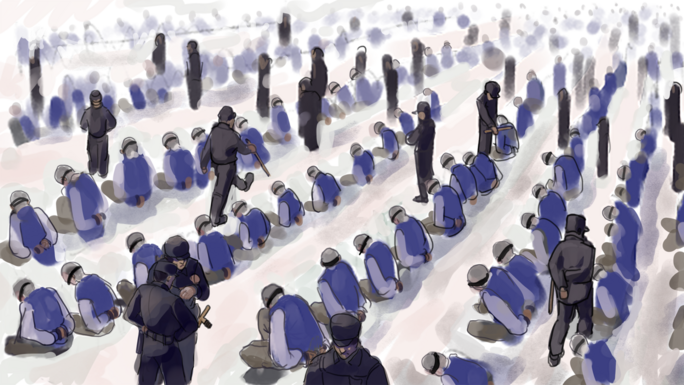
adopted by the Chinese. It was a talk about the rising threat of autocracies which included Russia and Turkey. He pointed out that the country leads the world in surveillance and it has a massive programme using facial recognition technology. It is also working hard to gain access and control to international agencies in the UN for example. The Warsaw Institute describes how they use their commercial power and investments to shut down any Security Council criticisms of their human rights infringements. His basic message was that China in particular has an organised and well-funded programme to attack western values by any and all means available. He added that the West has been complacent in thinking that western values are a settled state of affairs.
So where does that leave the Labour government? It is reported to be softening its position now it is in government. Nine individuals have travel restrictions placed on them including 5 Conservatives: Ian Duncan Smith being one and Tom Tugendhat another. All because they criticised the treatment of Uyghurs. These restrictions might be lifted. The concern is that the government is desperate to achieve growth and seems willing to abandon all principles to achieve it although a trade deal is not on the cards. This site is concerned with human rights but the wider issue is western governments – like the UK – who seem very slow to wake up to the organised threat posed by autocracies like China who are determined to pursue their view of the world by all means possible.
Sources include: Human Rights Watch, Amnesty, Guardian, US Department of State, New China Human Rights.

June 2025
A Threat to press freedom in Northern Ireland
Since 2019, Amnesty has documented over 70 death threats, bomb threats, and violent attacks against journalists. Most threats came from armed paramilitary gangs. Not one has been prosecuted to date. Some reporters now live behind bullet-proof windows, reinforced doors and CCTV. Many people assume Northern Ireland’s conflict is over. Yet some journalists are receiving more threats of serious violence from paramilitaries than ever before.
Amnesty calls for two urgent steps: a Media Safety Group – to coordinate an effective response to threats against journalists and A Home Protection Scheme – so journalists at risk can secure their homes without paying the price for doing their jobs.
Right to protest
The EHRC was set up to “encourage good practice in relation to human rights” and “promote… protection of human rights” but it appears to be seeking to ban protests outside its offices.
“Article 11 protects your right to protest by holding meetings and demonstrations with other people”, says its website but the landlord of the Vauxhall office of the Equality and Human Rights Commission is seeking an injunction against protests outside its offices for the entire period for which the EHRC has a licence to occupy, that is until 31 January 2026.
It would prohibit anyone (without the consent of the EHRC’s landlords) “entering, occupying or remaining upon all or any part of the commercial premises known as Tintagel House”, including on the forecourt outside its offices. Protest may be possible on the public pavement or road outside its office – although with a risk of criminal conviction – but anyone entering the forecourt would risk imprisonment. The application was sparked by an entirely peaceful encampment by Trans Kids Deserve Better outside Tintagel House on 30 May 2025. Good Law Project considers this unlawful and is intervening to resist the injunction application.
Vagrancy Act Scrapped
The “cruel and outdated” Vagrancy Act is finally set to be scrapped in 2026 after making rough sleeping a

criminal offence for more than 200 years, the Labour government has announced. The 1824 law has criminalised rough sleeping and begging in England and Wales since the days of the Napoleonic Wars.
Frontline homelessness charities have campaigned for years for the Vagrancy Act to be axed, warning that punishments, including fines, drive rough sleepers away from support. Labour has promised it will finally be removed from law next spring and replaced with increased financial support for people experiencing homelessness and new legislation targeting “real crimes” such as organised begging by gangs.
British support for foreign security and intelligence services
NGOs and senior MPs have expressed concern in a joint letter to David Lammy that the Labour government’s ‘light touch’ review of policies regulating British support for foreign security and intelligence services will not remove ministers’ ability to approve UK cooperation in situations where there is a real risk of torture or the death penalty. The policies were blamed for facilitating injustices in cases such as those of Jagtar Singh Johal and Ali Kololo. Johal, a British human rights activist, was allegedly tortured in India, where he remains in jail, after a tip-off from UK intelligence services. Kololo was wrongly convicted and sentenced to death over an attack on British tourists after the Met police provided assistance to Kenyan authorities.
The Mental Health Bill
This has now had its second reading in the Commons and aims to modernise the treatment of mental health. Among other things it will allow greater choice of treatment to patients, will reduce the use of detention especially in the case of autistic patients or those with learning difficulties and will address the disproportionate outcomes for black patients and those from minority groups.
UK’s legal obligations in Israel/Gaza conflict
The UK must impose sanctions on the Israeli government and its ministers and also consider suspending it from the UN to meet its “fundamental international legal obligations”, more than 800 lawyers, academics and retired senior judges, including former Supreme Court justices, have said.
In a letter to the prime minister, they welcome Keir Starmer’s joint statement last week with the leaders of France and Canada warning that they were prepared to take ‘concrete actions’ against Israel. But they urge him to act without delay as “urgent and decisive action is required to avert the destruction of the Palestinian people of Gaza”. The signatories, including the former Supreme Court justices Lords Sumption and Wilson, court of appeal judges and more than 70 KCs, say that war crimes, crimes against humanity and serious violations of international humanitarian law are being committed in Palestine.

More than 300 Foreign Office staff have been told to consider resigning if they cannot support the government’s policy on Israel, after they repeatedly expressed concern that the UK could be viewed as complicit in war crimes.
The UK government has now sanctioned Israeli government ministers Itamar Ben-Gvir and Benzalel Smotrich in response to their repeated incitements to violence against Palestinian communities and, in partner with Australia, Canada, New Zealand and Norway, calls for immediate action against extremist settlers.

June 2025
The case of the British citizen Abd El-Fattah is gaining more publicity and his mother, who has been on hunger strike for 245 days, has just been admitted to a London hospital as her medical condition is now critical. The Egyptian government has behaved atrociously throughout and has denied consular access to him in breach of the Vienna Convention. Appeals by the current and previous prime ministers and the Foreign Secretary have been ignored.
Mr Fattah’s ‘crime’ was to mention that someone was tortured in an Egyptian prison and his campaigning
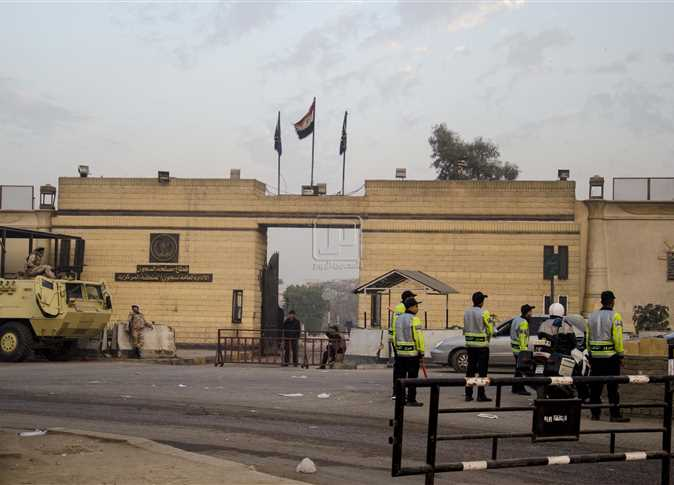
for human rights in the country more generally. He established the Adalah Center for Rights and Freedoms. He is held in very poor conditions in Tora Maximum Security 2 Prison in Cairo (pictured). He is in an airless cell, denied a bed or mattress, not allowed to exercise and is not allowed books or other reading material.
Egypt continues to crush dissent and stifle civil society, arbitrarily arrests thousands including journalists, opposition politicians and peaceful protestors.
His case was debated in parliament in December last year initiated by John McDonnell MP. The Parliamentary Under Secretary John Falconer said:
I re-emphasise, both to Alaa’s family and to the House, that his release remains a priority for the UK Government. I recognise the profound impact that his imprisonment has had on him and his family. The Government, and I as the Minister responsible, are doing all we can to find a resolution. Our priority remains to reunite him with his family, and until that happens, we are working to ensure that he is allowed consular access and support. As I said earlier, supporting British nationals overseas is at the heart of our work at the Foreign Office. That includes dual nationals and more recent British nationals such as Alaa.
Amnesty and two dozen human rights groups have campaigned on his behalf but to no avail. There seems no likelihood of his release since sentences in Egypt are simply rotated. He has been incarcerated for 10 years now. Alaa is part of the Middle East problem more generally and Egypt is seen as important in the issues surrounding Gaza (on its border) and with Iran. The government has been urged to consider sanctions or tougher action but is clearly reluctant to do so. The current Labour government, with its emphasis on growth, is unlikely to take actions which would limit that. The result is that he remains in prison for the foreseeable future. We hope his 69 year old mother, Laila Soueif, survives her ordeal.
Recent posts:

May 2025
There were a number of interesting events on the human rights front in the UK this month including the Court of Appeal judgement discussed below. There has been a steady ‘nibbling away’ of rights by successive governments which is why we have started this series of reports of which this is the second and why the judgement is good news.
Right to Protest
This month the Court of Appeal has upheld an earlier ruling of the High Court from May 2024 that then Home Secretary Suella Braverman did not have the power to create a new law that lowered the threshold of when the police can impose conditions on protests from anything that caused ‘serious disruption’ to anything that was deemed as causing ‘more than minor’ disruption. They said that “the term “serious” inherently connotes a high threshold … (and) cannot reasonably encompass anything that is merely ‘more than minor’”.
This was the first time a government had sought to make changes through so-called ‘Henry VIII powers’ of secondary legislation to a law which had been democratically rejected by Parliament when introduced in primary legislation.
Hundreds of protesters have been arrested under these measures since they were created, including the

climate activist Greta Thunberg (pictured: MusikExpress) who was acquitted of all charges in a hearing in February 2024.
Liberty has called for the regulations to be quashed immediately (as per the initial ruling from the High Court, whose decision to scrap them was put on hold until the conclusion of the appeal) and has called for all arrests and prosecutions under the legislation to now be urgently reviewed, alongside a comprehensive review into all protest laws that have been passed in recent years.
The Court will decide in the coming weeks if the legislation is to be quashed.
Gender Recognition Ruling
Five judges from the UK Supreme Court ruled unanimously that the legal definition of a woman in the Equality Act 2010 dealt with biological sex at birth and did not include transgender women who hold gender recognition certificates.
In a significant defeat for the Scottish government, their decision will mean that transgender women can no longer sit on public boards in places set aside for women and it will have far reaching implications for access to protected spaces and services such as the armed service, hospitals, women-only charities and changing rooms and access to sport.
Lord Hodge told the court the Equality Act (EA) was very clear that its provisions dealt with biological sex at birth, and not with a person’s acquired gender, regardless of whether they held a gender recognition certificate. In a verbal summary of the decision, he said: “Interpreting sex as certificated sex would cut across the definitions of man and woman in the EA and thus the protected characteristic of sex in an incoherent way.” He stressed that the ruling does not change the protection trans people are afforded under the protected characteristic of ‘gender reassignment’ under the Equality Act. Amnesty has called the decision ‘disappointing’.
Humanist Rights
Two couples are taking the government to court over its failure to legalise humanist marriage in Wales and England, five years after a ruling that the lack of recognition was discriminatory. Humanist marriages are legal in Scotland and Northern Ireland, and elsewhere in the world including New Zealand, Canada and Australia. In Scotland in 2022 there were 9,140 humanist wedding ceremonies compared with 8,072 based on faiths or other beliefs.
Activists Detained
Non-violent activists Roger Hallam and Dr Patrick Hart are being refused their right to a Home Detention Curfew. Days before their scheduled release from prison in March Dr Hart was told that there was ‘no suitable accommodation’ and Hallam that the media’s interest in his case meant that he was deemed unsuitable for HDC (which actually states that non-violent prisoners can only be denied release ‘in exceptional circumstances’). New release dates are respectively June and possibly August. There will be an appeal.
The Counter Terrorism and Border Security Act of 2019
This was invoked by police at St Pancras rail station for detaining a Palestinian-British Christian academic and his 8-year-old son on their return from Paris on Good Friday. Professor Makram Khoury-Machool (pictured: BBC Arabic Service) is a Palestinian-British Christian academic who has lived in the UK since 1999 and taught in Cambridge since 2004. He is the founder of the Cambridge Centre for Palestine Studies whose board members and patrons include Dr Rowan Williams, Baroness Helena Kennedy, Baroness Sally Morgan, Lord Chris Smith, HE Clare Short, Baroness Warsi and Lord David Steel.
He and his son were held over 4 hours until after midnight, were given no food while the police took his fingerprints, DNA samples, searched his personal belongings and confiscated his laptop and mobile phone using the threat of force. Seven days later, the devices were returned but without his SIM card. He was subjected to an intimate body search, and his son was left traumatised by the experience. This is perhaps the first time a child as young as eight has been detained in the UK under the 2019 Act; his treatment may breach the UN Convention on the Rights of the Child to which the UK is a signatory.
Economic, Social Cultural Rights
Amnesty reports that in the UK there is no legislatively defined universal social protection floor such as the one recommended by the UN’s International Labour Organisation: this is left to the discretion of the state and is inconsistent across Great Britain and Northern Ireland. The changes proposed by the Pathways to Work Green Paper 2025 will require new legislation allowing the secretary of state to implement proposed cuts to social security rates for disability and incapacity schemes, and removing some of the legislative protections which are in place to protect against political whims.
If implemented, Amnesty considers the extensive reforms proposed would be a deliberately discriminatory, disproportionate and retrogressive violation of human rights; The UK’s social security system does not legally guarantee essential social security payments that ensure access to basic needs such as healthcare, housing, food and education and that social security freezes, caps, and deductions, removal of the spare room subsidy (bedroom tax) and two-child limit have deepened poverty and disproportionately harmed children, the disabled and low-income families. Despite increased social security spending, poverty rates remain unacceptably high.
Recent posts:

May 2025
The CAAT Newsletter (Spring 2025, Issue 272) has details of what’s happening in the world of arms sales a world in which the UK is a big player. Our previous post discussed the continuing sale of arms to Israel which is subject to an Appeal Court hearing starting on 13th. Also we mentioned the role of the RAF in carrying out hundreds of flights over Gaza and quite what is being done with the information gleaned is not revealed.
Arms sales are important for several reasons. Weapons have an enormous capacity to do great harm in the wrong hands. Governments need to exert great control over licensing to ensure that arms do not fall into such hands. British governments are frequently to be heard claiming it exercises ‘robust’ controls. It is doubtful that this is the case and CAAT have often noted the considerable use of open licences which means little effective control exists.
The current Labour government has a policy of growth which seems to dominate thinking. As the court case will reveal, and papers have already revealed, this seems to trump considerations of human rights. CAAT News has the following examples:
The government seems keen to actively support these activities and to do all it can to promote arms and surveillance equipment to repressive regimes. It does this while piously claiming that:
This Government is fully committed to the protection of human rights both at home and abroad. We are committed to the international human rights framework and the important role that multilateral organisations like the Council of Europe play in upholding it. (Ministry of Justice, November 2024, ref: CP 1192)

It is hard to square the multi-level activities to promote arms sales and in the process currying favour with some of the world’s worst regimes, with their stated desire to be upholders of human rights and the wellbeing of those at the end of it all. While politicians, civil servants, military brass and ministers ‘schmooze’ with the arms manufacturers in expensive London hotels, it may be hard for them to empathise with those who have been bombed, starved, driven from their homes or incarcerated, tortured or executed for no reason. All facilitated by the weapons and equipment they so admire whilst quaffing the Bollinger. Is it growth above all else?
Sources include: CAAT, The Canary, Amnesty

April 2025
Amnesty began by focusing on human rights in other countries. This was probably based on the belief that rights in the UK were secure, we had after all, the Magna Carta, a justice system and things like torture ended several centuries ago. The UK was a key player in introducing the Universal Declaration in 1948. With the arrival of the European Court, it soon became clear that not everything in the UK human rights garden was rosy. The Birmingham Six case was a classic example of a failure to treat the six defendants fairly. The police fabricated evidence, the six were badly beaten in custody, the courts and judges manifestly failed, the forensic evidence was a nonsense. Eventually they were released – not because the justice system worked to correct its mistakes – but because of the dogged work of Chris Mullins, an MP and journalist.
In the recent decade and a half, there has been a long-lasting campaign, largely led by some newspaper groups, to denigrate the Human Rights Act and to claim that it is a ‘terrorist’s charter’ and allows serious criminals to escape justice because of allegedly spurious arguments provided by their human rights. This has been echoed by the Conservative party who have variously claimed to want to abolish or reform the act. We can remember the nonsense claim by Theresa May that a Chilean man could not be deported because of his cat.
Human rights therefore are by no means secure in the UK. Legislation introduced by the last Conservative government limiting the right to protest and increasing police powers, together with the remorseless increase in the use of surveillance technology, shows no sign of being annulled by the current Labour government.
Hence we feel the need to focus on our rights here in the UK and the slow but steady attempts to limit or curtail them.
Funding for victims of trafficking
The High Court has declared that denial of Exceptional Case Funding to four victims of trafficking to access legal advice to prepare an application for criminal injuries compensation breached their rights under Article 6 ECHR.
Military Misogyny
A coroner has concluded that the UK government may have breached a young soldier’s right to life by failing to protect Jaysley Beck from a sexual assault by a more senior colleague and from sustained unwelcome sexual attention from her line manager.
Deaths in custody
More than 100 relatives of people who have died after contact with the police in the UK since 1971 have joined plans for a class action lawsuit in pursuit of compensation and justice. At the People’s Tribunal on Police Killings, bereaved families presented evidence to a panel of international experts on how their relatives died and the long-term impact this has had on them. The findings and conclusions of the event will form the basis of a first-of-its-kind legal action directed at police officers, police chiefs and government departments involved in the deaths.
Economic, Social, Cultural Rights
Claims by Amnesty and Human Rights Watch state that the UK faces a cost-of-living crisis which has yet to be addressed by policies that safeguard the economic, social and cultural rights of people from low-income households, particularly their rights to food, housing and social security.
Freedom of Expression
Following last year’s criticism of the UK by the UN special rapporteur on environmental defenders, the High Court concluded that anti-protest measures introduced in 2023 – allowing authorities to clamp down on any protests deemed ‘more than minor’ disruptions – unlawfully restricted protest. The Labour Government has yet to repeal these repressive laws and is choosing to continue the legal challenge against the High Court ruling brought by the previous government.
Environmental Protest Sentencing
Gaie Delap (pictured), retired teacher, Quaker and climate protester has finally finished her sentence.

Her detention was notoriously extended when prison authorities could not equip her with a curfew tag bracelet. She said: “I think around 80% of the women I met should not have been in prison. Help with problems such as mental health, addiction and housing would have been more useful.”
This week the Court announced its ruling to uphold most of the harsh sentences of the ‘Walney 16’, jailing the group for a combined total of 35 years (originally 41) for peaceful protest. Global Witness say that the UK is at risk of becoming one of the world’s most repressive governments when it comes to policing climate protest, arresting campaigners at three times the global average. Lawyers for the protesters, backed by campaign groups Greenpeace and Friends of the Earth, argued that the sentences were disproportionate and violate the UK’s obligations under human rights law, including articles 10 and 11 of the European Convention on Human Rights and article 3(8) of the Aarhus Convention.
On 25 March prescriptive policing led to the arrest of six Youth Demand members as they met in a London Quaker House. The civil disobedience group has protested new oil expansion and UK arms to Israel. Quakers (not allied with the group) have protested at the police raid on their premises.
Open Justice
Apple is taking the unprecedented step of removing its highest level data security tool from customers in the UK, after the government demanded access to user data, citing powers given to it under the Investigatory Powers Act. After reluctantly pulling ADP from the UK, Apple has now launched legal proceedings against the government who argued it would damage national security if the nature of the legal action and the parties to it were made public. However a judge has sided with a coalition of civil liberties groups and news organisations – including the BBC – and ruled a legal row between the UK government and Apple over data privacy cannot be held in secret.
Sources: BBC News; The Guardian; Global Witness News; Doughty Street Chambers; Human Rights Watch; Amnesty.

March 2025
Members from groups in the South West gathered in Exeter last Saturday for an interesting day on human rights issues. All credit to the Exeter group who have organised this for several years now enabling us to meet other groups in the region. We held our usual photo opportunity in front of the fine Exeter Cathedral (almost as fine as Salisbury’s!), and this picture was to highlight the problems of being a woman in Afghanistan.

You can read a post on the issue of the UK’s support for cricket in Afghanistan particularly as women are not allowed to play it. There is a post on one of the speakers who discussed the current situation in Somalia.

March 2025
The violence continues. Israel has ended the ceasefire and over a hundred have been killed in the recent bombing in Gaza. Encouraged by President Trump and his desire to see some kind of Riviera on the Mediterranean coast, the IDF has restarted its bombing campaign. There can be little pretence that peace and a two state solution is anywhere present in current thinking.
To criticise Israel is to court being called ‘antisemitic’ a kneejerk reaction which has been immensely powerful. Many publications are wary of inviting this slur. It is very encouraging therefore to read of criticisms coming from within Israel itself and in particular in the Haaretz newspaper. A recent article by its editor Aluf Benn, is testimony to this [registration may be needed].
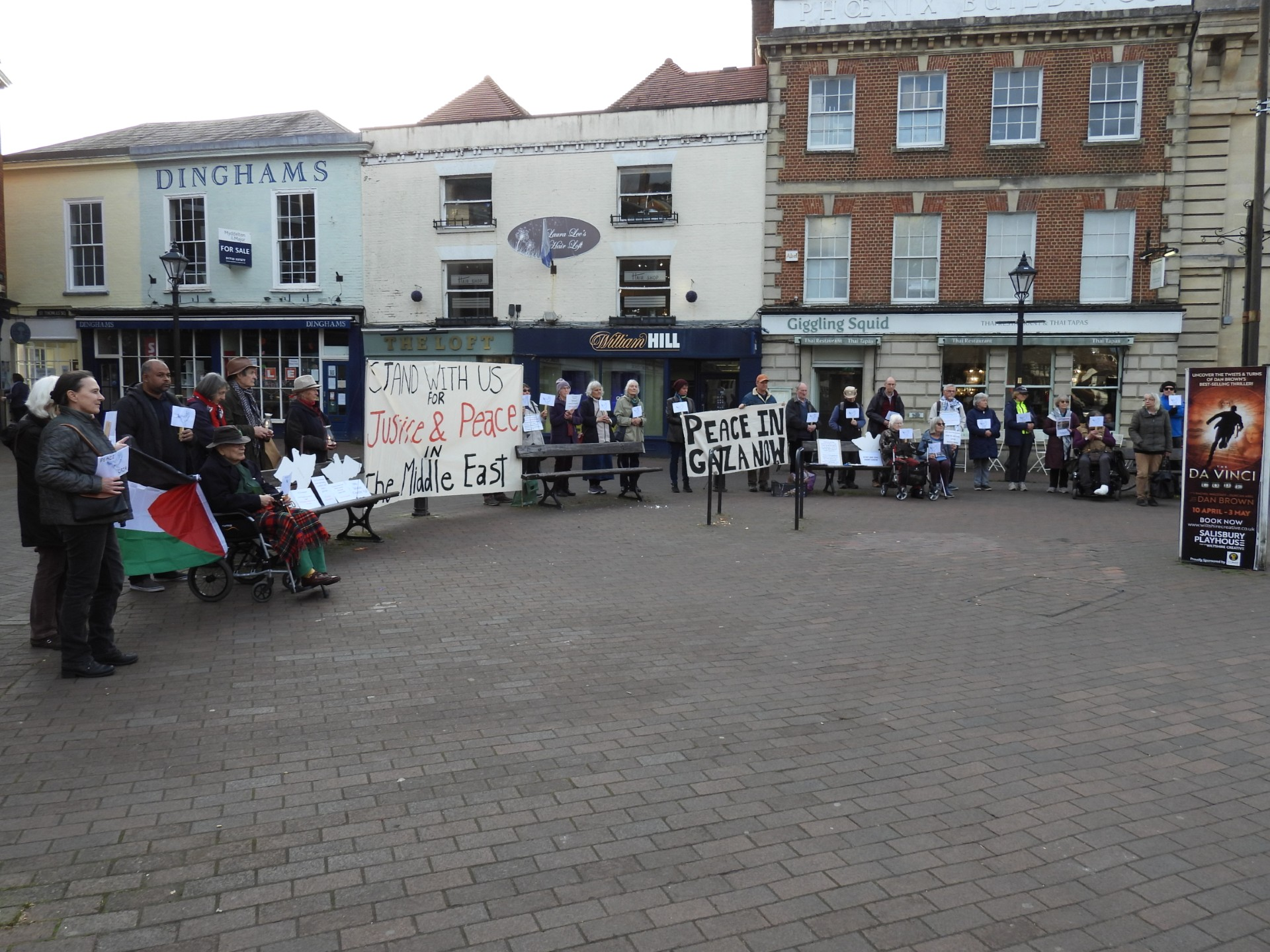
The images on our screens are truly horrific. A landscape of demolished buildings; mountains of rubble; hoards of people moving from one ‘safe zone’ to the next; rows of corpses and parents clutching dead infants. The scale of the response, with Netanyahu promising even worse to come, is demonstrably a crime against humanity. All supported by the United States and now Donald Trump with vague notions of moving 2 million Palestinians out of the territory to some other country.
Britain continues to support Israel and the RAF are reported to be overflying Gaza a largely unreported fact. And of course we are still selling them arms. We are thus complicit in these terrible events.
The 68th Vigil was held yesterday in the Market Place in Salisbury with around 35 in attendance. We are grateful to Peter Gloyns for a moving video.
Latest posts:

March 2025
Last year (2024) marked the fifty years since the group was founded and here we are, still going strong if sadly the only group left in Wiltshire. We had the opportunity for a tree to be planted in honour of this anniversary and today (4 March) some of the local group assembled for a photograph in Victoria Park. We were delighted to welcome two surviving members who formed the group half a century ago.
The need to keep human rights issues on the agenda is needed now more than ever. It was perhaps the belief all those years ago that the need for a human rights group would slowly melt away in the wake of the post war ideal of the new world order following WWII. This has not been the case. Rights are being slowly chipped away at home as governments have not liked protest groups drawing attention to their climate and environment failings and continued arming of Israel for example. The previous government introduced several pieces of legislation reducing rights, increasing police powers and limiting access to justice. The new government shows little inclination to repeal them. Some MPs – including both our local ones – generally vote against human rights matters according to the They Work for You website.
Overseas – well, where to start. China continues to persecute the Uyghurs and western firms continue to buy cotton produced by effectively slave labour. War and destruction continues in Sudan and other parts of sub Sahara Africa. The situation in Burma continues with the military attacking people and villages of minority groups. We continue to sell them jet fuel to enable them to carry on. The terrible death toll continues in Gaza.
So the need to keep the spotlight on human rights is needed today as it was 50 years ago. Power, in whatever form, does not like giving it up and will go to great lengths to keep it for themselves and their supporters.

If you would like to join us you would be welcome. See a list of current and future events where you can come and make yourself known. We welcome people who want to pursue a particular human rights theme – more rights for women for example.
Photo: Salisbury Amnesty
Latest posts:

 Amnesty in Salisbury & South Wiltshire