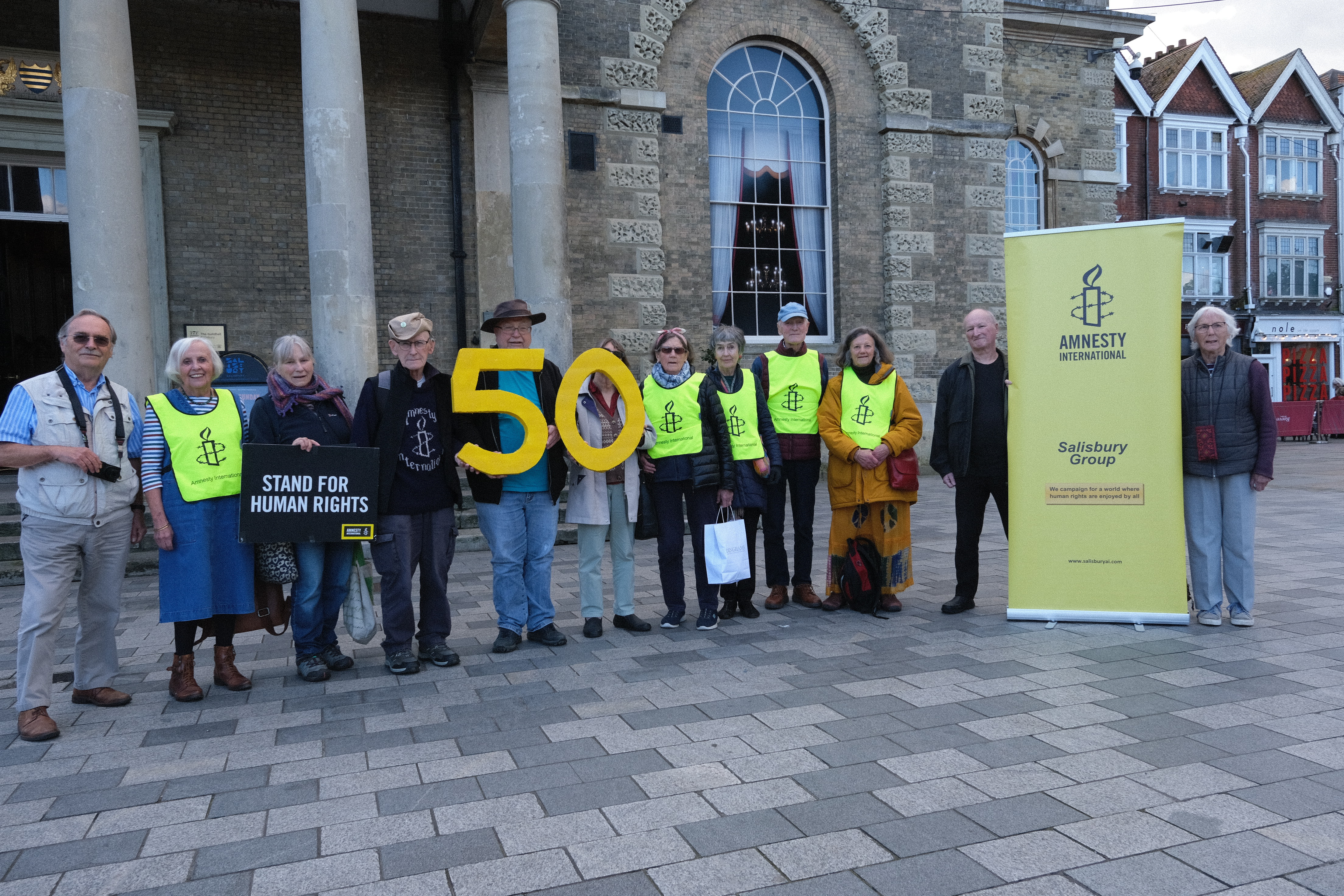
Salisbury group at 50


The Salisbury group was established 50 years ago: did the founders think we’d still be needed half a century later?

May 2024, amended in September

Following the Observer article by Peter Benenson in 1961 which led to the formation of Amnesty International, local groups formed around the country and the Salisbury group came into being in 1974. It is the only surviving group in Wiltshire which is disappointing to report. Did the founders, it might be asked, think we would still be campaigning all these years later? It might not have been a question they asked themselves at the time but there was a feeling following the horrors of the war and the signing of the Universal Declaration of Human Rights in 1948, that we were on some kind of improving path towards better treatment for people wherever they lived. There was some kind of belief in a new future.

To an extent, the history of the UDHR and the true commitment of nations to the cause of universal rights, has been overstated. There was considerable resistance by the colonial powers, in particular the UK, to the ‘universal’ element because of the likely effect of such rights in the subject peoples of the colonies. Many were seeking independence from the Empire and this was not always achieved peacefully. America was fearful of the effects in the southern states in particular because of the treatment of the black population and the Jim Crow laws.

The human rights situation in the world today is dire. Entire peoples have been oppressed or driven from their homes, the Rohingya in Burma for example. China has oppressed Tibet and is currently detaining around a million Uyghurs in what almost amounts to genocide. Russia has invaded the Ukraine and committed many human rights violations. Wars rage in sub-Sahara Africa with millions displaced from their homes and villages – those who have not been killed that is. The Israeli response to the October 7th massacre by indiscriminate bombing in Gaza is causing widespread international concern. Around 36,000 have now been killed.

Flaws

One of the flaws of the post-war agreement was the reliance on countries to be the ‘policemen’ so to speak. The US in particular did not want to grant powers to the newly created UN to enforce rules in countries not obeying them. Since it is countries which are heavily involved in committing the crimes this is a serious weakness.

Another flaw was the rise of corporate power and the ability of major corporations to operate in ways making control extremely difficult. These companies, and the banking system which supports them, engage in arms sales, mineral exploitation, tax evasion and abuse of people in sweat shops almost with impunity. Millions suffer impoverishment and almost non-existent rights as a result of their activities yet little is done to control them.

The Declaration grew out of the European tradition since it was Britain, France and the US who were the key players after the war. Power has slowly drifted away in the last few decades however, with the rise of China, a re-emergent post-Soviet Russia and the rise of new southern hemisphere countries such as South Africa and Brazil not all of whom share all these traditions. The freedom of the individual is not something they are concerned with. The Gulf states are another group of powers where free speech, religious freedom and human rights are not supported. Women enjoy few rights in these states. The world has changed therefore and the comfortable assumptions of European Emancipation is no longer the only game in town.

UK

The international order has changed, so has the climate in the UK. Over the past two decades or so, there has been a concerted move to abolish the Human Rights Act and by some, to leave the European Convention (see the last post). Sections of the media have characterised human rights as a threat not a protection. It is claimed that they enable terrorists and criminals to escape justice because their human rights will be infringed. Stories abound of the act being used to enable pornography in prisons or hostage takers to demand a burger of their choice. Infamously, the then home secretary Theresa May, claimed someone could not be deported because they had a cat. These and other stories provide background music for a variety of MPs to demand that the act be abolished or seriously modified. Local Wiltshire MPs generally vote against human rights measures according the They Work for You website.

Too negative?

Is the above too negative? It is and it isn’t. Millions have human rights but many of those millions do not enjoy them. They live in countries which have signed up to this and that convention – against the use of torture for example – but where police and security services use it routinely and with impunity. They live in countries where free speech is part of the country’s constitution but where the media is controlled, shut down or where journalists are arrested or even gunned down outside their apartment block (Russia).

But it also true to say that human rights have entered people’s consciousness. They know they should have them and they know they are being infringed which induces a tension in society and a deep sense of anger. It has put pressure on countries in their dealings with other countries to be aware of the human rights issue even if they proceed to ignore it in the interests of their economy and jobs. Most of all, it has articulated what rights should be and it is a genie which has escaped the bottle of power and oppression. It has provided campaigners around the world with a cause.

So, fifty years on, sadly the need for a human rights group in Salisbury is still present. With several Wiltshire MPs wishing to see those rights limited, curtailed or even abolished, it is a long way from ‘job done’. Those who are in positions of power and privilege and who consort with other power holders – corporate, City and media for example – there is a natural desire to hold on to that power, and demands by ordinary people are seen as some kind of threat to the natural order of things. Human rights groups, trade unions and protest organisations are seen as a threat to that natural order. Fifty years ago it was other countries which were the subject of campaigning and it is regrettable that we now spend part of our time defending rights in this country, such has been the regression. More and more legislation, ever increasing police powers and a sometimes supine judiciary together conspire to form a pincer movement against the rights of ordinary people. So we embark on the next 50 years …

21st Vigil video


The 21st Vigil took place on Saturday 27th April

May 2024

The conflict continues although it has largely dropped down the running order in recent weeks. The war in Gaza is causing great fury on US university campuses with close to riotous events taking place. It does not seem either productive or appropriate to perpetuate the violent behaviour in Gaza on the streets of American universities.

We attach a short video film of the last Salisbury vigil – the 21st – in which just over 30 took part, expertly put together by Peter Gloyns. The focus is on ending the violence and features images of weapons used by the Israelis which they purchase from western – mainly US but also UK companies – which cause so much damage in the territory.

As we write, President Netanyahu has said they are planning on a military attack on Rafah, currently packed with people who have fled other parts of Gaza because of the bombing. The current death toll stands at 34,000.

The Salisbury group was established 50 years ago this year

Hugh Grant settles


Hugh Grant settles his privacy action against NGN

April 2024

The actor Hugh Grant has finally agreed to settle his case against NGN, the Murdoch owned group and publishers of the Sun newspaper. The accusations involved phone hacking, unlawful information gathering, landline phone tapping, bugging his phone, burgling his home and office and blagging medical records. This activity, carried on on an industrial scale not just against Hugh Grant but a host of other celebrities, sports stars and politicians, is described in detail in Nick Davies’ book Hack Attack (Chatto & Windus, 2014) following years of investigation by him. The book describes in detail the failure of the media, parliament and the police to tackle the flagrant abuse of power by a media baron in the pursuit of newspaper sales.

The need to settle is another example of the failure of the British Judicial system to achieve justice and a hearing of the allegations in open court. The potential risk to Grant, even if he won his case, would be around £10m because if the damages were less than what NGN have paid into court, he would be liable to both side’s costs. He has won substantial damages which go along the £51m already paid in 2023 in settlements to keep the activity from being aired in court. The group is thought to have paid around £1bn to keep this out of the courts.

The interest from a human rights perspective, apart from the lack of justice and the abuse of power, is the light it shines on the right wing press and their campaigns to end the Human Rights Act and to come out of the ECHR. This is discussed in detail in Francesca Klug’s book A Magna Carta for all Humanity (Routledge, 2015, chapter 5). She points out that prior to the HRA coming into force, ‘our only remedy against press intrusion were torts such as breach of confidence, libel or malicious falsehood, none of which protected us from long-lens cameras or door-stepping journalists’ (p265). The ‘somewhat inflated’ boasts about the wonders of common law, privacy was not a principle it recognised.

Nick Davies was a journalist on the Guardian and it was that newspaper which the Metropolitan Police – senior officers of which has accepted large sums from the Sun for articles that were never published and whose officers revealed and sold confidential information to the hackers – attempted to prosecute the newspaper to get them to reveal their sources. Despite the scale of the wrongdoing, unbelievably, this was the only attempted prosecution. It was the HRA which played a part in stymying that attempt because again, the common law does not protect journalists and their sources.

As we pointed out in a previous post concerning anniversary of the Hillsborough tragedy, and the current arguments concerning Rwanda and the proposed deportation of the boat people, there are still politicians who wax lyrical about the Common law despite its many defects and the sometimes egregious failings of our judicial system to protect the innocent, the powerless and the victims. They argue, with plentiful support from sections of the media, that we do not need a foreign court to protect our rights and secure justice. Yet this case is yet another example where, despite the payment of a massive sum to Hugh Grant, the justice system failed and continues to fail and that it was and is the HRA and ECHR which are crucial weapons victims can use to achieve at least a smidgeon of justice.

The Salisbury group was established 50 years ago this year

Hillsborough


Today, 15 April 2024, is the 35th anniversary of the tragedy

April 2024

Thirty five years ago today, 97 people died at the Leppings Lane end of Hillsborough stadium during an FA Cup semi-final between Liverpool and Nottingham Forest. Once the immediate shock of the death toll had passed, much of the media and South Yorkshire police put the blame on the supporters and in particular those from Liverpool for the tragedy. This blame became the standard narrative and was part of the judicial narrative as well. Plentiful lies were told and a headline in the Sun newspaper has meant the paper is no longer sold in Liverpool to this day.

The copious lies told by the police meant inquests were thoroughly unsatisfactory and the families of those who died spent decades in an attempt to get justice. Why it has appeared on this site is because justice was not achieved until the right to life provisions in the European Convention on Human Rights, now part of UK law, came into force. That, together with funding support, meant the police could be cross questioned and a jury returned a verdict of unlawful killing. Previous poor decisions by judges and a coroner were overturned. A report by the Hillsborough Independent Panel said:

The disclosed documents show that multiple factors were responsible for the deaths of the
96 victims of the Hillsborough tragedy and that the fans were not the cause of the disaster.
The disclosed documents show that the bereaved families met a series of obstacles in their
search for justice
“.

Today, in the light of the government’s desire to deport refugees to Rwanda – a final decision on which might be made in parliament this very week – will find that it is in direct conflict with ECHR. The Conservatives are divided on this and some, like local Devizes MP Danny Kruger, do not believe we need the court and object to Strasbourg effectively overriding our judicial system. He and others believe our system of justice based on the Common Law is sufficient protection. The prime minister Rishi Sunak in a recent statement believes that controlling immigration is more important than ‘membership of a foreign court’.

Common law, or indeed any law at all, did not save the Hillsborough families the decades of distress, dire judicial decisions, police lies and media denigration they have had to endure. The judicial system also failed to make anyone accountable for the wrongdoing and bad decisions which led to the disaster. It is interesting in researching this post and looking at the reports of the anniversary, how little or no mention is made of the ECHR in the the right-wing papers. Yet it was crucial in achieving justice for the families. Mr Kruger and others have a rosy view of our justice system despite what Conor Gearty refers to in a discussion of a succession of miscarriages of justice in his book On Fantasy Island*,The role of judges in all this was either passive legitimisers of state abuse or – more scandalously – as drivers of wrong convictions in the first place’ (p40). He goes on to refer to how they seem somewhat impervious to ‘a succession of judicial debacles’ (ibid).

Hillsborough showed conclusively that we need the protections of the ECHR since our own legal system so often fails to offer protection to the ordinary citizen.

*Oxford University Press, 2016

March minutes


March 2024

We are pleased to attach the minutes of the group’s meeting in March thanks to group member Lesley for producing them. As we have explained before, they are lengthier than one would expect from normal minutes but as we do not produce a newsletter, they provide information of possible interest for recipients and supporters.

Due to a misunderstanding of WordPress statistics, previous reports of visitor numbers were erroneously reported and in fact are at a much higher level than realised. This arose because ‘visits’ are in fact visits by new people. Existing visitors – those whose IP address will be recognised – are not included in the figure.


The Salisbury Group was established 50 years ago this year.

Scrap anti-protest laws


The government should scrap the anti-protest laws it has passed

February 2024

This call was made in the current edition of the Amnesty magazine and refers to various laws the government has passed to curb or prevent protests taking place. The first is the Police, Crime, Sentencing and Courts Act 2022 and the second is the Public Order Act 2023. They were introduced mainly as a result of climate change protestors who carried out a range of protests and campaigns which were not popular with the government, the right wing media or some of the public. 

Protests, violent or otherwise, have been a feature of Britain’s political life for centuries. Indeed, the Conservative politician Ian Gilmour, who served in Mrs Thatcher’s cabinet, wrote a book Riot, Risings and Revolution: Governance and Violence in Eighteenth Century England, (Pimlico, 1993) which described the considerable number of such things which were a regular feature of life at the time. So the activities of Extinction Rebellion are neither new nor especially harmful in the light of history. It’s possible that the two Home Secretaries who pushed through this legislation were both daughters of immigrants who may not have been aware of this history. 

It is also ironic that both politicians, who are female, owe their right to be an MP – or to vote at all – to the actions of suffragists and latterly, the suffragettes who campaigned violently for those rights It is also ironic that the suffragists campaigned peacefully for around four decades and made little progress – arguably none. There were many campaigns which have led to positive change viz: ending Apartheid in South Africa, the Chartist movement, ending slavery and protests leading to the Great Reform Act. It is true to say that many of the rights we enjoy today, owe their existence to a protest of some kind to achieve them. 

It is also a sad fact of life that peaceful protests usually get ignored. There are many marches, some quite large involving many thousands, which get no coverage. But once violence erupts, it becomes news. Governments do not like protest and see them as some kind of threat to their right to govern. But protest is about the only way ordinary people to make their concerns heard or to promote change.

Both acts should be scrapped.  


Nigerian protest


Members of the Salisbury group took part in Humanist protest in 2022

February 2024

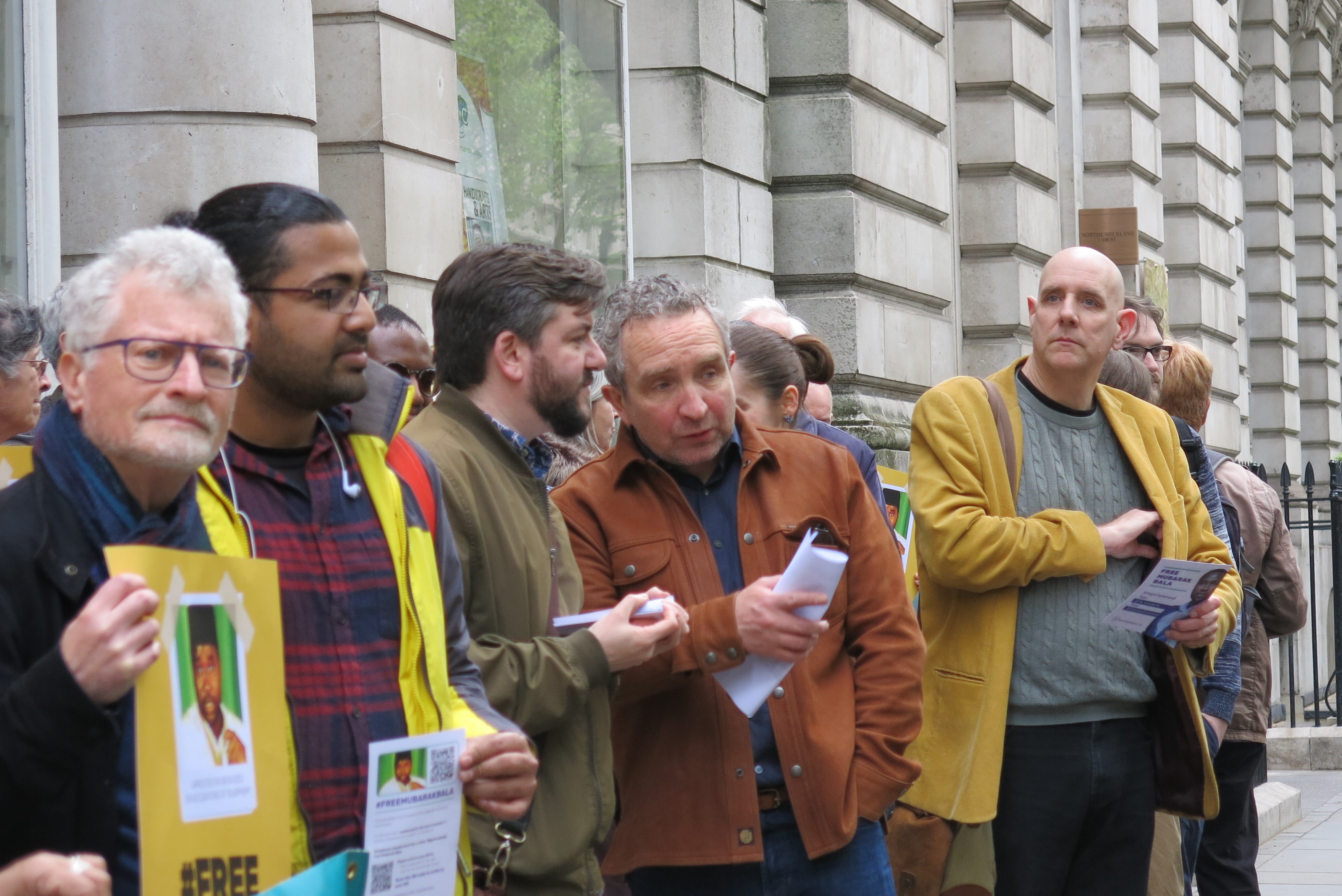
Pictured: Humanists UK’s #FreeMubarakBala protest outside the Nigerian High Commission, London, 2022. Two members of the Salisbury group can be seen, centre. Picture: Humanists

MPs have raised the case of Mubarak Bala, imprisoned President of the Nigerian Humanist Association, at a debate in Westminster Hall on Freedom of Religion or Belief in Nigeria. The debate was secured by Jim Shannon (Democratic Unionist Party), Chair of the All-Party Parliamentary Group on International Freedom of Religion or Belief (APPG FoRB) – of which Humanists UK is a stakeholder. 

Humanists UK has been calling for Bala’s release since he was arrested in April 2020. Two years later, Bala was convicted and sentenced to 24 years’ imprisonment for posting ‘blasphemous’ content on Facebook following an unfair trial: it was repeatedly delayed and the charges against him were duplicated. Procedural irregularities were rife. Bala remained incarcerated without charge for well over a year. He was denied access to his lawyers and family for an extended period. He was denied medical attention. The Abuja High Court’s ruling that he be released on bail was ignored by Kano State authorities. His case exemplifies the need to abolish blasphemy laws, which intrinsically contravene the right to freedom of religion or belief.

During the debate, Jim Shannon said that he, alongside other members of the APPG FoRB has visited Nigeria in 2022:

We used our visit to speak to some of the judiciary and judges in Nigeria… and made a very good case for the release of Mubarak. We thought we had made some headway on that, and the indications coming from the judiciary seemed to say that, but he is still in prison.’

Shadow Foreign Minister Lyn Brown said:

I can understand the anxiety about states in Nigeria continuing to imprison people for exercising religious freedoms. We all know the case of Mubarak Bala.’

Humanists UK campaigns for freedom of religion or belief (FoRB) around the world, particularly for non-religious people facing persecution. In many countries it is impossible to be openly non-religious. Laws that criminalise blasphemy and apostasy are often the source of such persecution – as they were in Mubarak Bala’s case. The repeal of such laws is therefore a vital step in guaranteeing FoRB for all.

Director of Public Affairs and Policy Kathy Riddick commented:

‘We thank Jim Shannon MP for securing the debate and raising the case of our colleague Mubarak Bala who has been imprisoned simply for expressing his humanist beliefs. 

‘The situation for humanists in Nigeria is dire. Blasphemy and apostasy are punishable by death and this is used to falsely justify the social persecution of the non-religious. Particularly worrying is that Nigeria is on the ‘safe country list’ under the Illegal Migration Act, which means that non-religious asylum seekers may face great risks if they are deported there.

‘We continue to call on the government to use all channels available to advocate for the repeal of all blasphemy and apostasy laws, and to secure not only the release of Mubarak, but the release of those convicted or imprisoned under such laws.’

Pictures: Salisbury Amnesty

UN Rapporteur ‘seriously concerned’ at crackdown in UK


UN Rapporteur on environment matters expressed ‘alarm’ ‘distress’ and ‘serious concern’ at the crackdown on environmental activists in UK

January 2024

Between 10 – 12 January 2024, David Forst, made his first visit to the United Kingdom since he was elected as UN Special Rapporteur on Environmental Defenders under the Aarhus Convention in June 2022.

On 23 January he issued a statement in the light of the extremely worrying information he received in the course of meetings regarding the increasingly severe crackdowns on environmental defenders in the United Kingdom, including in relation to the exercise of the right to peaceful protest.

These developments are a matter of concern for any member of the public in the UK who may wish to take action for the climate or environmental protection. The right to peaceful protest is a basic human right. It is also an essential part of a healthy democracy. Protests, which aim to express dissent and to draw attention to a particular issue, are by their nature disruptive. The fact that they cause disruption or involve civil disobedience do not mean they are not peaceful. As the UN Human Rights Committee has made clear, States have a duty to facilitate the right to protest, and private entities and broader society may be expected to accept some level of disruption as a result of the exercise of this right“.

Peaceful protests

During his visit, however, he learned that, in the UK, peaceful protesters are being prosecuted and convicted under the Police, Crime, Sentencing and Courts Act 2022, for the criminal offence of “public nuisance”, which is punishable by up to 10 years imprisonment. He was also informed that the Public Order Act 2023 is being used to further criminalize peaceful protest. In December 2023, a peaceful climate protester who took part for approximately 30 minutes in a slow march on a public road was sentenced to six months imprisonment under the 2023 law. That case is currently on appeal, but it is important to highlight that, prior to these legislative developments, it had been almost unheard of since the 1930s for members of the public to be imprisoned for peaceful protest in the UK.

He also expressed alarm to learn that, in some recent cases, presiding judges have forbidden environmental defenders from explaining to the jury their motivation for participating in a given protest or from mentioning climate change at all. It is very difficult to understand what could justify denying the jury the opportunity to hear the reason for the defendant’s action, and how a jury could reach a properly informed decision without hearing it, in particular at the time of environmental defenders’ peaceful but ever more urgent calls for the government to take pressing action for the climate.

He also received highly concerning information regarding the harsh bail conditions being imposed on peaceful environmental defenders while awaiting their criminal trial. These have included prohibitions on engaging in any protest, from having contact with others involved in their environmental movement or from going to particular areas. Some environmental defenders have also been required to wear electronic ankle tags, some including a 10pm – 7am curfew, and others, GPS tracking. Under the current timeframes of the criminal justice system, environmental defenders may be on bail for up to 2 years from the date of arrest to their eventual criminal trial. 

Such severe bail conditions have significant impacts on the environmental defenders’ personal lives and mental health and he seriously questioned the necessity and proportionality of such conditions for persons engaging in peaceful protest. In addition to the new criminal offences, he was deeply troubled at the use of civil injunctions to ban protest in certain areas, including on public roadways. Anyone who breaches these injunctions is liable for up to 2 years imprisonment and an unlimited fine. Even persons who have been named on one of these injunctions without first 2 being informed about it – which, to date, has largely been the case – can be held liable for the legal costs incurred to obtain the injunction and face an unlimited fine and imprisonment for breaching it. The fact that a significant number of environmental defenders are currently facing both a criminal trial and civil injunction proceedings for their involvement in a climate protest on a UK public road or motorway, and hence are being punished twice for the same action, is also a matter of grave concern to him.

Media derision

He was also distressed to see how environmental defenders are derided by some of the mainstream UK media and in the political sphere. By deriding environmental defenders, the media and political figures put them at risk of threats, abuse and even physical attacks from unscrupulous persons who rely on the toxic discourse to justify their own aggression. The toxic discourse may also be used by the State as justification for adopting increasingly severe and draconian measures against environmental defenders. In the course of his visit, he witnessed first hand that this is precisely what is taking place in the UK right now. This has a significant chilling effect on civil society and the exercise of fundamental freedoms.

As a final note, during his visit, UK environmental defenders told him that, despite the personal risks they face, they will continue to protest for urgent and effective action to address climate change. For them, the threat of climate change and its devastating impacts are far too serious and significant not to continue raising their voice, even when faced with imprisonment. We are in the midst of a triple planetary crisis of climate change, biodiversity loss and pollution. Environmental defenders are acting for the benefit of us all. It is therefore imperative that we ensure that they are protected.

A spokesperson for the UK Home Office, the government department that tackles policing and other elements of national security, said that “while decisions on custodial sentences are a matter for the independent judiciary, the Public Order Act brings in new criminal offences and proper penalties for selfish, guerrilla protest tactics.”

Sacha Deshmukh, Amnesty International UK’s chief executive, said: “The UN special rapporteur offers a damning indictment of the repressive crackdown climate activists in the UK face for exercising their right to peacefully protest.”

“The UK Government seems more intent on creating a climate of fear than tackling the climate crisis.“

The full report can be accessed here: Aarhus_SR_Env_Defenders_statement_following_visit_to_UK_10-12_Jan_2024.pdf (unece.org)

Sources: CNN; Guardian; UN, Mail on Line. [There does not seem to be a report on this in the Daily Telegraph]. All accessed 25 January 2024

75th anniversary


Today – 10 December – is the 75th anniversary of the Universal Declaration of Human Rights

December 2023

Today marks the 75th anniversary of one of the world’s most ground-breaking global pledges: the Universal Declaration of Human Rights (UDHR). This landmark document enshrines the inalienable rights that everyone is entitled to as a human being – regardless of race, colour, religion, sex, language, political or other opinion, national or social origin, property, birth or other status.

In one sense, we should be celebrating what was a great event. Yet surveying the world today, one wonders to what extent its aspirations are being followed. In many parts of the world, people are denied rights because of colour, race, religion or social status. Millions have been displaced and live in camps with only limited facilities. A war rages in Gaza. In China, around a million Uyghurs suffer persecution because of their faith.

Here in the UK, instead of celebration, we await a vote this week to see if parliament will agree to disapplying parts of the Human Rights Act – a child of the Declaration – and some within the Conservative party wish to see us leave the European Convention. Parts of the media carry out a regular assault on the act blaming it for many of our ills and allegedly providing a safety net for terrorists and criminals. There are many in positions of power who would like to see the act abolished or at least seriously curtailed. A sad commentary after three quarters of a century.


Today (10th) we shall be in the Cathedral for our annual Christmas signing for prisoners of conscience. From 10:00 till noon.

Suella Braverman’s speech


Home Secretary, Suella Braverman’s speech to the Tory party conference in Manchester

October 2023

Suella Braverman made a speech on the fringe of the Conservative Party conference on 3 October in which she said the Human Rights Act should be renamed the ‘Criminal’s Rights Act’. The speech as a whole – covering areas such as immigration and the threat that Britain will ‘go properly woke’ under Labour – received a standing ovation by a packed auditorium. She said that Britain was ‘enmeshed in a dense of set of rules designed for another era’ and that these rules acted against the interests of the country. The speech was dubbed a ‘red meat address’ by the Daily Mail.

Hostility to the HRA has a long history in the Conservative Party and many of its members would like to see it abolished and for us to come out of the European Convention. Plans to reform the act seem to have been shelved for the moment but may well reappear in the manifesto for the next election.

Commentators have seen the speech, together with one given in Washington on 26 September, as part of her leadership campaign ahead of a possible Conservative defeat and an election for a new party leader. But an attack on the HRA and the reception given to her remarks on this and other topics are of concern. A standing ovation suggests an element of the party still wish to see the legislation abolished. In some ways it is hardly surprising such has been the remorseless denigration of the act and its supposed iniquities by the right wing press. The impression has been firmly planted that the act is a criminal’s charter and enables such people to escape justice. This despite our gaols being crammed full to bursting and news that foreign prisons may have to be rented to house yet more.

People’s rights need protection like never before. We have witnessed example after example of wrong convictions, unarmed people shot by the police, criminal activities by the police themselves and a steady trail of mistrials and overturned convictions that to argue that we need less protection by abolishing our rights is perverse. The positive effects of the act seldom gain a hearing. In the coverage of the Hillsborough disaster for example, that it was the Human Rights Act which enabled families to gain justice scarcely got a mention in reporting by the right wing press.

Miscarriages of justice, police errors and overturned convictions, all weaken the public’s faith in the justice system. It is therefore depressing to see the Home Secretary make these remarks and receive a standing ovation for them. She seems to ignore the fact that terrorists and criminals are only alleged terrorists and alleged criminals until due process has found them guilty (or not) a fact which, as a barrister, she well knows.

Sources: APnews, Times, Guardian, Daily Mail, Evening Standard

Blog at WordPress.com.

Up ↑