Peace Vigil No 48


November 2024

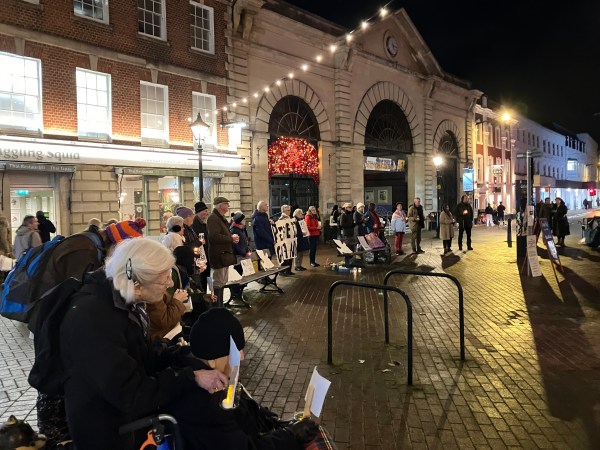
The 48th Vigil for peace in the Middle East took place yesterday and with the change in clocks, we were back to candles. About 40 were in attendance, the strongest turnout for some time. Also, a stronger contingent of young people. It is amazing to note the numbers – which do fluctuate – remain high.

Events in the region show no sign of a let up. Bombing continues in both Gaza and Lebanon. Commentators are reporting that the “General’s Plan” of clearing north Gaza of Palestinians seems to be happening despite denials. Such footage as emerges is shocking. With Unwra to be banned from the area and no other agency with the scale or infrastructure able to take its place, the future looks truly grim. So much now depends on the US election in a few days time. If Trump wins and becomes president in the New Year, then it seems unlikely any pressure will be put on Netanyahu to compromise. The future if Kamala Harris succeeds is less predictable as she has had to moderate her views in the light of the Jewish vote in the US.

More media outlets beginning to refer to Israeli actions as ‘genocide’. It is worth reminding ourselves what genocide is and the UN definition is:

The Genocide Convention establishes in Article I that the crime of genocide may take place in the context of an armed conflict, international or non-international, but also in the context of a peaceful situation. The latter is less common but still possible. The same article establishes the obligation of the contracting parties to prevent and to punish the crime of genocide.

The popular understanding of what constitutes genocide tends to be broader than the content of the norm under international law. Article II of the Genocide Convention contains a narrow definition of the crime of genocide, which includes two main elements:

  1. A mental element: the “intent to destroy, in whole or in part, a national, ethnical, racial or religious group, as such”; and
  2. A physical element, which includes the following five acts, enumerated exhaustively:
    • Killing members of the group
    • Causing serious bodily or mental harm to members of the group
    • Deliberately inflicting on the group conditions of life calculated to bring about its physical destruction in whole or in part
    • Imposing measures intended to prevent births within the group
    • Forcibly transferring children of the group to another group

As we have noted before, the issue of intent is important. A number of agencies and organisations have concluded that there is sufficient intent to conclude it is genocide.

The death toll in Gaza is around 43,000. Over 100,000 have been injured. Over 1,200 have been killed in Israel.

The Middle East conflict


Current phase of the conflict a year old and little sign of an end

October 2024

There has been an exchange of letters in the Salisbury Journal concerning the conflict in the Middle East. Two letters have focused on the issue of Britain continuing to supply arms to Israel. Although a limited embargo is in place, we still for example supply components for the F35. These aircraft are being used to deadly effect in both Gaza and Lebanon. Over 42,000 are dead in Gaza and more than 2,000 in Lebanon.

The word ‘genocide’ has been used to describe Israel’s action in Gaza and South Africa has launched an action in the International Criminal Court. The allegations make grim reading. There are huge numbers of forced evacuations. A significant part of the population is being forcibly moved. The death toll, particularly among women and children, is rising. Medical aid is failing to reach the population. Tens of thousands are living in make-shift accommodation (the link provides a more detailed picture). In the past day or two, evidence has been put forward to the effect that the starvation of those remaining in north Gaza might be an act of deliberate policy. This is said to be the ‘Generals’ Plan’.

Are these actions genocidal? The problem for the ICJ will be the question of intent. Is the destruction however terrible, a justifiable answer to the atrocious actions of Hamas most particularly on October 7th last year? Is Israel justified in going after the terrorist organisations who continually lob salvos of rockets into their territory? Or is it way over the top and disproportionate? One of the problems the Israelis have made for themselves is not allowing foreign journalists or observers into the area. Last month, the offices of al Jazeera were closed down and done so aggressively. Israel justifies the destruction of buildings, including schools and hospitals. It claims these buildings are used by Hamas to fire rockets into Israel and to prepare for terrorist activities. It claims that the deaths are because Hamas are using the population as ‘human shields’. Very little evidence is provided to justify these claims. One might expect that a year into this conflict, we would see evidence of these alleged activities, evidence that outside observers could verify. Entire buildings have been demolished with massive 2000 pound ‘dumb’ bombs because it is alleged Hamas operatives are present within them.

One of the writers to the Salisbury Journal asserts that the Hamas Covenant of 1988 calls for the obliteration of Israel. A subsequent charter in 2017 distinguishes between Jews and Zionists confining its more violent actions towards the latter. He failed to mention the statement by the Israeli Minister Amichae Eliyahu suggesting a nuclear bomb be dropped on Gaza. Bezalel Smotrich suggested recently that it would be ‘justified and moral’ to starve the population of Gaza. Both have been disavowed. Israeli minister Ben Gvir has said that his right to move around the West bank is superior to freedom of movement for Palestinians. The point being that aggressive and bloodthirsty statements have been made by both parties.

It is largely forgotten that Netanyahu supported Hamas for a period of several years as a means to weaken the PLO. And this is close to the heart of the problem: the desire for a Palestinian state and Israel’s refusal to countenance this. The desire for a greater Israel and the violent actions by the Israelis (misleadingly called settlers) on the West bank are a key element in the conflict. Another misunderstanding is to claim that the violent actions of October 7th were the start of the current hostilities. The roots go back to 1948 nakba at least and elements can be traced back to the Balfour Agreement and further back still. October 7th is but the latest manifestation of long term hatreds.

What makes the conflict hard to unpick is that in effect there are two wars going on. Firstly, that between Israel and Palestine and the former’s resolute stance not to allow a two state solution. Secondly, Iran’s role. This has history going back to the Shah. They have supported Hezbollah, Hamas and the Houthis in Yemen as proxies to attack Israel. But the seat of their aggression is again the Palestinian state and a belief that Israel has usurped Arab lands.

A key feature is the imbalance of power. Israel, with a largely unquestioning US support, is the regional superpower. It can project its power over the region. It can do this both militarily and with superior intelligence. This intelligence was seen with the spate of assassinations of Hezbollah leaders in Lebanon recently. None of the other states can match this. The US is sending manpower and more equipment this week. This makes it unwilling to compromise its position simply because it doesn’t need to. The world is waiting for Israel to respond to the rocket attacks from Iran of a few weeks ago. Israel has the capacity to inflict real damage on Iran’s military infrastructure. Iran by contrast, cannot do this. Despite the huge number of missiles hurled at Israel, the damage was minimal.

One major shift is the international attitude towards Israel. The world was shocked by the horrific attack on October 7th. The ensuing destruction of huge chunks of Gaza and the appalling death toll and squalor has seen sympathy for Israel drain away. Western media reporting was largely pro Israel arising partly from a fear of being labelled ‘antiSemitic’ for any criticisms. It has become more balanced and robust as time has gone by. Occasionally, commentators have mentioned the apartheid policy in the West bank. Amnesty, Human Rights Watch and B’Tselem have all published detailed reports on this and Israel has accused them of being anti-Israel. Reporting is hampered by a lack of access to the conflict zones. Claims and counter claims cannot be independently checked.

Conclusions

Should the UK stop sending arms to Israel? From the purely practical point of view, doing so will make little difference. We are a small supplier anyway and so ceasing supplies will not stop or help resolve the conflict. The political position is rather different. The UK is a member of the Security Council and still an influential force around the world. Other countries like Spain, Canada, Belgium, the Netherlands and Italy have stopped their supplies. The moral case is rather more compelling. Are we content to see the destruction of a vast swathe of both Gaza and increasingly Lebanon? Are we content to see thousands of children die or receive terrible wounds. Can we stand by and accept the use of starvation as a weapon of war? The answer should be ‘no’. If genocide is pronounced, the UK will be obliged to stop all weapons sales.

The imbalance of power is a major factor in the continuation of this conflict and we are contributing to this. We also help Israel with overflights from Cyprus. Wars have to end sometime. Few have mentioned the economic cost of this conflict bearing mind Israel’s population is around 9.5 million 75% of whom are Jews. How long can they sustain this even allowing for massive US aid?

Yesterday’s killing of Yahya Sinwar (17 October), the leader of Hamas, has led the Americans and others to hope that this is some kind of ‘moment of justice’. They hope this is the opportunity for negotiations to begin. It is unlikely. Netanyahu is holding on in the hope that Donald Trump will win the election. Since the US is powerless to rein in Israel and Hamas and the other terrorist groups ignore them, the possibility of an outside force successfully engineering some kind of peace seems remote. Frequent efforts by Qatar came to nought.

An end

Wars end because exhaustion sets in. Another reason is the parties see no hope of gaining victory. Thirdly, the loss of treasure becomes too great to bear and a kind of armed truce takes place. The public may become tired and the initial euphoria turns to boredom or frustration. Unfortunately, in the case of this conflict, these factors which researchers* have identified in other conflicts, may not apply. As argued above, outside forces most particularly the USA, are the drivers here enabling Israel to continue for a long period. In many respects this is a proxy war both by USA and Iran. Israel’s losses are minimal and containable. But the greatest factor is the abiding hatred that seems to exist between the parties.

Being surrounded by enemies, some of whom are committed to its destruction, has a powerful effect on Israel. Nevertheless, it had agreed peace treaties with several countries such as Jordan and Egypt. The Abraham accords were also a positive step. It can be done. Trump’s ending of rapprochement with Iran was a backward step.

This stage of the conflict will come to some kind of an end, or should we say pause. The answer to the arms question is clear. Britain should suspend deliveries and use its diplomatic power to push for a two state solution. It would give Israel the security it needs and it would weaken the power and influence of the terrorist groups.

*MIT Research

The Vigils continue


Forty fourth Vigil held yesterday

October 2024

The 44th Salisbury peace Vigil continues with around 35 in attendance yesterday (5th October). It is almost a year since the terrible events on 7th October 2023 was the trigger for the current round of violence which seems to be getting worse by the day. Last week, saw a huge barrage of missiles from Iran directed towards Israel. Israel also stepped up its campaign with a ground invasion of Lebanon as well as bombing communities in the south and in Beirut itself. A million or more have been displaced and there have been around 1,500 deaths. Over 41,000 have been killed in Gaza.

After October 7th, there was a wave of international sympathy for Israel. The number killed and the manner of their deaths – some burned alive and others brutally and gleefully murdered – shocked world opinion. As time has gone by and the images of destruction wrought on Gaza, sympathy for Israel has turned to frustration. We have seen footage of building after building being demolished. People are being forced to move time and again. The scale of misery has been shocking. The seemingly indiscriminate nature of the bombing is also shocking. The ‘human shield’ argument has been much used and evidence for it has not been supplied.

Huge numbers of women and children have been killed. Many thousands have received life changing injuries including the loss of limbs. Entire families have been wiped out when blocks of flats have been destroyed. Aid deliveries have been restricted or delayed. The situation in Gaza is catastrophic.

The world looks on powerlessly

And the world has looked on powerlessly. Peace efforts have come to nought. Military aid continues largely unabated. The US, formerly the key player in the region, is looking as feeble as its president. It is a tragedy being played out in real time on our screens. Israel is accused of genocide and ignoring claims that its response is disproportionate.

It seems a long time since talk of a ‘new world order’ and international relations being settled by diplomacy. Israel is in danger of winning battles but ultimately losing the war. They may inflict crippling physical damage on Hamas and Hezbollah due to its huge superiority in military strength, but they cannot crush the ideology. Peace in the area can never be achieved until the Palestinian question is resolved probably through some kind of two state solution. The sad fact is that at the end of this campaign (and when that will be is unpredictable) fundamental issues will remain unresolved. The Palestinians will not have a state: Israel will continue to be surrounded by hostile neighbours.

What is alarming to note is that neither the UN nor USA has been able to secure a peace deal or any kind of enduring settlement. The EU is side lined.

We shall continue our vigil in Salisbury each Saturday at 5 o’clock in the market square. A small gesture perhaps …

Three months in East Jerusalem


A talk by Nick Papadopulos describing his time in this city

September 2024

CORRECTED: 14TH September

Nick (pictured below) is the Dean of Salisbury Cathedral and has spent three months in this troubled city earlier in the year. He gave a talk last evening (September 11th) in St Thomas’s Church in the centre of Salisbury. Over 200 attended.

The conflict in the region raises great passions which are not to be seen in the same way with the Ukrainian conflict for example. Russia’s bombing of civilian targets and key infrastructure is seen straightforwardly as a war crime. The destruction of huge chunks of Gaza is not seen in such black and white terms. The increasing settler (and the word ‘settler’ came up in the talk, see below) violence receives only modest attention by news media or politicians. Indeed, Papadopulos commented on the reluctance of politicians in the UK to say or do much seeing the conflict as ‘toxic’ he said. The recent decision by the UK government for a modest reduction in arms sales suggested an effort to assuage those who argue for a total ban and a reluctance to upset the Israeli government. It looks as though they have achieved neither, one of the perils of fence sitting.

‘You can’t be neutral’

He gave a brief history of key events in the recent past starting with 1948, the declaration of the state of Israel and the displacement of three quarters of a million Palestinians which they refer to as the Nakba. He briefly discussed the 6 day war which saw the new state annex large areas of land in the region. These have been given up but they obtained control of Jerusalem, the West Bank, Golan Heights and maintained control of Gaza. Sanai reverted to Egypt. In answer to a question on this he emphasised that it was true that Israel no longer occupied Gaza but they did control it. It became the largest open air prison in the world with no access by sea or air and surrounded by checkpoints.

He described witnessing some of the arbitrary restrictions imposed by Israel on citizens in Jerusalem. One concerned a wish by Moslems to enter parts of the city to pray at the Al-Aqsa mosque. Restrictions were suddenly imposed which included only allowing men over 55 to enter and women over 45 likewise. New ID cards and a permit required giving them no time to acquire them. The result was that almost no one got in.

It was not just Moslems but similar restrictions applied to Christians who wish to celebrate Palm Sunday. 20,000 permits were applied for but only 2,000 issued too late for them to be of use. These events are confirmed by Machsom Watch a locally based women’s group which monitors checkpoints in the country. Freedom of worship is protected by article 37 of the Geneva Convention. We do not know the Israeli response to these events but they happen sufficiently often to appear to be an act of policy rather than a response to a particular threat. Checkpoints are surrounded by heavily armed soldiers with a ‘Skunk Water‘ van in attendance. These are used to drench crowds with an evil smelling fluid. The effect of these actions he said is to ‘weaken Jerusalem’s religious diversity’.

West Bank

A few items have appeared in TV news recently by BBC, ITV and Channel 4 showing the settler violence in the west bank. He described one such where Israelis arrived in the early hours and completely destroyed the Palestinian village. He also described the destruction of solar panels, important where there is no electricity. Pouring raw sewage onto land where children play was also mentioned. The various examples he gave concerned collective punishment which is contrary to article 33 of the Convention. He provided several examples of homes and facilities destroyed.

There was a question about the word ‘settler’ which by itself is a fairly neutral word and implies something small scale. In reality the settlements are almost cities and represent a permanent development. It was important to note he said that the ‘settlers’ were now part of the government.

Another question concerned the Holocaust. He reminded us that no Arab was involved in that atrocity, it was Europeans. He did not think that comparison of the Holocaust with what is going on today was helpful he said.

This was an extremely interesting illustrated talk from someone who has spent time in the region and witnessed first hand some of the oppression Moslems, Christians and Armenians experience on a regular basis. It was a pity he did not mention the ‘Apartheid‘ word which was relevant to his presentation. There seems no end to the violence at the time or writing and it does not appear the various cease fire initiatives have come to anything.


For those unable to get to this presentation, there will be a chance to hear it again on 13th November [not 3rd as we earlier posted] at the Quaker centre on Wilton Road, Salisbury.

There was a Vigil as usual this Saturday 14th September in the market place starting at 5pm for half an hour which attracted 30 people. Last week’s Vigil attracted around 35 people.

Salisbury Market Square Vigil: 39th Gathering for Peace


Vigil continues

September 2024

The 39th Vigil was held yesterday (31st August) in the market square as usual. Over 30 attended with a scattering of people joining in as they passed. The death toll is over 40,000 and there seems little sign of a peace deal. Efforts last week seem to have come to nought. There has been a short cessation of hostilities to enable the UN to carry out polio vaccinations.

ADDITION: the brutal murder by Hamas of six of the hostages has sent shockwaves around the world and has led to tens of thousands of Israelis to protest over the government’s failure to secure a peace deal and the release of the remaining hostages.

We shall be there again next week starting at 5pm in Salisbury market place next to the Library. All are welcome.

Tinderbox: a film


Film about the Israeli/Palestine conflict to be shown next month

September 2024

The film Tinderbox is to be shown at the United Reform Church in Fisherton Street, Salisbury on Monday 7th October starting at 7pm. Entry is free. It is a Christian Aid Film.

The conflict rages in Gaza and settler violence has increased in the West Bank. Over 40,000 are now dead in Gaza and prospects for peace being discussed only a week or so ago seem moribund. There has been a pause in hostilities to enable UN agencies to administer polio vaccine following an outbreak of this highly contagious disease.

The film was written and directed by Gillian Mosely who is Jewish and consists of a range of interviews with representatives of both sides of the conflict. It has received mixed reviews, the Times calling it ‘trite’ and the Jewish Chronicle said it was ‘thought provoking but out of its depth’ however the story itself concludes that ‘it does a great job in laying out some of the important moments in Israel’s history …’ Both the JC review and the Guardian found it strange that she did not interview friends or her own family although an educated guess might provide good reasons why not.

A detailed review published in the Conversation is worth reading giving an historical context to this conflict.

A glimmer of hope …


The West-Eastern Divan Orchestra brings a glimmer of hope to a troubled region

August 2024

The news from the Middle East is uniformly grim with the death toll in Gaza rising remorselessly to over 39,000 with more deaths a day or so ago following a bombing. Violence is emerging in Lebanon which threatens to worsen following the events in Tehran. A peace deal seems as far away as ever. Salisbury people still congregate every Saturday afternoon for a peace vigil.

The West-Eastern Divan Orchestra is a rare glimmer of light in the seemingly never ending gloom of conflict. Founded 25 years ago, and based in Seville, it is an orchestra consisting of both Arab and Israeli players with three desks for Iranians. Founded by Danial Barenboim and Edward Said, it is not a political venture but:

The Divan is not a love story, and it is not a peace story. It has very flatteringly been described as a project for peace. It isn’t. It’s not going to bring peace, whether you play well or not so well. The Divan was conceived as a project against ignorance. A project against the fact that it is absolutely essential for people to get to know the other, to understand what the other thinks and feels, without necessarily agreeing with it. I’m not trying to convert the Arab members of the Divan to the Israeli point of view, and [I’m] not trying to convince the Israelis to the Arab point of view. But I want to—and unfortunately I am alone in this now that Edward died a few years ago—create a platform where the two sides can disagree and not resort to knives.

Barenboim emphasises the role of dialogue and a feature of recent conflict is to note that there are people on both sides, who recognise the opinions, feelings and rights of the other. The orchestra performed at the Proms last evening (11th August) in a concert consisting of Brahms’s Violin concerto performed by Anne-Sophi Mutter, followed by Schubert’s 9th Symphony ‘the Great’. Looking down on the 80 or so players, could one tell them apart, Arab from Jew? Would one want to? A band of people from two nations tearing themselves apart, sublimely playing two wonderful pieces of music offering a glimmer of hope …

West-Eastern Divan Orchestra with Daniel Barenboim accepting applause.

Vigils continue


August 2024

The 36th Vigil took place again this Saturday, 10 August 2024 with just over 30 in attendance. When these Vigils started we did not imagine they would still be going and would attract continued support. This time we were joined by some passers by.

In that connection it is perhaps interesting to comment on the reaction of people walking past. Around 90 or so people took notice of what we were doing and registered (probably) that we were in support of peace in the region and a few took photos. This was around a quarter of those passing by. Many simply did not notice, hurrying home after work or rushing to catch a bus. Some quickly looked away for reasons we cannot know.

The conflict continues and the death toll stands at over 39,000. There seems to be no credible attempts at present to secure a ceasefire.

The next is on Saturday 17th at 5pm as usual.

The Vigils continue


August 2024

Here we are in August and we are still holding our weekly vigil in Salisbury market. Over 30 attended during the half hour session and it was all good natured this time. There seems no end to the conflict in Gaza: faint peace hopes were extinguished when the senior Hamas chief, Ismael Haniyeh was killed in Tehran. Some reports refer to a missile strike but later it appeared to have been a bomb placed in the house where he stays in the city, activated from afar. Israel has not claimed responsibility but it is assumed to be by them.

In any event, it has inflamed tensions and together with activity in Lebanon, any prospect of peace looks further away than ever. It is likely after Netanyahu’s rapturous reception in the American Congress last week, he is emboldened to take this kind of action. Retaliation is likely from Iran and so it goes on. Patrick Cockburn writing in the i newspaper (3 August) says that “Israel is getting locked into wars it will not lose – but cannot win”.

Vigil continues …


Salisbury Vigil still continues and is well supported

July 2024

Ten months since the terrible attack by Hamas and the start of the assault on Gaza and people still turn out on a Saturday to demonstrate their wish for peace. Just under 40 attended today (27 July). This week saw the rapturous reception of Benjamin Netanyahu by most of the Congress and Senate and heard his speech which contained many untruths. Peace in Gaza looks as far off as ever and today were reports of more attacks with 50 dead and around 200 injured. As long as the US supports Israel it does not seem likely that a peace deal is going to happen.

The politics changed in the US this week with President Biden agreeing to stand aside from the election and Kamala Harris looking set to be the presidential candidate. She has a more robust attitude to the conflict so it will be interesting to see how that plays out.

The UK position seems to be hardening and the new government does not appear to be stuck on following the US lead and is even thinking of reviewing the sale of arms to Israel.

We will be back in the market square in Salisbury at 5 pm as usual for half and hour.

Butter market, Salisbury

Blog at WordPress.com.

Up ↑