We were sad to note the death this summer of Brian Oosthuysen who was 87. Brian was an active member of the Stroud Amnesty group and, with other members of that group, took part in the campaign we ran on North Korea. Brian was born in South Africa during the Apartheid era. The picture below shows him holding the banner on one of his trips to Salisbury. There is an obituary in the Guardian which describes his many activities including being a County Councillor, helping at a food bank as well as his Amnesty work. We sent Our condolences go to Carole and family.
Members of Salisbury and Stroud Amnesty groups (Brian is 6th from right) in Queen Elizabeth Gardens.
North Korea is back in the news recently having sent thousands of troops to aid the Russians in their invasion of Ukraine. They are also supplying munitions in return for, it is thought, technological help from Russia. They are also engaged in using the death penalty and we are reproducing a post from Amnesty on this.
North Korea has admitted carrying out public executions in a rare admission about its treatment of prisoners, ironically made during an effort to defend and justify its human rights record. Rights organisations have long accused Pyongyang of shooting dead convicts in public, and defectors from the isolated country have given gruesome accounts of North Korean executioners tormenting condemned prisoners, burning and mutilating them after death and forcing others to look at their corpses.
On one occasion, an estimated crowd of 25,000 in the northern city of Hyesan was forced to watch as nine people were executed by firing squad for having slaughtered government-owned cattle and distributing the meat to businesses. “I kept thinking of the horrific scene of yesterday’s shooting, so I couldn’t sleep all night and trembled with fear,” one resident said.
North Korea defended its controversial law dictating harsh penalties for consuming foreign media on Thursday, while admitting that it carries out public executions and imprisons perpetrators of “anti-state” crimes. The DPRK government made the rare acknowledgement during the U.N.’s Universal Periodic Review (UPR) of the country in Geneva, which examines the human rights record of member states every four to five years.
At a session on 14 November, a North Korea official offered striking admissions of human rights abuses in the country, even as he sought to justify them under state policies. On the death penalty, Park said the DPRK executes individuals “who committed extremely serious crimes,” including publicly.
Until now, North Korea has denied staging public executions and has sought to promote the idea that there is a legal framework with safeguards for treatment of prisoners.
Public executions are considered to be a way to keep the population in line. According to witness testimonies from the DPRK, public executions for watching or distributing South Korean films and drug smuggling have increased in recent years, as well sentences for “crimes against the regime”.
Public executions of young North Koreans are on the rise, Seoul says, as Pyongyang seeks to stamp out South Korea’s cultural influence. One North Korean defector to the South recounted witnessing the public execution of a 22-year-old in South Hwanghae province in 2022. The young man’s crimes were listening to 70 South Korean songs and watching and sharing three South Korean films.
The death penalty has always been available in North Korea’s legal system but a commentary on the North Korean Criminal Law 3, published by the North Korean authorities in 1957, suggests that the death penalty will eventually be abolished in North Korea and is presently utilised as a last resort.
The revised Criminal Code of 1987 mentions the death penalty as one of two kinds of “basic penalties” to be imposed on criminal offenders. The minimum age for imposition was lowered from 18 to 17 and the prohibition against the lowering of human dignity was scrapped. Under the 1987 Criminal Code, the death penalty is mandatory for activities “in collusion with imperialists” aimed at “suppressing the national-liberation struggle” and the revolutionary struggle for reunification and independence” or for “acts of betraying the Nation to imperialists”
There are two mains religious beliefs in North Korea: Shamanism and Christianity. Both are severely persecuted and those thought or accused of engaging in either are subject to brutal treatment. This includes physical beatings, ingestion of polluted food, positional torture, sleep deprivation and forced squat jumps.
The Ministry of People’s Security are responsible for 90% of the documented serious human rights violations against Shamanic adherents and the Ministry of State Security is responsible for 90% of violations against Christians. The difference is that Christianity is seen as a political crime and adherents are tried in secret. To possess a bible is to risk death.
We are pleased to attach a copy of the June minutes thanks to group member Lesley for preparing them. It was a full meeting marked by a decision to end the North Korea campaign which has run for over a decade. The group thanked Tony for his work on this campaign over the years. Although no longer a specific campaign, we will carry out actions from time to time if the opportunity arises.
The human rights situation in North Korea is grim and the regime is one of the most repressive in the world. A report has just been published by Human Rights Watch called Worth less than an Animal which provides vivid descriptions of how prisoners awaiting trial are treated. All political, social, legal, economic and civil rights are severely restricted and the use of torture, forced labour and other abuses represent a crime against humanity.
There seems little likelihood of change in the near future. China holds the key since the state relies on them to survive. China has other problems of its own and is unlikely to want further instability and chaos which would ensue if Kim Jong Un was deposed. The HRW report is similar in many respects to the earlier UN report on DPNK published in 2018.
Speculation over health of Kim Jong-Un and his Nation
Kim Yong-Un
The unprecedented absence of North Korea’s leader from its most important state celebration, the Day of the Sun on 15 April, has fuelled speculation as to the health of Kim Jong-Un. Suggestions from Daily NK – news supplied largely from defectors – is that the leader has recently received heart surgery. No confirmation of this has been made to date however. Another theory is that the leader is being protected from Covid-19, since Kim Jong-Un is often seen in close physical contact with people, offering handshakes and hugs, which make him vulnerable to the virus.
This secrecy surrounding his health inevitably extends to the health of the entire ‘hermit kingdom’. While thousands have been quarantined, borders closed and tourists and foreign diplomats seen off, the government still insists there are ‘no cases in the country’.
Kim is however eager to be seen as pro-active in protecting the nation from the virus. He recently chaired a public health meeting and has issued hygiene advice nationwide. Pyongyang has received test kits from Russia and from China while various items of protective equipment have been donated by UNICEF and Doctors Without Borders.
The ‘great leader’ would be reluctant in any case to admit to the arrival of the virus since any weakness might invite criticism of his regime. It was fear of reporting the disease to central government that allowed it initially to spread in China but whether North Korea will learn from this lesson seems unlikely. A defector who recalls practising medicine during the SARS outbreak of 2002/03 said that not only was medical equipment seriously lacking then, but deaths were going unrecorded.
Certainly the sheer length of the border between North Korea and China, and its regular use by smugglers and traffickers, would suggest that the virus might enter relatively easily. If it did, that would be a tragedy for the 40% of North Koreans reportedly undernourished. And while new hospitals have been built under Kim’s rule, experts say they mostly benefit the elite in this two-tier nation.
This month the defector Thae Yong-Ho made history by winning a constituency seat in South Korea’s government. Once deputy ambassador to the UK, he says he is determined to work for the freedom of his compatriots who live in virtual ‘slavery’. The high price defectors pay (and there are on average 1000 per year) is the knowledge that their extended families will be detained, or worse, in one of the country’s many detention centres and labour camps.
Human rights, and the health care that these insist on, are sadly in very short supply in North Korea.
Update: 14 March. Ben Rogers has kindly sent us the text of his talk which is attached at the bottom of this post.
The Salisbury group is grateful to the Cathedral for holding an Evensong once a year marking the work of Amnesty International and enabling us to nominate a speaker during the course of the service. About 60 attended last nights service. For many years the Cathedral has provided space for the group to display each month an appeal for a Prisoner of Conscience. This month it is Ahmed Mansoor a human rights defender and POC who is in prison in Abu Dhabi. The Cathedral has a window dedicated to the work of Amnesty.
We were delighted to invite Benedict Rogers (pictured) to speak who, among other things, has a particular interest
Ben Rogers at Salisbury Cathedral (picture, Salisbury Amnesty)
in North Korea. Ben is East Asia Team Leader of CSW, a Christian charity which promotes religious freedom around the world.
He said that the UN regards North Korea to be in a category all of its own as far as human rights are concerned. It violates every single human right. As a member of CSW, they were the first to call for a commission of enquiry and two years later in 2014, the UN did so.
The gravity, scale and nature of abuses has no parallel in the modern world he said. The report found that:
North Korea had committed crimes against humanity and manifestly failed to uphold its responsibility to protect. These crimes entail “extermination, murder, enslavement, torture, imprisonment, rape, forced abortions and other sexual violence, persecution on political, religious, racial and gender grounds, the forcible transfer of populations, the enforced disappearance of persons and the inhumane act of knowingly causing prolonged starvation. Source, Wikipedia
In 2007, CSW produced a report A Case to Answer. A Call to Act which concluded that the human rights situation in North Korea was a crime against humanity. Although things seem bleak, he said there were some glimmers of light. In a recent report, Movies, Markets and Mass Surveillance, it was noted that North Koreans were getting more information about the outside world. They were beginning to realise that life south of the border was better. There was anecdotal evidence that prison guards did realise the world was watching.
The regime saw Christianity as a particular threat. Anyone caught practising it faced severe punishment or could be executed. If a carol was allowed it would only be ‘We three Kims of Orient are!’
Those who did manage to escape to China were sent back to face severe punishment in the prison camps. There were around 200,000 thousand people in the prison camps he said. He ended with the famous quotation mistakenly attributed to Edmund Burke:
The only thing necessary for the triumph of evil is that good men do nothing
Hwang Won, a former TV producer from South Korea, was not allowed to return to his home country after arriving involuntarily to North Korea on a hijacked plane on 11 December 1969. Despite repeated requests from his family, the North Korean authorities have refused to disclose information regarding Hwang Won’s vital status or whereabouts for the last 50 years. South Korean authorities must call on the North Korean authorities to provide accurate information on Hwang Won, who will turn 82 this year.
It is almost unimaginable that someone should be in prison for half a century and there would be concerns about their ability to cope with life outside. The Salisbury group has campaigned for human rights in North Korea and we are hopeful that, with a seeming desire for the regime to engage with the world outside, things might change.
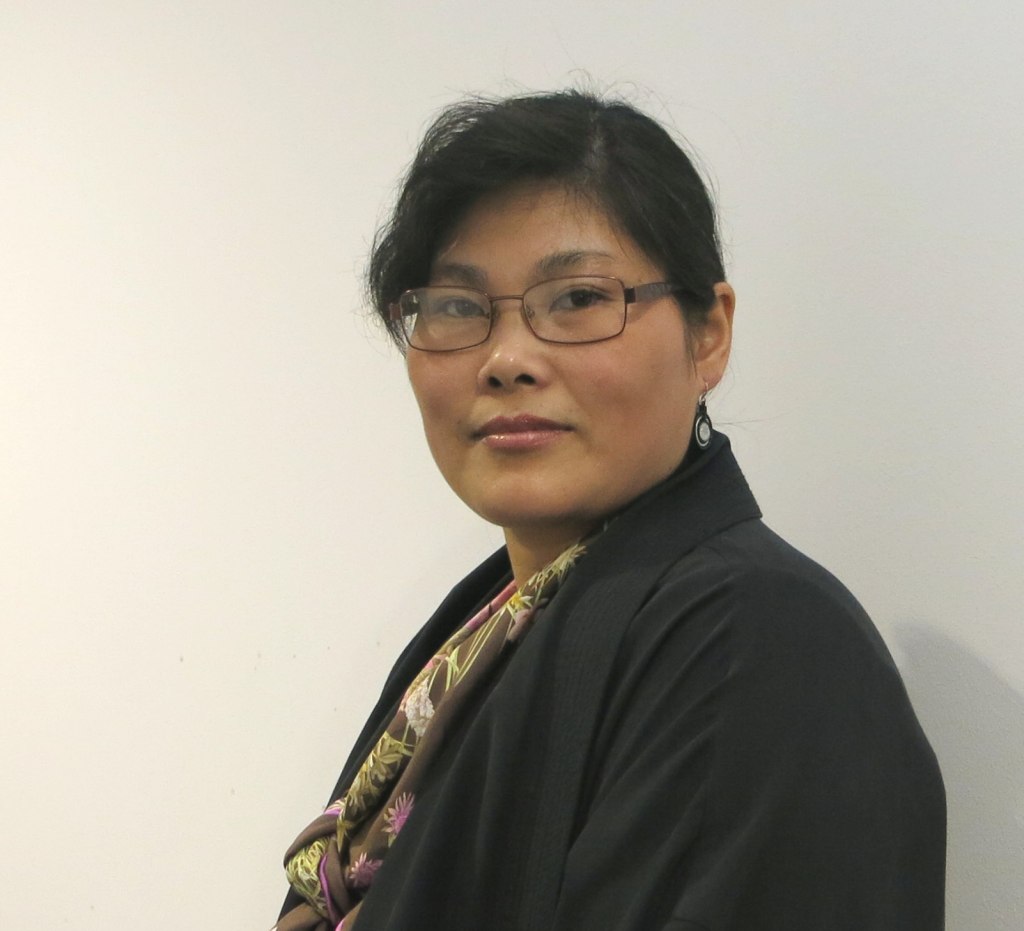
Jihyun Park gives moving talk to an audience in Salisbury
Jihyun Park. Pic: Salisbury Amnesty
Jihyun’s story is one that is difficult for British people to comprehend. She has endured privation both in China and in her home country of North Korea. She escaped from North Korea and spent six years in China effectively as a slave. She has been trafficked and forced into marriage. Eventually she was arrested and sent back to North Korea and was confined to a Labour Camp where she endured the severest of treatment. She escaped a second time via Mongolia and now lives in Manchester where she has been reunited with her son.
Part of her harrowing story was how she managed to regain contact with her young son on the phone while she was still in North Korea. He had been told she had deserted him and would not speak to her. It took several calls before meaningful contact could be resumed.
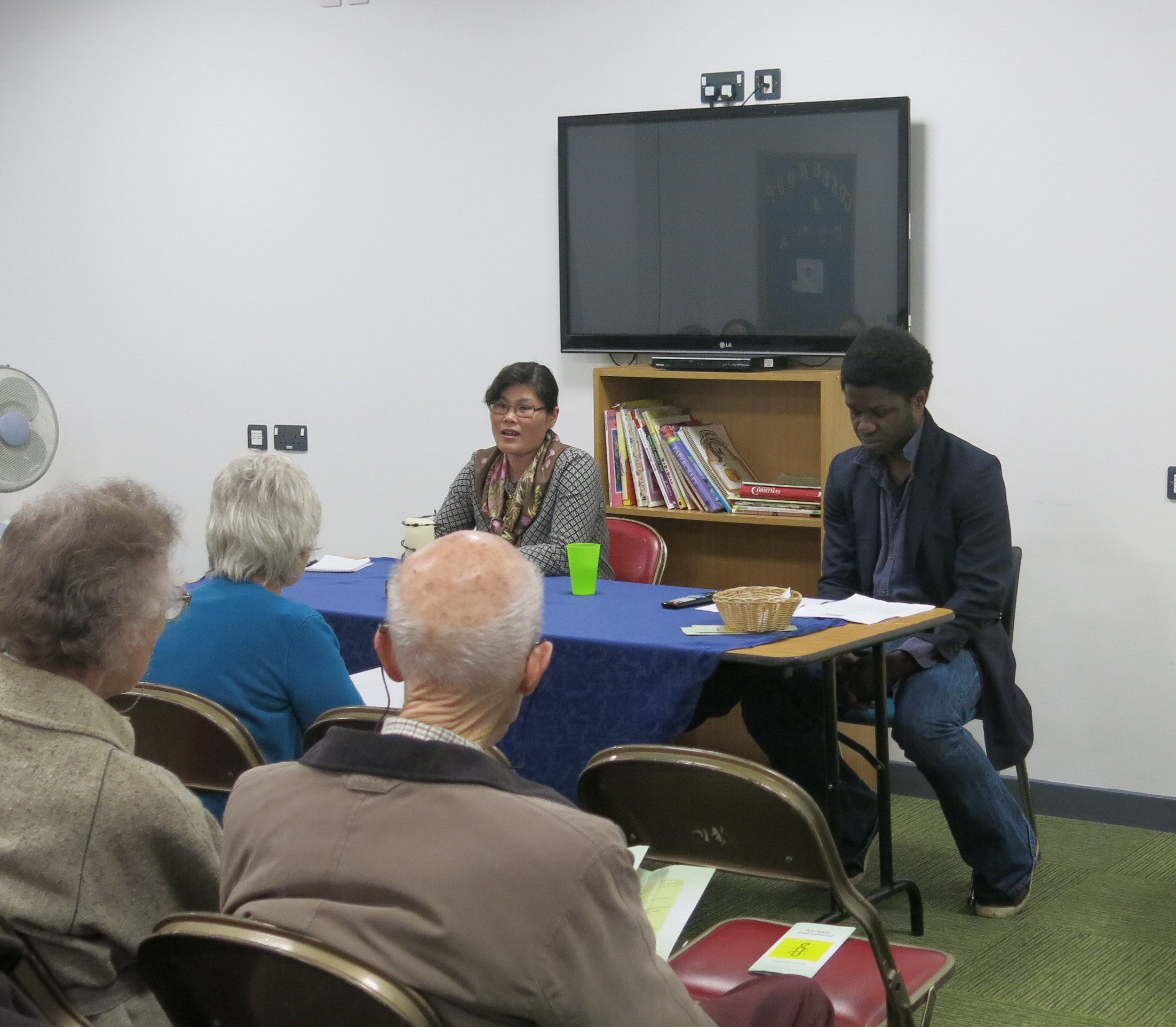
Jihyun and Kenny Latunde-Dada speaking at Five Rivers. Pic: Salisbury Amnesty
On Thursday 16 March, Jihyun came down to Salisbury and spoke to an audience at the Five Rivers Leisure Centre in the city. Over 50 attended and were immensely moved by her experiences. The evening started with a short film called The Other Interview (which can be viewed by following this link) followed by questions. The moderator was Amnesty regional representative Kenny Latunde-Dada who came down from Cambridge for the event. The audience asked many questions about both her experiences and life in North Korea.
There was some discussion about the role of China in both Jihyun’s story and more generally. North Korea is a sensitive issue for China and they are concerned about such an unstable country with its equally unstable leader on its doorstep. There are indications that they are tightening their policy of returning escapees to North Korea.
We were delighted to welcome Jihyun Park and were grateful for her making the trip down from Manchester to speak to us. We were also grateful to Kenny Latunde-Dada for coming down from Cambridge. Jihyun said she is writing her memoires and it should be published soon. Those interested may wish to read In Order to Live by another escapee Yeonmi Park published by Penguin (2015).







 Amnesty in Salisbury & South Wiltshire