Refugee report: November


Reports focus on destitution and the need for cooperation concerning asylum

November 2023

We are grateful to group member Andrew for his work in compiling this report on the current state of affairs with refugees and asylum seekers. A quiet month on the legislative front, but much noise from certain quarters. It was noted that the Home Secretary’s complaint against “tent-dwellers” included the aside “many of them from abroad”, with its implication of illegal immigrants joining in the supposed lifestyle choice. This was roundly condemned by a number of refugee charities, along with homelessness support groups. 

The Joseph Rowntree Trust have published a report on destitution in the UK. Among its findings was the fact that 28% of destitute households were migrants, and rates for that group were 35% higher than the national figure. Such households also tend to have more children. 

The Institute for Public Policy Research (a centrist think tank) has also published a report, “Charting New Waters”, on dealing with those crossing in small boats. Like the Safe Passage report mentioned last month it is concerned with developing safe routes, an organized Europe-wide system to share the responsibility, and a reform of the asylum processing system. The report does not give much detail, but reinforces the feeling that the government needs to engage with our neighbours in finding solutions to the issue. 

On that topic, the numbers of asylum seekers crossing the channel has been lower this month, mainly because of the weather 

We still await the High Court decision on the Rwanda plan, but the feeling is that the government is prepared to lose the case. This would, of course, put the European Court of Human Rights in the firing line, at least with the Home Secretary. The decision is expected in the first half of December. 

Many Afghans who were promised a safe passage to the UK after the Taliban takeover are still waiting; 3000 who have been promised asylum in the UK are in UK-funded hotels in Islamabad, but the Pakistan government is ejecting all Afghan refugees. There has been no government statement, as far as we know. 

The Home Office has rolled out a new “asylum decision-making prioritisation”. This is really a pushing ahead in trying to reduce the backlog of cases awaiting decision. The government has argued that the backlog has been reduced, but in fact the total has increased due to new cases, while the “legacy” cases from pre-2022 are indeed being reduced. 

Migration lawyers have noted with pleasure that the number of refusals of claims of trafficking by new arrivals has fallen, following a change in the regulations. 

The Home Office announced this week that the number of asylum seekers to be held on the barge Bibby Stockholm is to be reduced from 500 to 425, following a fire risk assessment. This would likely make the provision 10% more expensive than housing claimants in hotels. 

On the campaigning front, next year’s Refugee Week will be from 17th to 23rd June. The theme will be “Our Home.” 

AH

Refugee summary


The October update on the current state of refugees into the UK
October 2023

The week’s big event has been the start of the Supreme Court’s review of the legality of the Rwanda deportation plan. They are expected to take 3 days to come to a conclusion, but this will not be made known for some weeks. Also, the Mayor of Portland’s planning permission protest against the Bibby Stockholm ship was heard this week (she lost) and the Home Office have reported that claimants will be sent back to the barge from 19th October. In passing, the Home Office is refusing to state the cost of the barge, as it would not be “in the public interest”.

The government’s Illegal Migration Act is facing a court challenge from the Northern Ireland Human Rights Commission (NIHRC) on the ground that it breaches the Windsor Framework. The framework is the revised post-Brexit deal for Northern Ireland, which was agreed by the UK and EU earlier this year. It deals mostly with trade issues but also includes a human rights element. It commits the UK not to water down the human rights provisions that flow from the Good Friday Agreement.

Opening up the UN Refugee Convention to reform would cause the world to “go backwards” on refugee rights, a UN leader has said. Gillian Triggs, UN Assistant Secretary-General, told the One Young World Summit in Belfast that there is a “global environment of populist rhetoric” that is damaging to refugees. The 1951 UN Refugee Convention outlines a number of protections for refugees, including basic minimum standards, and asserts they should not be returned to a country where they face serious threats to their life or freedom.

Suella Braverman

In a trip to Washington DC last month, the Home Secretary, Suella Braverman, said it should be questioned whether the application of the UN’s Refugee Convention is “fit for our modern age”.

Channel crossings

The mild Autumn has kept the small boats coming, the total people arriving for the year so far being just over 25,000. This is down by about 20% on last year, mostly because of the absence of arrivals from Albania. There have been two major reports this month: Safe Passage has been looking at safe routes for prospective refugees and the Refugee Council have looked at the data on arrivals, and discuss the impact of the new Illegal Migration Act. The Refugee Council’s analysis of new Home Office statistics shows that three in every four of the people who have crossed the channel so far this year would be recognised as refugees if the UK Government processed their asylum applications. This is higher than the Refugee’s Council previous analysis of those who made the journey in 2022, which found it was almost two-thirds. The statistics also show that:

More than half (54 per cent) of those who have made the perilous crossing come from just five countries – Afghanistan, Iran, Eritrea, Syria and Sudan.

With the exception of Albanians, the number of people crossing the channel is higher in 2023 compared to 2022.

Analysis based on the data shows that once the Illegal Migration Act 2023 comes into force:

 • Each year, over 27,000 refugees who cross the channel will be denied status in the UK.

 • As few as 3.5 per cent of those people arriving by small boat, 1,297 people, will be removed from the UK to their own country.

 • 35,409 people who arrive in the UK by small boat could be left in limbo each year, having had their asylum claim deemed permanently inadmissible but not having been removed.

• Even with a safe third country agreement in place with Rwanda which allows for up to 10,000 people to be removed there annually at least 25,409 people will be left in a state of permanent limbo each year.

(The Illegal Migration Act The Illegal Migration Act became law on 20 July. The main elements of the Act include the creation of a duty for the Home Secretary to arrange for the removal of anyone who arrives irregularly into the UK – including, but not limited to, those who arrive by small boat. Anyone who is covered by the duty to remove will also have any asylum application or relevant human rights claim deemed automatically inadmissible. )

The Safe Passage report concentrates on devising a better system of dealing with new arrivals. It recommends developing safe routes, not least to end the control of the smugglers, an organized Europe-wide system to share the responsibility, and a recommitment to the UN-based regulations under international law.

The Migration Advisory Committee has recommended that the shortage occupation list is abolished and that people in the asylum system with permission to work are allowed to work in any role. These are some of the recommendations in the full review of the shortage occupation list, published this week.

With thanks to group member Andrew for the work in producing this report.

AH

Refugee report – September


Full report on the current situation with refugees and asylum seekers

September 2023

Refugees continue to be a hot political issue and it is likely to be a hotly contested feature of the next general election. Stemming the flow of cross Channel arrivals is proving to be extremely difficult. This report goes into the current situation in some detail and we are grateful for group member Andrew for compiling it.

As Parliament returns and the conference season looms, small boat crossings are back in the news. Latest figures show more than 800 people crossed the Channel in small boats on 2nd September. The latest provisional government data put the figure at 872 people in 15 vessels, suggesting an average of about 58 people in each one.

The cumulative figure for 2023 now stands at a provisional 20,973. The previous high for a single day this year was on 10 August when 756 people made the crossing. The total for the year so far is still lower than at this time last year, when 25,000 people had made the journey. The record for a single day since current records began in 2018 was 1,295 on 22 August 2022.

This week (one day into the new parliamentary session) Immigration Minister Robert Jenrick set out the next stage in the government’s immigration clampdown. Alongside the Illegal Migration Act against arrivals on small boats, he opened a second front focusing on people who employ, house or otherwise abet illegal immigrants.

Businesses that employ undocumented migrants are already liable to fines, and landlords are obliged to check whether prospective tenants have permission to reside in the UK. The penalties for not doing so will be increased threefold (up to ten times for a repeat offence).

A new focus of the policy is the pursuit, by the so-called professional enablers taskforce, of lawyers “who help migrants abuse the immigration system.” This follows newspaper reports earlier this year of cases where solicitors had colluded in false asylum claims and wilful deception to get refugee status. The maximum jail term for conviction in such cases will be life imprisonment – longer than the 10-year tariff reserved for extreme cases of fraud; longer in fact than the 14-year maximum for indecent assault of a child. The maximum penalty need not be the standard, but it is still revealing that the government thinks lawyers who help migrants break the rules (in ways not yet specified) should spend so long behind bars. It was noted that this only seems to apply to lawyers, not to Home Office staff…

Both these new crimes are already illegal; the only difference is the increased supervision and penalties. Colin Yeo at Free Movement has noted an increase in activity at the Home Office. These are his comments and summary of the current situation for migrants:

“The Times reported on 3 September 2023 that just over 2,000 asylum decisions were made in the previous week. Some of these may have been so-called “withdrawals” — essentially, the Home Office taking an asylum seeker off the books for some minor perceived or actual administrative failure by the asylum seeker — but it looks like a lot of proper decisions must be being made as well. This is reported to be in large part because full asylum interviews have been dropped for asylum seekers from Afghanistan, Eritrea, Libya, Syria and Yemen and certain claims from Sudan”.

Basically, it sounds like nationals of those countries are simply going to be granted asylum, subject to security checks. This change is in line with the historic trend of allowing more claimants to stay. The number of asylum seekers returned in 2006 was 18,000, against in 2022, 4,000 (and most of those voluntary.)

The 3 countries with the most applications are Albania, Afghanistan and Iran. Interestingly, the percentage of grants for them are 19%, 98% and 76% respectively.

The overall asylum grant rate for the year ended June 2023 was 71%. Of those who appeal against a refusal, a further 53% win their appeal. So, lots of asylum decisions mean lots of newly recognised refugees plus a relatively small number of failed asylum seekers.

What happens when asylum is granted?

When an asylum seeker is granted asylum, they will have to leave their Home Office-funded asylum accommodation and they will lose their Home Office-funded asylum support. That’s good; asylum accommodation is terrible and asylum support is miserly. It’s part of transitioning properly into British society. They will be granted leave to remain for five years. In theory this can be taken away if their country becomes safe; in practice this is very unlikely. At the end of the five years, they are eligible to apply for settlement, formally called indefinite leave to remain or sometimes permanent residence.

Once they have that grant of legal status and proof of their legal status the idea is that they can either find a job and a place to rent or they can access mainstream welfare benefits if they need to. They absolutely need proof of their legal status because employers will not usually give anyone a job without such proof, nor will landlords rent property to anyone without such proof. At the moment the fines for doing so are £15,000 per worker and £1,000 per occupier respectively. These are due to rise to £45,000 and £5,000 per person at some point in the near future .

And you cannot claim normal welfare benefits without proof of your legal status either, so the Department of Work and Pensions will simply send you away.

The problem is that the Home Office is failing to issue proof of legal status (called a biometric residence permit) promptly but evicting recognised refugees from their asylum accommodation and cutting off asylum support anyway. Newly recognised refugees have no prior notice of what was coming — after waiting for years for a decision, remember — and will have just a few days to find a job or contact their local authority for support.

The result is that a newly recognised refugee will often find themselves with no asylum support but also unable to work or rent accommodation and unable to to access the welfare benefits to which they should theory be entitled. They will almost inevitably therefore be homeless. They will become the responsibility of the local authority where they were then resident.

Local authorities have had as little notice as the refugees themselves.

Free Movement also have thoughts about the Illegal Migration Act:

“If the Illegal Migration Act is ever activated, the government’s plan is that every asylum seeker arriving after an as-yet unannounced date will either be removed to Rwanda or kept in the UK in a new perma-backlog. None of them will ever receive an asylum decision here in the UK. There will be no recognised refugees in future.

“There are two ways it might play out in practice.

“If it goes according to plan, the removal of a relatively small number of asylum seekers to Rwanda will suddenly stop the boats or severely diminish the number of arrivals. Ongoing removals to Rwanda will be necessary to maintain the deterrent effect but not in significant numbers.

“No-one actually thinks that is going to happen.

“It is possible the government will strain every sinew to try and make it happen anyway, building huge detention camps and forcing ever-increasing number of refugees onto flights to Rwanda. Some may be deterred but undetected arrivals would probably increase and anyone not detained will simply disappear into the community rather than risk removal to Rwanda. There will be a large official backlog of people who are either in detention or who have disappeared who will in theory one day be removed to Rwanda. And there will also be a large but unknown number of people who arrived undetected and never claimed asylum because there was no longer any point in doing so.

“Needless to say, creating a large permanent-backlog of people who might one day be removed to Rwanda as well as an unknown number of unauthorised entrants who try to stay below the radar is a questionable integration strategy. The vast majority will in reality stay in the UK permanently, so this approach will cause huge social damage.”

A couple of other items:

  • The independent Conservative think tank, Bright Blue, have run a survey on public attitudes towards asylum seekers, which showed how divisive the issue is. On most aspects, half of respondents took a hard line and half a more liberal view. Bright Blue themselves favour a quota system for applicants with “humanitarian visas”. The research can be found at Alternative policies for the UK’s asylum system – Bright Blue
  • A local council has ordered the Home Office immediately to halt building work converting a former RAF base into accommodation for asylum seekers. West Lindsey district council served contractors with a temporary stop notice after a “breach of planning control” at RAF Scampton in Lincolnshire. The stop notice has been pinned to the gates of the base, home to the 617 Squadron that carried out the Dambusters raid during the second world war and was also the base of the Red Arrows. The Home Office hopes to accommodate up to 2,000 people there in what it says will be a cheaper alternative to using hotels, where approximately 50,000 asylum seekers are accommodated at a cost of about £6m a day.

Refugee report


Many of the boat people are from Afghanistan

August 2023

The tragic events in the English Channel this week have served to draw attention to the fact that most of the asylum seekers affected by the disaster were from Afghanistan. This might invite the question: “But I thought that Afghans were the one group for whom official arrangements to come here had been made?” Indeed, there are two official processes by which Afghans can come to this country to escape persecution. One is the Afghan Relocation and Assistance Policy, designed to help those who had been involved with the UK administration pre-Taliban, and several thousand have arrived through this route. Asylum seekers arriving now may have worked with the British and been left behind or not, but clearly most feel threatened by any connection they may have had with the old regime. The Afghan Citizen Resettlement Scheme (ACRS) was designed for such cases.

So how has the ACRS been performing? A new report by the Refugee Council gives a gloomy assessment. The plan was to take 5,000 refugees in the first year and 20,000 in total. So far, 54 Afghans have arrived under ACRS; many are waiting in Pakistan for arrangements to be made to bring them over. Accommodation in the UK is not available however and, as the report notes, those 9,000 Afghans currently being accommodated in hotels here will be ejected at the end of the month to find their own places or become homeless.

Afghans arriving via the Channel will be sent back

Hence the large number of Afghans arriving on small boats. In the last year 8,429 have come by this route, of whom 96 have been given leave to stay. Of course, under the new Illegal Migration Act, none will be given that right and will in theory be returned to Afghanistan or a third country like Rwanda.

The report goes on to note that no method has been established to help reunite the families of asylum seekers with those who are here, despite assurances  from the government.

The Guardian has published an article by the Council’s chief executive, Enver Solomon, which gives more detail.

UPDATE: Shortly after posting this, the BBC Radio 4 programme ‘World at One’ devoted a lengthy package to this item.

AH

Refugee report: July


Refugee report with an update on the current state of play with legislation

July 2023

The Illegal Migration Bill continues its dizzying route to completion, despite 20 defeats in the House of Lords. The Commons has rejected all the amendments, and the Bill will return one more time to the Lords and, presumably, back to the Commons next week before the recess in a process called ‘ping pong’. Despite the enormous interest in this subject and its high political salience, it was reported that fewer than 40 MPs turned up for the debate and only 20 or so stayed to the end.

We are grateful for group member Andrew for this report.

The latest situation update:

All of the Lords’ amendments were overturned by the Commons, but several had some support from the Conservative benches (Tim Lough-ton complained that they had not had enough time to mull over the government’s changes). The Home Office offered several concessions on Monday evening, The bill’s provisions will no longer apply retrospectively to anyone deemed to have arrived illegally from March 7 (10,000 people will escape the legislation’s measures, according to the Daily Mail) … the detention of unaccompanied children will be limited to eight days (significantly longer than the 24 hours backed by peers) … and the detention of pregnant women will be limited to 72 hours (extendable to seven days by ministers). Other issues still in play from the Lords debates include:

• Removing unaccompanied children from within the scope of the Bill
• Allowing anyone not removed within 6 months to re-enter our asylum system and have their claims heard
• Ensuring Local Authorities maintain care of unaccompanied children and that children are protected during the age assessment process
• Ensuring LGBT+ people are not removed to countries where they risk persecution, and that victims of trafficking are not included within scope of the Bill (as sought by Theresa May). These will presumably come up again in the next Lords session.

Elsewhere

The highest number of small boat arrivals on a single day this year occurred last week at 686. The total for the year to last weekend was 12,119, slightly down on last year.

UNHCR report says the worldwide figure for refugees is now 29.4 million excluding Palestine. 76% in low/middle income countries 70% in a neighbouring country. 339,300 refugees returned home and only 114,300 refugees were resettled out of camps last year. UNHCR estimates that 1.5 million people globally are in need of resettlement because they are in a protracted refugee situation, meaning they had been refugees for longer than five years. For each refugee that was returned or resettled in 2022, there were 16 new refugees.

Free Movement have picked up on a story that the Home Office is planning to reintroduce the concept of “reasonable force” to remove families with children. Watch this space.

Small boats

The government does not know how much its new small boats bill will cost or if it will achieve its core aim of deterring Channel crossings, an official assessment has found. Documents published over three months after the Illegal Migration Bill was presented to parliament estimated that it will cost £169,000 to deport each asylum seeker – but it is unclear how many will be removed and what “third countries” will receive them. The only existing deal is with Rwanda and the Home Office refused to publish the actual payments agreed, citing “commercial sensitivities” as a Court of Appeal ruling on the scheme looms.
A report from the Migrant and Refugee Children’s Unit argues that Albania is not a “safe country”, as the Government maintains.

Controversial plans to house asylum seekers on a barge to reduce reliance on expensive hotels will save less than £10 a person a day, according to a report. The report, Bibby Stockholm – At What Cost? from the NGOs Reclaim The Seas and One Life To Live, provides the first detailed estimated costings of the Bibby Stockholm, the barge the Home Of-fice is planning to use in Dorset to accommodate asylum seekers.

On statistics, in correspondence between the head of the UK Statistics Authority, Sir Robert Chote and Immigration Minister Robert Jenrick, Chote commented: “concerns have been raised with us about your statement in the House of Commons on 20 March that :“Today, a majority of the cases being considered for modern slavery are people who are coming into the country – for example, on small boats. We are seeing flagrant abuse, which is making it impossible for us to deal appropriately with the genuine victims, to the point that 71% of foreign national offenders in the detained estate, whom we are trying to remove from the country, are claiming to be modern slaves.”

Minister accused of using the wrong statistics

“The Home Office advised us that the quoted figure comes from a recent report about modern slavery referrals for people detained for return after arriving in the UK in small boats and that your statement was intended to refer to the proportion of foreign national offenders (FNOs) that are referred to the National Referral Mechanism (NRM) as potential victims of modern slavery. The report explains that while an increasing proportion of all those in detention after arriving by small boat are referred to the NRM up from 52% in 2020 to 73% in 2021 (and subsequently falling to 65% between January and September 2022), the proportion among foreign national offenders is much lower (at around 20% between January and September 2022)”. This argument came up again in the Commons when Theresa May claimed Jenrick was using the wrong statistics.

Beyond Europe, it seems that the UN estimates that more than 31 mil-lion Africans live outside the country of their birth, mostly within the continent (only a quarter head for Europe). AlJazeera is running a se-ries of articles on this subject.

The BBC’s More or Less programme presented a special episode on immigration, featuring Colin Yeo as well as several other experts, which is recommended.


Migrant Help runs a guidance and advice helpline to assist asylum seekers in the UK as they move through the process. The charity is not part of the Home Office but is the advice by The Independent, a Migrant Help adviser said: “I am afraid Migrant Help are not contracted to respond to MPs correspondence and have forwarded the attached to the MP correspondence team. Our call handlers will reach out to the service user to see if there is any further support they can provide.
I would like to clarify that not responding to MP enquiries is not a Migrant Help policy but a directive given to us by the Home Office as part of our work under the advice, issue reporting and eligibility (AIRE) contract. I have expressed con-cerns regarding this process

The ‘New’ Conservatives


Danny Kruger: the leader of the New Conservatives

July 2023

Danny Kruger, the MP for Devizes in Wiltshire, whose odd ideas on human rights we have had occasion to highlight before, is the founding member of the New Conservative grouping within the party. All their manifesto concerns considerable hardening of attitudes towards immigration. Their ten point plan is:

  1. Closing temporary schemes that grant work visa eligibility for care workers and senior care workers.
  2. Raising the minimum income required to gain a skilled work visa.
  3. Extending the closure of the student dependant route.
  4. Closing the graduate route to students.
  5. Reserving university Study Visas for the brightest international students.
  6. Monitoring the reduction in visa applications under the humanitarian schemes.
  7. Implementing the provisions of the Illegal Migration Bill rapidly.
  8. Capping the number of refugees legally accepted for resettlement in the UK.
  9. Raising the minimum combined income threshold for sponsoring a spouse and raising the minimum language requirement.
  10. Capping the amount of social housing that councils may assign to non-UK nationals. [Source Wikipedia]

Several of these policies run counter to the UK’s treaty obligations and would have significant impacts on human rights particularly concerning the Illegal Migration Bill currently struggling in the House of Lords. The care worker proposal for example, would make an already serious situation considerably worse. Their policies are all concerning immigration at present and are reported to be designed to appeal to Red Wall voters which, curiously, does not include Devizes, a safe Wiltshire seat. It is depressing that the people of Devizes should support Kruger and one assumes, these policies. The grouping claims to have 25 supporters but those listed do not add up to 25.

It is concerning that a group of MPs should see it advantageous to major on – to the exclusion of all else – a range of draconian anti-immigrant policies believing them to be popular with the electorate. Mr Kruger has previously claimed that a number of our country’s ills – long waiting lists for example – are the fault of immigrants.

The item concerning the cap on refugees would apply across the piece and would include those from Ukraine, Afghanistan and Hong Kong. Mr Kruger is a committed Christian and has spoken often about his beliefs. He is himself, the son of an immigrant and it is a curious fact that many in his party who are sons and daughters of immigrants (Priti Patel, Suella Braverman and Rishi Sunak) are so hostile to those who follow them.

Sources: Wiltshire Times, Premier Christian News, Wikipedia, Blavatnik School of Government (Oxford University), Politico

Rwanda: the morality question


How moral is the plan to deport asylum seekers to Rwanda?

July 2023

The wish by the government to deport asylum seekers and refugees to Rwanda has consumed considerable political capital and is a topic rarely out of the news. It is the flip side of the problem of people arriving by small boats across the Channel which causes so much fury in sections of the media. The extreme difficulty in applying for asylum from outside the UK is only occasionally mentioned. Legal routes have all but been closed off forcing those seeking asylum to engage in perilous journeys. According to ex prime minister Boris Johnson however, writing for the Daily Mail in his new job, said there are ‘numerous safe and legal routes for people to come to Britain’. His argument is that once word gets round the ‘camp fires’ of northern France that there is a chance of being sent to Rwanda, the business model of the smugglers will be broken (We must take radical action to get Rwanda done!) 30 June*.

This raises a moral question which is that the idea of deportation and treating them badly is to use people as a matter of policy. It is using deportation as a kind of punishment for a class of people no matter what the legitimacy of their claim might be. It is also logically unsound since it will be the refugees who will suffer and end up in Rwanda, not the people smugglers. The likelihood of the policy deterring the smugglers has been challenged recently in an impact assessment report which notes that the Home Office had little evidence to show that it might work. Academics say that it is issue of culture, kinship and language which are important factors and changing the rules has little effect.

Stopping the boats – assuming that to be possible – does not stop the problem. War, persecution, climate and poverty are among the factors which force people to leave their homes and embark on long, perilous journeys to seek asylum.

It has been pointed out that Rwanda is not the best of countries as far as human rights are concerned. There is little freedom of expression. Journalists are harassed and intimidated and opposition leaders find it hard to make headway. Bloggers and lawyers are intimidated and sometimes unlawfully detained. What has not been commented on however is that the deportation policy crucially depends on Rwanda being a safe place for us to send refugees and it will be extremely difficult for the UK government to stop the deportations if evidence of mistreatment by police or security forces in Rwanda subsequently emerges. It will also be difficult and embarrassing for the government to criticise President Kagame for any infringements of evidence of bad treatment. Having invested so much political capital in the policy, to admit the country is not in fact safe will be extremely awkward.

Refugees will find it hard to settle in the country as did those who went their as part of the – now abandoned – Israeli scheme. Perhaps the enthusiasm for the schemes owes something to several Australians who act in advisory roles in Downing Street. The Australians sent their asylum seekers to islands in the Pacific in a much criticised scheme.

Public attitudes toward refugees seems slowly to be changing and a recent IPSOS poll showed the UK to have one of the most positive attitudes towards immigrants at 56%. The numbers wanting our borders closed totally has declined. 54% wanted immigrants to stay. This despite the relentless rhetoric in the tabloid press.

Government attitudes seem to have hardened by contrast and ‘stopping the boats’ is one of the prime minister’s five pledges. In the i newspaper on Saturday (2 July) there was speculation that the government is considering leaving the European Court of Human Rights to enable it to overcome the courts’ objections to the deportations.

In all the commentary, the political jousting in the Commons and the seemingly relentless articles in the media, the moral argument seems seldom to emerge. The boat people are treated as though they are almost criminal and there is even an attempt to besmirch the RNLI for rescuing them in the Channel: RNLI a Migrant taxi service claims the Daily Mail (1 July*). Deportation is to be used as an instrument of deterrence.

Some indeed might be economic migrants and not ‘real’ asylum seekers. But a large proportion are desperate people fleeing desperate circumstances and need our help. We have a moral and legal obligation to hear their appeals. It is a great shame that the voices of intolerance have such salience in our media and in some members of the government.

*Articles accessed 3 July

Refugee march


Members of the Salisbury group joined the refugee march in Southampton

June 2023

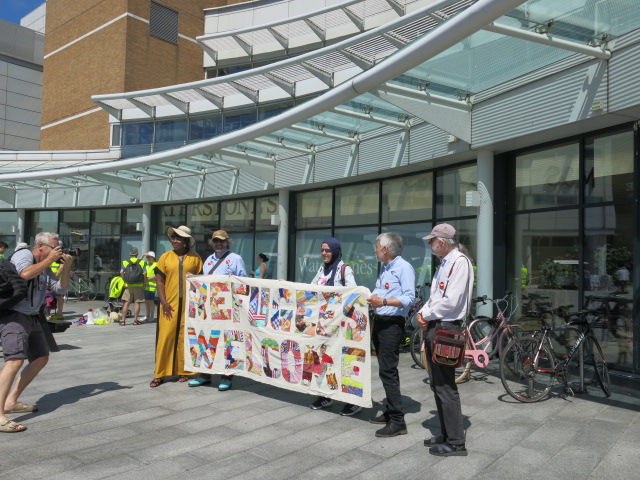
Some members of the Salisbury Amnesty group went over to join the march in Southampton held in support of refugees. It goes without saying that refugees are getting a terrible press at present with tabloid fury at the boat crossings showing no signs of abating. Politicians are in full cry and new legislation is promised to make asylum even harder. Plans to send them to Rwanda are still in place and there is a section of the Conservative Party which would be happy for the UK to withdraw from the European Court to achieve this. In a previous post we drew attention to some of the inconsistencies in the attitudes towards refugees and asylum seekers. We were sad not to meet colleagues from the Soton group.

Pics: Salisbury Amnesty

Refugee report – June


Refugees continue to generate considerable political tension in the UK

June 2023

We are pleased present our monthly refugee report thanks to group member Andrew for preparing it. Refugees, immigration and the boat people continue to generate a considerable degree of political and media heat in the country.

The latest immigration figures for 2022 give a total of 606,000 arrivals, but most of these are legal, and mainly students. There were 7,000 applications for asylum (by 91,000 people). In the first quarter this year 3,793 applications were received, compared to 4,548 last year. It is worth noting that the numbers are higher in France, Germany and Spain. Arrivals in the UK amount to just 7% of the European total.

Arrivals to the UK are just 7% of the European total

20,000 claimants were in detention in March, 20% fewer than last year, but the average period of detention was longer.

Few forced returns based on asylum claims have taken place, the majority of them being to Albania, where the new agreement has resulted in 90% of arrivals from Albania being returned there.

The Illegal Migration Bill is this week in committee stage in the House of Lords, and a vast number of amendments are being debated. The largest bone of contention currently is the lack of an economic impact assessment of the measures, which the government has said it will produce “in due course”. The BBC has claimed that the cost of the new rules will be up to £6 billion over the next two years. The Refugee Council have more precisely reckoned it at £8.7 to 9.5 billion over 3 years. The Home Office have admitted that numbers would have to be below 10,000 for the Act to be operational. On the plus side for the Government, former senior judge Lord Sumption has argued that justification for overruling their Rwanda plan by the ECHR would be “slender.” On this point, the Sun is reporting that the Home Office think they can make their first flight to Rwanda in September if the Court of Appeal rules in their favour.

The Prime Minister, on his visit to Dover this week, claimed that his policies were working, as the number of asylum seekers arriving in small boats was down 20% this year. Others have suggested this has had more to do with the weather in the English Channel, and the fact that most crossings take place between July and September.

It is reported that the two new vessels commissioned to house asylum seekers are cruise liners. Apart from the plan for a barge to be moored at Portland, other locations are presently unknown.

The Refugee Council has been protesting this week about the size of the accommodation made available to claimants. Operation Maximise is a deliberate initiative to cram as many claimants as possible into the available accommodation. The leader of Westminster Council has said it “defies common sense and basic decency.”

The UNHCR has produced an audit of the UK asylum system and declared it to be “flawed and inefficient.”  The report particularly points to a lack of training at the Home Office, inadequate information on claimants, lack of skill in interviewing, and an inability to assess children’s ages accurately.

An article in Coda Media has drawn attention to the EU’s International Centre for Migration Policy Development, a shady body based in Vienna that has been supplying Maghreb governments with material to aid disempowering boats aiming to cross the Mediterranean.

AH

Playhouse presence


Group members present at the Playhouse this week

This week, the Playhouse is performing the Beekeeper of Aleppo and members of the Salisbury group will be present before the performance and during the interval. It will be a good opportunity for anyone interested in the group’s activities to make themselves known.

Blog at WordPress.com.

Up ↑