The UN Security Council has a chance to show that the world has not forgotten about the victims of crimes against humanity that continue to be committed in North Korea, and that those responsible will face justice
said Nicole Bjerler, Deputy Representative at Amnesty International’s UN office in New York.
This meeting should serve as a wake-up call to the North Korean authorities to put an immediate end to the systematic, widespread and grave human rights violations that persist in the country. A starting point would be for them to cooperate with the UN and let independent human rights monitors into the country.
The meeting on Thursday is a significant step forward in the UN Security Council’s commitment to address the horrific human rights situation in North Korea alongside peace and security.
“Peace and security cannot be separated from respect for human rights, accountability for perpetrators and justice for victims and their families. These issues urgently demands the Security Council’s continued attention,” said Nicole Bjerler.
International pressure on North Korea has been building since the publication of the UN Commission of Inquiry report in February 2014. The damning report documented widespread human rights violations including forced labour, deliberate starvation, executions, torture, rape, infanticide, and up to 120,000 men, women, and children detained incommunicado in North Korea’s political prison camp system – a situation described as “without parallel in the contemporary world”.
Last December, the UN General Assembly overwhelmingly passed a resolution which, among other measures, called on the UN Security Council to take appropriate action to ensure accountability, including through consideration of referral of the situation in North Korea to the International Criminal Court. The General Assembly is reiterating its call in this year’s resolution, which was adopted by the Third Committee on 19 November and is to be formally adopted in the Plenary next week.
“The UN Security Council must seize the opportunity today to tell perpetrators of crimes against humanity in North Korea that ultimately they will be held accountable,” said Nicole Bjerler.
Last week we had the debate in Parliament about bombing the Islamic State IS or Da’esh as some call it. This was occasioned by the outrage in Paris and the massacre of ordinary people in that city. Parliament voted in favour of bombing and since then we have had recriminations in the Labour party between those who voted for and those against.
It is timely therefore that a report has been published by Amnesty International called Taking Stock: the Arming of the Islamic State. All politicians should read it. As we have noted several times on this blog, one cannot but help notice that when pictures are shown of IS fighters, they are well equipped and armed to the teeth. So where do all these arms come from? The report explains where and how in great detail.
The major source is Iraq supplemented by materiel taken from the Syrian army. The Iraq weapons were supplied by the coalition forces but because they were irresponsibly guarded, it was easy for them to be stolen or looted. As the report puts it, ‘there were decades of irresponsible arms transfers to Iraq principally by Russia, France and China.’
The supply and transfer of weapons was governed by a global treaty adopted by the UN in 2013. It places international human rights law, humanitarian law and criminal law standards alongside other international benchmarks for assessing the authorisation of exports and other transfers of conventional arms.
The report documents the astonishing amount of weaponry possessed by IS (the range and types are listed at the end). Although a total of 25 countries have been identified as suppliers – including some from the former Soviet Union – it is the Security Council members P5 who are the main culprits.
The Iraq invasion cast a long shadow over the region. Arms were poured in and in the chaos, thousands of weapons were lost to the militants. The Arms Trade Treaty was designed to put a stop to irresponsible activity and it will take a long time to take effect. We noted in an earlier blog that the UK and the US continues to supply Saudi Arabia which is bombing Yemen creating fertile ground for the next wave of insurrection.
It is much to be regretted that the House of Commons would not be packed or buzzing with excitement if the question of arms supplies was being debated. Yet unless and until arms supplies are curtailed to regions such as the middle east, organisations like IS will prosper in the chaos. Bombing the result seems a little pointless.
Yes, you read that right. A Saudi by the name of Faisel Trad, who is the kingdom’s ambassador to the UN in Geneva, was elected chair of an independent panel of experts on the UN’s human rights council.
This blog – and many, many others – has highlighted the appalling human rights situation in Saudi Arabia. The big increase in the use of the death penalty, often in public, floggings including that of Raif Badawi and most recently, the proposal to crucify a man. Along with a lack of free speech, and that women are denied basic rights and cannot drive for example, means that the country ranks as among the worst in the world.
UN Watch Director Hillel Neuer said according to the Independent (20 September):
Saudi Arabia has arguably the worst record in the world when it comes to religious rights and women’s rights and continues to imprison the innocent blogger Raif Badawi.
It’s bad enough that Saudi Arabia is a member of the council, but for the UN to go and name the regime as chair of a key panel only pours salt in the wounds for dissidents languishing ins Saudi prisons.
A UN Watch representative also said “This UN appointment is like making a pyromaniac into the town fire chief”. It gives Mr Trad power over the appointments of key UN human rights representatives.
We have been engaged in correspondence with our local MP to persuade the government to do more and we await a reply to our letter to him. This was sparked by the FCO’s decision to drop the abolition of the death penalty as a specific policy.
In all the discussion about the relative merits of refugees from the various war-torn parts of the world, the Syrians are presently claiming most attention. We all understand how dreadful their plight is, and so too those fleeing wars in Iraq, Afghanistan, Libya and the Sudan. But Eritrea? Eritrea is not actually at war with anyone (well, it’s in a face-off with Ethiopia, but wouldn’t dare to take on its bigger neighbor in a full-scale war), and the regime is in total control of the country. So why the desperation of people to escape to Europe? Indeed the British government has changed its view of the country in recent months to say that it is safe for asylum seekers to be returned home. The Home Office said:
its guidance on Eritrea is based on a careful and objective assessment of the situation in Eritrea using evidence taken from a range of sources including media outlets; local, national and international organisations, including human rights organisations; and information from the Foreign and Commonwealth Office.
However they have relied largely on a Danish report, the authors of which have disowned for its misinterpretation, and Eritrean government sources, rather than the reports of human rights groups.
The UK’s position is totally confused, as they are supposedly taking account also of a recent UN report, which would also give a somewhat different picture. The report, by the UN Commission of Inquiry on Human Rights in Eritrea, cites a raft of human rights violations – some, it says, which may constitute crimes against humanity – of a ‘scope and scale seldom witnessed elsewhere’. The report strongly urges continued international protection for Eritrean refugees fleeing human rights violations, and warns against sending them back to danger in a country that punishes anyone who tries to leave without permission
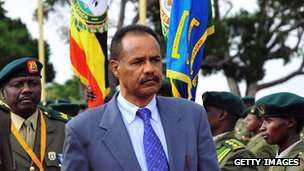
President Afeworki
Following its independence in 1991, the country has lapsed into a total disregard for the rule of law. Elections have been regularly postponed – President Isaias Afeworki has never faced the electorate – arbitrary detention is rife; torture is so common that the Commission concluded that it was government policy, and mass surveillance and neighbourhood spying is the norm. Justice is arbitrary, detention conditions are appalling, and complete disappearance not unusual. So far, so typical dictatorship but in Eritrea it is egregiously appalling.
The speciality of the state is that, under the pretext of defending the integrity of the State and ensuring national self-sufficiency, much of the population is subjected to open-ended national service, either in the army or through the civil service. When they turn 18 or even before, all Eritreans are conscripted. While national service is supposed to last 18 months, in reality conscripts end up serving for an indefinite period, up to 20 years in extreme cases. Thousands of conscripts are subjected to forced labour that effectively abuses, exploits and enslaves them for years. Women conscripts are at extreme risk of sexual violence during national service.
Many others – detainees, students, members of the militia – are also subjected to forced labour. The report says
The use of forced labour is so prevalent in Eritrea that all sectors of the economy rely on it and all Eritreans are likely to be subject to it at one point in their lives. The commission concludes that forced labour in this context is a practice similar to slavery in its effects and, as such, is prohibited under international human rights law.
The Eritrean Foreign Ministry inevitably claimed the Commission’s report contained ‘wild allegations’ which were ‘totally unfounded and devoid of all merit’ and charged the UNHRC of ‘vile slanders and false accusations’, without addressing any of the issues. The British government have since modified their stance based on Eritrean assertions that military service will be limited to 18 months to 4 years, which would render it legal, but there is no evidence of this happening.
These widespread abuses have prompted thousands of Eritreans to flee their home country in search of asylum in Europe. According to the latest estimates produced by Italian authorities, 32,000 Eritreans were rescued in 2014 as they attempted to traverse the Mediterranean – the majority of all migrants rescued by Italy’s comprehensive Mare Nostrum operation. Meanwhile, the UN refugee agency has placed the number of Eritreans under its concern outside the country at more than 357,400.
This is the country we are intending to return refugees to as being “safe”. The Government needs to think again.