The December group minutes are now available thanks to group member Lesley for preparing them. Busy meeting and we touched on forthcoming events, the death penalty report in particular.
Promoting human rights from Salisbury UK

The December group minutes are now available thanks to group member Lesley for preparing them. Busy meeting and we touched on forthcoming events, the death penalty report in particular.
Followers of this blog will know that one of the cases we have been supporting is that of Reggie Clemons who has been on death row for 19 years now. He is awaiting a hearing in January and our group sent a message of support recently. We have just received the following message from his mother Vera:
Thanking you and the group for your support. It has meant so much for Reggie. Thank you for the Christmas greeting. Reggie trial is scheduled for January. January 8th jury selection will start. Trial may start the week of the 15th. Will keep you posted. We have fought a long hard fight for Justice and thank you for being there with us in the fight.
Merry Christmas everyone!!!!!
Read our latest death penalty report
Reported in the Salisbury Journal that Reza in ‘in a really bad place’ physically and mentally. See the Journal article.
A refugee who has been living in Salisbury for 2 years was back in the news this week following his arrest in Melksham. He was scheduled to be deported back to Afghanistan, the second most dangerous country in the world according to the FCO.
Reza Magsoudi fled Afghanistan in 2004 when he was 13 and travelled alone to the UK. Early in November 2017 he was summoned to Melksham police station for the routine procedure of declaring his whereabouts in the UK, whereupon he was arrested. He was taken to Tinsley House in Gatwick from where he was due to be deported.
He was granted leave to remain in 2008 and has applied for asylum but for the most part without legal assistance. His English is said to be poor. There is now to be a judicial review. A Change.org petition has achieved 73,000 signatures.
He has been supported during his stay in Salisbury by Derri Southwood who has had considerable difficulty in making contact since his incarceration in Gatwick. BBC Wiltshire had several pieces on this topic on their morning show this week and a reporter has gained access to Tinsley House but was unable to tape an interview with him.
Issues
The case raises a number of issues concerning asylum policy in the UK and highlights the country’s poor record in offering a home to those fleeing war-torn countries. The UK does however contribute a great deal of aid to those countries who have high levels of refugees but is reluctant to help those who come here.
Part of the reason is the myth that large numbers of people are ‘flooding’ into the country. The facts do not support this myth. Countries such as Turkey, Pakistan and Jordan have a much, much higher numbers in their countries out of a world wide population of around 14 million refugees. By contrast, in quarter 2 of this year for example, there were 6,172 applications for asylum of which 65% were refused. This sort of statistic is fairly constant quarter by quarter (Source: Refugee Council). This is a tiny number of people in view of the world wide figure yet the impression created by some sections of the media is that we are somehow the principal port of call for refugees.
The UK no longer has a welcoming attitude to refugees and successive policies have sought to make it tougher and tougher to achieve leave to remain. An analysis of statistics and policy by four newspapers (Guardian; Le monde; Der Spiegel and El Pais) found that:
The analysis found that Britain takes fewer refugees, offers less generous financial support, provides housing that is often substandard, does not give asylum seekers the right to work, has been known to punish those who volunteer and routinely forces people into destitution and even homelessness when they are granted refugee status due to bureaucratic delays.
This was worse than any other country except Italy.
What is often overlooked in these debates is that the reason why there is conflict and a country riven by war is partly the result of our colonial and imperial activities in the past. Most obviously the Israeli and Palestinian conflict; the division of lands in the middle east after the fall of the Ottoman Empire following the Great War; the Yemen conflict today where we continue to sell arms to the Saudis causing enormous hardship to the people there, and our invasion of Libya which has led to instability, violence and also allowed people smugglers to prosper. So we had a major historical impact and continue to do so by supplying arms which increases the level of conflict.
Looking at the below the line comments in the Salisbury Journal article, one gets a taste of the vitriol that the whole question of refugees generates. Someone who calls him or herself ‘art91e’ says:
He has no right to be here, he serves no useful purpose, he’s illiterate after 13 years here, so he certainly did not do an apprenticeship … that is a lie! Send him home asap.
The great majority of comments were sympathetic however.
Mr Glen, the Salisbury MP, has become involved and has promised to make contact with the minister’s office and to do what he can. The problem – not unique to MPs like Mr Glen – is that the Home Office is carrying out government policy which has been supported by him. It illustrates the problem of myths in the media being left unchallenged but which have a huge influence on how people think. This drives policy and has created a harsh environment for asylum seekers. They have become a problem best solved by keeping them out in the first place and then throwing them out if at all possible if they do make it here.
We await developments.
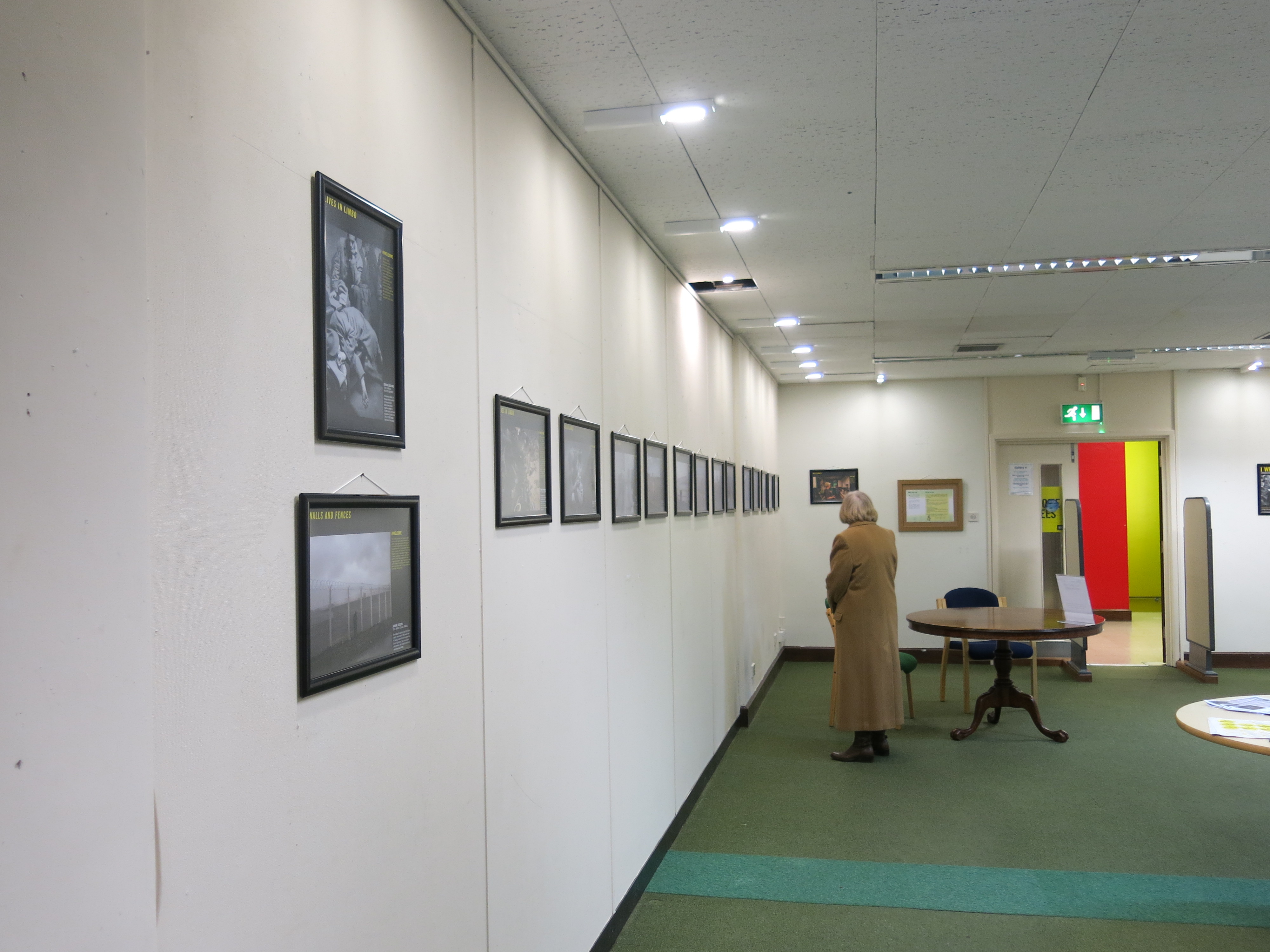
Don’t forget to visit our refugee photo exhibition in the Library which is running until the end of December. Please sign or comment in the visitor’s book if you do go. Follow us on Facebook and Twitter, Salisburyai.
We shall be card signing in the Library passage on Saturday morning 16th between 10 and noon.

The monthly death penalty report is now available thanks to group member Lesley for her hard work on this. Discusses USA; India; Egypt among other countries. China remains the world’s largest executioner of its own citizens but information is regarded as a state secret.

An Amnesty International report alleges that EU governments are knowingly complicit in the torture and abuse of refugees and asylum seekers in Libya. The cause of the problem seems to be the payment of funds to authorities who are working with local militias and people smugglers.
The situation in Libya is chaotic as an Amnesty report describes. There is widespread lawlessness and the country is deeply divided. We may return to this story as it unfolds. Amnesty say they have enough evidence to take governments to court.
Sources: Euronews; BBC; Guardian
Card signing this Saturday in the market. Don’t forget to visit the refugee exhibition in the Library running during December.
Monthly meeting takes place this Thursday 14th at Attwood Road Salisbury starting at 7:30 and all supporters are welcome.

 The ‘I Welcome’ exhibition is now open in the Salisbury Library and will last until the end of December. It focuses on the plight of refugees and consists of a series of 30 powerful photographs from the Magnum agency. Refugees get a poor reception in the UK and the numbers we take in is a tiny proportion of the total. Rich countries generally take in a very small proportion. The exhibition is free and visitors are invited to make any comments in the book provided.
News this week that the government has delayed removing the European Charter of Fundamental Rights from the Brexit bill is to be welcomed. Theresa May as Home Secretary and Chris Grayling when he was Justice Secretary both pledged to do this and a commitment has been a feature of the Conservative manifesto for some time. There is a strong desire to curb the role of European law in this country and ‘bringing back our sovereignty’ was a familiar claim in the Referendum debate.
The Charter has played an important role in improving equality, privacy and children’s rights. Opposition to it is based on an exaggerated view of the degree of interference by the European court into the law of this country when in fact it has been slight.
We have argued for some time now that the government is going to have its hands full dealing with Brexit and will not want to be involved in protracted commons time trying to wrestle through this aspect of the bill. The Lords are likely to reject it anyway.

November 2017
Throughout December we will be hosting an exhibition in the Library with a display of 30 evocative panels entitled I Welcome. There are 30 panels and they represent the experience of millions of refugees, people of all ages, faiths and walks of life. The exhibition was first shown on the South Bank a year ago and attracted considerable media attention. Refugees get a bad press in the UK and there is considerable hostility to them coming here. Some of this hostility is whipped up by the media.

It will be on display upstairs (a lift is available) and is free. All the photographs are by Magnum photographers.
The Library is open:
Monday: 10 – 7pm
Tuesday/Friday: 9 – 7pm
Wednesday/Thursday/Saturday: 9 – 5pm
The exhibition is FREE

November 2017
The publication of the Paradise Papers which have revealed yet more insights and names of those engaged in the murky world of massive tax avoidance, has so far stayed clear of discussing the human rights angle to this activity. A letter in today’s Guardian newspaper, written jointly by Helena Kennedy and Hans Corel, draws attention to this particular aspect. The huge outflow of resources from the developing world means governments are starved of the resources to tackle poverty, improve their health and education systems and to upgrade infrastructure generally. A staggering $859bn was lost in 2010 and the cumulative loss between 2001 and 2010 amounted to $5.86trn *. It often comes a surprise to people when it is pointed out for example that Africa, taken as a whole, is a net creditor to the rest of the world. This is a combination of corruption, resource extraction and tax avoidance. So while aid is paid into the country, more money flows out because of tax avoidance and criminal activity.
 The Paradise Papers follows on from other leaks including the Panama Papers, Lux leaks and others which exposes the scale of the perfectly legal tax avoidance industry and names some of those involved. These have included the Queen’s Duchy of Lancaster estate, Prince Charles and a slew of celebrities, media and sports people. Several said they did not know this was being done in their name.
The letter draws attention to a report prepared by the International Bar Association in 2013. This 262 page report examines exhaustively the nature of this activity and came before some of the recent revelations. The key question for us is the link between this activity and human rights and the report discusses this in detail since it is not entirely direct. In the report is says:
Most stakeholders tended to agree that there is an important distinction between labelling tax abuses as ‘legal violations of human rights’ versus stating that tax abuses have ‘negative impacts on human rights’. Depending on the scope and scale of the tax abuses, they might have a significant impact on human rights. As one tax authority expressed it: ‘What do we need to fulfill economic, social and cultural rights? Resources including taxes. Therefore, tax abuses are clearly a human rights issue when massive amounts are lost from State revenues.’ p96
To the extent that tax abuses have an impact on poverty and that poverty has an impact on human rights, as outlined above, it is possible to make a connection between tax abuses and human rights. Most simply put, tax abuses deprive governments of the resources required to respect, promote and fulfil human rights. More dramatic examples of human rights impacts can be imagined when you juxtapose the billions of dollars that are said to be flowing out of developing countries with the comparatively small amounts that are required to lift individuals, families and communities out of the most extreme forms of poverty. p103
In a summary on p148 they say:
Human rights have not often been part of the global debate about tax matters. However, a human rights analysis can strengthen our understanding of poverty and development, as well as reinforce our determination to confront tax abuses. In the recently adopted UN Guiding Principles on Extreme Poverty and Human Rights, the UN Special Rapporteur on Extreme Poverty and Human Rights describes how extreme poverty is connected as a cause or consequence of violations of numerous human rights, including all the key human rights principles − ranging from the right to life, the right to food, the right to health, the right to education, the right to social security and principles of non-discrimination, participation, transparency and accountability.
Simply put, tax abuses deprive governments of the resources required to provide the programmes that give effect to economic, social and cultural rights, and to create and strengthen the institutions that uphold civil and political rights. Actions of states that encourage or facilitate tax abuses, or that deliberately frustrate the efforts of other states to counter tax abuses, could constitute a violation of their international human rights obligations, particularly with respect to economic, social and cultural rights. p148 Our italics
It is important to recognise therefore that this is not a victimless activity.
The City of London is a key player in the avoidance industry and is surrounded by a worldwide network of islands which have secrecy in one form or another as part of their appeal to international corporations, rich individuals, criminals and despotic governments. These include the Isle of Man, Jersey, British Virgin Islands, and several more.
The report also devotes space to non-state actors and in particular the international corporations such as Apple, Amazon, Starbucks and several others. These are able to move funds between one jurisdiction and another employing various legal techniques such as ‘The Swiss Role’ ‘Going Dutch’ and Thinning on Top’. Apple featured most strongly in the latest revelations.
For those who would like to read the report in full it can be accessed from this link. Full report
*586 000 000 000 000 US dollars

 Amnesty in Salisbury & South Wiltshire