We have described the events in Yemen and the role of the UK in selling arms to the Saudis who are using them to bomb civilian targets in that country. We have been assured that the UK has a strict policy when it comes to selling arms which does not in fact seem to work. The most recent activity by our government is to block and enquiry by the European Union into allegations of war crimes in Yemen.
The UN’s Human Rights Council based in Geneva was hoping to carry out a proper enquiry but this was stymied by the UK. Only today, Boris Johnson condemned the Russians for war crimes in Syria alleging that civilians were being targeted. There seems little difference to what the Russians are alleged to be doing and what we are doing by selling arms to the Saudis who then use them to bomb civilian targets, hospitals and schools.
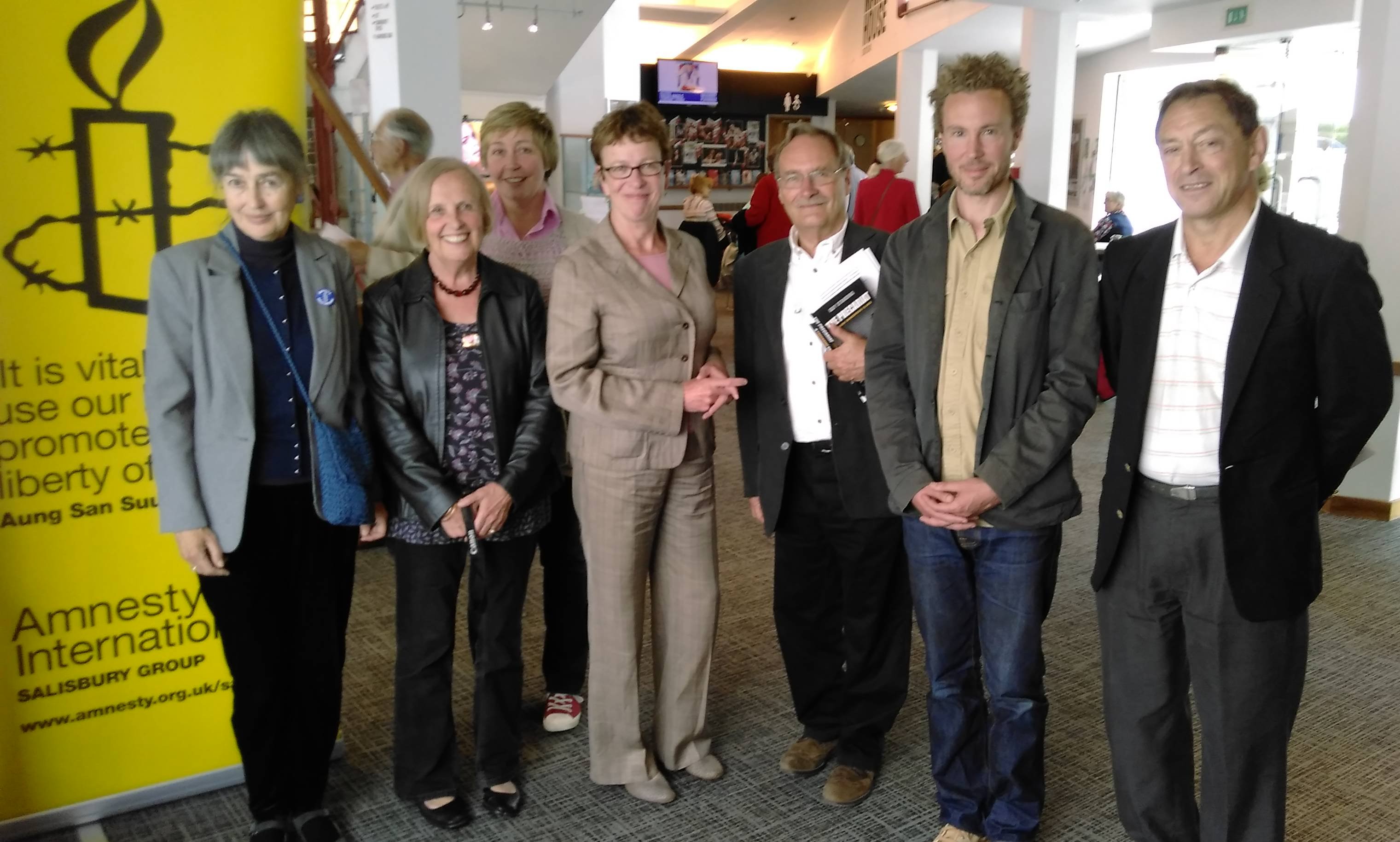
Amnesty protest against arms sales to Yemen
The policy has been condemned by Human Rights Watch and by the Campaign Against the Arms Trade.
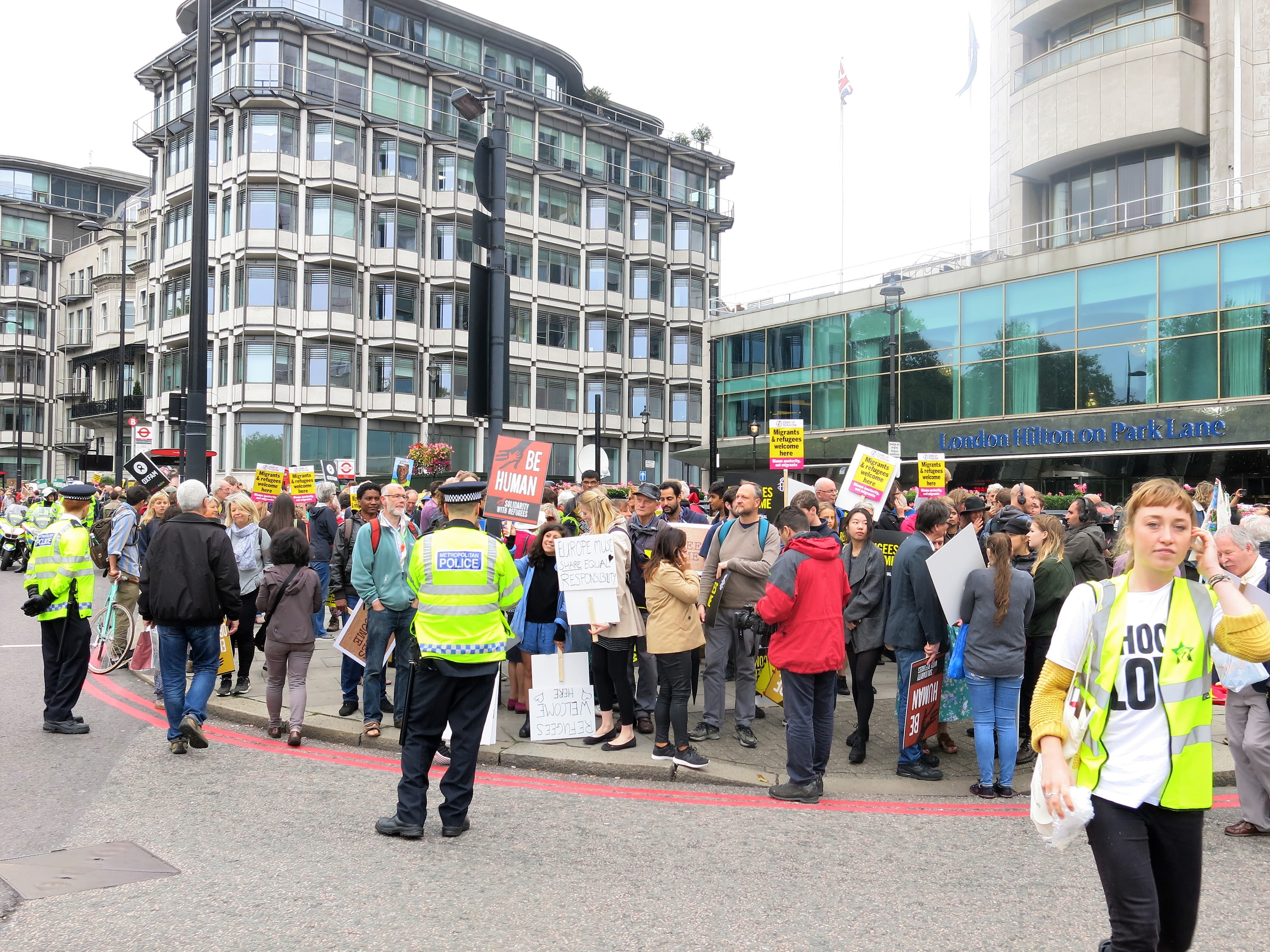
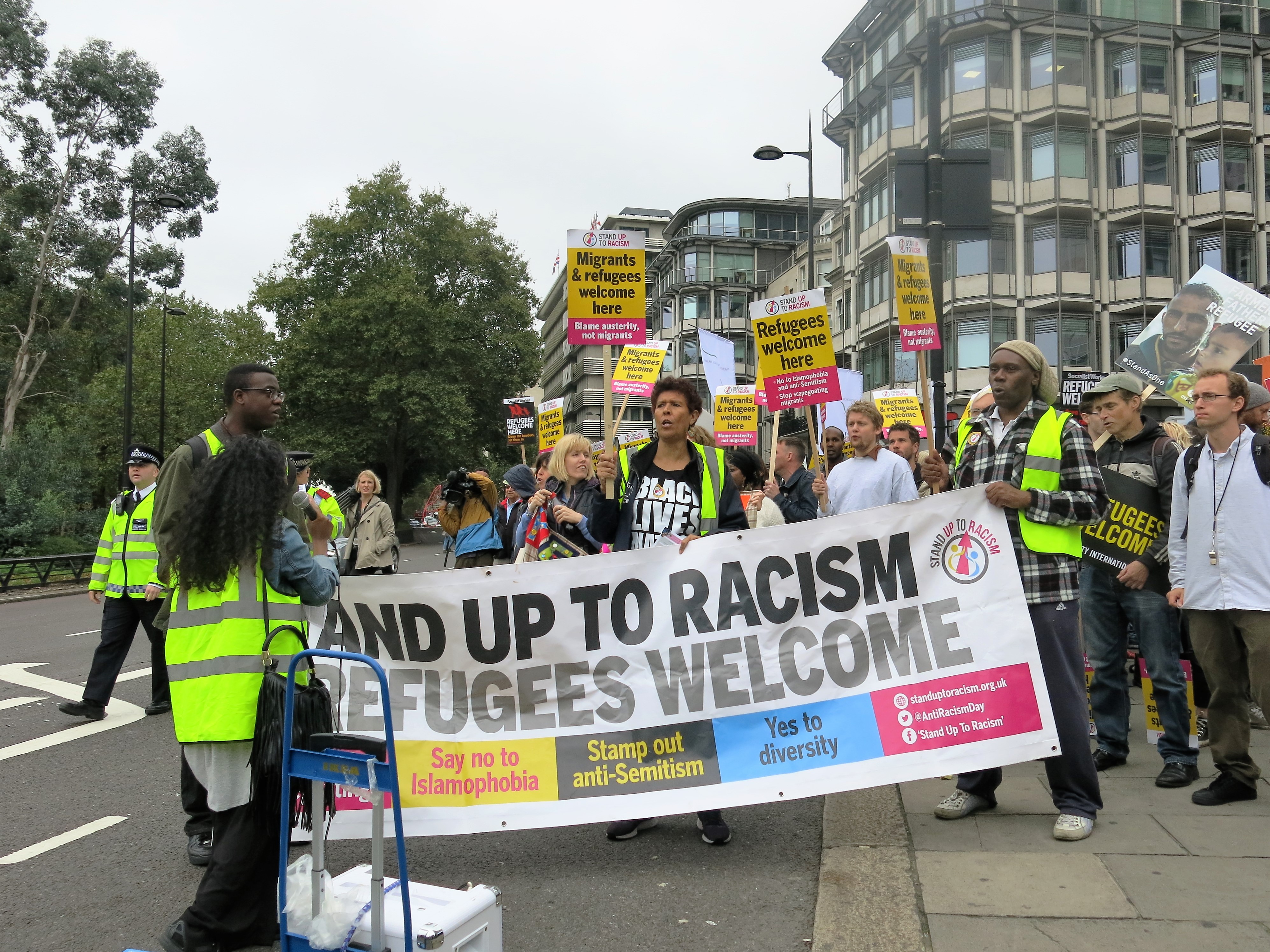
The march in aid of refugees was attended by at least 15,000 yesterday and was good natured and uplifting. It started in Pall Mall, London, and wove its way along Piccadilly ending up in Parliament square. It is encouraging in the current climate to see so many people travel from as far afield as the Wirral and Penzance to show their solidarity for a better treatment of refugees. Britain’s role has been exceptionally poor largely because of hostility towards them egged on by a xenophobic press.
Three year report on the group’s activities is published
The three year report, prepared by our chair, is published and shows what we have achieved over this time. It is always interesting to look back and review progress and for a small group, we have done a lot in the last 3 years.
The death penalty report is now available thanks to group member Lesley for the work in putting it together. The report covers several countries but it must always be remembered that China leads the world in executing its citizens.
The march was a huge success and was attended by at least 15, 000 people. A fuller report and pictures will be posted soon.
March in London on Saturday 17 September to support refugees
Source: Wikimedia
Women, men and children around the world are fleeing war, persection and torture. They have been forced into the hands of smugglers and onto dangerous journeys across the sea in rickety old boats and dinghys. Many have lost their lives. Those who have made it often find themselves stranded in makeshift camps in train stations, ports or by the roadside.
And still, politicians across Europe fail to provide safe and legal routes for people to seek asylum.
Meanwhile, ordinary people have responded with extraordinary displays of humanity and generosity. They’ve been moved to act after seeing thousands of people drowning in the Mediterranean, the continuing misery of camps in places like Calais, and images of the brutal conflicts across the world.
We need to tell the Prime Minister Theresa May that we want to help.
The UK government must do more – let’s call on them to:
Lead the way towards a more human global response to the millions fleeing conflict
Offer safe passage to the UK for more people who have been forced to flee their homes
Do more to help refugees in the UK rebuild their lives
The march starts at 11:30 outside Green Park station and ends in Parliament Square.
On the BBC last night (6 September) there was an item concerning arms sales by Britain to Saudi Arabia. Readers of this blog will be no strangers to this item and we have been highlighting this trade for some time. The weapons are being used to bomb Yemen and targets include hospitals, schools and even wedding parties. British service personnel are involved in the command centre doing what is not entirely clear.
At last the Commons Committee on Arms Export Controls is asking questions and a leak of their report said:
The weight of evidence of violations of international humanitarian law by the Saudi-led coalition in Yemen is now so great that it is very difficult to continue to support Saudi Arabia while maintaining the credibility of our arms licensing regime
Oxfam is among the agencies who have been critical of this trade and the results in Yemen. At least 4,000 have died, many have had to flee their homes and among the dead are women and children. Oxfam said:
The UK government is in denial and disarray over its arms sales to the Saudi-led coalition bombing campaign in Yemen. It has misled its own parliament about its oversight of arms sales and its international credibility is in jeopardy as it commits to action on paper but does the opposite in reality
Even now, the Foreign Office continues to defend the sales and Boris Johnson has reportedly defended the Saudis saying:
They have the best insight into its own procedures and will be able to conduct the most thorough and conclusive investigation
Will be able to but will they?
Of course this is linked to the powerful lobbying by the arms firms themselves and countries like Saudi (who have a representative Adel al-Jubeir here to try and persuade the Committee not to recommend banning arms sales). The current version of Private Eye (1246) has a lengthy report on what is called the ‘revolving door,’ that is the huge numbers of senior civil servants, ex-ministers and senior military people who move from their posts into companies and firms linked to their previous roles. It makes the point that sound government is eroded if ministers and other senior people are hoping to hop into a lucrative directorship or consultancy once they leave government or the services. In a four page report it lists the shear numbers moving out of government or the services into commercial posts usually linked to their previous roles. How likely are they to stop sales to Saudi if it could jeopardise their post ministerial employment?
The Committee meets today so it will be interesting to hear what they decide.
Liz Truss announces that the British Bill of Rights is back on the agenda
The new Lord Chancellor, Liz Truss, said in an interview that the abolition of the Human rights Act and its replacement with the British Bill of Rights is back on the agenda. On the 10 August, The Times had suggested that it was not going forward. As we speculated on this blog a while ago, the sheer amount of work needed to negotiate new trade agreements with the world and our exit from the EU, is going to consume parliamentary effort and ministerial time on an enormous scale. Will they have time and energy to spend time haggling with the Lords over a new bill with all the rest that is going on? Then there are the complex relations with Scotland and Northern Ireland to consider. This pledge has been around for 10 years now yet Liz Truss gives no timetable.
We are committed to [abolishing the Human Rights Act]. It is a manifesto pledge. We are looking very closely at the details but we have a manifesto pledge to deliver that Liz Truss
Liz Truss – picture gov.uk
The result will at best be a modest change in the law unless we are going to withdraw from the European Court itself. This will have widespread effects especially in eastern Europe where the Court’s activities has had a positive effect on human rights.
The shame of it is that the public anger about the ‘terrorist’s charter’ and other nonsenses are fostered by the media and few of our MPs and Ministers seem to have the courage to stand up to them. The Daily Mail, the Sun and the Daily Express are often loud in their criticisms but connection to actual facts is often weak. But even periodicals like the Spectator – a venerable political weekly – is not above publishing tendentious material. The hostility to the act is in part we argue, due to the privacy clauses which give some protection to those who have suffered press intrusion for no good reason other than boosting newspaper sales.
Abu Qatada is frequently produced as evidence that the act doesn’t work and meant, allegedly, that we were not able to deport him. Firstly, if he was such a terrible man, why was he not arrested and prosecuted here? Secondly, the failure of the Home Office and the then Home Secretary Theresa May to deport him was not the HRA but treaties we have which prevent us returning people to countries where torture is routine (as well as the HRA). Qatada would not have had a fair trial in Jordan because, at the time torture, was common there.
We often read that duties and responsibilities are to be added as there are many – not just on the Conservative back benches – who are unhappy with ‘rights’ and feel that such rights should only be available to those who act responsibility. How this would work is not explained. Who’s to judge what ‘responsible’ means? A police officer at the time of arrest feels that the person behaved irresponsibly and therefore decides not to allow the person access to a lawyer – a provision in the HRA? Some rights are absolute and do not depend on good behaviour. Other rights are qualified anyway.
It is hard not to see a parallel with the Brexit debate. Years were spend denigrating the EU and then when it mattered, those like the previous prime minister, David Cameron, wanted to persuade country to Remain, he lacked conviction. He was hoist by his own petard, or more colloquially, ‘stuffed’.
A concerted campaign has been waged by the media against the act and stories produced which only occasionally have any relation to the truth. We have suggested before to refer to Rights Info to get the background and a sober assessment of some of the fictions.
Whether the BBoR ever sees the light of day remains to be seen. It is likely that this is a rash statement by the new Lord Chancellor which may quietly drift into the background when the difficulties and disadvantages are explained. But it will continue to lurk until a sufficient number of MPs – like those in the Runnymede group – stand up and speak positively about the act and the benefits it has brought to thousands of ordinary citizens who have used it to secure basic rights, stories that rarely find their way into print.
Salisbury MP, John Glen is among those who have publicly called for the act to be abolished.
Full page articlein the Observer newspaper on the subject of arms sales to Yemen.
In many previous posts we have drawn attention to the war in Yemen which receives far less coverage than events in Syria. In particular, we have drawn attention to the role of the UK government in supporting the Saudis with weapons, political cover and providing – quite shamefully – British service personnel to advise them on the military activities. We wrote last year to our local MP John Glen who replied with a bland letter from a Foreign Office minister, Tobias Ellwood which began to unwind in the following weeks.
We have also highlighted the role of British arms suppliers and the many billions of pounds of weaponry which has gone to the Saudis to enable them to continue the bombing campaign in Yemen. Bombing has been indiscriminate and hospitals; mosques; weddings and schools have been targeted.
The FCO has now admitted that its responses have been less than honest in a statement slipped out on the last day of parliament. The claim that human rights law was not being breached is now no longer claimed only that they were not being assessed.
Picture: Middle East online
So our involvement in the Yemen conflict has been shameful in the extreme and the fact that Britain is profiting from it as well only makes matters worse. The government has been lucky in the world has been distracted by Syria and Yemen only appears in the news now and again with little sign of media traction.
A leader article in the Guardian on 18 August, set out again many of the points it and others have been making over the last year or so. It points out that we have licensed £3.3bn (yes that’s BILLION) of weapon sales to Saudi over the past year alone according to the Campaign Against the Arms Trade. The cost to the Yemenis has been immense with 6,500 dead and 2.5 million displaced. Save the Children point out that one in three of under-fives suffers malnutrition. The World Bank; UN and EU agencies estimate £14bn of damage to the economy. And so on and so on. We and the US are the main culprits in terms of support and arms sales yet there is no sign of an end to the conflict. The Saudis are apparently pretty hopeless in their bombing activities despite the help they get from our service personnel.
But – there is a glimmer of good news with CAAT winning the right to a judicial review of arms sales to Saudi Arabia. The government has resisted this naturally enough but CAAT has won through.
The UK government – with the USA – has helped support terrible humanitarian and economic damage on this country. It has behaved less than honestly. When and if the conflict ends there will be need to carry out massive reconstruction. Once again we have been involved in destabilising a country with little thought to the aftermath. Parliamentary scrutiny has been lamentable.
It is alleged that this is a commercial arrangement between the two organisations which somehow omits any mention of human rights. The College of Policing’s site is full of stuff about ethics and integrity and says:
We are committed to ensuring that the Code of Ethics is not simply another piece of paper, poster or laminate, but is at the heart of every policy, procedure, decision and action in policing.
The code itself is 23 pages long. The College has earned £8.5m from its international word since its formation in 2012. The Home Affairs Select Committee has criticised the College for its ‘opaque’ affairs and it has taken a leak to enable us to see some of the details of what was agreed.
At one level there is an argument that encouraging police officers to work in the country to raise standards is perfectly acceptable. If by a combination of training and encouragement they are able over time to reduce the incidence of poor treatment, people denied lawyers and all the other things the Bahrain government is accused of, so much the better. This is indeed the Foreign Office’s line. However, there is much to improve – in the words of Human Rights Watch:
Bahrain’s human rights climate remains highly problematic. The country’s courts convict and imprison peaceful dissenters and have failed to hold officials accountable for torture and other serious rights violations. There is evidence that the security forces continue to use disproportionate force to quell unrest. Human rights activists and members of the political opposition face arrest and prosecution and dozens have been stripped of their citizenship. Bahrain restricts freedom of speech, and has jailed and fined Bahraini photographers. Migrant workers in Bahrain endure serious abuses such as unpaid wages, passport confiscation, unsafe housing, excessive work hours, physical abuse and forced labor.
If on the other hand, the College is helping the security services in their various activities (with surveiilance and intercept techniques for example) then this is not an appropriate thing for them to do. Their legitimacy has also been queried as they are set up as a company limited by guarantee. DPG Law has queried whether the Home Office can outsource this kind of activity anyway. Certainly, the trend recently by the UK government is to encourage business activities and to play down human rights concerns as it may offend countries which regularly violate them. The absence of a human rights clause or statement in the contract is in line with this commercial approach.
NGO’s today sent an open letter to Boris Johnson, Secretary of State for Foreign and Commonwealth Affairs, raising urgent concerns over the poor human rights record of Bahrain’s ambassador to the UK, and asking him to raise their concerns.
[They point out that] The ambassador, Sheikh Fawaz bin Mohammad Al Khalifa, is a member of the Bahraini royal family and formerly the president of the Information Affairs Authority (IAA), the state’s media regulator and home of state media channels and websites, including Bahrain TV and the Bahrain News Agency.
This is a country where violence against peaceful protest, torture and other forms of mistreatment is the norm. It appears a British agency is assisting the Bahrainis in their activities rather than seeking to help them reform since the human rights situation there is getting worse rather than better. Even though the activity was commenced when our current Prime Minister Theresa May was the Home Secretary, let us hope that with the new broom in place, this dubious contract is ended.