Snoopers’ charter now in prospect with increased #surveillance for all


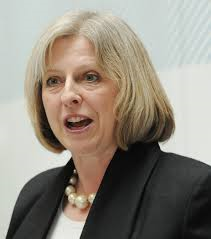
Teresa May, Home Secretary

The government announced its fifth attempt to introduce the snooper’s charter in the Queen’s Speech a few weeks ago.  Called the Investigatory Powers Bill, it looks to be more wide ranging than was previously expected.  Most people seem to be quite relaxed about this.  There few signs of a grass roots campaign taking place and there do not seem to many letters to national papers on the subject.

In conversation people will say things like ‘if they want to listen in to me chatting to a friend they are welcome’ and ‘I’ve got nothing to hide’ is a popular refrain or they accept that it is a price we have to pay for increased surveillance of terrorist threats.  Some do not believe it possible with the millions, nay billions of emails; phone calls; Skype sessions; tweets and so forth, that it would ever be possible for the security services to do this, perhaps not understanding that it is metadata they are after.

There are few who would disagree with the need for our security services to look out for possible terrorist threats or indeed other major crime activities such as people or drug smuggling.  The justification by ministers for the need for increased surveillance has been based on the fear of terrorist activity especially after the terrible outrage on 7/7 almost 10 years ago.

At the heart of the debate is the issue of trust.  We cannot know much of what the security services do for fairly obvious reasons and this means the notion of transparency does not have much relevance.  We want to trust however that the intelligence services do the right thing to protect us.  We want to trust them to be concerned with terrorists and serious crime.  We would like to be reassured that someone is in overall control who is able to ask the relevant questions.  It is here that there is a problem: namely if you ask people ‘do you trust politicians?’ you are likely to receive a dusty answer.  The sweeping powers demanded by ministers and in turn the intelligence agencies, gives them considerably increased powers to pry into our lives.  The powers are sweeping in nature and in effect treat everyone as a suspect.

The report by David Anderson QC published this month is entitled ‘A Question of Trust’ tackles this issue head on.  There have been a succession of scandals over the years which mean trust in politicians and those at the top of our society is extremely low.  The Leveson enquiry revealed an unholy alliance between senior Metropolitan Police officers and sections of the media.  Anderson proposes that oversight shall not be by politicians but by senior judges.  Many would agree with this.

No one shall be subjected to arbitrary interference with his privacy, family, home or correspondence.  UN Declaration of Human Rights

The whole issue of trust emerged on 15 June with the results of the investigatory powers tribunal into
GCHQ
GCHQ

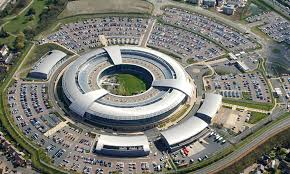
GCHQ.  It emerged that this agency has been covertly monitoring two human rights organisations, one in South Africa and one in Egypt.  The case was brought by Privacy International, Amnesty International, the American Civil Liberties Union and Liberty.  It made ‘no determination’ on whether GCHQ intercepted these latter organisations illegally.  It is left open therefore whether they (we) are being monitored and their messages being intercepted.

So while ministers talk of terrorist threats to gain support for ever widening intrusion, their agencies intercept and monitor journalists, whistleblowers, human rights groups and defence lawyers in what has been termed a ‘scandalous misuse of terrorism legislation’*.  Sir Tim Berners-Lee has observed that ‘the UK has lost the high moral ground and is doing things even the NSA weren’t’.  We need to be extremely concerned at the government’s proposals.

Sources:

Liberty; Amnesty International; The Spectator*; The Guardian

Kate Allen of #Amnesty International at the Sixth Form Conference in #Salisbury


June 15 007

Kate Allen, Director of Amnesty International with David Davis MP, Peter Oborne the journalist, and Ed Probert of the Cathedral posing for a photo during the sixth form conference which took place at the Cathedral on 15 June.

Attendance was good with several hundred 6th formers from the local schools who listened to the speakers and then asked questions.

Kate also took part in another event in the Playhouse in which she was joined by Prof Guy Standing, author of The Precariat and A Precariat Charter and Ben Rawlence writer and researcher and author of Radio Congo.  Ben used to be a country representative with Human Rights Watch.

The event was called Magna Carta Now and was looking at the relevance of the Magna Carta in today’s world especially as it was the 800th anniversary of its sealing.  Edward Fox the actor read out sections of the charter and the panel debated their significance and relevance today.  Local member, Peter Curbishley was in the chair.  Around 140 people attended.

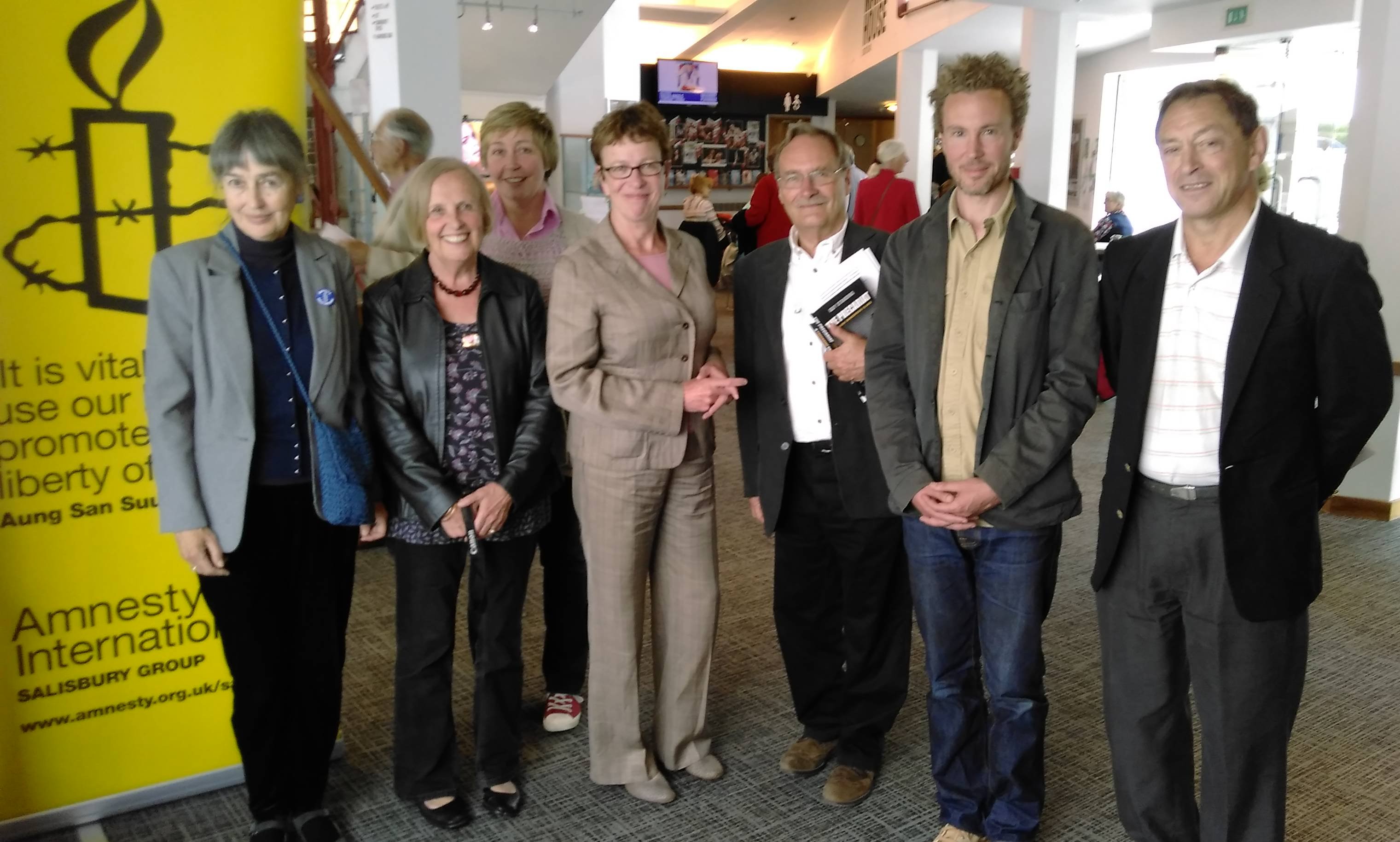
Playhouse event. L to R: Group members Fiona, Karen, Lesley, Kate Allen, Peter Curbishley, Ben Rawlence and Prof Guy Standing. Photo: Paul Donovan
Playhouse event.

Raif Badawi is still in peril in SaudiArabia as sentence is renewed. #backlash


UPDATE: 11 June  Sentence upheld and flogging could start tomorrow (Friday 12th)

The blogger Raif Badawi’s life is still in peril after the court in Saudi Arabia upheld the sentence of 1000 saudi flogginglashes.  This case has received enormous publicity worldwide with calls for Raif to be pardoned and released.  There is now a suggestion that he may face a retrial with the possible sentence of being executed.

This case brings into focus the role of the British government and arms sales to the Saudis.  The Coalition government authorised £3.8bn in arms sales (Source: Campaign Against the Arms Trade) and previous governments have done the same.  These arms are now being used in the Yemen where the latest death toll estimate has passed 2 000.  CAAT say the human rights situation is ‘dire’ and Amnesty International has described in many reports the high rate of executions, routine torture and ill-treatment of prisoners and discrimination which is rife.

When the Badawi case came into the limelight earlier this year the British government was stirred into some kind of action.  The Deputy crown prince Muhammad bin Nayef had dinner with the Foreign Secretary, Philip Hammond and met the Defence Secretary, Michael Fallon on his visit here in February.  Prince Charles was said to have raised the case with the Saudi Royal family on his visit to the country.  The British Ambassador was quoted as saying that ‘Royal to Royal links have a particular value…  These kinds of visits are capable of having a significant value.’

The government has long taken the approach that discrete and ‘behind the scenes’ contacts are better than what they might term mega-phone diplomacy.

The problem is that absolutely nothing has changed

It is interesting to contrast our government’s quietly, quietly approach – which is clearly ineffective – with Sweden which has cancelled its arms treaties with Saudi.  They were worth £900m which compared to its size is worth more than Britain’s.  France has a high level of sales to Saudi yet Francois Hollande felt able to speak out in public about their human rights record.

It is clear that the Saudi government is deaf to all approaches either from our ministers or from the Royal family.  It is very hard to pursue an ethical foreign policy when what underpins everything is the sale of arms.

The local group has written to our local MP John Glen to ask him to lobby for a more vigorous response to the Saudis and we await his reply.

#Deathpenalty report for June


No to the death penaltyAttached is the #Deathpenalty report for June prepared for the group by Lesley.  It reports on the increasing tide of executions in #Pakistan.  We note again that China doesn’t feature because, although they lead the world in the number of executions, it is a state secret.

Death penalty report

NB: the date given in the report for the World Day Against the Death Penalty should be 10th not 11th October.

Magna Carta Now – panel discusssion with readings by Edward Fox OBE


A PANEL DISCUSSION WITH READINGS BY EDWARD FOX, OBE

MAIN HOUSE

Monday 15 June at 2pm

MAGNA CARTA

Magna Carta’s importance meant that it was traditionally read out at the opening sessions of Parliament and in English cathedrals. This panel discussion about its relevance today will include Kate Allen, Director of Amnesty International UK, Professor Guy Standing, author of The Precariat: The Dangerous New Class and Ben Rawlence, formerly of Human Rights Watch. Excerpts from the charter will be read by one of our most celebrated actors, Edward Fox OBE.

Chaired by Peter Curbishley.

Presented in partnership with the Playhouse and Amnesty International.  Tickets from Salisbury Playhouse http://www.salisburyplayhouse.com or 01722 320333

Success for Amnesty campaigning in Nigeria


Moses Akatugba
Moses Akatugba

Success for local group

The Salisbury group, along with other groups around the world, has been campaigning on behalf of Moses Akatugba in Nigeria.  He was accused of stealing three mobile phones and then subjected to torture and sentenced to death.  Regrettably, torture has become endemic in Nigeria and police stations even appoint ‘torture officers’ to carry it out.

We have held many signings in Salisbury and a large number of cards were sent off to the Nigerian authorities.  We are pleased to report that this campaigning effort has been a success and he has been granted a total pardon.  Unusually, the Governor of Delta State mentioned the Amnesty campaign in his Facebook page.

Moses himself made a statement:

I am overwhelmed, I thank Amnesty International and their activists for the great support that made me a conqueror in this situation.  Amnesty International and activists are my heroes.

I want to assure them that this great effort they have shown to me will not be in vain by the special grace of God I will live up to their expectation.

I promise to be a human rights activist, to fight for others.  I am thanking the Governor for his kind gesture and for keeping to his words.

Further details of our campaign can be read on the fact sheet below;

Nigeria fact sheet

Deathpenalty report for May now available


No to the death penaltyThe monthly death penalty report is available here thanks to Lesley for compiling it.  A great deal of interest in the subject in the past month especially the executions in Indonesia.  The use of hair evidence by the FBI in America – which has led to a number of people being executed or dying on death row – has now been discredited.  Another interesting development is the criticism by the French President Francois Hollande of the use of the death penalty in Saudi Arabia.  Like the UK, France has big arms sales contracts with the kingdom but unlike the UK, feels free to criticise them for their barbaric public beheadings.  The Willie Manning case is also featured.

May death penalty report

Repeal of the Human Rights Act HRA and a new Communication Bill both put pressure on human rights in the UK


Great was the joy among those who want to see an end to the ‘hated’ Human Rights Act when it was announced that Michael Gove is the new Justice Secretary and Theresa May – no longer hampered by Lib Dems – will be able to introduce a new Communication Bill commonly called the ‘snoopers’ charter’.

Details will be in the Queen’s Speech at the end of the month and the act might be gone by Christmas.  We look forward to seeing the British Bill of Rights when it is finally published and there is press comment that it has gone through eight drafts in an attempt to sort out the complexities.

There will be many who will be delighted by these moves such has been the press campaign waged against it.  We have noted in a previous blog that a web site called Rights Info has been launched to try and counter the avalanche of negative reporting.  As the debate goes by it would be worthwhile catching up with this site which seeks to set out the true story in each case.  Few will read it unfortunately.  The case of Abu Qatada has become to epitomise the (alleged) failings of the act and the fact that Jordan used torture was conveniently overlooked.

In common with almost any act of parliament you care to mention, the Human Rights Act is capable of improvement or reform and few would argue with that.  For years the problem was individuals who had a problem had to make their way to Strasbourg to seek justice.  The HRA was passed with a lot of cross party support to enable these sorts of cases to be heard in the UK.  Such has been the hysteria and miss-reporting that a calm look at the act does not seem to be possible and in any event the die has now been cast.  The benefits that many ordinary people derive from the act rarely get a mention.

We shall follow events with interest.

UPDATE: 16 May Message from Kate Allen

Over the last few months we have been calling on all our political leaders to keep the Human Rights Act. Tens of thousands of you have taken action, held hustings, and discussed human right issues directly with your prospective parliamentary candidates. 
With the election results now in it is likely that the Human Rights Act is will be under threat like never before.

Over the next few days and weeks we will be carefully analysing the results and planning our next steps. Together we face a huge challenge and you have a vital role to play in the next phase of our campaign if we are to be successful. We will be in touch with more information about the campaign and how you can get involved soon.

Thank you,

Kate Allen
Director, Amnesty International UK 

Magna Carta event at the #playhouse with #EdwardFox reading


Playhouse event

UPDATE: Piece in the Salisbury Journal

On Monday, June 15, celebrated actor Edward Fox will read extracts from Magna Carta at Salisbury Playhouse as part of a panel discussion investigating the relevance of the historic document today.

We are pleased to announce an event at Salisbury Playhouse called Magna Carta Now on 15 June at

Edward Fox
Edward Fox

2pm.  It will involve Edward Fox OBE who will read parts of the Magna Carta and there will be a panel discussion on the relevance of these readings in the politics today.

The event is particularly relevant in view of the announcement by the new government of their plans to scrap the Human Rights Act (or the ‘hated’ Human Rights Act as some would say), details of which are expected in the forthcoming Queen’s Speech on 27th.  We have waited several years now for the promised British Bill of Rights which we understand from press comment has gone through at least 8 drafts but has still not been published.

The panel is a distinguished one:

  • Kate Allen, Director of Amnesty UK
  • Prof Guy Standing, author of among other writings The Precariat and A Precariat Charter
  • Ben Rawlence, from Salisbury, who has been a country representative for Human Rights Watch and is author of Radio Congo

Tickets are available from Salisbury Playhouse www.salisburyplayhouse.com (24 hours) or phone 01722 320333 or at the Playhouse itself.

We hope local Amnesty supporters and others will come along to what promises to be an interesting event.  We should add that there will be an opportunity for audience participation at the end of the event.

April minutes of the Salisbury group available


The April meeting minutes are here thanks to Karen.  They contain a lot of useful information about the death penalty and North Korea in particular.  There is a group meeting this Thursday 14th

April minutes

Display in the cloister

Blog at WordPress.com.

Up ↑