Death penalty


DEATH PENALTY SUMMARY – JUNE 2014

No to the death penaltyGeneral 

  • USA
    • Tennessee – are reported to be considering bringing back the electric chair in the light of the recent difficulties with the use of lethal injections
    • Wyoming – are reported to be considering using a firing squad
    • New Hampshire – disappointingly, the second attempt at the repeal of the death penalty was defeated in the Senate on 22nd May. The death sentence remains.
    • Missouri – a stay of execution was granted for Russell Bucklew on 22nd May following his claim that a congenital illness would probably cause additional suffering under the current regime of lethal injection
    • A report appeared on Google that the US Supreme Court has said states must look beyond an intelligence test score in borderline cases of mental disability to determine whether a death row inmate is eligible to be executed

Urgent Actions 

  • #Sudan – Meriam Ibrahim – a Christian woman has been sentenced to hang (and to a flogging) for the ‘apostasy’ of marrying a non-muslim, and for refusing to renounce her Christian faith.  An AI email UA was circulated to the DPLWG on 26th May.  Information in media on 31.5.14 that she was to be released but there are doubts as to the truth of this.  Note – Nesrine Malik expressed concern in the Guardian (4.6.14) that western media are harming Meriam’s chances of release.  Initial local opposition had been having an effect, and Government pride is an issue.  She criticised David Cameron’s approach.  Latest news – Meriam gave birth in chains. She is to be hanged in 2 years.


  • USA – Florida – Michael Duane Zak – UA 140/14 – has exhausted his ordinary court appeals and is seeking executive commutation of his death sentence of life imprisonment. Circulated to DPLWG 28.5.14 (this month’s Urgent Action)


  • #Iraq – UA 151/13 – Osama Jamal ‘Abdullah Mahdi’s files are now with the office of the President for review. If his death sentence is ratified, he could be executed at any time. Circulated to DPLWG 30.5.14


 Campaigning 

  • Hakamada Iwao – information has been received from Caroline Butler that the Devizes Group have been in contact with AI in Japan in order to send cards and messages to Hakamada. Would the Salisbury Group like to do so?


  • #Belarus – a response has now been received from SCT with contact details of Barry Hay for seeking further advice – an email was sent on 10th June. Note: 


Belarus is the last UN member state in Europe to have retained the death penalty.  In 2013 there were no reported executions, but the death penalty was reinstated this year, and to date two men are believed to have been executed. Death row prisoners receive no advance notice and are executed by a bullet through the back of the head. This month the UN Human Rights Council will be focusing on the human rights situation in Belarus – making it a particularly appropriate time for action by Amnesty.


Monthly meeting – update


The monthly meeting took place on Thursday, 12 June.

The following were discussed:

  • there was an update on the death penalty from Lesley and her report will be a separate post in a few days.  It was noted that the Devizes group were active with Hakamada Iwao who was probably the longest serving prisoner on death row but is now on release.  We are waiting advice from AIUK on the campaign in Belarus
  • an email has been received from Kenny Latunda Dada concerning North Korea and he has a speaker on that country.  This will be investigated
  • John Glen MP.  11 July has been confirmed for him to speak to the group which will be in the Methodist Church at 7:30.  It is restricted to members and supporters.  We are to let AIUK know of this event
  • Unfortunately the regional rep could not come to this meeting but is coming to the next
  • Peter said he had received no copy from anyone and was reluctant to write an entire newsletter.  It was agreed that it would wait until after 11 July
  • Magna Carta.  The group were very disappointed not to have heard from AI HQ following the contact Kate Allen had made with Robert Key.  Fiona is to write to the regional rep to complain.  Peter is to contact the manager of the MC event being organised by the cathedral.  It was unlikely that there would be any money coming from the City Council as they had awarded money to the Cathedral project
  • Cathedral service in November: Tony is to follow up
  • Film.  Omar has been agreed on as this years film.  More details in future.  To be shown on 4 December
  • The stall is on Saturday 21st!

Meeting with John Glen MP: update


The MP for Salisbury, #JohnGlen, has agreed to come and speak to the Salisbury group on Friday 11 July starting at 7:30 pm.  It will be in the Methodist Church in St Edmund’s Church Street, Salisbury.  Parking is in Salt Lane car park.

We invited Mr Glen to speak to the group following his various statements saying he wished to see the Human Rights Act abolished #HRA.  It is about this subject that we want to hear his views and for members to ask questions if they wish.

Open to members and supporters.

UPDATE

Mr Glen came on 11th and members had the opportunity to put points in favour of the HRA to him.  A fuller report will be placed here soon.

Sudan


The case of Meriam Ibrahim has shaken the world and there have been many calls for her to be released from prison.  The basic facts seem by now to be familiar although there are some differences on details depending where you look.  Over 150,000 signed Amnesty International’s petition and there has been widespread coverage including by the tabloid press in the UK.

She is to receive 100 lashes for adultery and it has to be made clear that it is not adultery as we in the west know it – that is having sexual relations with, in this case, a man not her husband – but the act of marrying a Christian.  In two years she will be executed for apostasy.  On 27 may she gave birth whilst chained to her bed in what has been described as primitive conditions.

The issue of the death penalty for apostasy seems far from clear and some experts say that the relevant hadith actually allows someone to renounce their faith without the penalty of death.  Others say differently.  Another relevant fact which did not receive that much coverage is that it was a complaint made by a relative that caused her to be arrested and tried for apostasy.

Of course Sudan sees it differently and the embassy in Washington DC claims that her real name is not Meriam Ibrahim but Abrar Elhadi Muhammad Abugadeen although it does not explain the significance of this.  What is significant in their view is that it is not a political or religious issue but a legal one.  The problem with this in an Islamic country is distinguishing the difference particularly where the president is keen to make Sudan an Islamic state.  Indeed, one commentator suggests that it is an attempt to distract people from other problems and to be able to claim he is a ‘defender of Islam.’

The media has for the most part, focused on this one woman and ignored the wider context.  An exception is Time Magazine and an article by Kimberly L Smith who argues that ‘fundamentally, the crisis in Sudan is not one of religion but a complete disregard for the dignity of life, particularly female life’ (May 16, 2014).  She goes on to describe in horrific detail the treatment of women and some men in that country because they had the wrong skin colour.  Her descriptions come from working for 10 years in the Sudan.

Once Meriam became a cause célèbre and featured on the front pages it was not long before politicians joined in and all three UK party leaders were loud in their condemnations.  By contrast, a quick look at Amnesty’s web site under, say, Saudi Arabia, reveals two recent cases which are relevant.  One is of a Filipino women sentenced – after an unfair trial with no legal representation and who cannot speak Arabic – to 18 months and 300 lashes of which 50 have already been administered (23 May).  Another is an outrageous sentence of 1,000 lashes and 10 years in prison given to a man who set up an on-line forum allegedly because it ’insulted Islam’ (7 May).  Both are prisoners of conscience.   There are pages of these but when did you hear of protests from our party leaders about any of them?

It is encouraging to see international protests and we hope for a successful result.  But in a thoughtful piece in the Guardian by a Sudanese writer, Nesrine Malik, she argues that these public interventions can be counterproductive.  There is the sensitivity she says of Sudan being an ex-colony.  She also argues that a lot of these dramatic sounding sentences are because the ‘authorities in a sudden fit of piety pass the harshest sentences, ones rarely carried out, to prove the Islamic project still exists.’  Whereas a private phone call would be made to Saudi Arabia or Bahrein, David Cameron and the other leaders chose a more public condemnation which according to Malik went down badly in Khartoum.

Condemning barbaric sentences is right but there does need to be a degree of even handedness.  There were 21 executions in Sudan last year, only slightly fewer than Saudi which are carried out in public.  Publicly condemning one country while courting another is not helpful.


Oklahoma


The botched execution this week of Clayton Lockett in #Oklahoma has shocked many people around the world.  The focus has mainly been on the time it took for him to die – 43 minutes – during which he was seen to writhe in agony and struggle against the straps of the gurney.  Towards the end, the curtains were drawn across the execution chamber and it was reported later that he had died from a ‘reported heart attack.’

The southern states of the USA have a particular devotion to the death penalty with #Texas in the lead.  The penalty has a high degree of support from sections of the public despite the lack of any evidence that it has a deterrent effect.  On the blog posts of an Oklahoma newspaper there is a selection of comments both against and for the execution.  There are many Americans who find the process barbaric and the fact that it took Lockett 43 minutes to die is especially upsetting.  But there are plenty who relish it, for example;

‘how can people feel pity for these cons?’

‘I am glad he died a slow and painful death.  I only wish he suffered more.’

‘NO SYMPATHY from me.’

‘I only hope this happens to each and every other inmate where the death sentence is carried out.’

And so on and so forth.  This is a selection and there are people who found it repugnant.  Although the particular circumstances of this man’s death has caused a storm of outrage, the fact remains that many people are being executed and in the southern states at least, it remains in rude health.  The posts show that a significant number of people relished the suffering and were not afraid of expressing this, albeit anonymously.  On another blog post we reported on the governor of Texas’s use of the penalty as a draw for people to come to his state – a kind of promotional tool.

Although slow progress is being made with abolition, it will be many years before it is removed from states like Oklahoma and Texas.  But why focus on this when the level of executions in China (a state secret but known to thousands) and Iran are at very much higher levels?  The difference is that the USA is a leading nation and sets the moral tone in all sorts of situations.  It is hard to persuade other countries in the world to stop this practice if the USA is still very publicly using it.

Amnesty is opposed to the death penalty in all circumstances.


Ursula Milner-White


On Monday 21 April 2014, Easter Monday, there was a Service of Thanksgiving at Salisbury Cathedral for the life of Ursula Milner-White who died on 12 February.  Ursula was one of the longest serving members of the local group and became a member soon after the group was founded.  She rarely missed a meeting or a campaign action 3925 and she will be sadly missed.

It is always surprising that when someone dies, you often learn more about them than when they were alive.  We discovered that Ursula had lived in India and for a long period in New Zealand where she had helped bring up two girls after their mother died.  She was a war time evacuee and spent the war years in Canada where she stayed and got her degree from McGill University.  She had a deep interest in natural life and gardens and was a keen walker.  She loved opera and music and used to attend meetings of the Recorded Music Society in Salisbury.  She was a member of the Wiltshire Wildlife Trust.

She was a committed Christian and her faith led her to long time involvement in Amnesty and prisoners of conscience.

One of our longest serving members, Michael Stokely, has written:

The monthly meeting of the local group — held on the second Thursday of the month — will no longer be quite the same without Ursula Milner-White.  Whatever the weather, and if she wasn’t on her travels, she would be present.  Bending forward, hand raised, ‘Mr Chairman …’ and some sharp, pertinent point would be made.  We shall miss her enormously.

Ursula wrote a short piece for the October newsletter last year on why she joined Amnesty and this is included here:

“I had been rather vaguely interested [in Amnesty] and then heard the story of a particular man Raoul Wallenberg.  He was a Swedish diplomat who was sent to the Nazi run government of Hungary during the war with the brief to do what he could to help the Jews there.  He did so with vigour and considerable success, so that he was thought to have saved twenty thousand lives.  Then the Russians captured Budapest and sent for him.  He went off cheerfully, saying that he wasn’t sure whether the Russians were inviting him as a guest or a prisoner, but he was never seen in freedom again.

Some people who were later released from Russian prisons witnessed seeing him there and after two years the Russians reported he had died of a heart attack which of course may or may not have been true.

His family in Sweden thought he’d been taken for his possible exchange value and were bitter about the Swedish government which apparently released Russian prisoners in Sweden without making sure that Wallenberg would be freed.  Perhaps they believed that he was already dead?

I was greatly distressed and impressed by this story.  I thought that if people had – disastrously – not protested soon enough, or hard enough, about Wallenberg, the least I could do was to try and help other people unjustly imprisoned.

So I joined Amnesty.

It is open to others to make a contribution to this page.

North Korea event


Amnesty logo
Amnesty logo

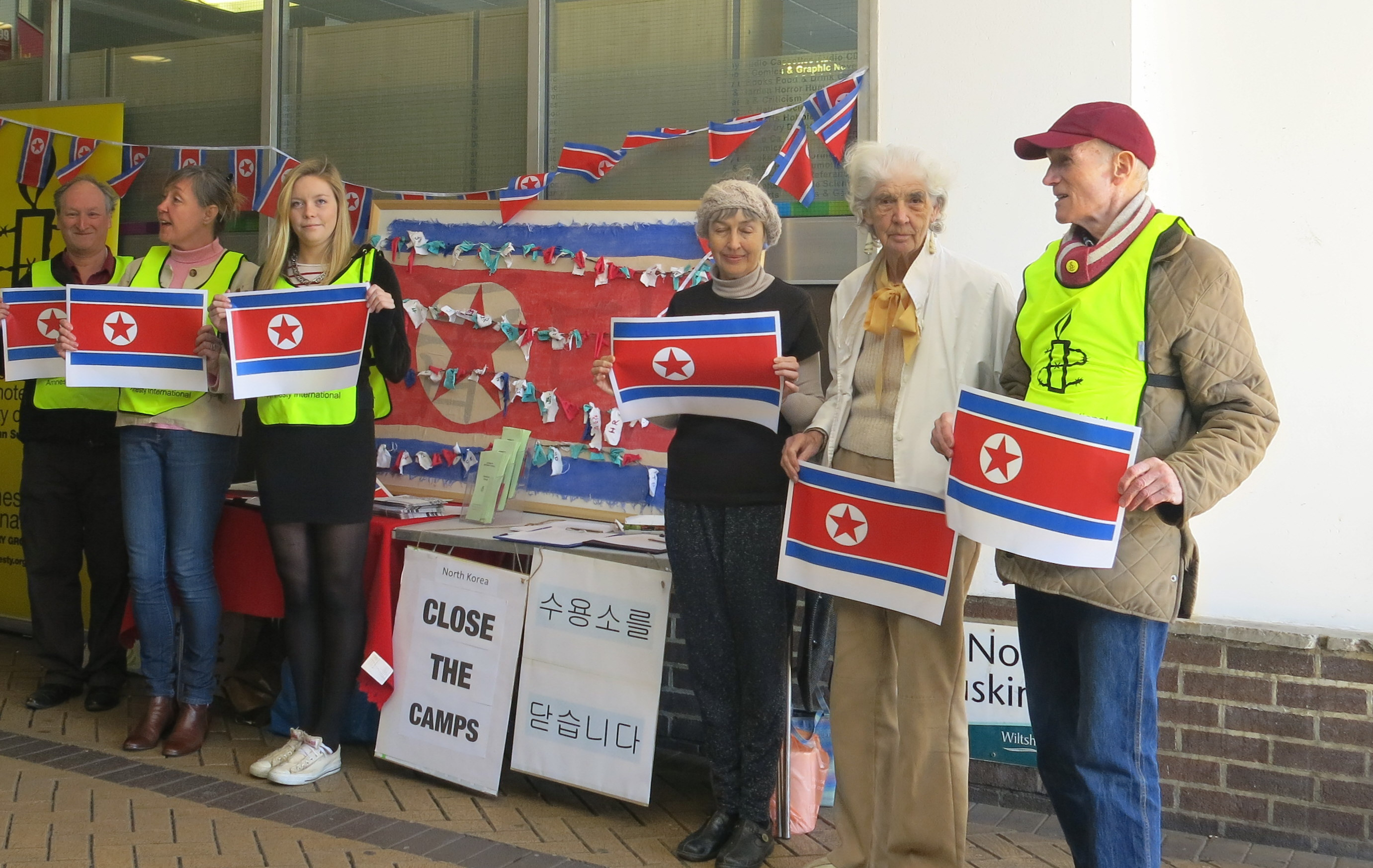
The group ran a short event in the Library passage on Tuesday 15 April 2014 to ‘celebrate’ the birthday of Kim Jong-un of North Korea.  Not really a celebration of course but to highlight the terrible situation in the camps in that country.  People are sent to them for the slightest reason and sometimes they might not know the reason.  If a member of their family is arrested, then other family members can be arrested without knowing why.

The worst of the camps are in effect a death sentence.  Some do escape but the usual route is via China who often sends them back as they do not wish to upset the status quo.

The Salisbury group wanted to highlight the situation in the camps and asked people to sign a petition which achieved 128 signatures.  There is a brief item and a photo in the Salisbury Journal – see the link below.  Thanks to Karen for leading on this. We were joined by two members of the Ringwood group and we are grateful for their help and support.

North Korea pops up in the news occasionally and a few weeks ago there was some shelling of an island in the south.  There was a story that all men in the north must have the same haircut as Kim Jong-un the current leader.  This is probably a rumour although it does appear all male students have to have one.  In any event, a hairdresser in London put up a poster with a photo of Kim Jong-un as part of a promotion campaign only to receive a visit from two sinister men from the North Korean Embassy asking them to take the picture down.  This made it onto the BBC’s Radio 4 PM programme with a rather bemused proprietor of the salon being interviewed about the visit.

Of course this is to our eyes ludicrous but it does reveal the intense paranoia and sensitivity of the country and its leader to criticism.   Many people when asked to sign a petition say it probably isn’t worth it as nothing would ever make a difference.  This suggests it might not be a total waste of time.

The Guardian newspaper is commendably taking a wider interest in the affairs of North Korea and has supplied some useful links to sites providing further information about this secretive country.

North Korea News

Peterson Institute

Choson Exchange


Group members at the North Korean signing


Salisbury Journal

Stall in the market


The #stall is to take place in the market square, Salisbury on 21 June starting early!  We need helpers and stuff to sell so if you can do either or both it would be a great help. We need clothes and small items like china and glass and pictures.  Plants are popular (labelled if possible) and cakes, pickles and jams also go well.  CDs and DVDs go well. We do not need books thanks certainly in any quantity unless they are in good condition. You can take stuff to Tony’s house in Victoria Road a week before if you cannot make the stall itself. Please price stuff if you can and go up rather than down in your estimate — we can always reduce prices at the end of the day.

Amnesty logo
Amnesty logo

Texas


It is sad to record that a Mexican, Ramiro Hernandes Llanas  has been executed in #Texas.  This is despite many misgivings about the mental capacity of Ramiro.  It is Governor Rick Perry’s 275th execution in the state which must be some kind of a record.

Most cities, towns and states promote their location as an ideal place to live.  They say how attractive it is, how well connected it is to the highway or rail network, they talk about the culture and leisure activities on offer and so on.  The governor of Texas by contrast promotes the use of the death penalty.  In an article in the New Yorker in February, following a decision by the governor of Washington, Jay Inslee, to suspend the death penalty there, Rick Perry was quoted as saying ‘vote with your feet and move to Texas, where the death penalty is thriving.’   Thriving?  In what was described as an emotional speech, he added ‘Come to Texas, the death penalty is alive and well here.’  ‘We believe in the sanctity of death.’  It is truly extraordinary to be promoting this barbaric penalty as an encouragement to move to your state.

There appear to be several reasons to explain why Texas executes more than any other state in the Union.  One is that judges are elected and accordingly have to respond to the wishes of those who elected them.  Presumably, there are many who see a benefit to executions and hence elect those who campaign for it to be used.  It is suggested that the quality of judges appointed by this method is lower than in other states as evidenced by the failure by the Texas Court of Criminal Appeals to publish most of its death penalty decisions.

A frequent problem in the cases we have asked you to write about, is the poor quality of the lawyers representing the accused many of whom do not have any relevant experience of murder trials.

Although Texas does not sentence more people to death than other states, it does execute more because it has speeded up the process from conviction to execution.

But where does this desire to use the penalty come from?  In his book The American Future, a History (Bodley Head), Simon Schama describes the violent history and founding of the state.  It essentially involved the removal of the indigent Mexican population and the introduction of slaves.  Following the near liquidation of the native Indians, then the expulsion of the Mexicans and the introduction of slavery, it is a state where there is a ‘cultural tradition of dehumanising certain groups of people’ (Ned Walpin, Frontline, Online).  This applies to all the states of the former Confederacy and accounts for the fact that 90% of all executions are carried out within them (ibid).  It is further argued that there is a link between executions and lynching, both of which go to show ‘who’s boss’ and as a means to exclude certain groups from society.  It is no coincidence that this latest appeal is for Ramiro a Mexican.  Gradually, executions replaced the illegal lynchings but served the same purpose of satisfying the predominantly white population’s desire to exclude black and Mexican people from society.

There is a lot of debate in America surrounding Rick Perry’s faith which is said to be strong and genuine.  He started life as a Methodist but has recently become an Evangelical and moved away from GW Bush’s church in Austin to support a mega church at Lake Hill.  He is in favour of teaching creationism and intelligent design and regards evolution as ‘just a theory’.

All this matters because he wants to run for president of the USA and so his attitude to execution and what that says about his political and liberal beliefs could be important.

Amnesty is opposed to the death penalty in all cases and it is unsettling to see it being promoted, not as some kind of necessary evil, but as though it is a thriving industry to be encouraged and lauded.  Poor quality advocacy, packed juries and a dismissal of proper analysis by the appeals process results in many unnecessary deaths.

Sources:

Frontline, Online; http://www.pbs.org

The American Spectator

The New Yorker

Texas April 14

Blog at WordPress.com.

Up ↑