Arrests prior to the coronation


Graham Smith, the leader of Republic, was arrested prior to the coronation and held for 16 hours

May 2023

UPDATE: 8 May: Police express ‘regret’ at the arrest of Graham Smith. No charges will be brought under the new Public Order Act against any of those arrested. The only charges brought are for drugs related offences. Questions remain concerning why the arrests were made in the first place and what, if any, pressure had been put on the police to make them.

We have been warning for some time in previous posts – along with other organisations – that the desire by the present government and Home Secretary Suella Braverman, to limit the ability of individuals and organisations to protest by passing a series of laws to limit such activity and to give the police yet more powers to carry them out. The new Public Order Act was rushed into law and signed by King Charles just days before his coronation took place.

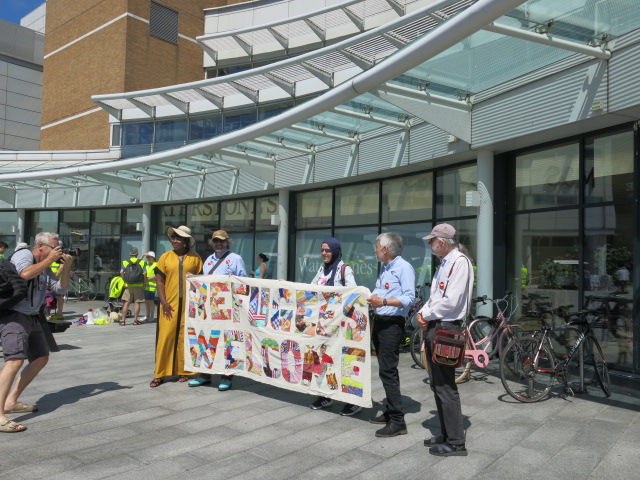
Using the act (it seems), Graham Smith the leader of Republic, an organisation which believes we should be run as a democracy and not have an inherited royal family at the head of the country, was arrested before the coronation took place. It is unclear on what the grounds the arrest was made and he was released after 16 hours. He was not the only one to be arrested and others included volunteers from Night Stars which prompted Westminster Council to say it was ‘deeply concerned’ by their arrest.

The new legislation arose because of the activities of the climate protestors who used a variety of methods to disrupt the capital including gluing themselves to pavements. Their protests did seem to shine a light on the poor performance by the government to tackle the climate emergency. They were not popular however and the disruption caused to commuters and others led the government to pass a range of laws to limit the ability to protest. The Home Secretary famously said in parliament that such people were “Guardian-reading, tofu eating, dare I say the anti-growth coalition”.

There is a tension when it comes to protesting. There are many who are in support of peaceful protests but are angry about those which are disruptive in some way or even where there is some violence. The problem with peaceful protests is that they are almost always ignored. It is the more violent type which become news and where the cause is thereby recognised. There were many decades of peaceful protests for women to have the vote for example which yielded nothing. Once more violent methods were employed by the suffragettes, change eventually occurred although there were other factors at play.

The Salisbury Amnesty group neither supports nor condemns the campaign for the country to be a Republic. The issue at stake is the right to campaign on the matter. There is no specific right of protest. We do have the right to free speech and we do have a right of assembly under articles 10 and 11 of the European Convention. Giving the police yet more powers to arrest on the pretext that the person might be disruptive is a worrying development. Another worrying development is the alleged use of facial recognition during the coronation. This technology has been widely used by repressive regimes such as China where the ability of people to move almost anywhere is tracked by the police.

Sources: Evening Standard, CNN, The Times, Amnesty International, and yes, the Guardian

Ceremony to mark Nakba


Dean of Salisbury to mark the tragic event of Nakba

May 2023

The very Reverend Nicholas Papadopulos is to address a ceremony at the Quaker Meeting House on 15th May in Salisbury to mark the tragic event of Nakba in the Middle East. Christians, Muslims and Jews will gather to mourn the event when Palestinians around the world mark the time when they were driven from their homes never to return. A report in the New Valley News says:

“Canon Jonathan Herbert, from the Hilfield Priory in Dorset, who will lead the service, said it was important to remember the Nakba. Three quarters of the population of Palestine left their homes during the fighting when the State of Israel was set up in 1948.

“But that was not the end of the story – the Nakba continues to this day. The descendants of those who did not leave are suffering under the brutal military occupation where every aspect of their lives is strictly controlled. Homes are routinely demolished to make way for illegal Israeli settlements on Palestinian land, soldiers burst into in the middle of the night to kidnap children who are alleged to have thrown stones.

“The youngsters are often kept in solitary confinement and made to sign confessions in Hebrew – a language they do not understand. Farmers have to get permits to access their own land – and the permits are frequently refused”. He says he bore witness to these events when he served as a human rights monitor in Palestine.

For further details of this event contact Salisbury Concern for Israel Palestine. Most of this text taken from the New Valley News currently available around Salisbury.

Future event planned

In partnership with SCIP, we are in the early stages of planning an event to highlight the various reports by Human Rights Watch, B’Tselem and Amnesty of the Apartheid system being operated by the Israelis. This will be held probably in June and details will appear here once they are finalised.

The curious thinking of Danny Kruger MP


Danny Kruger is the MP for Devizes in Wiltshire

April 2023

Kruger wins the newly created seat of East Wiltshire in the 2024 General Election. None of his odd thinking emerged during the election period.

Danny Kruger has become conspicuous in recent weeks as the quasi leader of a group of MPs who wish to see a firmer crackdown on the boat people crossing the Channel to claim asylum in the UK.  The issue of the boat crossings is the subject of considerable political controversy and many people are outraged at the arrivals.

He was in the news recently when it was reported that the government had ‘caved in’ to demands by party rebels, in which he was a leading member, to amend the Illegal Immigration Bill by allowing ministers to ignore European Judges in certain situations.  This sprang from the last minute intervention by the European Court which prevented the deportation flight to Rwanda last year from leaving Boscombe Down near Salisbury. This decision enraged many in the Conservative party and much of the right wing media.

He is in the news again this week for an article in the New Statesman (online) which repeats and amplifies comments about immigrants calling it a ‘national disgrace’.  He goes on:

The importance of this topic to many voters cannot be overstated.  To put it as plainly as people outside the liberal bubble put it: the small boats scandal shows that the powers that be are not on the side of the British people, but instead serve the abstractions of “human rights”, “international law”, or other signals of the middle class virtue. Lawyers and activists get to buff their own haloes while ordinary people pay the price, in longer queues for public services, lower wages and higher taxes”. 

The placing of human rights and international law in inverted commas is interesting and is a piece with another quote from a chapter he wrote on this subject discussed below.  The article suggests that ordinary people are experiencing difficulties in obtaining public services and having to pay higher taxes because of this immigration.  The facts speak otherwise and a number of Home Office reports demonstrate that immigrants are a net benefit to the UK economy. Mr Kruger may be forgiven for not knowing this as the reports have not been published. Wording such as the ‘abstractions’ of human rights suggest that they are in some way theoretical and is perhaps intended to be dismissive. ‘Powers that be’ is also puzzling since that is the Conservative party of which he is a member. Issues of access to public services is as a result of government policy, austerity and other matters not connected with immigrants.  

In a book produced by a group of backbench Conservatives called Common Sense: Conservative Thinking For a Post-Liberal Age (2021) is a chapter written by Danny Kruger entitled Restoring rights: Reclaiming Liberty. This chapter goes a little way to explain the thinking of the MP.

His chapter contains odd reasoning and some curious logic.  His first claim is that the European Convention on Human Rights, drafted by British Lawyers after World War II [lawyers from other countries were involved so it is incorrect to say ‘British lawyers’] ‘sits uncomfortably with the English tradition of preventing tyranny’.  This will come as something of a surprise to the millions of people who were enslaved and were worked to death in the sugar plantations or those who worked in fearful conditions in nineteenth century factories.  The acquisition and retention of Empire also has many horror stories. Quite where this ‘prevention of tyranny’ was taking place is not made clear.

Human rights are misnamed he claims ‘the rights we really need, and the only ones we really have, derive from something higher and something lower than mankind.  They derive from the idea of God, and from the fact of nations: from a Christian conception of law …’ It would be difficult to locate in the Bible many of the principles enshrined in the ECHR or the Human Rights Act (which Mr Kruger is keen to abolish) if only because these ideas and principles were a long way from a society colonised by the Romans and where practices like slavery were common.  There are many favourable references to slavery in the Bible for example.  The ‘lower than mankind’ element is not explained (although it could be a reference to Psalm 8).

He quotes approvingly the American author Patrick Deneen who wrote Why Liberalism Failed (2018).  Many do not agree with Kruger’s admiration of Deneen’s book regarding his blame of a huge range of society’s ills on excessive liberalism to be odd not to say ridiculous.

His analysis seems to go seriously awry however with the following passage:

And so, from an early stage we came to think of rights as the means by which we are set free from external pressure, set free from obligations to others; and from there it is a small step to the hypocritical assumption that rights confer obligations on others to satisfy usp49 ibid.  This is a unique view of what human rights is about.  Surely the point of our system of government is that it does involve governments carrying out policies which are about the wellbeing of those who are governed?  It is why we elect members of parliament to raise taxes and pass laws which make our life as acceptable and as fair as possible.  Who are these ‘others’ he refers to?

To read all of Mr Kruger’s articles and speeches is to struggle to find a coherent strain of thought as far as human rights is concerned.  They are a mixture of false premises, muddled thinking and ideas sprayed around which frequently make little sense.  Yet he appears to be someone of influence in the party at present and is often to be seen being interviewed.

Sources include: New Statesman, the Sun, Evening Standard.

Market stall


April 2023

Market Stall, Saturday, 22 April 2023

We held our annual market stall in Salisbury Market, Saturday 22 April and it was a success. We stayed until nearly 1 pm and there was a steady flow of customers throughout the morning. It’s surprising to note what sells and doesn’t sell each year: this year saw books sell well whereas there was little interest in CDs for example. Pictures all cleared. One picture is off to hang is a café in Oregon and another was going to Virginia. Thanks to supporters for coming and helping.

April minutes


April 2023

We are pleased to attach the minutes of the April meeting thanks to group member Lesley for producing them. It contains a number of activities and reports of interest. We shall be holding our annual fund raising stall in the market place this Saturday 23rd and if members and supporters have any thing to sell that would be appreciated. Bric-a-brac is popular, good books, china and pottery are also wanted. No electrical goods.

It will also be an opportunity to make yourself known if you are interested in joining us.

Death penalty report: mid March – April


We are pleased to attach this month’s death penalty report for the period mid March to Mid April thanks to group member Lesley for compiling it. Note that China is believed to execute more of its citizens than the rest of the world combined but details are a state secret.

Refugee report, March


March 2023

Refugees summary for the period mid March to mid April.

With the third reading of the Illegal Migration Bill due on the 25th April, the main centre of debate this month has been over the accommodation problems for refugees awaiting processing by the Home Office. With the cost of hotels soaring, other possibly cheaper options are being considered. The most notable suggestion has been for housing applicants on the barge Bibby Stockholm off the Dorset coast.

Asylum seekers will be housed in the most basic accommodation possible, including disused army bases, airfields and possibly ships, to save money and to dissuade people from coming to the UK, the government has said. Conservative MPs with possible sites in their constituencies are not happy; one suggestion to use an airfield in Essex has been opposed by Priti Patel, so the plan looks fraught. On the Home Office’s calculations the planned accommodation would take on a total of 5400 single men.

In a Commons statement setting out the next stage in the plans to reduce asylum claims in the UK, Robert Jenrick, the immigration minister, said the plans would meet legal requirements to ensure that those who arrived were not made “destitute”, but nothing more.  “We must not elevate the wellbeing of illegal migrants above those of the British people,” he told MPs.

After falling by 17% on last year’s figures, the number of boat arrivals was at a record 1000 last week.

It has been noted that up to one third of the overseas aid budget is now being spent on the domestic asylum system.

Arguments continue about the methods of assessing the age of arrivals claiming to be children. The government intends to continue with its “biological” checks although these have been dismissed as not working. Presently about 15% of those claiming children status are found to be adults.

2021 report by the Independent Chief Inspector of Borders and Immigration on an inspection of asylum casework found poor workplace culture, low morale and high attrition. According to a recent letter to the Home Affairs Select Committee the annual attrition in the 2021/2 financial year was 46%. The Inspector cited pressure to meet targets, the downgrading of the decision-maker role in 2014 and poor career progression as key contributing factors to this problem.

A decline in productivity is borne out in official statistics, with the Institute for Government calculating that there has been a 62% decrease in asylum decision making rates between 2011/12 and 2021/22, despite an increase in the number of caseworkers. This demonstrates that simply increasing the number of caseworkers, as proposed by the Prime Minister in December 2022, will not alone address the productivity issues.

Reducing unnecessary processes in the asylum decision-making system could help reduce the asylum backlog. The United Nations High Commissioner for Refugees have recommended that the UK better triages cases to “enable those with vulnerabilities and/or meritorious claims to obtain the protection they need on a timely basis”, as well as recommending the introduction of simplified asylum case processing, for example through the use of “pre-filled caseload specific templates for interviews”. Applications from countries that have been identified as having high grant rates, such as Afghanistan, Syria, Libya, Eritrea and Yemen, could be suitable for such processes.

The Home Office has been accused of “blocking” MPs from helping desperate asylum seeker constituents despite the backlogs in the department. Labour MP Kate Osamor has been seeking to help a family of five, including a newborn, facing imminent homelessness in her Edmonton constituency. They submitted an asylum application last September and are in the usual state of limbo. Ms Osamor says when she contacted the Migrant Help charity on their behalf she was told they were unable to deal with MPs directly. Migrant Help is an advice charity and is the Advice Issue Reporting and Eligibility provider appointed by the Home Office.


When contacted by The Independent, a Migrant Help adviser said: “I am afraid Migrant Help are not contracted to respond to MPs correspondence and have forwarded the attached to the MP correspondence team. Our call handlers will reach out to the service user to see if there is any further support they can provide. I would like to clarify that not responding to MP enquiries is not a Migrant Help policy but a directive given to us by the Home Office as part of our work under the advice, issue reporting and eligibility (AIRE) contract. I have expressed concerns regarding this process”.

AH

South West Conference, Exeter


March 2023

Members of the Salisbury group attended the conference in Exeter

It was good to get back to having a conference after a two year hiatus because of Covid. It was extremely well attended with over 60 people coming from all over the region including Penzance in the west and ourselves and people from Southampton in the east. To open, there was a video from Agnès Callamard, the Secretary General of Amnesty International.

Among the speakers was Tom Davis who addressed the subject of protecting the protest. A series of bills have been introduced by the present government, some in advanced stages of enactment, which individually and collectively will have a serious effect on the rights of citizens to protest. There is no direct right to protest but it is inherent in the right of free speech and the right of assembly. It is sometimes forgotten that the protests of people in the past have brought much needed social change to our nation. Women would not have the vote without it; workplace laws would not have happened without it. The riots after the Peterloo massacre brought change and the Great Reform Act. Throughout our history there has been protest, sometimes violent, in an attempt to force change.

Recently, Extinction Rebellion have mounted a series of protests in their campaign to promote more attention to climate change and, in their view, insufficient and inadequate action by the government to tackle it. Many have objected to the inconvenience their actions have caused. Almost certainly, the succession of bills have had as a focus, giving police the means to frustrate these protests. For example, introducing the crime of ‘locking on’ to make it an offence to glue oneself to the pavement or link arms. Have we forgotten that the suffragettes chained themselves to railings?

Tom said the Public Order bill, currently weaving its way through parliament, was “deeply, deeply, concerning”. The police will be able to prevent people from attending protests in certain circumstances. The intention appears to be to so limit the ability to protest to those which no one notices. It is disappointing to note that Sir Keir Starmer is supporting some of the measures.

It seemed appropriate that another speaker was a journalist from Nicaragua. She is currently at the University of York, but were she to return to her country she will be arrested. Nicaragua is the only country in the Americas which has no newspaper she said. All have been shut down by the government. Daniel Ortega runs a brutal regime, any protest results in arrest and long sentences. The prisons are dangerously overcrowded and violent. The Pope recently described the state as a dictatorship resulting in Ortega cutting off diplomatic relations with the Vatican.

Photos show a quick demonstration in front of the Cathedral and people getting ready for the conference at the Mint in Exeter. Photos: Salisbury Amnesty

All praise to the Exeter group of Amnesty for hosting and organising this event.

UK government denies Apartheid operates in Israel


New British/Israeli agreement opposes use of the word ‘Apartheid’ to describe Israeli actions against the Palestinians

March 2023

On Tuesday, the UK government signed an agreement with the Israeli government part of which agreed to oppose the use of the word ‘Apartheid’ to describe Israeli’s actions in the occupied areas. Three substantial reports have been published describing the system in operation: one by Human Rights Watch, one by Amnesty and one by B’Tselem in Israel itself. We provided links to each in a previous post. Each is a closely argued and evidenced document and to our knowledge, has not received a detailed rebuttal from the Israeli government. Haaretz and other news organisations described Israel’s reaction to the Amnesty report as ‘hysterical’. The Israeli government described Amnesty as ‘anti-Semitic’.

The agreement says that it will also seek to confront anti-Israel bias in international relations including in the UN. The Palestinian Ambassador said it represented ‘an abdication of the UK’s responsibilities under international law and the UK’s unique responsibility to the Palestinian issue’.

President Netanyahu is on a visit to the UK this week and was met by a demonstration of Jewish people when he visited 10, Downing Street for a meeting with the prime minister. Banners and cries of ‘Dictator on the run’ greeted his arrival. There have been months of demonstrations in Israel itself over proposals to prevent Netanyahu being deprived of office if he is found guilty of corruption and other crimes (which he denies). The agreement’s description as a ‘freedom loving and thriving democracy’ seems extraordinary in view of these events.

The evidence of Israel’s mistreatment of its Arab population has been well documented. Many Israel politicians and writers have warned of the steady slide towards apartheid as has the Israeli group Yesh Din who gave a legal opinion that ‘the crime against humanity of apartheid is being committed on the West Bank’.

Israeli politicians have become increasingly worried that the unquestioning support the country received from the US is beginning to waver. More and more Americans are beginning to doubt Israeli actions and protestations of a desire for peace. The unquestioning and uncritical support by the UK government by contrast will be very welcome therefore. In addition to the Conservatives, Sir Keir Starmer is quoted as saying that ‘Israel is not an apartheid state’. Labour has experienced severe problems concerning alleged anti-Semitism and the party is keen to ‘root out’ the problem to use Starmer’s words. Neither party seems able to look at the evidence and they deny the facts, if for different reasons.

This is yet one more action by the UK government which seems to demonstrate an almost wilful neglect of human rights norms both within the UK and overseas. Its desire to get rid of the Human Rights Act as well as other legislation limiting the ability to protest or seek judicial review represent an increasingly authoritarian view. An official was quoted as saying that moral considerations now come a poor second to business and diplomacy.

Sources: International Centre for Justice for Palestine; Haaretz (English); Human Rights Watch; Amnesty International; Middle East Eye; Daily Mail; Guardian; Jewish Chronical.

Playhouse presence


Group members present at the Playhouse this week

This week, the Playhouse is performing the Beekeeper of Aleppo and members of the Salisbury group will be present before the performance and during the interval. It will be a good opportunity for anyone interested in the group’s activities to make themselves known.

Blog at WordPress.com.

Up ↑