The Uyghurs are exploited across several different sectors
August 2026
We have focused on cotton in previous posts with estimates of around 20% of the cotton clothes we wear has been produced using forced labour. But it’s not only cotton, a large amount of raw materials, and products, are manufactured in Xinjiang also using Uyghur forced labour. This production includes 35% of polysilicon – the raw material used to make solar panels – is created in Xinjiang, along with 10% of global PVC production.
Although the UK is trying to combat modern slavery through the Modern Slavery Act 2015, this act has no enforceable legislation to prevent those products from entering the UK. As the EU and the US have stronger legislation in place, the UK risks being the dumping ground for products issued from Uyghur forced labour.
One way to tackle this issue is to contact your local council to urge them to adopt more stringent practices in their procurement contract to ensure the goods and services used by public bodies are not a result of Uyghur forced labour.
To shine some light on this issue, we are encouraging you to submit a question to Wiltshire Council to ask about processes and safeguards currently in place to prevent public bodies from procuring goods or services that are issued from forced labour. Some local councils have already adopted measures to address Uyghur forced labour, but you can still ask what is done practically to ensure the motion is respected. The address is:
Wiltshire Council, Bythesea Road, TROWBRIDGE, BA14 8JN. We could find no general point of contact and searches of their site revealed no relevant policies.
Some local councils give the chance to submit questions to be addressed by the mayor and councillors during meetings. For other councils, you may need to ask them directly how to submit a question, or contact a local councillor directly to engage with them.
Chinese government seeks to coerce Uyghurs living overseas
August 20206
Not content with seeking to extinguish a people and a culture in its own backyard, the Chinese are engaged in a variety of coercive tactics overseas. In Australia the Chinese government is interrogating Uyghur Australians visiting Xinjiang, pressing them to collect information on Uyghurs in Australia, Human Rights Watch said today as its executive director, Philippe Bolopion, visited Australia.
Chinese authorities have long engaged in transnational repression—human rights abuses committed beyond a country’s borders to curtail dissent—against Uyghurs living abroad and their relatives in Xinjiang, by targeting activists critical of the Chinese government. By pressing visitors to provide information about Uyghur activists, organizations, and language schools in Australia, the authorities are repressing the rights of Uyghurs in Australia to freedom of expression, association, culture, and family life.
“The Chinese government exploits the vulnerability of separated Uyghur families as an opportunity for surveillance and disruption of communities abroad,” said Philippe Bolopion, executive director at Human Rights Watch. “Interrogating Uyghurs visiting Xinjiang and strict monitoring of diaspora activities have a chilling effect emblematic of Beijing’s transnational repression in Australia.”
Transnational repression
Visitors to Xinjiang can only do so under very strict conditions and are required to report to the authorities every day. Another Uyghur Australian said authorities interrogated him more than a dozen times, once for more than seven hours: “They asked for addresses and phone numbers of several prominent Uyghur activists in Australia.” When he said he did not have that information, the police pressed him to monitor the activists’ activities upon returning to Australia and photograph them during events.
Beijing’s transnational repression derives its impact abroad from these crimes. Chinese authorities use the vulnerability of relatives in Xinjiang, restrictions on travel and communication, and fear of retaliation to pressure Uyghurs abroad.
Since the start of Chinese leader Xi Jinping’s Strike Hard Campaign in Xinjiang in late 2016, the authorities have arbitrarily confiscated Uyghurs’ passports in the region, and punished Uyghurs for contacting family members and others abroad. While the authorities are now permitting select Uyghurs to travel internationally or to visit family members in Xinjiang, they continue to exert tight control over those who travel.
Although this is a description of the CCP’s actions in Australia, it will be replicated around the world including the UK.
Massive destruction of mosques
We have concentrated in these posts on people aspects which of course is extremely important. But the UK government also discusses actions by the Chinese against culture including mosques. Satellite imagery and witness reports indicate that around 16,000 mosques, approximately 65% of the total in Xinjiang, have been destroyed or damaged by the government, with about 8,500 demolished entirely and much of the land left vacant. Additionally, 30% of key Islamic sacred sites, including shrines and cemeteries, have been demolished, and 28% of altered mosques have been repurposed (see State treatment of Muslims in Xinjiang province – Mosques and Islamic spaces). The full analysis by the UK government of the tragedy taking place there can be read here.
These actions represent a crime against humanity and are receiving too little attention in the West as we have noted previously.
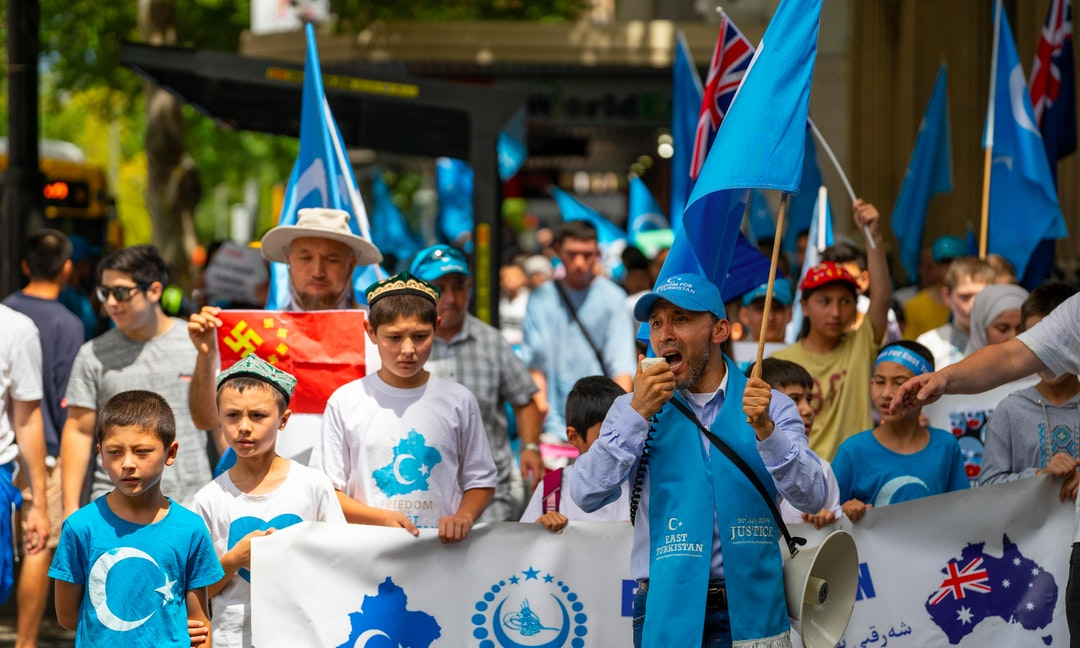
We are grateful to Human Rights Watch for much of the material in this post. Image: protestors in Australia.
Well attended meeting added useful insights into the campaign
August 2026
Several new topics and concerns emerged from this well attended Zoom meeting including from four Uyghurs living in the West. It is worth reflecting on the wider issues that the repression of minorities in China – of which the Uyghur people are just one – and that is the extent of the barbarity being perpetrated by the Chinese state and the CCP. This is a highly organised and well planned series of actions against an entire community of people which is unparalleled in the modern era. It is being committed by a state which was closely involved in the preparation and signing of the Universal Declaration after the War. China is also on the Security Council of the United Nations a position and status which is entirely undeserved.
The numbers are massive with 1.8 million taken away from their homes to be ‘re-educated’ but a further half million have been sentenced and forced to work in China itself.
We were introduced to the observable fact that there is little press or media interest in the fate of these people. Indeed, one can mention the campaign and the plight of the Uyghurs usually to receive blank looks. Awareness is low. The reasons are not hard to find: it is a long way away and the Chinese have banned almost all journalists from entering the region. So what extra did we learn this evening?
First from a Uyghur woman living in the US whose father is in prison for life for speaking out. He has not been heard from since 2017. She does not know whether he is alive and a request for ‘proof of life’ has not been answered. It is hard to imagine an action so cruel as this.
Another Uyghur who is living in the UK has witnessed the pain in her parent’s lives as they have lost contact with their culture. Contact is banned and contacts from overseas can result in punishment for those receiving them in Xinjiang. She is often asked about Uyghur culture but in fact seldom knows how to reply since all contact is lost. Another spoke of his brother in gaol for his journalism and he believes his conditions have got harsher.
Organ harvesting
The most chilling of the comments however concerns organ harvesting. Visitors might want to read the Hansard debate on this topic ten years ago which discussed this disgusting activity or a more recent UN report. The focus at the time was the Falun Gong but it has spread to Tibetans, Mongolians and now the Uyghur. The harvesting of organs is on a massive scale. According to the allegations received, the most common organs removed from the prisoners are reportedly hearts, kidneys, livers, corneas and, less commonly, parts of livers. They are extracted from prisoners often without anaesthetic. The role of a British university in the trade has been recently revealed.
Transnational repression
Other speakers told of Chinese transnational repression. Nobody in the Chinese diaspora is safe from the activities of the Chinese state which expends enormous efforts to silence critics overseas. This is why plans to build the massive embassy in London is so dangerous. Not only will it enhance and facilitate Chinese espionage activities but it will also help in their attempts to intimidate, threaten or coerce those who criticise China. That this embassy is even being considered is extremely unwise.
The CCP and its leader Xi Jinping seems almost paranoid. The state has the most extensive video surveillance system in the world. Media and the internet are closely controlled. It is hellbent on extinguishing any non-Chinese culture such as the Uyghurs, having done the same in Tibet and Mongolia. Freedoms in Hong Kong were quickly extinguished.
But we hear little of this in the UK. Politicians are largely mute. The Chinese are sensitive to direct or forthright criticism and so western politicians express their disquiet in private (they claim). But do they? There is next to no media interest or reporting. Issues in which Beijing diverges from the norms of the current system, such as human rights, it seeks to undermine those values and create alternative institutions and models. China works with other authoritarian powers such as Russia to create standards that reflect their interests for example internet governance.
Pip: A local Amnesty group in Salisbury posts about Uyghur rights — and suddenly cities across China are reading. That is either heartening or a sign that someone in Beijing is taking notes.
Mara: This episode covers Salisbury Amnesty’s recent posts on the Uyghur campaign, from the surprising reach of their online presence to the forced labour hidden inside your high street wardrobe. Let’s start with the campaign itself and what those viewing figures actually revealed.
Uyghur Campaign Reaches Across the Firewall
Pip: The Salisbury group ran a daily posting campaign on Uyghur rights — and the audience that showed up was not quite the one anyone expected.
Mara: The campaign newsletter reported figures that stopped people mid-scroll. Here is what it said: “Around 70% were from China and Hong Kong SAR, a figure we have never seen before. Usually, views from China seldom reach double figures.”
Pip: So a small Wiltshire group is somehow punching through one of the most sophisticated censorship systems on earth. That is the real story here — not the post count, but who is reading.
Mara: The breakdown gets more specific. Fifty-six cities across China are represented in the data, with 31 views from Beijing and 15 from Shanghai. The newsletter notes that “views from nine cities in China even exceeded the views of people from Salisbury.”
Pip: Which suggests ordinary people actively routing around the Great Firewall to find this material — not just state monitors checking in.
Mara: Facebook told a different story. The same posts drew only around twenty views each there, with almost no engagement from the eighteen-to-twenty-four age group. The campaign also secured a letter in the Salisbury Journal, which the newsletter describes as a paper that does not usually publish material on topics outside the local area.
Pip: Harder to get into than Beijing, apparently.
Mara: The Uyghur Crisis Response Team acknowledged the group’s posts on Bluesky, which rounds out a campaign the newsletter calls “altogether a satisfactory response.” And the month was not yet over when those figures were filed. That reach into China sets up the harder question — what exactly are people in Xinjiang living under?
Forced Labour in the Clothes on Your Back
Pip: The post titled “Slavery was abolished in 1807 — Not in Xinjiang” opens with a blunt premise: the system did not end, it just became harder to see on a label.
Mara: The post draws on Sheffield Hallam University research, which states that “previous research has provided significant evidence indicating that these programmes are indeed tantamount to forced labour, human trafficking, and modern slavery and that this system of repression is particularly deployed in the cotton and textile industries.”
Pip: Xinjiang produces around eighty percent of China’s cotton — which is roughly twenty percent of global supply. The brands that pledged to cut ties in 2020 did not necessarily solve anything.
Mara: That is the mechanism the post calls “cotton laundering.” Once raw cotton becomes yarn or fabric and passes through a third country like Bangladesh or Vietnam, its origin becomes nearly impossible to trace. Even the “Better Cotton” label offers no guarantee — the post notes it “can be mixed or blended with what they call conventional cotton very early on in the supply chain.”
Pip: So the ethical label is doing the laundering for them. Efficient.
Mara: The post names M&S specifically, via an RTÉ investigation, as a retailer featured in footage about vague labelling practices. The campaign asks readers to write directly to retailers — a sample letter is included — asking what safeguards they have in place to verify their cotton’s origin.
Mara: The post closes with a line worth sitting with: “The products of this obnoxious and cruel system are sitting on the clothing racks of our major high street retailers and hence in your wardrobes. Truly we are all involved.”
Pip: And that is the thread connecting both posts — the question of who is paying attention, and whether attention is enough.
Pip: A record month of hits from inside China, and forced labour woven into everyday retail. The local and the global keep colliding.
Mara: They do. Next time, we will see where that thread leads.
A love story illustrates the tragedy of the Uyghur people
August 2026
This is a love story which appeared in today’s Guardian (5th August) which highlights the effects on innocent lives arising from the repression and cultural genocide being committed in Xinjiang by the Chinese. The relationship blossomed around a discovered novel entitled Leyighan Bulaq (The Muddy Spring) written by the Uyghur novelist Jalalidin Băhram. It is a book about the brutalities of the Cultural Revolution.
The boy who uncovered the book wanted to share it with a female friend which in a Moslem environment was difficult to do. He smuggled a copy of the book to her. He left to study abroad. She was unable to sit a university entrance exam as she wore a headscarf. She was unable to obtain a passport either which the Chinese are reluctant to permit Uyghurs to have. She eventually made it out and they married in Istanbul. No family members were present. Messages from abroad can result in punishment which meant they could not convey messages to their families back home including the sad death of their 2 year old daughter.
The story illustrates very well the effects on ordinary lives by the campaign of repression. How people cannot leave the area, how messages from abroad can result in punishment. How indignities are heaped on the people for wearing a scarf. Unspoken in the story is the use of CCTV cameras which control lives not just in Xinjiang but throughout China. They make ordinary contact and movement almost impossible.
A message …
“To all Amnesty activists and supporters,
Thank you for standing with the Uyghur people at a time when our language, culture, faith, and very identity are under systematic attack. The recent testimony of former Chinese police officer Zhang Yabo has once again confirmed what Uyghurs have long tried to tell the world: in today’s Uyghur homeland, almost anyone can become a target — writers, poets, musicians, artists, intellectuals, religious figures, and ordinary people simply trying to preserve who they are. Songs are banned, the Uyghur language is criminalised, faith is weaponised against believers, and even memory itself is treated as a threat.
Beyond the camps and prisons, the repression follows Uyghurs across borders through intimidation, surveillance, disinformation, and relentless transnational repression designed to silence us and isolate us from the world. Many Uyghurs are afraid even to speak publicly, fearing consequences for loved ones back home.
That is why your solidarity matters so deeply. Every voice raised, every campaign organised, every act of compassion tells Uyghurs that we have not been abandoned or forgotten. In the face of fear and erasure, solidarity becomes a form of protection, dignity, and hope.
Please continue to stand with us, support the work of Stop Uyghur Genocide, and help amplify Uyghur voices by following and sharing our work on social media. Your support truly makes a difference.
With heartfelt gratitude,
Rahima Mahmut Executive Director Stop Uyghur Genocide”
Responses
We are delighted to report that the response to our earlier posts on the Uyghur Solidarity Month have been good. Our post made top ranking on Startpage’s search engine today. Most pleasing is the number of views from China and Hong Kong which together were second and third in the rankings. Amnesty is banned in China so this is encouraging.