Zoom meeting on the Uyghur campaign


Well attended meeting added useful insights into the campaign

August 2026

Several new topics and concerns emerged from this well attended Zoom meeting including from four Uyghurs living in the West. It is worth reflecting on the wider issues that the repression of minorities in China – of which the Uyghur people are just one – and that is the extent of the barbarity being perpetrated by the Chinese state and the CCP. This is a highly organised and well planned series of actions against an entire community of people which is unparalleled in the modern era. It is being committed by a state which was closely involved in the preparation and signing of the Universal Declaration after the War. China is also on the Security Council of the United Nations a position and status which is entirely undeserved.

The numbers are massive with 1.8 million taken away from their homes to be ‘re-educated’ but a further half million have been sentenced and forced to work in China itself.

We were introduced to the observable fact that there is little press or media interest in the fate of these people. Indeed, one can mention the campaign and the plight of the Uyghurs usually to receive blank looks. Awareness is low. The reasons are not hard to find: it is a long way away and the Chinese have banned almost all journalists from entering the region. So what extra did we learn this evening?
First from a Uyghur woman living in the US whose father is in prison for life for speaking out. He has not been heard from since 2017. She does not know whether he is alive and a request for ‘proof of life’ has not been answered. It is hard to imagine an action so cruel as this.

Another Uyghur who is living in the UK has witnessed the pain in her parent’s lives as they have lost contact with their culture. Contact is banned and contacts from overseas can result in punishment for those receiving them in Xinjiang. She is often asked about Uyghur culture but in fact seldom knows how to reply since all contact is lost. Another spoke of his brother in gaol for his journalism and he believes his conditions have got harsher.

Organ harvesting

The most chilling of the comments however concerns organ harvesting. Visitors might want to read the Hansard debate on this topic ten years ago which discussed this disgusting activity or a more recent UN report. The focus at the time was the Falun Gong but it has spread to Tibetans, Mongolians and now the Uyghur. The harvesting of organs is on a massive scale. According to the allegations received, the most common organs removed from the prisoners are reportedly hearts, kidneys, livers, corneas and, less commonly, parts of livers. They are extracted from prisoners often without anaesthetic. The role of a British university in the trade has been recently revealed.

Transnational repression

Other speakers told of Chinese transnational repression. Nobody in the Chinese diaspora is safe from the activities of the Chinese state which expends enormous efforts to silence critics overseas. This is why plans to build the massive embassy in London is so dangerous. Not only will it enhance and facilitate Chinese espionage activities but it will also help in their attempts to intimidate, threaten or coerce those who criticise China. That this embassy is even being considered is extremely unwise.

There was brief mention of the reach of our posts into China with views from over 50 cities and from Hong Kong.

The CCP and its leader Xi Jinping seems almost paranoid. The state has the most extensive video surveillance system in the world. Media and the internet are closely controlled. It is hellbent on extinguishing any non-Chinese culture such as the Uyghurs, having done the same in Tibet and Mongolia. Freedoms in Hong Kong were quickly extinguished.

But we hear little of this in the UK. Politicians are largely mute. The Chinese are sensitive to direct or forthright criticism and so western politicians express their disquiet in private (they claim). But do they? There is next to no media interest or reporting. Issues in which Beijing diverges from the norms of the current system, such as human rights, it seeks to undermine those values and create alternative institutions and models. China works with other authoritarian powers such as Russia to create standards that reflect their interests for example internet governance.

The campaign continues …


Recent posts:

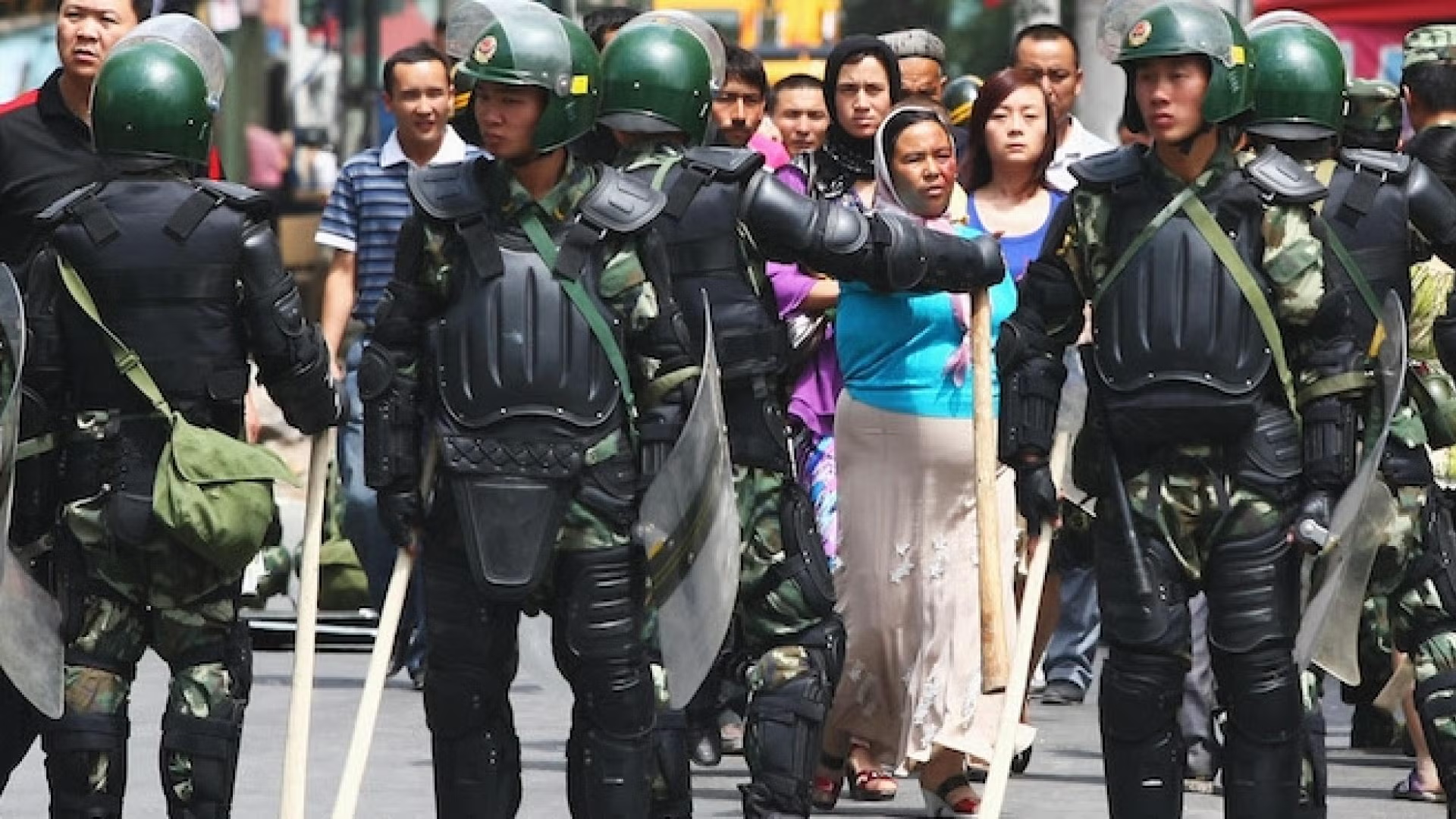
Image: repression in Xinjiang, Hudson

Thought of subscribing?

Podcast Episode: Xinjiang Forced Labour Campaign


Pip: A local Amnesty group in Salisbury posts about Uyghur rights — and suddenly cities across China are reading. That is either heartening or a sign that someone in Beijing is taking notes.

Mara: This episode covers Salisbury Amnesty’s recent posts on the Uyghur campaign, from the surprising reach of their online presence to the forced labour hidden inside your high street wardrobe. Let’s start with the campaign itself and what those viewing figures actually revealed.

Uyghur Campaign Reaches Across the Firewall

Pip: The Salisbury group ran a daily posting campaign on Uyghur rights — and the audience that showed up was not quite the one anyone expected.

Mara: The campaign newsletter reported figures that stopped people mid-scroll. Here is what it said: “Around 70% were from China and Hong Kong SAR, a figure we have never seen before. Usually, views from China seldom reach double figures.”

Pip: So a small Wiltshire group is somehow punching through one of the most sophisticated censorship systems on earth. That is the real story here — not the post count, but who is reading.

Mara: The breakdown gets more specific. Fifty-six cities across China are represented in the data, with 31 views from Beijing and 15 from Shanghai. The newsletter notes that “views from nine cities in China even exceeded the views of people from Salisbury.”

Pip: Which suggests ordinary people actively routing around the Great Firewall to find this material — not just state monitors checking in.

Mara: Facebook told a different story. The same posts drew only around twenty views each there, with almost no engagement from the eighteen-to-twenty-four age group. The campaign also secured a letter in the Salisbury Journal, which the newsletter describes as a paper that does not usually publish material on topics outside the local area.

Pip: Harder to get into than Beijing, apparently.

Mara: The Uyghur Crisis Response Team acknowledged the group’s posts on Bluesky, which rounds out a campaign the newsletter calls “altogether a satisfactory response.” And the month was not yet over when those figures were filed. That reach into China sets up the harder question — what exactly are people in Xinjiang living under?

Forced Labour in the Clothes on Your Back

Pip: The post titled “Slavery was abolished in 1807 — Not in Xinjiang” opens with a blunt premise: the system did not end, it just became harder to see on a label.

Mara: The post draws on Sheffield Hallam University research, which states that “previous research has provided significant evidence indicating that these programmes are indeed tantamount to forced labour, human trafficking, and modern slavery and that this system of repression is particularly deployed in the cotton and textile industries.”

Pip: Xinjiang produces around eighty percent of China’s cotton — which is roughly twenty percent of global supply. The brands that pledged to cut ties in 2020 did not necessarily solve anything.

Mara: That is the mechanism the post calls “cotton laundering.” Once raw cotton becomes yarn or fabric and passes through a third country like Bangladesh or Vietnam, its origin becomes nearly impossible to trace. Even the “Better Cotton” label offers no guarantee — the post notes it “can be mixed or blended with what they call conventional cotton very early on in the supply chain.”

Pip: So the ethical label is doing the laundering for them. Efficient.

Mara: The post names M&S specifically, via an RTÉ investigation, as a retailer featured in footage about vague labelling practices. The campaign asks readers to write directly to retailers — a sample letter is included — asking what safeguards they have in place to verify their cotton’s origin.

Mara: The post closes with a line worth sitting with: “The products of this obnoxious and cruel system are sitting on the clothing racks of our major high street retailers and hence in your wardrobes. Truly we are all involved.”

Pip: And that is the thread connecting both posts — the question of who is paying attention, and whether attention is enough.


Pip: A record month of hits from inside China, and forced labour woven into everyday retail. The local and the global keep colliding.

Mara: They do. Next time, we will see where that thread leads.

Slavery was abolished in 1807* – Not in Xinjiang


Slavery and forced labour is alive and well in Xinjiang. Major retailers complicit. Welcome to ‘cotton laundering’

August 2026

Many people believe that slavery ended sometime in the 19th Century and many – certainly older people reading this – think that Britain led the way. Slavery continued for many years afterwards. The reality is that slavery is alive and well and that you are wearing the products of this vile system while sat reading this. You may feel that you have purchased your cotton garments from a respectable high street retailer so this surely cannot be the case. If you watch the video in the RTE programme [link below], they will explain how retailers such as M&S who feature strongly in the film, are evading controls with vague labelling.

The story of cotton

Around 80% of cotton production in China comes from Xinjiang, using forced labour from the Uyghur which represents 20% of the global cotton production. Following an uproar and call to action in 2020 that called on numerous fashion brands (such as Nike, Adidas, Zara, H&M, Amazon, etc) to sever ties with Uyghur forced labour, many of these brands decided apparently to stop sourcing cotton from Xinjiang. If we were to ask these brands today about their commitment to Uyghur rights, they would answer that Uyghur forced labour has been cut from their supply chain. (Photo is one of the major companies involved in China).

However, the reality is not that simple. Cotton production has not reduced in the region since 2020; instead, Chinese manufacturers have resorted to “cotton laundering”. Once the cotton has been transformed into yarn or fabric, the cotton enters the supply chain through third countries such as Bangladesh or Vietnam. This results in cotton that is extremely difficult to trace.

Cotton laundering

Some brands may claim that having the label ‘Better Cotton’ to claim that their supply chains are ethical. However as investigated by RTÉ, it appears that “the Better Cotton can be mixed or blended with what they call conventional cotton very early on in the supply chain, and that includes cotton from the Uyghur region“. The RTE film (5 mins) can be viewed here.

Although companies have acted on demands to stop using suppliers that rely on Uyghur forced labour, it can be easy to imagine that cotton harvested in Xinjiang finds its way to those factories through cotton laundering. That is why we are asking you today to write a question to a company that produces apparel which contains cotton to ask them what processes and safeguards are in place to ensure forced labour is not present in their supply chains.

Research published by Sheffield Hallam University shows in detail how the system works and contains much evidence. They say that previous research has provided significant evidence indicating that these programmes are indeed tantamount to forced labour, human trafficking, and modern slavery and that this system of repression is particularly deployed in the cotton and textile industries, which for China are centred in the Uyghur Region. Reports have shown that much of the region’s cotton is hand-picked by people who are forced to do so, that textile factories in the Uyghur Region employ forced labour, and that minority citizens of the region have been “transferred” thousands of miles into the interior of China to work in factories for major textile and apparel exporters.

The notion of slavery today is universally condemned. Britain was heavily involved in the trade for nearly two centuries transporting well over 3 million in the triangular trade. Many are often surprised to discover that the slave owners (not the slaves) were compensated and the debt was only paid off in 2015.

As we have noted before, although Xinjiang seems a long way off and few will have been there, the products of this obnoxious and cruel system are sitting on the clothing racks of our major high street retailers and hence in your wardrobes. Truly we are all involved.

[*Quite when slavery ended is difficult to be precise. Many ships simply reflagged to avoid patrols. Slavery persisted for decades in the Caribbean and America. Slaves were still transferred between countries. A separate act was later passed to end the practice in India. Freed slaves simply became indentured.]

Letter

This is a sample letter to a retailer or manufacturer to model yours on. It is likely you will receive a standard reply but it will register with the retailer that they are being watched and if not careful, they could receive reputational damage:

Dear xx,
I am writing to express my concern as to the possibility that your cotton products contain cotton produced in Xinjiang using Uyghur forced labour.
One tactic used by Chinese manufacturers to sell cotton produced by forced labour and internal displacement of Uyghur population is “cotton laundering”. These companies will transform cotton into yarn or fabric and then introduce them to global chains through third countries such as Bangladesh or Vietnam. As a result, the origin of the cotton is extremely difficult to trace.
In addition, the label “Better Cotton” does not prevent products from containing cotton produced through forced labour. The Better Cotton Initiative does not have a traceability protocol and enable mixed or blended cotton with ethically sourced material. Cotton from the Uyghur region may very well be present in those mixes or blends.
As a concerned consumer, I would like to ask you: what protocols and safeguards do you have in place to absolutely ensure that none of the cotton present in your garments is a result of Uyghur forced labour? How do you verify that the cotton used in your garment does not come from Xinjiang?
Thank you in advance for your reply.
Yours sincerely,

We have drawn from material produced by RTE (Ireland), Sheffield Hallam University, Statista and from the Uyghur Solidarity Team with thanks.


Uyghur campaign progress


Local group features in today’s action

August 2026

We are pleased to report that the activities of the Salisbury group feature in part of today’s (16th August) action by the campaign team. We have put up a post on most days of the campaign using material provided by the team and we have a letter published in the local paper.

What has been remarkable however, is the numbers viewing the posts from China itself. China rarely appears in our viewing figures, we suspect because our posts are blocked. We reported the latest figures – accessed yesterday (15th August) – i.e. half way through the month and these are reproduced in the newsletter:

The Salisbury group has experienced considerable interest in the Uyghur campaign on its website with a record number of views from China itself. The numbers are high for the site and the month looks as though it is heading for a record number of hits likely to exceed 3,000 for the first time led by the Uyghur campaign although there is other material posted.

No less than 88% of the hits were posts on the campaign partly because we have posted something on almost every day. Around 70% were from China and Hong Kong SAR a figure we have never seen before. Usually, views from China seldom reach double figures. And it is not just China as a country, further analysis reveals it is cities all over China which are viewing. There were 88 from Hong Kong, 31 from Beijing and 15 from Shanghai. A total of 56 cities throughout China are represented.

One might expect the CCP to monitor posts about their country but the fact that views are coming from all over suggests that ordinary people may be evading the tight controls over access to foreign sites such as ours. Views from nine cities in China even exceeded the views of people from Salisbury. The group also managed to get a letter published in the Salisbury Journal which sees itself as very much a local paper and does not usually publish material on topics outside the area.

Sadly, this interest was not reflected on Salisbury Amnesty’s Facebook page with only twenty or so views for each of the posts. Almost none were in the 18-24 age group. We are pleased to note the Uyghur Crisis Response Team thanked us for our posts on Bluesky @ucrt.bsky.social.

Altogether a satisfactory response and we are of course not at the end of the month. The group is proud to have played a small part in this campaign. Salisbury group’s website: https://salisburyai.com and Bluesky: @salisburyai.bsky.social. We no longer post on X.”

The campaign continues …


Image: Observe Algerie

Blog at WordPress.com.

Up ↑