Rwanda report


Cross party committee on human rights criticizes the government’s Rwanda policy

February 2024

The Rwanda (Asylum and Immigration) Bill ends its House of Lord’s stage today (12 February) and returns to the Commons. The Bill has been roundly condemned by many human rights and other organisations and the committee said that it is ‘fundamentally incompatible with Britain’s human rights obligations’.

The Supreme Court has already ruled that Rwanda is not a safe country and the government’s attempt to pass a law simply saying it is is bit like passing a law saying water can run uphill. The Committee went on to say ‘the Bill disapplies laws that might prevent and individual’s removal to Rwanda including many of the key provisions of the Human Rights Act.

‘It might also impact on Northern Ireland, that it would both undermine the Windsor Framework and the Belfast (Good Friday) Agreement’.

It also raises the point about UK’s reputation. We have they say, a reputation for respect for human rights of which ‘we should be proud’. 

Immigration, and most recently the Channel crossings, have generated a considerable degree of angst and hostile media coverage. This is not recent and goes back many years and started to emerge as a political force during the Blair years. In many respects it goes back further to various waves of immigrants such as the Huguenots from France, Flemings from the low countries and Jews fleeing Russia. All have been met with hostility of some degree. 

Recent immigrants are cast as not really refugees at all but economic migrants, are cheating the system, are living off benefits and so forth. Newspapers – and not just tabloids but the Daily Telegraph and the Independent – have carried hundreds of negative stories and helped keep the temperature high. The Sun even ran a story that swans were being stolen from the London parks and eaten by immigrants (invented). The raised media attention has increased public concern to which the politicians are obliged to reflect. 

Watch the Amnesty video

Anomaly

A curious anomaly is that people who’s offspring emigrate to live and work overseas (as ‘economic migrants’ no less) are spoken of in terms of pride. Emigrants good: immigrants bad. 

Another curiosity is that many of the politicians leading the hostility and proposing ever harsher measures including deportation to Rwanda, are themselves sons or daughters of immigrants. Priti Patel, Kwasi Kwarteng, Suella Braverman, Rishi Sunak, Danny Kruger and going back further, Michael Howard (Romania). 

The benefits of immigration to this country almost don’t get a look in. In November last year, the government’s own statistics show that around one in 5 of people working in the health service were not born in the UK. Indeed, the service would struggle to survive (even more than now) if these people were not working here. 

The entire debate is based on hysteria. Boat people have assumed a disproportionate sense of anger and fear even though they represent a small proportion of all immigrants to this country. The majority do go on to claim asylum. The hysteria and media mis- and disinformation has resulted in the plan to deport a few hundred to Rwanda, a policy which is performative rather than likely to be effective. 

Sources: Daily Mail, FullFact; Liberty; Hansard, Guardian (accessed 12 February 2024)


The Salisbury Amnesty group celebrates 50 years of existence this year

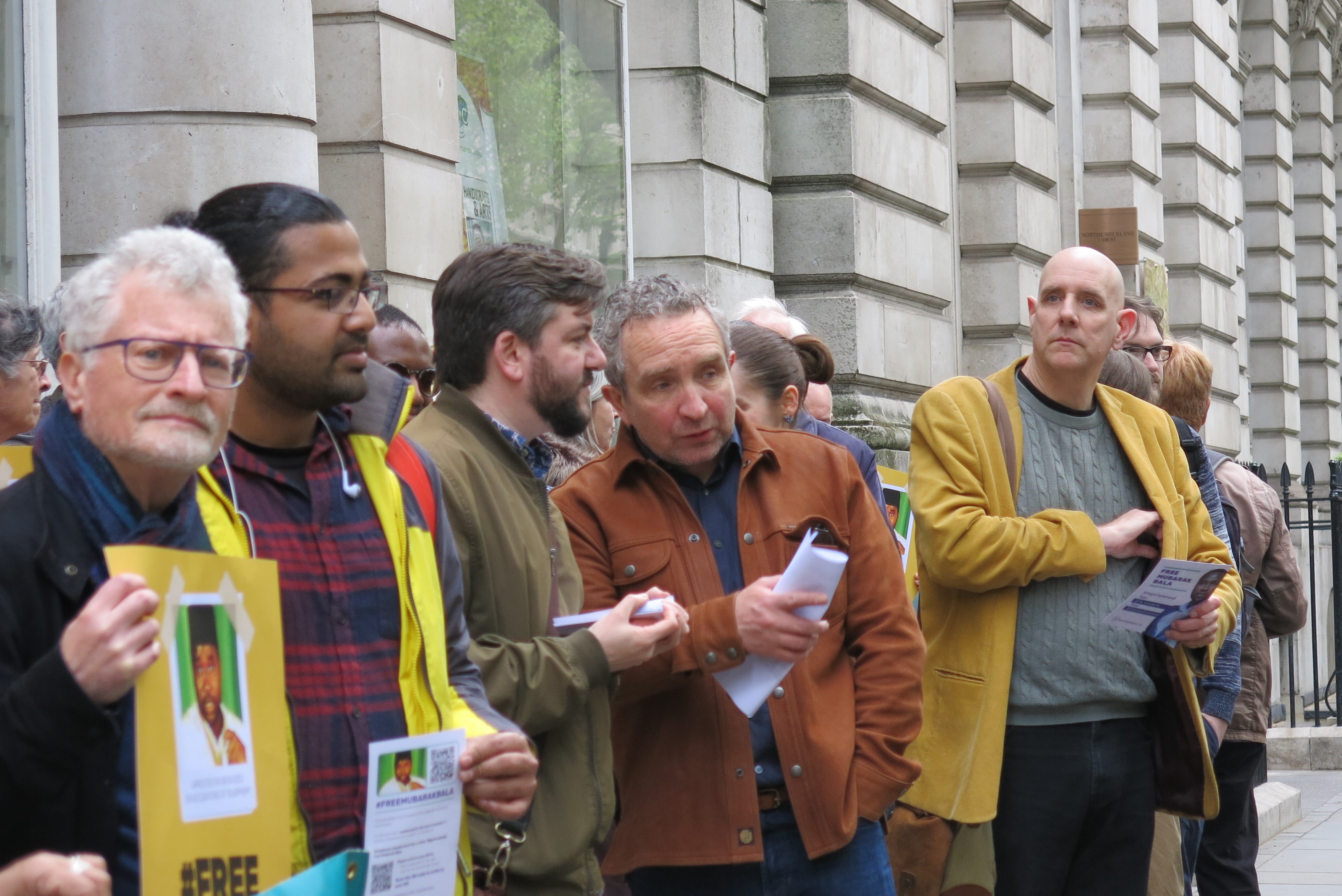
Nigerian protest


Members of the Salisbury group took part in Humanist protest in 2022

February 2024

Pictured: Humanists UK’s #FreeMubarakBala protest outside the Nigerian High Commission, London, 2022. Two members of the Salisbury group can be seen, centre. Picture: Humanists

MPs have raised the case of Mubarak Bala, imprisoned President of the Nigerian Humanist Association, at a debate in Westminster Hall on Freedom of Religion or Belief in Nigeria. The debate was secured by Jim Shannon (Democratic Unionist Party), Chair of the All-Party Parliamentary Group on International Freedom of Religion or Belief (APPG FoRB) – of which Humanists UK is a stakeholder. 

Humanists UK has been calling for Bala’s release since he was arrested in April 2020. Two years later, Bala was convicted and sentenced to 24 years’ imprisonment for posting ‘blasphemous’ content on Facebook following an unfair trial: it was repeatedly delayed and the charges against him were duplicated. Procedural irregularities were rife. Bala remained incarcerated without charge for well over a year. He was denied access to his lawyers and family for an extended period. He was denied medical attention. The Abuja High Court’s ruling that he be released on bail was ignored by Kano State authorities. His case exemplifies the need to abolish blasphemy laws, which intrinsically contravene the right to freedom of religion or belief.

During the debate, Jim Shannon said that he, alongside other members of the APPG FoRB has visited Nigeria in 2022:

We used our visit to speak to some of the judiciary and judges in Nigeria… and made a very good case for the release of Mubarak. We thought we had made some headway on that, and the indications coming from the judiciary seemed to say that, but he is still in prison.’

Shadow Foreign Minister Lyn Brown said:

I can understand the anxiety about states in Nigeria continuing to imprison people for exercising religious freedoms. We all know the case of Mubarak Bala.’

Humanists UK campaigns for freedom of religion or belief (FoRB) around the world, particularly for non-religious people facing persecution. In many countries it is impossible to be openly non-religious. Laws that criminalise blasphemy and apostasy are often the source of such persecution – as they were in Mubarak Bala’s case. The repeal of such laws is therefore a vital step in guaranteeing FoRB for all.

Director of Public Affairs and Policy Kathy Riddick commented:

‘We thank Jim Shannon MP for securing the debate and raising the case of our colleague Mubarak Bala who has been imprisoned simply for expressing his humanist beliefs. 

‘The situation for humanists in Nigeria is dire. Blasphemy and apostasy are punishable by death and this is used to falsely justify the social persecution of the non-religious. Particularly worrying is that Nigeria is on the ‘safe country list’ under the Illegal Migration Act, which means that non-religious asylum seekers may face great risks if they are deported there.

‘We continue to call on the government to use all channels available to advocate for the repeal of all blasphemy and apostasy laws, and to secure not only the release of Mubarak, but the release of those convicted or imprisoned under such laws.’

Pictures: Salisbury Amnesty

Sudan: teenager’s death sentence quashed


Good news from Sudan
Amnesty’s Urgent Action successful

Following the South Sudan Court of Appeal’s decision on 14 July to quash the death sentence imposed on Magai Matiop Ngong because he was a child at the time of the crime, and to send his case back to the High Court to rule on an appropriate sentence, and his removal from death row on 29 July, Amnesty International’s Director for East and Southern Africa, Deprose Muchena said:

We welcome the Court of Appeal’s decision to quash Magai Matiop Ngong’s death sentence because under South Sudan and international law a child cannot be sentenced to death. Magai is one of the lucky ones.

At least two other people, who were children at the time of the crime, have been executed in the country since May 2018; their lives extinguished as well as all the hopes their families had for them.

The South Sudanese government must fully comply with national and international laws which prohibit the use of the death penalty against anyone below 18 years of age at the time the crime was committed. The authorities must abolish this cruel, inhuman and degrading punishment.

Background
In its annual letter writing campaign, Write for Rights, Amnesty International prioritized the case of Magai mobilizing its global membership to write to President Salva Kiir to commute the death sentence. More than 765,000 people around the world took action, calling on President Salva Kiir to commute Magai’s death sentence, and expressing their solidarity with Magai.

South Sudan is one of four countries in Sub-Saharan Africa that carried out executions in 2018 and 2019.

Amnesty International opposes the death penalty in all cases without exception regardless of the nature of the crime, the characteristics of the offender, or the method used by the state to carry out the execution.

Amnesty International post 27 July 2020.  Thanks to all those who wrote letters or sent emails for this action.  See our monthly death penalty update.

Death penalty report


The most recent death penalty report on the use of the death penalty around the world is now available thanks to group member Lesley for compiling it.

Report (Word)

Tax avoidance and human rights


November 2017

Paradise Papers the latest to shine a light on the multi-billion pound avoidance industry

The publication of the Paradise Papers which have revealed yet more insights and names of those engaged in the murky world of massive tax avoidance, has so far stayed clear of discussing the human rights angle to this activity.  A letter in today’s Guardian newspaper, written jointly by Helena Kennedy and Hans Corel, draws attention to this particular aspect.  The huge outflow of resources from the developing world means governments are starved of the resources to tackle poverty, improve their health and education systems and to upgrade infrastructure generally.  A staggering $859bn was lost in 2010 and the cumulative loss between 2001 and 2010 amounted to $5.86trn *.  It often comes a surprise to people when it is pointed out for example that Africa, taken as a whole, is a net creditor to the rest of the world.  This is a combination of corruption, resource extraction and tax avoidance.  So while aid is paid into the country, more money flows out because of tax avoidance and criminal activity.

The Paradise Papers follows on from other leaks including the Panama Papers, Lux leaks and others which exposes the scale of the perfectly legal tax avoidance industry and names some of those involved.  These have included the Queen’s Duchy of Lancaster estate, Prince Charles and a slew of celebrities, media and sports people.  Several said they did not know this was being done in their name.

The letter draws attention to a report prepared by the International Bar Association in 2013.  This 262 page report examines exhaustively the nature of this activity and came before some of the recent revelations.  The key question for us is the link between this activity and human rights and the report discusses this in detail since it is not entirely direct.  In the report is says:

Most stakeholders tended to agree that there is an important distinction between labelling tax abuses as ‘legal violations of human rights’ versus stating that tax abuses have ‘negative impacts on human rights’.  Depending on the scope and scale of the tax abuses, they might have a significant impact on human rights.  As one tax authority expressed it: ‘What do we need to fulfill economic, social and cultural rights?  Resources including taxes.  Therefore, tax abuses are clearly a human rights issue when massive amounts are lost from State revenues.’ p96

To the extent that tax abuses have an impact on poverty and that poverty has an impact on human rights, as outlined above, it is possible to make a connection between tax abuses and human rights.  Most simply put, tax abuses deprive governments of the resources required to respect, promote and fulfil human rights. More dramatic examples of human rights impacts can be imagined when you juxtapose the billions of dollars that are said to be flowing out of developing countries with the comparatively small amounts that are required to lift individuals, families and communities out of the most extreme forms of poverty. p103

In a summary on p148  they say:

Human rights have not often been part of the global debate about tax matters. However, a human rights analysis can strengthen our understanding of poverty and development, as well as reinforce our determination to confront tax abuses.  In the recently adopted UN Guiding Principles on Extreme Poverty and Human Rights, the UN Special Rapporteur on Extreme Poverty and Human Rights describes how extreme poverty is connected as a cause or consequence of violations of numerous human rights, including all the key human rights principles − ranging from the right to life, the right to food, the right to health, the right to education, the right to social security and principles of non-discrimination, participation, transparency and accountability.

Simply put, tax abuses deprive governments of the resources required to provide the programmes that give effect to economic, social and cultural rights, and to create and strengthen the institutions that uphold civil and political rights.  Actions of states that encourage or facilitate tax abuses, or that deliberately frustrate the efforts of other states to counter tax abuses, could constitute a violation of their international human rights obligations, particularly with respect to economic, social and cultural rights.  p148  Our italics

It is important to recognise therefore that this is not a victimless activity.

The City of London is a key player in the avoidance industry and is surrounded by a worldwide network of islands which have secrecy in one form or another as part of their appeal to international corporations, rich individuals, criminals and despotic governments.  These include the Isle of Man, Jersey, British Virgin Islands, and several more.

The report also devotes space to non-state actors and in particular the international corporations such as Apple, Amazon, Starbucks and several others.  These are able to move funds between one jurisdiction and another employing various legal techniques such as ‘The Swiss Role’ ‘Going Dutch’ and Thinning on Top’.  Apple featured most strongly in the latest revelations.


For those who would like to read the report in full it can be accessed from this link.  Full report

*586 000 000 000 000 US dollars


Blog at WordPress.com.

Up ↑